Showing posts with label Quest for the Self. Show all posts

Sunday, August 18, 2013

A New Awakening, Part 18

I have in this ongoing series been investigating the wisdom of myth as it informs what I'm calling a new awakening of spirituality in our society. I take as one of my main reference points the book and PBS television series The Power of Myth, in which, during the mid-1980s, Bill Moyers interviewed at great length the scholar of comparative mythology Joseph Campbell.

Now that I've finally finished reading Fr. Richard Rohr's excellent book Falling Upward: A Spirituality for the Two Halves of Life, I've been racking my brain trying to see how to sell its insights, along with a vaunted "new awakening" of myth-oriented spirituality, to a skeptical younger generation. In the middle of the night recently I awoke with an answer: the hero's journey.

Joseph Campbell cut his academic teeth in the late 1940s with the book The Hero with a Thousand Faces, a comprehensive study of hero myths throughout the ages. He told Bill Moyers in The Power of Myth about the universal characteristics of the  "journey," actual or metaphorical, taken by the mythic hero. The hero sets out on a perilous quest, often in order to locate someone or something of great importance, such as the Holy Grail, that is lacking/missing/lost in the day-to-day world the hero knows. On his (or possibly her) journey, he undergoes many trials, tests, and ordeals; he may have close brushes with death; and, first with the help of wise mother figures and then of demanding father figures, he ultimately succeeds in his quest. After he wins, despite great adversity, he closes the circle of his journey, returning home with a boon in tow. The boon can be tangible or intangible, yet it must always be something beneficial to the hero's community. The benefit can be internal (spiritual) or external (physical, practical).

The latter sort of boon might be a sign that the hero has "performed a courageous act in battle or saved a life." The former kind is more subtle:

" ... the spiritual deed, in which the hero learns to experience the supernormal range of human spiritual life and then comes back with a message."

The Buddha
The beneficent "message" is like the one related by the Buddha, whose "journey" was partly geographic and partly a metaphorical one. After contemplating the true nature of reality while sitting under the famous Bo tree, he went around teaching others what he had discovered. Basically, the Buddha taught the various paths to a full "awakening" of the human soul.


* * * * *

A general description of the hero that Campbell gives to Moyers is:

"The hero is the one who comes to participate in life courageously and decently, in the way of nature, not in the way of personal rancor, disappointment, or revenge."

Another is:

"Even in popular novels, the main character is a hero or heroine who has found or done something beyond the normal range of achievement and experience. A hero is someone who has given his or her life to something bigger than oneself."

The hero can be a woman. Campbell, for example, tells Moyers:

"Giving birth is definitely a heroic deed, in that it is the giving over of oneself to the life of another."

The boon which the hero-mother carries back from her "journey" into childbirth is, of course, the child itself. The new human infant as a female hero's boon is a tangible reality as well as a spiritual one.

* * * * *

Yet the mythic hero, male or female, is not one who seeks ultimate union with "transcendence," a desideratum which Campbell identifies as the final destination of the human spirit. Rather:

"The hero’s sphere of action is not the transcendent but here, now, in the field of time, of good and evil — of the pairs of opposites."

The pairs of opposites? Why are they important in this discussion? Campbell says:

"Whenever one moves out of the transcendent, one comes into a field of opposites. One has eaten of the tree of knowledge, not only of good and evil, but of male and female, of right and wrong, of this and that, and of light and dark. Everything in the field of time is dual: past and future, dead and alive, being and nonbeing."

So the mythic hero operates in the dualistic "field of time," rather than seeking blissful unity with the eternal source of being. He is participating in life's game, says Campbell — a game which Campbell insightfully calls "a wonderful, wonderful opera — except that it hurts."

* * * * *

Joseph Campbell with
his wife, the dancer
Jean Erdman
Parallel with the distinction between, on the one hand, the field of time and its pairs of opposites, and, on the other hand, the eternal source of all that has being, there are two distinct aspects of mythic aware­ness. Campbell says:

"There’s a fine saying in India with respect to ... two orders of myths, the folk idea and the elementary idea. The folk aspect is called desi, which means 'provincial,' having to do with your society. That is for young people. It’s through that that the young person is brought into the society and is taught to go out and kill monsters. 'Okay, here’s a soldier suit, we’ve got the job for you.' But there’s also the elementary idea. The Sanskrit name for that is marga, which means 'path.' It’s the trail back to yourself. The myth comes from the imagination, and it leads back to it. The society teaches you what the myths are, and then it disengages you so that in your meditations you can follow the path right in."

The first aspect, desi — as in "Here’s a soldier suit, now go out and kill monsters ... " — seems to me to match up well with Richard Rohr's first-half-of-life description in Falling Upward: A Spirituality for the Two Halves of Life. Rohr even calls the transition to true second-half-of-life spirituality "discharging our loyal soldier," by which he means getting clear of that system of "impulse control" which has gotten us safely through the first half of life. Yet I think he misses, in this part of his discussion, the myth-hero aspect of wearing "a soldier suit" and slaying "monsters" which threaten the larger society.

Campbell does not miss it. He sees the value "for young people" of such soldier-suit heroism ... even if he, too, talks to Moyers more of the ultimate "trail back to yourself," or marga, that seems to me to correspond well with Rohr's notion of second-half-of-life spirituality.

* * * * *

My thought is that our churches and religions aren't teaching and supporting the "hero's journey" which our young people need first to set forth on, if they are ever to reach their "discharging their loyal soldier" transition into second-half-of-life spirituality. I believe (or so I suddenly find) that if religions did this, you wouldn't be able to keep the youngsters out of today's places of worship that are pretty much empty, or else filled with gray heads like mine.

Instead, the young are flocking to movie palaces to see the likes of Star Wars and Lord of the Rings, and The Chronicles of Narnia, and the "Harry Potter" series. All of these — and, I assume, newer films I have yet to see — are fundamentally about (you guessed it) heroes and their mythic journeys.

Some churches today are quite focused on teaching the (absent/not listening) youth "impulse control." By that I mean the traditional list of sins and taboos, sexual and otherwise. There's a very real place for that, of course, as necessary guidelines to keeping the hero's journey on track, rather than having it run off the rails. But "control" without "mission" is sterile; would-be heroes find it irrelevant to their needs.

* * * * *

Frodo Baggins
The mythic hero of J.R.R. Tolkien's Lord of the Rings trilogy is a Hobbit named Frodo Baggins. The Wizard Gandalf tells the diminutive Frodo that the land of Middle Earth is doomed to serve a power-mad, bodiless master of evil, Sauron, unless a certain golden ring is carried out of the Shire where the Hobbits have blissfully lived since time immemorial. The task falls to Frodo, who begins the story totally ignorant of any imminent danger. The danger now arises because Frodo's Uncle Bilbo had brought the One Ring back with him from his own youthful hero's journey.

The now-aged Bilbo knows full well he needs to relinquish the ring to his nephew, now that Bilbo is about to leave the Shire for the second time, to go off to Rivendell, elsewhere in Middle Earth, to write his memoirs. But somehow the ring keeps finding its way back into Bilbo's vest pocket — he hesitates to put it on his finger, because doing so renders him invisible to all but the maleficent Eye of Sauron. Gandalf has to remind Bilbo repeatedly to leave the ring behind.

The ring is a metaphor. It symbolizes, among other things, the psychological inertia that can keep us from crossing each necessary threshold into a new phase of life. Bilbo is about to enter the phase associated with old age, which, like all the successive stages of life, requires of him a new mindset. He will cultivate that mindset as he writes There and Back Again, recounting the tale of his first threshold-crossing when he as a young Hobbit set out on the hero's quest that Tolkien told of in his earlier book titled The Hobbit.

The One Ring
in Lord of the Rings
Once Frodo takes the ring, his own adventure begins. Accompanied by fellow Hobbit Samwise Gamgee, whom Gandalf adjures to keep watch over Frodo, and by two other Hobbits, Merry and Pippin, Frodo treks out of the Shire and soon has a near brush with death at the hands of the soulless Ring-Wraiths, who at Sauron's bidding seek to restore the One Ring to its evil master. To ward off his momentary demise, Frodo hastily puts the One Ring on his finger and disappears.This act, however, is the one thing Gandalf has told him he must never do, since it alone renders him visible to the archenemy.

This or any other use of the power of the ring, however well motivated, constitutes the equivalent of a sin; on this particular hero's journey, it is Frodo's taboo. Tolkien was a devout Roman Catholic, and although there is no reference to religion in Lord of the Rings, it is not hard to discern religious motifs just under the surface.

One such motif has to do with the self-sacrifice entered into willingly by Frodo, once it has become clear to him that he alone can carry the ring to the destroying fires of the Cracks of Doom, in Sauron's home realm of Mordor. Frodo ultimately succeeds in his arduous quest, but at the cost of losing his psychological ability to return to his home in the Shire and take up ordinary life there ever again. Instead, he goes off with the immortal Elven-folk as they retire from Middle Earth to the Undying Lands of the Valar.

The parallel in Christian belief is Christ's ascension into heaven. When Joseph Campbell tells Bill Moyers in The Power of Myth about the canonical adventure of the mythic hero, as found in all the world's mythologies, he includes Christ's birth, sojourn in the desert for 40 days, being thrice tempted by the devil, return to society with a message, death on a cross, resurrection, descent into hell to retrieve lost souls, and eventual ascension into heaven as an example of a mythic hero's journey.

Frodo can destroy the One Ring and save his Shire and all the other lands in Middle Earth only with the help of an extended band of heroes that include the four Hobbits; the Wizard Gandalf; Aragorn, the self-exiled King of Gondor; his steward Boromir and Boromir's brother Faramir; the Elf Legolas; and the Dwarf Gimli. This is the Fellowship of the Ring. Each member brings both weaknesses and strengths to what amounts to a mutually enabling "ring" of heroes who work together to destroy the physical One Ring, it's immaterial master Sauron, and Sauron's henchman, the turncoat Wizard Saruman.

The Eye of Sauron
So we have a symbolic contrast. The One Ring works to impede what might be called the soul's natural itinerary across life's thresholds toward ever greater consciousness, as Frodo finds when he learns one hard-to-accept truth after another over the course of his hero's adventure. His Fellowship of the Ring, by supporting him in his quest, nevertheless works to "unbind" all Middle Earth from the "One Ring to rule them all/And in the darkness bind them." Two "rings," as it were, exist: the first is a demonic parody of the life-affirming second.

The lesson here is that the greater conscious awareness each new life-stage brings — Campbell refers to it as an increased "experience" of being alive, and in the Bible we find the notion of attaining a greater "abundance" of life — is always paid for by some heroic sacrifice. Symbolically, when Aragorn's resumed reign at the end of the Lord of the Rings tale brings renewed joy to him and all his kingdom of Gondor, and when Sam Gamgee returns to the Shire to marry the true love who awaits him, it is due to Frodo's heroic self-sacrifice on behalf of all Middle Earth. The seeming distinction here between the hero and the beneficiary is, however, an arbitrary one. In actuality, just as we are all said to possess a "Christ within," we can likewise be said to possess a "Frodo within." Something old within us has to "die and go to heaven" each time something new is born.


Tuesday, July 09, 2013

A New Awakening, Part 17

I have in this ongoing series been investigating the wisdom of myth as it informs what I'm calling a hoped-for "new awakening" of spirituality in our society. I take as one of my main reference points the book and PBS television series The Power of Myth, in which, during the mid-1980s, Bill Moyers interviewed at great length the scholar of comparative mythology Joseph Campbell.

Fr. Richard Rohr's book Falling Upward: A Spirituality for the Two Halves of Life tells of a spiritual maturity that we gain only in, loosely speaking, the "second half" of our life. It is a fundamental change that sets how we act and think and what we are like apart from how we once acted and thought, and even who we once were. Yet first-half-of-life religion and second-half-of-life spirituality, however different they may seem on their face, are both absolutely valid and both equally needed.

That it is possible for us to shift gears spiritually, and that until we do so we never finally learn to do our own "sacred dance," is something of a riddle. In our early years — including much of our young-to-middle adulthood — we are, Rohr somewhat wryly says, understandably fixed on "externals, formulas, superficial emotions, flags and badges, correct rituals, Bible quotes, and special clothing, all of which largely substitute for actual spirituality." Only in our later years, if we have done our first-half task aright, does "this burning, this inner experience of God" become possible for us.

Richard Rohr
"Early-stage religion is largely preparing you," Rohr writes, "for the immense gift of this burning, this inner experience of God, as though creating a proper stable into which the Christ can be born." Put another way, "The first task is to build a strong 'container' or identity; the second is to find the contents that the container was meant to hold."

Yet, oddly enough, says Rohr, "Most of us are never told that we can set out from the known and the familiar to take a further journey. Our institutions and our expectations, including our churches, are almost entirely configured to encourage, support, reward, and validate the tasks of the first half of life."

That phrase, "further journey" crops up again and again in Rohr's text. It might well have been the author's alternate choice for the book's title. And here's a key thing: Before we can embark on our "further journey," we have to experience "some kind of falling," says Rohr. There has to be some sort of "necessary suffering." Accordingly: "In legends and literature, sacrifice of something to achieve something else is almost the only pattern. ... In Scripture, we see that the wrestling and wounding of Jacob are necessary for Jacob to become Israel ... and the death and resurrection of Jesus are necessary to create Christianity."

In his sadly now-out-of-print book Enchantments: Religion and the Power of the Word, Jesuit father Thomas M. King writes of a "second baptism," not by water but by "fire and spirit." It typically follows, he says, a parlous "night of the soul" in which old verities collapse and crumble around us. This "dark night" comes only after the bright day of our original devotion to God on High ... or to whatever other "enchantment" we have aligned ourselves with or been captured by. Our baptism by fire and spirit accordingly comes only after we have first undergone an intermediate time of questioning and disenchantment.

This is a paradox. First must come an "enchantment" — our original fealty to a religion, cult, or philosophy — after which our continued growth toward full spiritual maturity demands that we undergo a "disenchantment": we must leave behind all that originally brought us certainty, comfort, and security. Here we undergo the proverbial hero's journey. We need to journey far out of our original comfort zone, and then find that the problem we are actually called to solve in life isn't the one we initially confronted. Or, rather, we may find that it is the same problem, but that it is now somehow transformed.

This hero's journey, with a problem that we are called on to solve — and actually do solve — has a twofold outcome. The internal, spiritual result is that we finally learn to do our own "sacred dance." The external outcome is that we return from the journey with a boon to offer our community, our society, our land. Our compatriots — in Jesus's term, our "neighbors" — can now live life more abundantly in an everyday sense because we are now capable of living life more abundantly in an inner, spiritual sense.

Lord of the Rings author
J.R.R. Tolkien
I consider this the import of what happens to Aragorn in J.R.R. Tolkien's fantasy tale The Lord of the Rings. Aragorn is introduced as "Strider," a quasi-lowlife gifted in hunting, tracking, and living rough. It gradually becomes apparent that his present identity represents his fallen, "dark night" —or "dark knight"? — state, as he was born to be a king. He has for various reasons been dodging his destiny, but the quest of the Fellowship of the Ring to defeat the evil Sauron, along with his power-mad henchman Saruman, entangles Aragorn and elicits from him unstinting leadership and heroism. At the end of the narrative, he resumes his true identity and once more sits upon his rightful throne to rule his subjects in justice, abundance, and peace.

Aragorn's original "life problem" — whether and how to rule — can't be solved until he takes his hero's journey. When he comes home in triumph, the reality of his boon betokens that his original problem now has a solution, where it didn't before. Now he can reign over a peaceable kingdom that is no longer under dire threat from the forces of evil, personified by Sauron and Saruman.

All this sounds abstruse, stated baldly and without the candy-coating of mythical narrative. The mythical "hero's journey" — which Joseph Campbell ably documented in his 1949 book The Hero with a Thousand Faces — is, after all, but a metaphor. It symbolizes in narrative form the transition from first-half to second-half spirituality, from baptism by water to baptism by fire and spirit, inevitably by way of a dark night of the soul.

* * * * *

Clearly, Rohr considers his book to be mainly about second-half-of-life spirituality and the transition to it from the first half's distinctive preoccupations. Yet he does not short-shrift the first half of life. While we are young, he says, we must learn to "value law, tradition, custom, authority, boundaries, and morality of some clear sort. These containers give us the necessary security, continuity, predictability, impulse control, and ego structure that we need, before the chaos of real life shows up."

Put simply, our inner needs in the first half of life revolve around lawfulness. Rohr states, "Here is my conviction: without law in some form, and also without butting up against that law, we cannot move forward easily and naturally ... we have to have something hard and half good to rebel against."

This notion is indeed a subtle one. There has to be an authority figure who sets limits and boundaries for us, a set of rules, and a moral tradition that we take up in a respectful way. But we also must come to rebel against our society's "hard and half good" rules at some point.

Why the need for lawfulness and the need for rebellion, in proper sequence? Rohr says: "You need [to build] a very strong container to hold the contents and contradictions that arrive later in life. You ironically need a very strong ego structure to let go of your ego. You need to struggle with the rules more than a bit before you throw them out. You only internalize values by butting up against external values for a while. All of this builds the strong self that can positively obey Jesus — and 'die to itself.' "

What a conundrum! If what we ultimately seek, spiritually speaking, is to let go of our ego, how odd it is that we must start by creating a very strong ego in the first place. That clearly means we need to build our egos on something other than quicksand.

Writers on Christian spirituality
Richard Rohr and Thomas King
suggest they are all true,
in proper sequence ...
Yet we also need to, by acts of defiance and rebellion, chip away at the very foundation of our ego structure. That is what happens in our youth after we "butt up against" the norms of tradition that have been laid down for us by earlier generations. If we try to short-circuit the process by skipping over the crucial first stage, we will fail to gain the boon of the second stage.

Rohr states it this way: "In fact, far too many (especially women and disadvantaged people) have lived very warped and defeated lives because they tried to give up a self that was not there yet."

It seems that the full human "spirituality sequence" — the early preparation for our "hero's journey," the journey itself, and our ultimate return in triumph — is thus composed of a "baptism by water," early obedience to tradition, later rebellion, an inevitable "night of the soul," and then "baptism by fire and spirit" — at which point we have finally learned to do our own "sacred dance"!


Sunday, October 05, 2008

On Secrets

A confession: I've been looking at porn on the Internet. Smut. Naughty stuff ... what used to be called, quaintly, "French postcards." Yet I've found that what you can see if you enter the right words in the Google Images search box goes way beyond naughty. And it isn't really all that much fun to look at, truth be told. The question is, why not?

An answer crossed my mind today as I pondered the nature of secrets.

Secrets are things we don't want to tell others, don't want them to see or know about. That much is unremarkable. What seems to me to be more remarkable about secrets is that each one is unique.

That's a big deal if you are like me and tend to agree with the protagonist of Muriel Barbery's award-winning novel The Elegance of the Hedgehog. Renée Michel is the concierge in a Parisian hôtel particulier who ponders thoughts above her station. At one point she glimpses the master's thesis of one of her tenants' daughters and is set to musing about the philosophy of William of Ockham.

Ockham held that there are no universals, just unique and particular entities that only seem to participate in a universal form or ideal. There is no such thing as the quintessence of table-ness, only this table, that table, this other table. The notion that the abstract idea of the table is real is a trick of the human capacity to use language, thereby to invent (non-existent) general categories.

But Renée Michel disagrees:

As far as Will of Ockham is concerned, things are singular, and the realism of universals is erroneous. There are only particular realities, generality is merely in the mind and to presume that generic realities exist is merely to make what is simple complicated. But can we be so sure? Was I not seeking congruence between Raphael and Vermeer only yesterday? The eye recognizes a shared form to which both belong, and that is Beauty. And I daresay there must be reality in that form, it cannot be a simple expedient of the human mind classifying in order to understand, and discerning in order to apprehend: for you cannot classify something that is not classifiable, you cannot put things together that cannot be together in a group, or gather those that cannot be gathered. A table cannot be a View of Delft: the human mind cannot create this dissimilarity, any more than it can invent the deep solidarity connecting a Dutch still life to an Italian Virgin and Child. In every table there is an essence that gives it its form and, similarly, every work of art belongs to a universal form that alone confers its seal upon the work. To be sure, we cannot perceive this universality directly: that is one of the reasons why so many philosophers have balked at considering essences to be real, for I will only ever see the table that is before me, and not the universal "table" form; only the painting, and not the very essence of Beauty. And yet ... and yet it is there, before our eyes: every painting by a Dutch master is an incarnation of Beauty; a dazzling apparition that we can only contemplate through the singular, but that opens a tiny window onto eternity and the timelessness of a sublime form.

Eternity: for all its invisibility, we gaze at it.

Yet, it seems to me, we can never gaze upon the essence of a secret, for a secret has no essence. A secret is what it is only by virtue of the intentions of the person who is keeping it.

Suppose you are gay, but keeping it a secret. Suppose also that you have a friend — not a lover — who is also in the closet. It may seem that you share the same secret, and that therefore secrets have universal essences.

But now imagine that your friend tells someone else that you and he (let's say your friend is male) are both gay. What will be your reaction? Isn't it apt to be that it's well and good for him to part with his own secret if he bloody well wants to, but he has no right whatsoever to betray your confidence?

Secrets belong only to their originators. Even if the gist of a secret is identical between two secret-keepers, each person's secret is an entirely separate entity. Ergo, secrets (though they have gists) have no essences.


It all has to do with consciousness. Animals don't have secrets, because they are not conscious. (Or, if they do possess consciousness at some level, it is only to that extent that they are capable of secrecy.)

Jung had it that human consciousness lies along an arc from the pre-conscious "participation mystique" of infancy to the advanced awareness of a guru on a mountaintop — which amounts to the same oceanic, all-is-one immersion, now at a fully conscious level.

If you are a pre-conscious infant, there can be no hiddenness, no secrecy. The same is true of the mountaintop guru, to whom all secrets are revealed. And the same goes for God, from whom no secrets can be kept. In fact, Jung spoke of the advanced stages of consciousness as the realization of the Self as the imago Dei, the image of God.

But most of us spend our days at stages of consciousness that are somewhere in between these endpoints. Everyday consciousness is secret-keeping consciousness. If our lives were open books to everyone who is not a baby or a guru, and their interior lives were equally open to our own view, life would be impossible to deal with.

I have often fantasized about what it would be like if one could see each innermost thought of another individual, blazoned on his or her forehead: "I don't really like Alice, but I have to pretend to since her husband is my husband's boss"; "I don't want the buddies I hang around with to know I like medieval French poetry"; "I'm planning to dump my girlfriend, but I'm not ready to tell her yet."

Those pieces of inner dialogue would be bad enough, if revealed to one and all. Far worse, though, would be thoughts about sex: "I'm sure horny today"; "I'm not horny, but would like to be — where can I score some Viagra?"; "I'm sleeping with my secretary and don't want my wife to find out"; "I can't keep my eyes off her breasts/his behind"; and so on.

Well, then ... why are thoughts about sex more secret than other thoughts? I think the answer is that secrecy is the essence of sex.


If not secrecy per se, then intimacy. Confidentiality. What goes on between us is nobody else's business. That sort of thing. Otherwise, it's just friction and heat, spanning and delving, pumping and orgasm.

The eternal essence of sex retches at the thought. The eternal essence of sex knows that sex involves holding, and being held, close. You aren't really holding someone close if you know that what the two of you are doing is being filmed and will wind up on the Internet.

So, from something without an essence — the secrets of the bedroom, as kept separately by those who share the bed — comes something with an essence and a universality: the beauty of real sex. Go figure.

Wednesday, October 01, 2008

What's Your Blick?

"What's Your Blick? God or Science?" is the title of a recent book review in Washington Post Book World. The book in question: Michael Novak's No One Sees God: The Dark Night of Atheists and Believers.

Reviewer Jacques Berlinerblau described the book as a riposte to the New Atheism of Christopher Hitchens, Sam Harris, Richard Dawkins, and Daniel Dennett, all of whom have recent bestsellers disparaging religion and belief in God. Novak, says the "unrepentant Jewish atheist" Berlinerblau, is a Catholic theologian who would like to have a "heart-to-heart chat with these Four Horsemen of the Apocalypse."

According to Berlinerblau,

To help frame the debate, Novak invokes the idea of a "blick," a "way of viewing reality that is not usually overturned by one or more pieces of countervailing evidence." Coined in about 1950 by the British philosopher R.M. Hare (who spelled it "blik"), the term refers to a mental filter through which people sift information, admitting some things as facts and rejecting others. To simplify somewhat, atheists and theists process information about the cosmos in radically different ways.


I'll take that "blick" idea a bit further. According to the late psychologist Carl Jung (see Quest for the Self, Part 2), human consciousness has at least five (and perhaps seven) stages of development:

  1. A stage in early infancy when the conscious mind as such has yet to develop, and we experience a "participation mystique" where we have no idea we are separate from the rest of the world.
  2. Then we learn to differentiate external persons and objects from ourselves — and right off we begin projecting the potencies of our inner unconscious mind outward upon them. A primitive sort of religious sense evolves, where the powerful archetypes, projected outward, seem to animate objects in the environment. Every tree is a god.
  3. Later, we start projecting our inner archetypes out upon upon abstract entities, such as our notion of God in Heaven. Now it is the One God who has the numinous power of all the archetypes.
  4. The next, fourth stage of conscious development is characterized by a seeming end to the proclivity to project the energy of our inner archetypes out onto persons and things, whether they be concrete and specific (Stage 2) or abstract and general (Stage 3). This is the stage atheists embody.
  5. Next, in Stage 5, the "modern man's" anomie, meaninglessness, and lack of spiritual center, typical of Stage 4, gives way to an ability to take the once-hidden potencies of the unconscious mind — the archetypes — and bring them under direct mental scrutiny and into conscious acceptance.
  6. In Stage 6 (see Quest for the Self, Part 3), the boundary between inside-the-mind and and outside-the-mind begins to crumble. This is a stage reached by mystics. The apparently inner structures which Jung called archetypes are seen to correspond, after all, to structures of being in the outer, nonpsychic world.
  7. Finally, Stage 7 consciousness has come full circle, back to the "participation mystique" of infancy in which we have not yet become aware that we are distinct from everyone and everything in our environment. The difference is that originally we did not understand the inner-outer distinction in the first place, while now we are fully conscious of having overcome it.

Few people get beyond Stage 4, and modern people who have strong religious beliefs remain at Stage 3. While Jung described these seven stages as coming in the indicated sequence, and he seemed to think later stages superior to earlier stages, I find it more useful to think of the stages as stations on a circular railroad line, none of which is privileged over any other.

Some people, as we know, get off the train at the third station. They are religious believers.

Other people, atheists, disembark at the fourth stop. (Many of them were seemingly asleep when the train let off passengers at Station 3.)

When and if someone stays on the train for the entire journey and disembarks only at Station 7, he has in effect arrived back where he started — but making the trip has elevated what was originally strictly unconscious in him, as the "participation mystique," to the level of full consciousness.


Now, add to that model the following: each stage from 2 through 4 involves an increasingly insistent act of repudiation:

  • Stage 2 repudiates the (pre-conscious) notion from Stage 1 that "all is one."
  • Stage 3 repudiates the idea that what are really our inner archetypes, projected outward, control the outside world — if we are in harmony with the gods, things go our way.
  • Stage 4 repudiates the notion that the same kind of thinking applies validly, but only to God Above, whom we can't see.

Then the final three stages involve successive reintroductions of the powers and relationships that were formerly repudiated:

  • Stage 5 reintroduces the inner powers (the archetypes) at the level of conscious belief.
  • Stage 6 re-links these powers with external potencies.
  • Stage 7 returns us to a (now-conscious) "all is one" awareness.


In this model, there are not two blicks, but seven.

Admittedly, only blicks 3 and 4 apply to most modern adults. Blick 5 is the one Jung advocated, in which adults, usually in the second half of their life spans, follow a path of "individuation" toward a goal of "Self-realization."

(The Self is the archetype-of-archetypes, the "image of God" in the soul. Self-realization involves paying attention to the symbols the archetypes propel into our dreams and fantasies, rituals and myths — symbols which link up with things treated by traditional religious believers as facts. Moses' burning bush is a fact to a traditional theist, a symbol to a Jungian.)

Perhaps the New Atheists and the champions of traditional religion could stop shouting at each other if they recognized that theirs are only two of the seven possible blicks!

Wednesday, September 17, 2008

Jungian Web Links

In recent weeks, in overlapping topics whose labels appear at the bottom of this post, I've been blogging about the psyche as mapped by Carl Jung, the Swiss psychologist who died in 1961. Through reading several books which I've mentioned in these posts, I have become convinced that Jung's insights speak volumes about our human capacity for spirituality — including my own Christian and Roman Catholic spirituality.

This post contains links to valuable information I've found on the Web concerning Jung's ideas.

The first link is to a lengthy but extremely readable article on "The Organization Leader as King, Warrior, Magician and Lover: How Jungian Archetypes Affect the Way Men Lead Organizations." This article, in addition to describing various organizational leadership styles in terms of Jungian archetypes, is a good introduction to the idea of archetypes in general:

Archetypes, in Jung's thought, are as basic as, and very similar to, instincts. They are power centers that are "hard-wired" into the psyche of every human being, whether male or female, that largely control, or at least provide channels for, our thought, speech and behavior ...

The purpose of this essay is to enlighten and empower male leaders and their male and female coworkers by describing how the positive and negative aspects of the King, Warrior, Magician, and Lover archetypes influence male behavior, the way men lead, and the way they follow leadership.


The second link is to the Symbol Watcher website, dedicated to "the search for meaning in cultural, artistic and dream imagery." A tasty appetizer for the smorgasbord of this site is the short, succinct "The Projection of Sarah Palin," which tells how the country has projected the archetype of the Great Mother upon the governor of Alaska, who has been tapped as the Republican nominee for vice president:

... the Great Mother is at once container, cherisher and guardian of life, as well as ruler, possessive controller/destroyer and seductress. ... we seem to have thrust some — if not all — of the Great Mother’s expansive powers onto Gov. Palin.


To me, the very fact that almost no one is neutral about Palin is indicative of the strength with which we are archetypally projecting an image onto her — whether or not we like the image! One of the advantages of a Jungian approach to understanding ourselves is that it allows us to step back and know that we are projecting. Giving full rein to our subjectivity and irrationality, then looking at it through Jungian eyes, can be the first step in reclaiming our reason and our objectivity.

My Roman Catholic faith calls me to be rational. The Church teaches the fundamental rationality of God above. Yet, paradoxically, for us the way to rationality can be through the chaos of the unconscious and its archetypal wisdom. Jungian Web links such as these may serve seekers as guideposts through the chaos and beacon lamps in the darkness.

Friday, September 12, 2008

Jungian Agape

An area of tension between Christian theology and Jungian psychology addressed by Eugene C. Bianchi in "Jungian Psychology and Religious Experience," is that which Bianchi labels "religious-demonic." (See The God of Synchronicity for my initial comments on this article and the book it is in, Carl Jung and Christian Spirituality: A Reader, edited by Robert L. Moore.)

The late Swiss theorist of the human psyche Carl Gustav Jung had it that there are numinous, alluring powers in the unconscious mind. These powers, which he called archetypes, are common to all humans. The central one of these archetypes, he called the Self.

He identified the Self as the image of God within the soul. As such, the Self works behind the scenes to foster psychic healing and wholeness.

The opposite of wholeness is one-sidedness, an attribute of the psyche that is likewise common to us all — for the conscious mind couldn't really learn to function properly unless certain energies of the psyche were walled off from conscious awareness. This walling off takes place from early childhood on, as we grow into competent adults with codes of behavior that render us both morally grounded and socially adept.

The center of our conscious awareness, called by Jung the ego, is assisted by the repository of attributes we present ourselves as having, called the persona. The two work together to develop "who we are," and in so doing are responsible for making us one-sided. Moreover, this is natural and normal; there is nothing intrinsically "bad" or "wrong" with it. We couldn't become valued members of the community without it.

Then at midlife we are apt to grow restive and feel a sort of "is that all there is?" feeling. The Self is calling us to deal with the energies of the psyche that have been walled off and held in the depths of the unconscious.

To do this, the Self uses indirect means: symbols. Symbols that a skilled interpreter can recognize as standing for the wholeness and healing that the Self would engender in us appear insistently in our waking imaginations and nighttime dreams. Some of these symbols I have already mentioned in earlier posts:

There is the mandala, associated with Eastern religions. (Yes, Eastern ... the Star of David in this mandala is not just a symbol used in Judaism.)


There is the Christian cross. It is associated with Western religion. This one is a Celtic version of the cross of Christ.


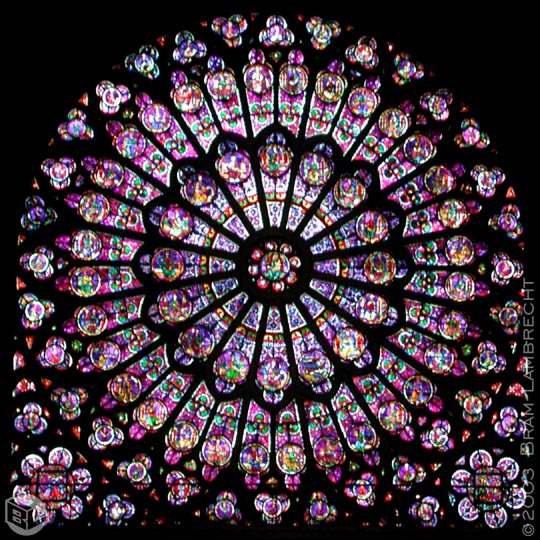
And t is the rose window of a Gothic cathedral: here, Notre Dame in Paris. Notice how like the Eastern mandala it is.


These are just three examples of symbols that draw us in the direction of the Self ... and of God. They do so by representing the ideas of wholeness, symmetry, balance, unity, healing, and beauty.


But, as Bianchi points out, there are numerous reasons why many lay Christians and theologians resent Jung's seeming identification of the Self archetype with God.

One of these reasons is the tension Bianchi identifies (pp. 29ff.) between the truly religious and the demonic. If Jung was right, and the numinous archetypes (including the Self) are responsible for our deep-and-mystical religious experiences, Bianchi asks,

How do we determine an authentic religious experience from those of magic, superstition or insanity? In this area of criteria for testing the value of a subjective happening, any test will be relative and partial. The descriptive signs of a religious experience may resemble those of insanity. Moreover, a temporary insanity, as an ego disturbance via encounter with the Self, may be both numinous and healing for an individual. (p. 29)


Jung used the word "numinous" when discussing the power which the various archetypes have to break into our rational, everyday consciousness and command attention. As with the everyday one-sidedness of the rational ego that I mentioned earlier, such assertions of archetypal potency are not necessarily "wrong" or "bad," to a Jungian. They can be "both numinous and healing." Or, they can bring us to madness and evil.

How do we tell the difference? Bianchi writes:

The classic Christian testing of the inner spirits revolved around the doctrine of agape. Does the experience in some way contribute to a fuller life of charity, that is, of self-giving love? (p. 29)


The very next thing Bianchi writes is something I have a problem with:

In the Jungian perspective, the traditional Christian of experience can be too one-sided, overly stressing self-giving in benevolence to others. The Jungian criterion would ask: does the experience contribute to wholeness in a person's overall life? Does it foster the reconciliation of opposites in the psyche? (p. 29)


I don't agree that these two criteria are, at the end of the day, different.


In my own personal experience, movement toward Jungian wholeness in my inner life has brought about greater agape, charity, and self-giving love in my orientation toward others.

(The Greek word agape, by the way, is pronounced OGG-uh-pay. It is a word long appropriated by Christians from the Greek language of the New Testament to represent what has also been rendered as the Latin caritas: the idea of a charitable love toward others that is in no way either lustful or self-serving.)

I have found that wholeness à la Jung — to the limited extent that I have attained it — is a remedy for the problem I spoke of in the posts in my Existential Guilt topic. I have long suffered from a "free-floating guilt" that has, frankly, impaired my life. I am not alone in this — though in my case, "existential guilt" has been more of a problem in life than it is for most people.

Bianchi describes the reason for it:

... as each person in the course of life moves away from infancy's union of undifferentiated consciousness (the participation mystique of womb life and early childhood), specific ego identity is fashioned. ... the self-conscious ego realizes the precariousness of existence in the face of death and other threats. Just as the ego incurs existential guilt in the necessary process of alienating itself from identity with its original maternal source, it also ignores or struggles against the promptings of the Self that call to wholeness. The all-absorbing quest [is rather] for survival, material comfort and self-valuation through outward acclaim ... .

Yet the depths of the Self will not be denied ... . (pp. 26-27)


Alienation, existential guilt, free-floating guilt ... these can result from the very process by which the ego tries to deal with the "precariousness of existence" on its own terms, while holding the Self at arm's length.


I have personally found that trying to be a "good Christian" has not been enough to deal with my existential guilt. On the other hand, seeking Jungian wholeness has, quite ironically, made me a better Christian. It has let me become a better exponent of caritas, agape, and Christian love.

This change has not been something I am just putting on for others' benefit. I have noticed, furthermore, that other people are treating me differently than before. They seem to be more interested in being around me. They seem to just assume that I am more empathetic to their needs and concerns than was ever the case before. They can talk to me less guardedly and more "humanly" than before.

There seem to be fewer times when they "get me wrong" and behave as if I am an entirely different sort of person than I think of myself as being.

Better yet, it seems as if my personality, or whatever you want to call it, now tends to bring out the best in the people I meet. People on the whole seem to be kinder and gentler when I encounter them than would seem to be generally the case, judging by the culture. Yet I don't get the sense that people are putting on a false front. It's just that we, all of us, seem to respond to other people according to some subliminal cue that they emit. If the cue says "this person is one I like and I needn't fear," then people act accordingly.

People who have attained some degree of Jungian wholeness are people that others instinctively respond to with the self-giving behavior patterns of a "good Christian." That's perhaps the key lesson I've learned.


That I think was what made Jesus special. Before his crucifixion and resurrection, after which it became apparent he was God in human form, he drew people to him as he traveled about not just because he was a miracle worker — he always was reluctant to do miracles. He was, I think, what Jung would call "fully individuated," "fully self-realized." People instinctively responded to him as such: he brought out the "better angels of their nature."

Not that I identify myself with Jesus: I admit I am far from fully self-realized.

One big reason I'm not "all the way there" is what Bianchi brings out immediately after he draws what I consider to be his problematic distinction between benevolent self-sacrifice in the traditional Christian mode and the reconciliation of opposites in the psyche, in the Jungian mode.

The latter process is long and arduous, Bianchi says, and fraught with danger and pain. It involves coming to terms with the Shadow, another key archetype which "represents that part of a personality whose traits we neither perceive nor wish to perceive" (p. 30). If the Self is the image of God within the psyche, the Shadow is the image of Lucifer or Mephistopheles. It is also the "portal to the unconscious" (p. 30), and we can't realize the Self without confronting the Shadow ... even at the seeming peril of our death. As Jesus was tempted thrice by the Devil, we have to encounter the Shadow en route to the Self.

Jung discovered that the secret to dealing with the Shadow is to find constructive ways to "channel the energy of our negativities" (p. 30). This can be done by taking advantage of "the transformative polarity of opposites in the psyche" (p. 31). That is, we need to balance the positive and negative — good and evil — aspects of the unconscious psyche off against one another. The result, mysteriously, is not zero, but personal transformation.


After discussing the Shadow, Bianchi returns to his theme of the tension between the Christian call for benevolent, virtuous self-sacrifice and the Jungian call to acknowledge the Shadow en route to the Self. He calls the Jungian outlook "Socratic" or "Greek," while the Christian outlook is "Hebraic."

In the former view, the process of individuation and Self-realization, by reducing our conscious ego's need to perpetuate its own existence, can defang death itself and make us calm and steadfast in death's very face. In the latter view, we cannot defeat our inner proclivity to evil on our own, and death is a very real tragedy and threat to us, unless we accept Jesus Christ as our personal savior.

I think the two views can be reconciled by noting that the traditional Christian view makes perfect Jungian sense for people who are not yet ready for the call that can be expected "in mature life," and that will be proclaimed in symbolic form by the numinous forces of the psyche's unconscious, "to experience the depths" (p. 31).

This needs to be done "with a fully formed ego identity," Bianchi writes (p. 31); otherwise, it is too dangerous.

The "fully formed ego identity" is something we develop during the first half of life: prior to, say, age 40. But in Jesus's day, and in the classical/medieval European culture in which Christianity first flourished, how many people lived into what we would today consider the "second half of life"?

Accordingly, how many of the people Jesus addressed, either directly or later on through the Gospel stories and the New Testament, were ready to go beyond "a fully formed ego identity" on their own (or with a Jungian therapist by their side)?

We can reconcile the traditional Christian outlook with the Jungian if we recognize the validity of the former for all people who have not (yet) felt the call to go beyond "a fully formed ego identity." The validity of the latter is for those who need to get beyond establishing the ego's identity as the prime exigency of the first half of life ... some of whom are still young, perhaps, but most of whom will be in middle age or beyond.

In so doing, Self-realizers will still need to keep in mind the Christian call to agape and caritas. The litmus test: do others instinctively respond to you with the self-giving, other-honoring behavior patterns of a "good Christian"? If so, you're probably on the path of angels and not of demons.

Tuesday, September 09, 2008

Jung vs. a Righteous One-Sidedness?

An area of tension between Christian theology and Jungian psychology — it is the second of the five topics that Eugene C. Bianchi addresses in "Jungian Psychology and Religious Experience," an article in Carl Jung and Christian Spirituality: A Reader, edited by Robert L. Moore — is that which Bianchi labels "receptive-initiatory." (See The God of Synchronicity for my initial comments on this article and book.)

Bianchi means by this label that traditional theologians accuse Jungians of claiming that the individual who attends to the urgings of the "archetypes" in his "collective unconscious," and who thinks God is thereby calling him from within his soul, is not really hearing God. God is not, in this anti-Jungian view, an archetype such that our encounter with God is initiated from within our psyche. A Jungian-style faith is a false one, not a response to an objectively real God's freely made external offer of salvation, to which we are merely receptive.

Jungians hold, on the other hand, that there is something called the Self, and it is very real. It is (a) an archetype of the collective unconscious and (b) the image of God within every human soul. It calls each of us to psychological wholeness and completion.

The Self, which like all archetypes is not something we are consciously aware of, represents itself to us in code, as it were, through our affinity for certain symbols. The rose window of the Cathedral of Notre Dame in Paris (right) is just such a symbol. Its fullness, roundness, unity, balance, and symmetry betoken wholeness and completion.

Another symbol that betokens wholeness and completion is the cross of Christ (left). It conveys the same balance and symmetry as the rose window — which is actually a kind of mandala — and the fact that it has exactly four peripheral compass points incorporates the symbolism always associated in the psyche with the number four. The number four is, Jung said, intrinsically a symbol of completion and wholeness.

To a Jungian, psychological wholeness/completion is the prime desideratum of a human life. It is achieved when the Self archetype is "realized" by means of a long process which Jung called "individuation." Individuation makes each of us into the particular and unique individual he/she is destined to be. In so doing, it makes each person less wedded to group or societal norms than he/she once may have been.

Self-realization comes by means of balancing the various forces within the psyche off against one another, just as the individual "rays" of Notre Dame's rose window balance each other off. This balancing act is easier said than done: typically, some of the sources of energy in the psyche are considered dangerous, antisocial, or downright evil. Those centers of energy which threaten our "nice," conscious self-image are pushed into the unconscious, where they only seem to be gotten out of the way and thereby rendered harmless.


Self-realization involves recognizing that the supposedly "evil" forces of the psyche are only evil when they are not properly in balance with the "good" forces.

There's no getting around it: this is a point of view that relativizes evil. Evil, sinfulness, transgressiveness — whatever you want to call it — is not absolute after all. If an inner urge or drive that would initially seem to be absolutely evil is brought into balance with the rest of the forces of the psyche, it is no longer (as we Catholics say) an occasion of sin.

A simple analogy would be to coffee: to many people, the taste of coffee is foul and bitter unless it is balanced off by adding cream and sugar. Likewise, a Jungian would say that certain aspects of the psyche are foul and sinful ... but only unless and until they are balanced off against other aspects of the psyche.

When the psyche is not in balance, Jung said it is "one-sided." One-sidedness is, to a Jungian, something to be overcome. Self-realization through individuation is what overcomes it.

The Self archetype is what calls us from within to perform such a balancing act. In fact, Jung called the Self the imago Dei, the image of God, within us.


But there is another point of view about what God calls us to do. This one would seem to say to us that there is in fact a righteous and holy one-sidedness which God wants us — with his help and guidance — to achieve.

We are to do, and be, naught but good. We are to spurn sin and evil. Those temptations, drives, and urges which we experience within us that would have us commit acts that are prohibited by God's law (or fail to do things we are called by God to do) simply have to be resisted.

This point of view is the one which Bianchi treats as "initiatory." An objectively real deity, namely God, initiates a relationship with us from outside our world. We then feel as if we are receiving God's word and law from a transcendent, not immanent, Being who simply tells us how (and how not) to live godly lives.


By treating God as someone to whom we are "receptive" because he comes to us through an inner archetype called the Self, Jungians supposedly risk making right and wrong into a subjective thing. How do we know that the urgings we may become aware of, stirring within our soul, are indeed coming from God, traditional Christians ask?

One way to bring the two perspectives closer together is to point out that in Jung's theory, human consciousness passes through several stages. I discussed this more fully in Quest for the Self, Part 2. Self-realization through individuation is associated with one of the "later" stages, Stage 5.

In this stage, we become skilled in interpreting the meaning of the symbols that our unconscious mind throws into the light of consciousness by way of our dreams, our fantasies, our inner preoccupations, and our myths. Seeing religious revelation à la the Bible as a work of symbols and myth changes our perspective. It opens up possibilities for interpretation which allow us to accept some of the hitherto unconscious forces of our own psyche into conscious awareness, so to achieve a more complete balance of psychic forces.

Compare that with Stage 3 consciousness. In that stage, we "project" our inner ideals out upon abstract entities such as God. That stage is all about fidelity and allegiance to God (or whatever abstract entity we are projecting our ideals onto).

Naturally, in order for this strategy of projection to work, we see the one that receives our projections as absolutely, objectively real. We resent any outlook that suggests God is anything but that.

So Bianchi's "receptive-initiatory" conflict could be seen as a Stage 5-Stage 3 contrast. People who are in Stage 5 are receptive to the Self as the ambassador of God within the soul. People who are in Stage 3 need to see God as coming into their lives from outside the subjective psyche.


All this is complicated by the fact that these stages are not strictly sequential. We can cycle "backwards" from a "later" stage to an "earlier" one.

In my own life, I seem to have entered Stage 4 consciousness, which is characterized by a seeming "end" to the erstwhile proclivity to project our inner images out onto persons and things, whether they be concrete and specific (Stage 2) or abstract and general (Stage 3). In Stage 4, we are atheists and agnostics. There simply are no external gods, no God, worthy of our projected ideals.

Stealthily, we are actually projecting our innermost ideals onto our own ego, the center of our conscious awareness, Jung said ... but never mind. We don't see that unless or until we arrive at Stage 5.

At any rate, I seem to have arrived at Stage 4 before coming to Stage 3. Then I had to double back and become a midlife convert to Christian belief. Yet, even as that was happening, I began to feel stirrings of what I would much later come to identify as Stage 5 consciousness. This stuff can get complex!

Monday, September 08, 2008

Close Encounters with Synchronicity

I've been blogging about the human psyche as mapped by the late Swiss theorist Carl Gustav Jung. His theory has it that "archetypes" common to every last one of us are responsible for putting certain patterns into our heads, so to speak. For example, we all have an inbuilt image of what a mother is, thanks to the Mother archetype.

Toward the end of his long and fruitful life, Jung began to realize that the archetypes are not just psyche-internal. They exist outside the individual person, as well as being active within the soul.

Jung developed a notion of the real existence of independent, potent, numinous archetypes. This came as an outgrowth of his work on "synchronicity," an often-encountered phenomenon in which internal images found in our dreams and fantasies match patterns occurring approximately simultaneously in objectively real events. The pattern-matching between inner and outer realities happens with no apparent cause, but it is not by chance either, Jung said. Instead, it reflects an "acausal orderedness" in the world that conveys meaning to us, where external events and their timing might by themselves appear to be meaningless.

All that is quite a mouthful, and a headful to boot. I'd like to give an example of synchronicity that may make it easier to understand. The example comes from the movie Close Encounters of the Third Kind.


In this 1979 classic of the science fiction genre by celebrated filmmaker Steven Spielberg, the main character is Roy Neary, played by Richard Dreyfuss. Neary is a lineman for the electric company who, while out in the field dealing with a puzzling electrical outage, has his pickup truck buzzed by an alien spaceship. He winds up with an inexplicable sunburn and an irresistible urge to sculpt his mashed potatoes into replicas of a place he's never seen: Devil's Mountain, Wyoming, also known as Devil's Tower.

Neary is so obsessed with trying to somehow externalize the Devil's Tower image that has been seared into his unconscious, in fact, that his constant preoccupation with doing so loses him his job, his wife, and his family.

Finally, he happens to see a picture on TV of the natural landmark in Wyoming and twigs to the fact that it matches his mashed-potato sculptures precisely. The TV coverage has it that the U.S. Army has been forced to clear the area around Devil's Tower of all human occupants, owing supposedly to an unexplained outbreak of anthrax that is killing livestock and wildlife. Neary, however, knows deep, deep down that the simultaneous occurrence of his mashed-potato obsession and the anthrax news story means something. He considers it absolutely necessary that he go to the very place that people are being evacuated from.

Along the way, he meets up with Gillian Guiler, a woman whom he knows only casually as someone who was likewise exposed to an alien spacecraft. Her small son has in fact been abducted by the aliens. She, like him, has been unable to stop thinking of and drawing shapes resembling Devil's Tower, and she has felt the same compulsion to travel to it that Neary has himself.

Neary and Guiler have to fight their way past the authorities in the region, but they make it to a spot overlooking an area that scientists have been secretly readying for a return visit by the aliens. The scientists have managed to decode messages from the aliens couched in the form of music and other containers of information. The messages have promised the scientists that the aliens will come in their spaceships to Devil's Tower on a certain night. On that night, Neary and Guiler are there towatch from their hiding place as the aliens make good on their promise.

This is not a hostile encounter, as some might expect. Instead, the massive "mother ship" of the alien race engages in a sort of otherworldly jam session with the music the earthlings play for it. This is music that has been taught to us by the aliens during previous encounters. We play the simple theme we were taught, and the aliens play back for us a bevy of ever more complex variations on that theme. Thus is the idea signaled to all those assembled that the aliens have come to us in harmony and peace.

Then comes the pièce de resistance: the alien mother ship opens its vast "mouth" and out march not only representatives of the alien race themselves but also former abductees who are being returned unharmed ... including Gillian Guiler's son. Next, pre-selected volunteers from earth march up the ramp to become the new generation of abductees, as it were. Among them is Roy Neary, who scampers down from his hiding place nest to Gillian and, even though he has not officially been pre-selected, is understood by the scientists to have been chosen for inclusion by the aliens themselves.


In order to see this narrative as betokening synchronicity in action, we have first to stipulate that the aliens in Close Encounters are stand-ins for archetypes of the collective unconscious. Indeed, it is generally understood by Jungians that our ideas about alien encounters pattern with our ideas about encounters with angels and gods ... or, if the aliens are hostile, as in H.G. Wells' War of the Worlds, with devils and demons. To a Jungian, angels and demons are symbolic of the influences of certain crucial archetypes.

For example, there is a Messenger archetype, an ally of the most important Jungian archetype of all, the Self. In classical myth, the god Mercury was a messenger. In Christian belief, angels serve as messengers from God. In Jung's theory, the Self archetype represents the very image of God in the soul, so messenger angels are of great importance as symbols of personal transformation.

Extending that notion to Close Encounters, the visitors from another world are likewise symbols of the transformation of Roy Neary as "everyman." Neary clearly grows as a person as a result of his experiences during the film. This growth could not have come to pass without the synchronicity between the particular image that keeps inexplicably popping into his head and the distinctive shape of Devil's Tower in the real world. That synchronicity gives meaning and content to his obsession with a certain "meaningless" form, and that meaningful content winds up transporting him to a higher plane of consciousness, symbolized by his being carried away in a spaceship by friendly aliens.

Sunday, September 07, 2008

The God of Synchronicity

Carl Jung and Christian Spirituality: A Reader, edited by Robert L. Moore, contains an article that is required reading for anyone such as I who would like to bring Christian thought into harmony with Jungian psychological theory. Eugene C. Bianchi's essay "Jungian Psychology and Religious Experience" discusses five major points of conflict between traditional theology and Jungian imperatives. The first is the tension between the traditionalist view that the truths of Christ and his church are manifestly objective and historical, whereas Jungians emphasize the personal inwardness and subjectivity of all religious experience.

Bianchi admits he is biased in the Jungian direction, yet disturbed by the "discontinuities and inadequacies" of Jung's ideas about religion (p. 17). For example, he understandably feels Jungians' emphasis on pure spiritual inwardness "can lead to a diminishing of community responsibility ... [and] submerge social consciousness and civic responsibility" (p. 22).

Jung, for his part, held that universal archetypes common to all human beings produce images in the unconscious mind that show up always and everywhere in dream and myth. These images present themselves consciously as symbols. The conscious mind sees, not the archetypes themselves, but the symbols that the archetypes lie behind.

Furthermore, Jung found that there was often an uncanny coincidence between symbols appearing in our dreams and "real-world" events that transpire at roughly the same time. He called these coincidences "synchronicity."


The cross of Christ is such an archetypally derived symbol. Because of its balanced shape, it is typical of all symbols of symmetry and wholeness. The rose window of Notre Dame Cathedral, depicted on the book's cover, is likewise a symbol of the archetype for wholeness.

Jung identified the archetype behind such wholeness symbols/images as the Self. The Self, if realized, is capable of bringing the psyche or soul into balance by harmonizing its internal tensions and bridging between its inherent pairs of opposites such as male-female or light-dark. It is the most important and potent of the archetypes ... and the most mysterious.

In earlier installments of my Quest for the Self series, I tried to show what the Jungian Self is all about. In the final two of those posts, I discussed the key related concept of "synchronicity." I believe this concept is capable of resolving Bianchi's doubts about joining Christian thought to Jungian.


Jung's idea of synchronicity covers many bases, to use a baseball metaphor. Jung's "first base of synchronicity," as it were, is the notion that there are uncanny coincidences between events that happen in the "real world" and events that happen in the psyche.

The events that happen in the "real world" are objective events that occur in time and space and are caused in the usual way. The events that happen in the psyche, often in visions and dreams, are archetypally produced images. The external events and the archetypal images, in confirming one another, give rise to a sense of deep meaning.

Such a synchronistic, confirming event occurred to my father at the time that his brother Ralph was released by death from his long, painful struggle against inoperable, incurable cancer. At the time that it happened, my father was away from home on the island of Guam, while Ralph was in Maryland with his family. My mother and I were living near Ralph Stewart and his family.

When Ralph finally succumbed to his terrible disease and was pronounced dead in the hospital by his doctor, it was night on Guam, and my father wakened from a dream — he later reported it to my mother — with the feeling of a great weight having been lifted from him. She and he calculated that his awakening from dream had taken place at very possibly the exact moment Ralph died. Thus the uncanny synchronicity of two events, one objective and "real," the other personal and psychic.

I never learned from Dad what the actual content of his dream had been, but in later years he often spoke of his fascination with widespread reports of near-death experiences, in which people who have almost died have come back to life saying they have "seen" a bright light at the end of a tunnel and even the figures of loved ones waiting to welcome them "to the other side." The contents of such near-death dreams and imaginings are so persistent and ubiquitous that they simply must be produced by archetypes, any follower of Jung would say. I wonder if Dad's synchronistic dream was not such an archetypally-driven near-death experience that he had on Ralph's behalf.


Extending the baseball metaphor to include Jung's "home plate of synchronicity," as I'll call it, involves making the assertion that the archetypes that "speak to us" so uncannily, in the guise of inexplicable coincidences between inner images and outer events, are objectively real in and of themselves. Furthermore, Jung said, they are "transgressive" — not in the sense of being sinful, but in the sense of traducing the ordinary boundaries of time, space, and causality.

Jung originally placed the archetypes in the individual's "collective unconscious," a part of the hidden psyche common to us all. Later, he came to realize that there was a distinction to be drawn between the archetypal images/ideas that well up in the deep unconscious of every individual human being, and the archetypes proper which produce them. The archetypes, he came to believe, must actually reside in a "psychoid" — i.e., psyche-like — region of the individual, a place outside the psyche per se which is part-mind, part-body.

Then, in expanding upon his "first base of synchronicity" idea, as I am calling it — the idea that external events and internal images uncannily co-occur — he said that archetypes actually exist on their own in a manner that is independent of the individual psyche. They pre-exist the psyche of any particular person, and they persist when each one of us dies.

Synchronicity writ large — my "home plate of synchronicity" — is Jung's idea that powerful, numinous, uncanny patterns show up in the world and its events, and are matched by similar events in the mind, because the archetypal potencies behind the events are godlike and very, very real.


Jung called these archetypal potencies "transgressive," a choice of terms that is not calculated to endear the idea to Christians for whom "transgression" and "sin" are synonyms. If he had called synchronicity's uncanny effects "miraculous" instead, ordinary believers might have welcomed Jung's ideas with open arms.

For what Jung had in mind by synchronicity was a way of explaining the "acausal orderedness" in the world.

That the world exhibits more order than it has any right to expect to have is a point of agreement between Christians and Jungians ... and, increasingly, among secular scientists who champion, say, Darwin's theory of evolution.

The secular point of view has it that the world is "causally closed," meaning that there is simply no way for a deity to reach into the intact causal chains by which events normally proceed and alter their outcomes.

If synchronicity were causal — bound by ordinary chains of cause and effect — it would violate that assumption. But Jung very carefully stated that synchronicity was at the opposite end of a conceptual axis from causality. Causality and synchronicity together explain events, Jung held, including the uncanny relationships between objective, factual, "real" events and internal, personal, psychic events.


In his article, Eugene Bianchi has trouble with what he perceives as a tendency among Jungians to overemphasize "symbolic causation," which "appears to proceed almost exclusively from the inward to the outward" (p.21), and underemphasize "external causality" (p. 22). Presumably, "external causality" is what the miracles, teachings, and life-death-resurrection of Jesus affirm to ordinary believers. That is, all that is told of in the Gospels actually happened and is objectively real ... even the miracles.

On the other hand, a Jungian perspective seems to Bianchi to suggest that such events as the Resurrection might have been dreamlike illusions, mere images welling up in the psyche of the Apostles due to the influence of internal archetypes.

But that is not what anyone who fully accepts Jung's ideas about synchronicity would hold, any more than they would hold that only in my father's dream did his brother Ralph die and "go to heaven." Ralph died objectively and really ... and may or may not now be in heaven, who can say? My father's dream did not cause his death. Nor did his death cause my father's dream. Rather, the two in their coincidence were an example of acausal order appearing in the world we know.

Likewise, for us believers to note that Jesus' Resurrection was an example of an archetypal image and a real-world event "falling together" need not imply that one of the pair was logically (or temporally) prior to, or any more "real" than, the other. Jung carefully insisted that in any such case of "falling together," the provision by an archetype of an internal image or symbol and the arranging by the same archetype of an external event whose meaning is given by the symbol are equally real.


Admittedly, this is an odd way for us to look at things. As creatures of modernity, we are so wedded to explaining things "rationally" by relying exclusively on ordinary notions of causality that there doesn't seem to be much room for synchronistically-based explanations.

This is in part why we, when we wear our hats as scientists, ascribe certain so-called "random" events to chance. The result of a flip of a coin is supposedly a chance event — either that, or we tend to go to elaborate lengths to qualify such a statement by saying that if we could only know all the factors leading up to the instant of the coin flip with sufficient precision, we would find the outcome to be as causally deterministic and predictable as the orbit of Jupiter.

Similarly, we say that the occurrence of genetic mutations in producing new types of organisms and accounting for biological evolution is chance or random, and has no cause.

In other words, all events have causes that arise naturally in a causally closed cosmos, or they have no cause at all, and are purely random.

Jung in effect said that causality (or its absence) isn't the whole story. Synchronicity plays a real, acausal, non-random role in explaining worldly events. And synchronicity is produced by archetypes that are as real as real can be. The archetypes, most notably the Self, are patterns that give meaning to what goes on in the world. They do so by influencing objective events and subjective ideas, in tandem with one another.

If Eugene Bianchi would have given full credit to Jung's ideas of the synchronistic workings of the Self, he might have seen that the Christian God of redeeming miracle and the Jungian God of uncanny synchronicity were one and the same God.