Showing posts with label Jungian Wholeness. Show all posts

Tuesday, October 14, 2008

Theology of the Body, Part 8

Now, more in my Theology of the Body series about the "theology of the body" (TOB) espoused by the late Pope John Paul II, as described in Christopher West's book Theology of the Body for Beginners.

In Theology of the Body, Part 7 I described TOB as a way of understanding Christ's redemption of humankind's "original sin." The original sin of Adam and Eve, our mythical forebears in the Book of Genesis, was rooted in lust: exchanging their initial ability to delight in each other sexually, in the context of giving themselves to one another totally, for something much, much less ennobling, and therefore shameful. Lust (even when shared) is self-gratification for its own sake. It blocks us from knowing the "nuptial meaning" of human existence.

I made the case in the prior post that you can match up the process of re-appropriating this nuptial meaning of life with the process of Self-realization laid out by Jung. Given the essential Jungian step which I refer to as "addressing the Anima (or Animus)", the biblical idea that a man and woman must cleave together as "one flesh" receives its secular, psychological interpretation. Two approaches to one great truth, these would seem to be.

The two approaches are united in being more matters of inner personal experience than just believing in psychological formulas or adhering to religious laws. Pope John Paul II talked about how the thing that his theology of the body seeks is not just adherence to an ethic or set of rules concerning sex. Rather, our hearts must be converted to a "new ethos" wherein we no longer desire to break the erstwhile rules.

To gain the inner personal experience we seek, so that we might come to know the "nuptial meaning of the body," is not something that we can expect to happen fully in this lifetime. Fulfillment, in the sense of completion, West writes, comes only in heaven. Yet we can make a start:

As we open ourselves to this gift, the grace of redemption begins to "re-vivify" our humanity, to enliven our hearts with God's own goodness. To the degree that we allow this grace to inform and transform us, God's Holy Spirit impregnates our sexual desires [in John Paul II's words] "with everything that is noble and beautiful," with "the supreme value which is love" ... (pp. 43-44)


My own problem with this is one West addresses in his section "Purity Is Not Prudishness" (pp. 45-47). The problem is this: I don't yet seem to have the ability to find the middle way between lust and prudishness.

I accordingly feel quite encouraged by John Paul's words (written in Love & Responsibility while he was still Karol Wojtyla) to the effect that "mature purity"

consists in quickness to affirm the value of a person in every situation, and in raising [sexual reactions] to the personal level ... (p. 45)


I sort of already know that, but can't always put it into practice ... and so I have found myself adopting a "don't look" policy: don't even produce an occasion of sin by looking at a woman with concupiscence in the first place. As West points out (p. 46), that's a bit like the Old Testament admonition, "Turn away your eyes from a shapely woman" — and it is no more than "a necessary first step," a "negative" and immature purity.

According to John Paul II:

"In mature purity man enjoys the fruits of the victory won over lust." He enjoys the "efficacy of the gift of the Holy Spirit" who restores to his experience of the body "all its simplicity, its explicitness, and also its interior joy" ...

... thus rescuing us from both lust and prudishness at one and the same time!

This means I can expect to discard my "don't look" training wheels real soon now.

Theology of the Body, Part 7

This post represents a re-taking up of my Theology of the Body series from three years ago. The focus of the series is the "theology of the body" espoused by the late Pope John Paul II, as described in Christopher West's book Theology of the Body for Beginners.

In previous installments, I indicated how conflicted I was about what I'll abbreviate as TOB. On the one hand, I felt deeply drawn to it; on the other, repelled by it as a sure way to drive a wedge between true believers and everyone else.

The basic idea of TOB is that there is really nothing more fundamental, in terms of our life in this world, than sex in all its ramifications, and therefore nothing more capable of serving as the taproot of sin than sex. When our original desire to share ourselves fully with one another, man-to-woman and woman-to-man, was perverted into lust, it became our "original sin." Christ's death on a cross and resurrection to life everlasting have redeemed that sin and all its follow-on transgressions fully, assuring us of a place in heaven, but we have to appropriate that redemption willingly, and at some great difficulty, in this life.

The theology of the body, laid out by John Paul II in a series of talks early in his pontificate, is a discourse in how we do that.


Herein, rather than try to lay out the entire complex subject in one blog post, I'd like to try to relate the Holy Father's theology of the body to Jungian psychology.

In my long recent series on Jungian Wholeness and its Addressing the Anima subset, I discussed Jung's ideas about the hidden powers of the unconscious mind: the archetypes, including the Shadow, the Anima, and the Self. The Shadow, I said, betokens the repository of aspects of the psyche that we don't like about ourselves. We don't particularly want to see our sexual avidity as "lust," for instance, so we park "lust" in the unconscious depths, where it becomes part of the Shadow complex.

Jung held that deeper than the Shadow in men lies the archetype called the Anima (the Animus in women). As a feminine component in a masculine personality, the Anima represents a man's ideal for members of the opposite sex. The Animus in women, as a masculine component in a feminine soul, does the same in return. True psychic health demands that at some point the Anima/Animus should be confronted, internally and consciously, but even before that happens, the Anima/Animus typically gets projected outward on a member of the other sex. As a result, we fall in love.

The way we treat our Anima/Animus figure, once we have done so, is intended to be the opposite of lust.

If the healthy sexual desire we have for our beloved turns to lust, or gets smothered by the lust we have for other women or men, we lose the ability to "address the Anima." But addressing the Anima allows "her" (or "him," as the Animus in women is referred to) to guide us in our ultimate search for the Self.

The Self is the one archetype which can unify the psyche. It has a number of aspects which I discussed in earlier posts, including the capability of being symbolized as a Christian cross. For purposes of this post, the Self represents the imago Dei, the "image of God" within us.

Stripped of excess detail, we need to move from being slave to the Shadow (lust) to full expression of the "better angels of our nature" when we address the Anima, either in the guise of our beloved spouse or internally and consciously. That leads us onward to some sort of union with God.

So the Jungian scheme of things would seem to be consistent with John Paul II's theology of the body!

Sunday, October 05, 2008

On Secrets

A confession: I've been looking at porn on the Internet. Smut. Naughty stuff ... what used to be called, quaintly, "French postcards." Yet I've found that what you can see if you enter the right words in the Google Images search box goes way beyond naughty. And it isn't really all that much fun to look at, truth be told. The question is, why not?

An answer crossed my mind today as I pondered the nature of secrets.

Secrets are things we don't want to tell others, don't want them to see or know about. That much is unremarkable. What seems to me to be more remarkable about secrets is that each one is unique.

That's a big deal if you are like me and tend to agree with the protagonist of Muriel Barbery's award-winning novel The Elegance of the Hedgehog. Renée Michel is the concierge in a Parisian hôtel particulier who ponders thoughts above her station. At one point she glimpses the master's thesis of one of her tenants' daughters and is set to musing about the philosophy of William of Ockham.

Ockham held that there are no universals, just unique and particular entities that only seem to participate in a universal form or ideal. There is no such thing as the quintessence of table-ness, only this table, that table, this other table. The notion that the abstract idea of the table is real is a trick of the human capacity to use language, thereby to invent (non-existent) general categories.

But Renée Michel disagrees:

As far as Will of Ockham is concerned, things are singular, and the realism of universals is erroneous. There are only particular realities, generality is merely in the mind and to presume that generic realities exist is merely to make what is simple complicated. But can we be so sure? Was I not seeking congruence between Raphael and Vermeer only yesterday? The eye recognizes a shared form to which both belong, and that is Beauty. And I daresay there must be reality in that form, it cannot be a simple expedient of the human mind classifying in order to understand, and discerning in order to apprehend: for you cannot classify something that is not classifiable, you cannot put things together that cannot be together in a group, or gather those that cannot be gathered. A table cannot be a View of Delft: the human mind cannot create this dissimilarity, any more than it can invent the deep solidarity connecting a Dutch still life to an Italian Virgin and Child. In every table there is an essence that gives it its form and, similarly, every work of art belongs to a universal form that alone confers its seal upon the work. To be sure, we cannot perceive this universality directly: that is one of the reasons why so many philosophers have balked at considering essences to be real, for I will only ever see the table that is before me, and not the universal "table" form; only the painting, and not the very essence of Beauty. And yet ... and yet it is there, before our eyes: every painting by a Dutch master is an incarnation of Beauty; a dazzling apparition that we can only contemplate through the singular, but that opens a tiny window onto eternity and the timelessness of a sublime form.

Eternity: for all its invisibility, we gaze at it.

Yet, it seems to me, we can never gaze upon the essence of a secret, for a secret has no essence. A secret is what it is only by virtue of the intentions of the person who is keeping it.

Suppose you are gay, but keeping it a secret. Suppose also that you have a friend — not a lover — who is also in the closet. It may seem that you share the same secret, and that therefore secrets have universal essences.

But now imagine that your friend tells someone else that you and he (let's say your friend is male) are both gay. What will be your reaction? Isn't it apt to be that it's well and good for him to part with his own secret if he bloody well wants to, but he has no right whatsoever to betray your confidence?

Secrets belong only to their originators. Even if the gist of a secret is identical between two secret-keepers, each person's secret is an entirely separate entity. Ergo, secrets (though they have gists) have no essences.


It all has to do with consciousness. Animals don't have secrets, because they are not conscious. (Or, if they do possess consciousness at some level, it is only to that extent that they are capable of secrecy.)

Jung had it that human consciousness lies along an arc from the pre-conscious "participation mystique" of infancy to the advanced awareness of a guru on a mountaintop — which amounts to the same oceanic, all-is-one immersion, now at a fully conscious level.

If you are a pre-conscious infant, there can be no hiddenness, no secrecy. The same is true of the mountaintop guru, to whom all secrets are revealed. And the same goes for God, from whom no secrets can be kept. In fact, Jung spoke of the advanced stages of consciousness as the realization of the Self as the imago Dei, the image of God.

But most of us spend our days at stages of consciousness that are somewhere in between these endpoints. Everyday consciousness is secret-keeping consciousness. If our lives were open books to everyone who is not a baby or a guru, and their interior lives were equally open to our own view, life would be impossible to deal with.

I have often fantasized about what it would be like if one could see each innermost thought of another individual, blazoned on his or her forehead: "I don't really like Alice, but I have to pretend to since her husband is my husband's boss"; "I don't want the buddies I hang around with to know I like medieval French poetry"; "I'm planning to dump my girlfriend, but I'm not ready to tell her yet."

Those pieces of inner dialogue would be bad enough, if revealed to one and all. Far worse, though, would be thoughts about sex: "I'm sure horny today"; "I'm not horny, but would like to be — where can I score some Viagra?"; "I'm sleeping with my secretary and don't want my wife to find out"; "I can't keep my eyes off her breasts/his behind"; and so on.

Well, then ... why are thoughts about sex more secret than other thoughts? I think the answer is that secrecy is the essence of sex.


If not secrecy per se, then intimacy. Confidentiality. What goes on between us is nobody else's business. That sort of thing. Otherwise, it's just friction and heat, spanning and delving, pumping and orgasm.

The eternal essence of sex retches at the thought. The eternal essence of sex knows that sex involves holding, and being held, close. You aren't really holding someone close if you know that what the two of you are doing is being filmed and will wind up on the Internet.

So, from something without an essence — the secrets of the bedroom, as kept separately by those who share the bed — comes something with an essence and a universality: the beauty of real sex. Go figure.

Wednesday, October 01, 2008

What's Your Blick?

"What's Your Blick? God or Science?" is the title of a recent book review in Washington Post Book World. The book in question: Michael Novak's No One Sees God: The Dark Night of Atheists and Believers.

Reviewer Jacques Berlinerblau described the book as a riposte to the New Atheism of Christopher Hitchens, Sam Harris, Richard Dawkins, and Daniel Dennett, all of whom have recent bestsellers disparaging religion and belief in God. Novak, says the "unrepentant Jewish atheist" Berlinerblau, is a Catholic theologian who would like to have a "heart-to-heart chat with these Four Horsemen of the Apocalypse."

According to Berlinerblau,

To help frame the debate, Novak invokes the idea of a "blick," a "way of viewing reality that is not usually overturned by one or more pieces of countervailing evidence." Coined in about 1950 by the British philosopher R.M. Hare (who spelled it "blik"), the term refers to a mental filter through which people sift information, admitting some things as facts and rejecting others. To simplify somewhat, atheists and theists process information about the cosmos in radically different ways.


I'll take that "blick" idea a bit further. According to the late psychologist Carl Jung (see Quest for the Self, Part 2), human consciousness has at least five (and perhaps seven) stages of development:

  1. A stage in early infancy when the conscious mind as such has yet to develop, and we experience a "participation mystique" where we have no idea we are separate from the rest of the world.
  2. Then we learn to differentiate external persons and objects from ourselves — and right off we begin projecting the potencies of our inner unconscious mind outward upon them. A primitive sort of religious sense evolves, where the powerful archetypes, projected outward, seem to animate objects in the environment. Every tree is a god.
  3. Later, we start projecting our inner archetypes out upon upon abstract entities, such as our notion of God in Heaven. Now it is the One God who has the numinous power of all the archetypes.
  4. The next, fourth stage of conscious development is characterized by a seeming end to the proclivity to project the energy of our inner archetypes out onto persons and things, whether they be concrete and specific (Stage 2) or abstract and general (Stage 3). This is the stage atheists embody.
  5. Next, in Stage 5, the "modern man's" anomie, meaninglessness, and lack of spiritual center, typical of Stage 4, gives way to an ability to take the once-hidden potencies of the unconscious mind — the archetypes — and bring them under direct mental scrutiny and into conscious acceptance.
  6. In Stage 6 (see Quest for the Self, Part 3), the boundary between inside-the-mind and and outside-the-mind begins to crumble. This is a stage reached by mystics. The apparently inner structures which Jung called archetypes are seen to correspond, after all, to structures of being in the outer, nonpsychic world.
  7. Finally, Stage 7 consciousness has come full circle, back to the "participation mystique" of infancy in which we have not yet become aware that we are distinct from everyone and everything in our environment. The difference is that originally we did not understand the inner-outer distinction in the first place, while now we are fully conscious of having overcome it.

Few people get beyond Stage 4, and modern people who have strong religious beliefs remain at Stage 3. While Jung described these seven stages as coming in the indicated sequence, and he seemed to think later stages superior to earlier stages, I find it more useful to think of the stages as stations on a circular railroad line, none of which is privileged over any other.

Some people, as we know, get off the train at the third station. They are religious believers.

Other people, atheists, disembark at the fourth stop. (Many of them were seemingly asleep when the train let off passengers at Station 3.)

When and if someone stays on the train for the entire journey and disembarks only at Station 7, he has in effect arrived back where he started — but making the trip has elevated what was originally strictly unconscious in him, as the "participation mystique," to the level of full consciousness.


Now, add to that model the following: each stage from 2 through 4 involves an increasingly insistent act of repudiation:

  • Stage 2 repudiates the (pre-conscious) notion from Stage 1 that "all is one."
  • Stage 3 repudiates the idea that what are really our inner archetypes, projected outward, control the outside world — if we are in harmony with the gods, things go our way.
  • Stage 4 repudiates the notion that the same kind of thinking applies validly, but only to God Above, whom we can't see.

Then the final three stages involve successive reintroductions of the powers and relationships that were formerly repudiated:

  • Stage 5 reintroduces the inner powers (the archetypes) at the level of conscious belief.
  • Stage 6 re-links these powers with external potencies.
  • Stage 7 returns us to a (now-conscious) "all is one" awareness.


In this model, there are not two blicks, but seven.

Admittedly, only blicks 3 and 4 apply to most modern adults. Blick 5 is the one Jung advocated, in which adults, usually in the second half of their life spans, follow a path of "individuation" toward a goal of "Self-realization."

(The Self is the archetype-of-archetypes, the "image of God" in the soul. Self-realization involves paying attention to the symbols the archetypes propel into our dreams and fantasies, rituals and myths — symbols which link up with things treated by traditional religious believers as facts. Moses' burning bush is a fact to a traditional theist, a symbol to a Jungian.)

Perhaps the New Atheists and the champions of traditional religion could stop shouting at each other if they recognized that theirs are only two of the seven possible blicks!

Wednesday, September 17, 2008

Jungian Web Links

In recent weeks, in overlapping topics whose labels appear at the bottom of this post, I've been blogging about the psyche as mapped by Carl Jung, the Swiss psychologist who died in 1961. Through reading several books which I've mentioned in these posts, I have become convinced that Jung's insights speak volumes about our human capacity for spirituality — including my own Christian and Roman Catholic spirituality.

This post contains links to valuable information I've found on the Web concerning Jung's ideas.

The first link is to a lengthy but extremely readable article on "The Organization Leader as King, Warrior, Magician and Lover: How Jungian Archetypes Affect the Way Men Lead Organizations." This article, in addition to describing various organizational leadership styles in terms of Jungian archetypes, is a good introduction to the idea of archetypes in general:

Archetypes, in Jung's thought, are as basic as, and very similar to, instincts. They are power centers that are "hard-wired" into the psyche of every human being, whether male or female, that largely control, or at least provide channels for, our thought, speech and behavior ...

The purpose of this essay is to enlighten and empower male leaders and their male and female coworkers by describing how the positive and negative aspects of the King, Warrior, Magician, and Lover archetypes influence male behavior, the way men lead, and the way they follow leadership.


The second link is to the Symbol Watcher website, dedicated to "the search for meaning in cultural, artistic and dream imagery." A tasty appetizer for the smorgasbord of this site is the short, succinct "The Projection of Sarah Palin," which tells how the country has projected the archetype of the Great Mother upon the governor of Alaska, who has been tapped as the Republican nominee for vice president:

... the Great Mother is at once container, cherisher and guardian of life, as well as ruler, possessive controller/destroyer and seductress. ... we seem to have thrust some — if not all — of the Great Mother’s expansive powers onto Gov. Palin.


To me, the very fact that almost no one is neutral about Palin is indicative of the strength with which we are archetypally projecting an image onto her — whether or not we like the image! One of the advantages of a Jungian approach to understanding ourselves is that it allows us to step back and know that we are projecting. Giving full rein to our subjectivity and irrationality, then looking at it through Jungian eyes, can be the first step in reclaiming our reason and our objectivity.

My Roman Catholic faith calls me to be rational. The Church teaches the fundamental rationality of God above. Yet, paradoxically, for us the way to rationality can be through the chaos of the unconscious and its archetypal wisdom. Jungian Web links such as these may serve seekers as guideposts through the chaos and beacon lamps in the darkness.

Friday, September 12, 2008

Jungian Agape

An area of tension between Christian theology and Jungian psychology addressed by Eugene C. Bianchi in "Jungian Psychology and Religious Experience," is that which Bianchi labels "religious-demonic." (See The God of Synchronicity for my initial comments on this article and the book it is in, Carl Jung and Christian Spirituality: A Reader, edited by Robert L. Moore.)

The late Swiss theorist of the human psyche Carl Gustav Jung had it that there are numinous, alluring powers in the unconscious mind. These powers, which he called archetypes, are common to all humans. The central one of these archetypes, he called the Self.

He identified the Self as the image of God within the soul. As such, the Self works behind the scenes to foster psychic healing and wholeness.

The opposite of wholeness is one-sidedness, an attribute of the psyche that is likewise common to us all — for the conscious mind couldn't really learn to function properly unless certain energies of the psyche were walled off from conscious awareness. This walling off takes place from early childhood on, as we grow into competent adults with codes of behavior that render us both morally grounded and socially adept.

The center of our conscious awareness, called by Jung the ego, is assisted by the repository of attributes we present ourselves as having, called the persona. The two work together to develop "who we are," and in so doing are responsible for making us one-sided. Moreover, this is natural and normal; there is nothing intrinsically "bad" or "wrong" with it. We couldn't become valued members of the community without it.

Then at midlife we are apt to grow restive and feel a sort of "is that all there is?" feeling. The Self is calling us to deal with the energies of the psyche that have been walled off and held in the depths of the unconscious.

To do this, the Self uses indirect means: symbols. Symbols that a skilled interpreter can recognize as standing for the wholeness and healing that the Self would engender in us appear insistently in our waking imaginations and nighttime dreams. Some of these symbols I have already mentioned in earlier posts:

There is the mandala, associated with Eastern religions. (Yes, Eastern ... the Star of David in this mandala is not just a symbol used in Judaism.)


There is the Christian cross. It is associated with Western religion. This one is a Celtic version of the cross of Christ.


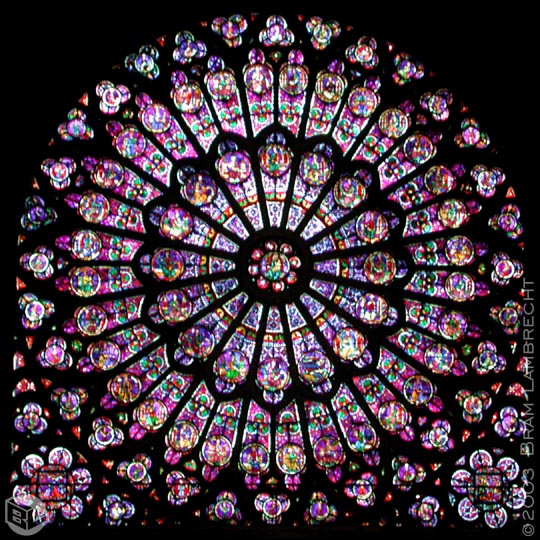
And t is the rose window of a Gothic cathedral: here, Notre Dame in Paris. Notice how like the Eastern mandala it is.


These are just three examples of symbols that draw us in the direction of the Self ... and of God. They do so by representing the ideas of wholeness, symmetry, balance, unity, healing, and beauty.


But, as Bianchi points out, there are numerous reasons why many lay Christians and theologians resent Jung's seeming identification of the Self archetype with God.

One of these reasons is the tension Bianchi identifies (pp. 29ff.) between the truly religious and the demonic. If Jung was right, and the numinous archetypes (including the Self) are responsible for our deep-and-mystical religious experiences, Bianchi asks,

How do we determine an authentic religious experience from those of magic, superstition or insanity? In this area of criteria for testing the value of a subjective happening, any test will be relative and partial. The descriptive signs of a religious experience may resemble those of insanity. Moreover, a temporary insanity, as an ego disturbance via encounter with the Self, may be both numinous and healing for an individual. (p. 29)


Jung used the word "numinous" when discussing the power which the various archetypes have to break into our rational, everyday consciousness and command attention. As with the everyday one-sidedness of the rational ego that I mentioned earlier, such assertions of archetypal potency are not necessarily "wrong" or "bad," to a Jungian. They can be "both numinous and healing." Or, they can bring us to madness and evil.

How do we tell the difference? Bianchi writes:

The classic Christian testing of the inner spirits revolved around the doctrine of agape. Does the experience in some way contribute to a fuller life of charity, that is, of self-giving love? (p. 29)


The very next thing Bianchi writes is something I have a problem with:

In the Jungian perspective, the traditional Christian of experience can be too one-sided, overly stressing self-giving in benevolence to others. The Jungian criterion would ask: does the experience contribute to wholeness in a person's overall life? Does it foster the reconciliation of opposites in the psyche? (p. 29)


I don't agree that these two criteria are, at the end of the day, different.


In my own personal experience, movement toward Jungian wholeness in my inner life has brought about greater agape, charity, and self-giving love in my orientation toward others.

(The Greek word agape, by the way, is pronounced OGG-uh-pay. It is a word long appropriated by Christians from the Greek language of the New Testament to represent what has also been rendered as the Latin caritas: the idea of a charitable love toward others that is in no way either lustful or self-serving.)

I have found that wholeness à la Jung — to the limited extent that I have attained it — is a remedy for the problem I spoke of in the posts in my Existential Guilt topic. I have long suffered from a "free-floating guilt" that has, frankly, impaired my life. I am not alone in this — though in my case, "existential guilt" has been more of a problem in life than it is for most people.

Bianchi describes the reason for it:

... as each person in the course of life moves away from infancy's union of undifferentiated consciousness (the participation mystique of womb life and early childhood), specific ego identity is fashioned. ... the self-conscious ego realizes the precariousness of existence in the face of death and other threats. Just as the ego incurs existential guilt in the necessary process of alienating itself from identity with its original maternal source, it also ignores or struggles against the promptings of the Self that call to wholeness. The all-absorbing quest [is rather] for survival, material comfort and self-valuation through outward acclaim ... .

Yet the depths of the Self will not be denied ... . (pp. 26-27)


Alienation, existential guilt, free-floating guilt ... these can result from the very process by which the ego tries to deal with the "precariousness of existence" on its own terms, while holding the Self at arm's length.


I have personally found that trying to be a "good Christian" has not been enough to deal with my existential guilt. On the other hand, seeking Jungian wholeness has, quite ironically, made me a better Christian. It has let me become a better exponent of caritas, agape, and Christian love.

This change has not been something I am just putting on for others' benefit. I have noticed, furthermore, that other people are treating me differently than before. They seem to be more interested in being around me. They seem to just assume that I am more empathetic to their needs and concerns than was ever the case before. They can talk to me less guardedly and more "humanly" than before.

There seem to be fewer times when they "get me wrong" and behave as if I am an entirely different sort of person than I think of myself as being.

Better yet, it seems as if my personality, or whatever you want to call it, now tends to bring out the best in the people I meet. People on the whole seem to be kinder and gentler when I encounter them than would seem to be generally the case, judging by the culture. Yet I don't get the sense that people are putting on a false front. It's just that we, all of us, seem to respond to other people according to some subliminal cue that they emit. If the cue says "this person is one I like and I needn't fear," then people act accordingly.

People who have attained some degree of Jungian wholeness are people that others instinctively respond to with the self-giving behavior patterns of a "good Christian." That's perhaps the key lesson I've learned.


That I think was what made Jesus special. Before his crucifixion and resurrection, after which it became apparent he was God in human form, he drew people to him as he traveled about not just because he was a miracle worker — he always was reluctant to do miracles. He was, I think, what Jung would call "fully individuated," "fully self-realized." People instinctively responded to him as such: he brought out the "better angels of their nature."

Not that I identify myself with Jesus: I admit I am far from fully self-realized.

One big reason I'm not "all the way there" is what Bianchi brings out immediately after he draws what I consider to be his problematic distinction between benevolent self-sacrifice in the traditional Christian mode and the reconciliation of opposites in the psyche, in the Jungian mode.

The latter process is long and arduous, Bianchi says, and fraught with danger and pain. It involves coming to terms with the Shadow, another key archetype which "represents that part of a personality whose traits we neither perceive nor wish to perceive" (p. 30). If the Self is the image of God within the psyche, the Shadow is the image of Lucifer or Mephistopheles. It is also the "portal to the unconscious" (p. 30), and we can't realize the Self without confronting the Shadow ... even at the seeming peril of our death. As Jesus was tempted thrice by the Devil, we have to encounter the Shadow en route to the Self.

Jung discovered that the secret to dealing with the Shadow is to find constructive ways to "channel the energy of our negativities" (p. 30). This can be done by taking advantage of "the transformative polarity of opposites in the psyche" (p. 31). That is, we need to balance the positive and negative — good and evil — aspects of the unconscious psyche off against one another. The result, mysteriously, is not zero, but personal transformation.


After discussing the Shadow, Bianchi returns to his theme of the tension between the Christian call for benevolent, virtuous self-sacrifice and the Jungian call to acknowledge the Shadow en route to the Self. He calls the Jungian outlook "Socratic" or "Greek," while the Christian outlook is "Hebraic."

In the former view, the process of individuation and Self-realization, by reducing our conscious ego's need to perpetuate its own existence, can defang death itself and make us calm and steadfast in death's very face. In the latter view, we cannot defeat our inner proclivity to evil on our own, and death is a very real tragedy and threat to us, unless we accept Jesus Christ as our personal savior.

I think the two views can be reconciled by noting that the traditional Christian view makes perfect Jungian sense for people who are not yet ready for the call that can be expected "in mature life," and that will be proclaimed in symbolic form by the numinous forces of the psyche's unconscious, "to experience the depths" (p. 31).

This needs to be done "with a fully formed ego identity," Bianchi writes (p. 31); otherwise, it is too dangerous.

The "fully formed ego identity" is something we develop during the first half of life: prior to, say, age 40. But in Jesus's day, and in the classical/medieval European culture in which Christianity first flourished, how many people lived into what we would today consider the "second half of life"?

Accordingly, how many of the people Jesus addressed, either directly or later on through the Gospel stories and the New Testament, were ready to go beyond "a fully formed ego identity" on their own (or with a Jungian therapist by their side)?

We can reconcile the traditional Christian outlook with the Jungian if we recognize the validity of the former for all people who have not (yet) felt the call to go beyond "a fully formed ego identity." The validity of the latter is for those who need to get beyond establishing the ego's identity as the prime exigency of the first half of life ... some of whom are still young, perhaps, but most of whom will be in middle age or beyond.

In so doing, Self-realizers will still need to keep in mind the Christian call to agape and caritas. The litmus test: do others instinctively respond to you with the self-giving, other-honoring behavior patterns of a "good Christian"? If so, you're probably on the path of angels and not of demons.

Tuesday, September 09, 2008

Jung vs. a Righteous One-Sidedness?

An area of tension between Christian theology and Jungian psychology — it is the second of the five topics that Eugene C. Bianchi addresses in "Jungian Psychology and Religious Experience," an article in Carl Jung and Christian Spirituality: A Reader, edited by Robert L. Moore — is that which Bianchi labels "receptive-initiatory." (See The God of Synchronicity for my initial comments on this article and book.)

Bianchi means by this label that traditional theologians accuse Jungians of claiming that the individual who attends to the urgings of the "archetypes" in his "collective unconscious," and who thinks God is thereby calling him from within his soul, is not really hearing God. God is not, in this anti-Jungian view, an archetype such that our encounter with God is initiated from within our psyche. A Jungian-style faith is a false one, not a response to an objectively real God's freely made external offer of salvation, to which we are merely receptive.

Jungians hold, on the other hand, that there is something called the Self, and it is very real. It is (a) an archetype of the collective unconscious and (b) the image of God within every human soul. It calls each of us to psychological wholeness and completion.

The Self, which like all archetypes is not something we are consciously aware of, represents itself to us in code, as it were, through our affinity for certain symbols. The rose window of the Cathedral of Notre Dame in Paris (right) is just such a symbol. Its fullness, roundness, unity, balance, and symmetry betoken wholeness and completion.

Another symbol that betokens wholeness and completion is the cross of Christ (left). It conveys the same balance and symmetry as the rose window — which is actually a kind of mandala — and the fact that it has exactly four peripheral compass points incorporates the symbolism always associated in the psyche with the number four. The number four is, Jung said, intrinsically a symbol of completion and wholeness.

To a Jungian, psychological wholeness/completion is the prime desideratum of a human life. It is achieved when the Self archetype is "realized" by means of a long process which Jung called "individuation." Individuation makes each of us into the particular and unique individual he/she is destined to be. In so doing, it makes each person less wedded to group or societal norms than he/she once may have been.

Self-realization comes by means of balancing the various forces within the psyche off against one another, just as the individual "rays" of Notre Dame's rose window balance each other off. This balancing act is easier said than done: typically, some of the sources of energy in the psyche are considered dangerous, antisocial, or downright evil. Those centers of energy which threaten our "nice," conscious self-image are pushed into the unconscious, where they only seem to be gotten out of the way and thereby rendered harmless.


Self-realization involves recognizing that the supposedly "evil" forces of the psyche are only evil when they are not properly in balance with the "good" forces.

There's no getting around it: this is a point of view that relativizes evil. Evil, sinfulness, transgressiveness — whatever you want to call it — is not absolute after all. If an inner urge or drive that would initially seem to be absolutely evil is brought into balance with the rest of the forces of the psyche, it is no longer (as we Catholics say) an occasion of sin.

A simple analogy would be to coffee: to many people, the taste of coffee is foul and bitter unless it is balanced off by adding cream and sugar. Likewise, a Jungian would say that certain aspects of the psyche are foul and sinful ... but only unless and until they are balanced off against other aspects of the psyche.

When the psyche is not in balance, Jung said it is "one-sided." One-sidedness is, to a Jungian, something to be overcome. Self-realization through individuation is what overcomes it.

The Self archetype is what calls us from within to perform such a balancing act. In fact, Jung called the Self the imago Dei, the image of God, within us.


But there is another point of view about what God calls us to do. This one would seem to say to us that there is in fact a righteous and holy one-sidedness which God wants us — with his help and guidance — to achieve.

We are to do, and be, naught but good. We are to spurn sin and evil. Those temptations, drives, and urges which we experience within us that would have us commit acts that are prohibited by God's law (or fail to do things we are called by God to do) simply have to be resisted.

This point of view is the one which Bianchi treats as "initiatory." An objectively real deity, namely God, initiates a relationship with us from outside our world. We then feel as if we are receiving God's word and law from a transcendent, not immanent, Being who simply tells us how (and how not) to live godly lives.


By treating God as someone to whom we are "receptive" because he comes to us through an inner archetype called the Self, Jungians supposedly risk making right and wrong into a subjective thing. How do we know that the urgings we may become aware of, stirring within our soul, are indeed coming from God, traditional Christians ask?

One way to bring the two perspectives closer together is to point out that in Jung's theory, human consciousness passes through several stages. I discussed this more fully in Quest for the Self, Part 2. Self-realization through individuation is associated with one of the "later" stages, Stage 5.

In this stage, we become skilled in interpreting the meaning of the symbols that our unconscious mind throws into the light of consciousness by way of our dreams, our fantasies, our inner preoccupations, and our myths. Seeing religious revelation à la the Bible as a work of symbols and myth changes our perspective. It opens up possibilities for interpretation which allow us to accept some of the hitherto unconscious forces of our own psyche into conscious awareness, so to achieve a more complete balance of psychic forces.

Compare that with Stage 3 consciousness. In that stage, we "project" our inner ideals out upon abstract entities such as God. That stage is all about fidelity and allegiance to God (or whatever abstract entity we are projecting our ideals onto).

Naturally, in order for this strategy of projection to work, we see the one that receives our projections as absolutely, objectively real. We resent any outlook that suggests God is anything but that.

So Bianchi's "receptive-initiatory" conflict could be seen as a Stage 5-Stage 3 contrast. People who are in Stage 5 are receptive to the Self as the ambassador of God within the soul. People who are in Stage 3 need to see God as coming into their lives from outside the subjective psyche.


All this is complicated by the fact that these stages are not strictly sequential. We can cycle "backwards" from a "later" stage to an "earlier" one.

In my own life, I seem to have entered Stage 4 consciousness, which is characterized by a seeming "end" to the erstwhile proclivity to project our inner images out onto persons and things, whether they be concrete and specific (Stage 2) or abstract and general (Stage 3). In Stage 4, we are atheists and agnostics. There simply are no external gods, no God, worthy of our projected ideals.

Stealthily, we are actually projecting our innermost ideals onto our own ego, the center of our conscious awareness, Jung said ... but never mind. We don't see that unless or until we arrive at Stage 5.

At any rate, I seem to have arrived at Stage 4 before coming to Stage 3. Then I had to double back and become a midlife convert to Christian belief. Yet, even as that was happening, I began to feel stirrings of what I would much later come to identify as Stage 5 consciousness. This stuff can get complex!

Monday, September 08, 2008

Close Encounters with Synchronicity

I've been blogging about the human psyche as mapped by the late Swiss theorist Carl Gustav Jung. His theory has it that "archetypes" common to every last one of us are responsible for putting certain patterns into our heads, so to speak. For example, we all have an inbuilt image of what a mother is, thanks to the Mother archetype.

Toward the end of his long and fruitful life, Jung began to realize that the archetypes are not just psyche-internal. They exist outside the individual person, as well as being active within the soul.

Jung developed a notion of the real existence of independent, potent, numinous archetypes. This came as an outgrowth of his work on "synchronicity," an often-encountered phenomenon in which internal images found in our dreams and fantasies match patterns occurring approximately simultaneously in objectively real events. The pattern-matching between inner and outer realities happens with no apparent cause, but it is not by chance either, Jung said. Instead, it reflects an "acausal orderedness" in the world that conveys meaning to us, where external events and their timing might by themselves appear to be meaningless.

All that is quite a mouthful, and a headful to boot. I'd like to give an example of synchronicity that may make it easier to understand. The example comes from the movie Close Encounters of the Third Kind.


In this 1979 classic of the science fiction genre by celebrated filmmaker Steven Spielberg, the main character is Roy Neary, played by Richard Dreyfuss. Neary is a lineman for the electric company who, while out in the field dealing with a puzzling electrical outage, has his pickup truck buzzed by an alien spaceship. He winds up with an inexplicable sunburn and an irresistible urge to sculpt his mashed potatoes into replicas of a place he's never seen: Devil's Mountain, Wyoming, also known as Devil's Tower.

Neary is so obsessed with trying to somehow externalize the Devil's Tower image that has been seared into his unconscious, in fact, that his constant preoccupation with doing so loses him his job, his wife, and his family.

Finally, he happens to see a picture on TV of the natural landmark in Wyoming and twigs to the fact that it matches his mashed-potato sculptures precisely. The TV coverage has it that the U.S. Army has been forced to clear the area around Devil's Tower of all human occupants, owing supposedly to an unexplained outbreak of anthrax that is killing livestock and wildlife. Neary, however, knows deep, deep down that the simultaneous occurrence of his mashed-potato obsession and the anthrax news story means something. He considers it absolutely necessary that he go to the very place that people are being evacuated from.

Along the way, he meets up with Gillian Guiler, a woman whom he knows only casually as someone who was likewise exposed to an alien spacecraft. Her small son has in fact been abducted by the aliens. She, like him, has been unable to stop thinking of and drawing shapes resembling Devil's Tower, and she has felt the same compulsion to travel to it that Neary has himself.

Neary and Guiler have to fight their way past the authorities in the region, but they make it to a spot overlooking an area that scientists have been secretly readying for a return visit by the aliens. The scientists have managed to decode messages from the aliens couched in the form of music and other containers of information. The messages have promised the scientists that the aliens will come in their spaceships to Devil's Tower on a certain night. On that night, Neary and Guiler are there towatch from their hiding place as the aliens make good on their promise.

This is not a hostile encounter, as some might expect. Instead, the massive "mother ship" of the alien race engages in a sort of otherworldly jam session with the music the earthlings play for it. This is music that has been taught to us by the aliens during previous encounters. We play the simple theme we were taught, and the aliens play back for us a bevy of ever more complex variations on that theme. Thus is the idea signaled to all those assembled that the aliens have come to us in harmony and peace.

Then comes the pièce de resistance: the alien mother ship opens its vast "mouth" and out march not only representatives of the alien race themselves but also former abductees who are being returned unharmed ... including Gillian Guiler's son. Next, pre-selected volunteers from earth march up the ramp to become the new generation of abductees, as it were. Among them is Roy Neary, who scampers down from his hiding place nest to Gillian and, even though he has not officially been pre-selected, is understood by the scientists to have been chosen for inclusion by the aliens themselves.


In order to see this narrative as betokening synchronicity in action, we have first to stipulate that the aliens in Close Encounters are stand-ins for archetypes of the collective unconscious. Indeed, it is generally understood by Jungians that our ideas about alien encounters pattern with our ideas about encounters with angels and gods ... or, if the aliens are hostile, as in H.G. Wells' War of the Worlds, with devils and demons. To a Jungian, angels and demons are symbolic of the influences of certain crucial archetypes.

For example, there is a Messenger archetype, an ally of the most important Jungian archetype of all, the Self. In classical myth, the god Mercury was a messenger. In Christian belief, angels serve as messengers from God. In Jung's theory, the Self archetype represents the very image of God in the soul, so messenger angels are of great importance as symbols of personal transformation.

Extending that notion to Close Encounters, the visitors from another world are likewise symbols of the transformation of Roy Neary as "everyman." Neary clearly grows as a person as a result of his experiences during the film. This growth could not have come to pass without the synchronicity between the particular image that keeps inexplicably popping into his head and the distinctive shape of Devil's Tower in the real world. That synchronicity gives meaning and content to his obsession with a certain "meaningless" form, and that meaningful content winds up transporting him to a higher plane of consciousness, symbolized by his being carried away in a spaceship by friendly aliens.

Sunday, September 07, 2008

The God of Synchronicity

Carl Jung and Christian Spirituality: A Reader, edited by Robert L. Moore, contains an article that is required reading for anyone such as I who would like to bring Christian thought into harmony with Jungian psychological theory. Eugene C. Bianchi's essay "Jungian Psychology and Religious Experience" discusses five major points of conflict between traditional theology and Jungian imperatives. The first is the tension between the traditionalist view that the truths of Christ and his church are manifestly objective and historical, whereas Jungians emphasize the personal inwardness and subjectivity of all religious experience.

Bianchi admits he is biased in the Jungian direction, yet disturbed by the "discontinuities and inadequacies" of Jung's ideas about religion (p. 17). For example, he understandably feels Jungians' emphasis on pure spiritual inwardness "can lead to a diminishing of community responsibility ... [and] submerge social consciousness and civic responsibility" (p. 22).

Jung, for his part, held that universal archetypes common to all human beings produce images in the unconscious mind that show up always and everywhere in dream and myth. These images present themselves consciously as symbols. The conscious mind sees, not the archetypes themselves, but the symbols that the archetypes lie behind.

Furthermore, Jung found that there was often an uncanny coincidence between symbols appearing in our dreams and "real-world" events that transpire at roughly the same time. He called these coincidences "synchronicity."


The cross of Christ is such an archetypally derived symbol. Because of its balanced shape, it is typical of all symbols of symmetry and wholeness. The rose window of Notre Dame Cathedral, depicted on the book's cover, is likewise a symbol of the archetype for wholeness.

Jung identified the archetype behind such wholeness symbols/images as the Self. The Self, if realized, is capable of bringing the psyche or soul into balance by harmonizing its internal tensions and bridging between its inherent pairs of opposites such as male-female or light-dark. It is the most important and potent of the archetypes ... and the most mysterious.

In earlier installments of my Quest for the Self series, I tried to show what the Jungian Self is all about. In the final two of those posts, I discussed the key related concept of "synchronicity." I believe this concept is capable of resolving Bianchi's doubts about joining Christian thought to Jungian.


Jung's idea of synchronicity covers many bases, to use a baseball metaphor. Jung's "first base of synchronicity," as it were, is the notion that there are uncanny coincidences between events that happen in the "real world" and events that happen in the psyche.

The events that happen in the "real world" are objective events that occur in time and space and are caused in the usual way. The events that happen in the psyche, often in visions and dreams, are archetypally produced images. The external events and the archetypal images, in confirming one another, give rise to a sense of deep meaning.

Such a synchronistic, confirming event occurred to my father at the time that his brother Ralph was released by death from his long, painful struggle against inoperable, incurable cancer. At the time that it happened, my father was away from home on the island of Guam, while Ralph was in Maryland with his family. My mother and I were living near Ralph Stewart and his family.

When Ralph finally succumbed to his terrible disease and was pronounced dead in the hospital by his doctor, it was night on Guam, and my father wakened from a dream — he later reported it to my mother — with the feeling of a great weight having been lifted from him. She and he calculated that his awakening from dream had taken place at very possibly the exact moment Ralph died. Thus the uncanny synchronicity of two events, one objective and "real," the other personal and psychic.

I never learned from Dad what the actual content of his dream had been, but in later years he often spoke of his fascination with widespread reports of near-death experiences, in which people who have almost died have come back to life saying they have "seen" a bright light at the end of a tunnel and even the figures of loved ones waiting to welcome them "to the other side." The contents of such near-death dreams and imaginings are so persistent and ubiquitous that they simply must be produced by archetypes, any follower of Jung would say. I wonder if Dad's synchronistic dream was not such an archetypally-driven near-death experience that he had on Ralph's behalf.


Extending the baseball metaphor to include Jung's "home plate of synchronicity," as I'll call it, involves making the assertion that the archetypes that "speak to us" so uncannily, in the guise of inexplicable coincidences between inner images and outer events, are objectively real in and of themselves. Furthermore, Jung said, they are "transgressive" — not in the sense of being sinful, but in the sense of traducing the ordinary boundaries of time, space, and causality.

Jung originally placed the archetypes in the individual's "collective unconscious," a part of the hidden psyche common to us all. Later, he came to realize that there was a distinction to be drawn between the archetypal images/ideas that well up in the deep unconscious of every individual human being, and the archetypes proper which produce them. The archetypes, he came to believe, must actually reside in a "psychoid" — i.e., psyche-like — region of the individual, a place outside the psyche per se which is part-mind, part-body.

Then, in expanding upon his "first base of synchronicity" idea, as I am calling it — the idea that external events and internal images uncannily co-occur — he said that archetypes actually exist on their own in a manner that is independent of the individual psyche. They pre-exist the psyche of any particular person, and they persist when each one of us dies.

Synchronicity writ large — my "home plate of synchronicity" — is Jung's idea that powerful, numinous, uncanny patterns show up in the world and its events, and are matched by similar events in the mind, because the archetypal potencies behind the events are godlike and very, very real.


Jung called these archetypal potencies "transgressive," a choice of terms that is not calculated to endear the idea to Christians for whom "transgression" and "sin" are synonyms. If he had called synchronicity's uncanny effects "miraculous" instead, ordinary believers might have welcomed Jung's ideas with open arms.

For what Jung had in mind by synchronicity was a way of explaining the "acausal orderedness" in the world.

That the world exhibits more order than it has any right to expect to have is a point of agreement between Christians and Jungians ... and, increasingly, among secular scientists who champion, say, Darwin's theory of evolution.

The secular point of view has it that the world is "causally closed," meaning that there is simply no way for a deity to reach into the intact causal chains by which events normally proceed and alter their outcomes.

If synchronicity were causal — bound by ordinary chains of cause and effect — it would violate that assumption. But Jung very carefully stated that synchronicity was at the opposite end of a conceptual axis from causality. Causality and synchronicity together explain events, Jung held, including the uncanny relationships between objective, factual, "real" events and internal, personal, psychic events.


In his article, Eugene Bianchi has trouble with what he perceives as a tendency among Jungians to overemphasize "symbolic causation," which "appears to proceed almost exclusively from the inward to the outward" (p.21), and underemphasize "external causality" (p. 22). Presumably, "external causality" is what the miracles, teachings, and life-death-resurrection of Jesus affirm to ordinary believers. That is, all that is told of in the Gospels actually happened and is objectively real ... even the miracles.

On the other hand, a Jungian perspective seems to Bianchi to suggest that such events as the Resurrection might have been dreamlike illusions, mere images welling up in the psyche of the Apostles due to the influence of internal archetypes.

But that is not what anyone who fully accepts Jung's ideas about synchronicity would hold, any more than they would hold that only in my father's dream did his brother Ralph die and "go to heaven." Ralph died objectively and really ... and may or may not now be in heaven, who can say? My father's dream did not cause his death. Nor did his death cause my father's dream. Rather, the two in their coincidence were an example of acausal order appearing in the world we know.

Likewise, for us believers to note that Jesus' Resurrection was an example of an archetypal image and a real-world event "falling together" need not imply that one of the pair was logically (or temporally) prior to, or any more "real" than, the other. Jung carefully insisted that in any such case of "falling together," the provision by an archetype of an internal image or symbol and the arranging by the same archetype of an external event whose meaning is given by the symbol are equally real.


Admittedly, this is an odd way for us to look at things. As creatures of modernity, we are so wedded to explaining things "rationally" by relying exclusively on ordinary notions of causality that there doesn't seem to be much room for synchronistically-based explanations.

This is in part why we, when we wear our hats as scientists, ascribe certain so-called "random" events to chance. The result of a flip of a coin is supposedly a chance event — either that, or we tend to go to elaborate lengths to qualify such a statement by saying that if we could only know all the factors leading up to the instant of the coin flip with sufficient precision, we would find the outcome to be as causally deterministic and predictable as the orbit of Jupiter.

Similarly, we say that the occurrence of genetic mutations in producing new types of organisms and accounting for biological evolution is chance or random, and has no cause.

In other words, all events have causes that arise naturally in a causally closed cosmos, or they have no cause at all, and are purely random.

Jung in effect said that causality (or its absence) isn't the whole story. Synchronicity plays a real, acausal, non-random role in explaining worldly events. And synchronicity is produced by archetypes that are as real as real can be. The archetypes, most notably the Self, are patterns that give meaning to what goes on in the world. They do so by influencing objective events and subjective ideas, in tandem with one another.

If Eugene Bianchi would have given full credit to Jung's ideas of the synchronistic workings of the Self, he might have seen that the Christian God of redeeming miracle and the Jungian God of uncanny synchronicity were one and the same God.

Monday, September 01, 2008

Quest for the Self, Part 6

Synchronicity is the topic of the final chapter of Murray Stein's book Jung's Map of the Soul: An Introduction, my ongoing concern in the current series of posts.

The book as a whole is about the theory of the human psyche advanced by the late Swiss psychologist Carl Gustav Jung. The crowning feature of this theory is the notion of synchronicity.

Narrowly defined, synchronicity is Jung's term for coincidences between objective events in the external world, on the one hand, and images and ideas that carry force in the psyche, on the other. Whensoever the conjunction of two events, one external and the other internal, has meaning to us, synchronicity is at work.


For example, as I said in my last post, when I read in Stein's book that the physicist Wolfgang Pauli once wrote an essay about synchronistic tinges in the development of the thought of 17th-century astronomer Johannes Kepler, I found it strangely meaningful that, the very evening before, completely independently, I had happened to watch an episode of Carl Sagan's TV series Cosmos in which the life of Kepler was dramatized.

"Strangely" meaningful? Yes, because there was clearly no causal relationship going on here. I watched the Cosmos episode not because I had anticipated Kepler showing up in the next few pages of Stein's book. Nor did I read further in Stein the next day because I expected some echo of Sagan's Kepler discussion. The two events were independent and coincidental ... and strangely meaningful.


I think a good way to talk about synchronicity, then, is to say that it is all about (at least in its narrow definition) "confirming coincidences."

In my example concerning the two references to Kepler cropping up in my life at roughly the same time, albeit by pure coincidence, the confirmation actually preceded the thing being confirmed by a matter of a few hours. Specifically, the thing being confirmed was the significance of the subject of synchronicity itself.

My second "encounter" with Kepler, in the order in which these encounters occurred in time, came as I was reading further in Stein's chapter on synchronicity. Now I have to admit that, of all the aspects of Jung's theory, synchronicity is the one at which I felt most skeptical of, as I was making my way through Stein's book. I sort of wanted to believe in it, but I wasn't (and still am not) fully on board with it.

I had read the first few pages of Stein's chapter on synchronicity, then put the book down with a feeling of ambivalence about what I had just read. Later that day, I cued up my video of Carl Sagan's Cosmos episode extolling Kepler's contributions to the European revolution in science, which began in the early 17th century. This episode was next in the original order of the episodes, and I had been faithfully re-watching the episodes in that order. I did not have in mind that this was the episode concerning Kepler's vaunted willingness to give up his preconceived notions and to do science in the modern, empirical way.

Then, the next day, I picked up Stein's book again and continued reading about synchronicity ... and found the development of Kepler's thought cited by physicist Wolfgang Pauli as a case study in synchronicity itself!

This was something I could not help but interpret as a "confirming coincidence."


At least by Jung's narrow definition of synchronicity, in order for a coincidence to be confirming, therefore synchronistic, what is being confirmed needs to be attached to an image or idea that an archetype has injected into the psyche.

In my example, the image or idea was that of the Seeker of Truth. Kepler, Sagan, Jung, and Stein are all truth-seekers.

More broadly, the image or idea was that of Jungian wholeness: the potentiality that the unconscious parts of the psyche can be integrated into consciousness, bringing about a sense of completion.

Psychic wholeness, in turn, is an image or idea that is generated by the most important archetype of all: the Self. In this instance, the Self in its wholeness was being imaged as the Seeker of Truth; the Self can take on any number of personified or abstract images in the psyche.

The Self, like all archetypes, lies outside the psyche proper, in what Jung called the "psychoid region," where physical being and psyche meet.

Jung theorized that the Self — again, like all the archetypes — has potency over not just psychic events but physical events as well. The objective events that take place in the world external to the psyche can sometimes be explained not by ordinary causality alone, but with recourse to synchronicity as well. Jung posited that there is a continuum between those events whose entire explanation is causal and those events whose explanation is wholly synchronistic. The latter, were it not for their synchronistic aspects, might otherwise be thought of as entirely random or chance events.

Because of the hidden synchronistic aspects of some or all "chance" events in the world, Jung came to believe that the Self transcends each of our individual identities. The Individual Self is actually a Universal Self which pre-exists us and continues to exist after we die.


Jung had realized that such acausal, confirming coincidences contain meaning for us, even if causal chains that produce such events generally lack intrinsic meaning. E.g., the event of my happening to watch a Cosmos episode featuring Johannes Kepler had, by itself, its particular chain of causes. So did the event of my happening to see Kepler mentioned in Stein's book. Ostensibly, though, there was no meaningful relationship between the two causal chains.

Likewise, the events of Darwinian evolution are lawfully caused — when they are not random, that is — but they are thought by Darwinists to be inherently meaningless. Nothing guides them, nothing orders them, nothing imparts meaning to them.

But Jung enlarged his definition of synchronicity to make of it the root source of all "acausal orderedness" in the world. Where there is synchronicity, there is order. Where there is order, there is meaning. Whether we are aware of the world's orderedness or not (p. 220), it is ordered ... synchronistically. Because it is ordered, it has meaning.

That is, synchronicity creates meaning beyond what we can be aware of, and this is the source of all meaning in the world.

Here, then, is Jung's broad definition of synchronicity: as a product of the Universal Self, synchronicity is the source of acausal orderedness and meaning in the world.


The importance of synchronicity to us individually is that the

... unforgettable mysteries that are embodied in synchronistic events transform people. Lives are turned in new directions, and contemplation of what lies behind synchronistic events leads consciousness to profound, perhaps even to ultimate levels of reality. When an archetypal field is constellated and the pattern emerges synchronistically within the psyche and the objective non-psychic world, one has the experience of being in Tao. And what becomes available to consciousness through such experiences is foundational, a vision into as much of ultimate reality as humans are capable of realizing. Falling into the archetypal world of synchronistic events feels like living in the will of God. (p. 219)


The importance of synchronicity to us communally is, Jung imagined, that

... the meaning of life on this planet [is] tied to our capacity for consciousness, to add to the world a mirroring awareness of things and meanings that otherwise would run on through endless eons of time without being seen, thought, or recognized. For Jung, the raising into consciousness of patterns and images from the depths of the collective psychoid unconscious gives humankind its purpose in the universe, for we alone (as far as we know) are able to realize these patterns and give expression to what we realize. Put another way, God needs us in order to be held in awareness. (pp. 214-215).


Humans, the product of evolution, "are in a position to become aware that the cosmos has an ordering principle" (p. 215) One name for this ordering principle is God.

Sunday, August 31, 2008

Quest for the Self, Part 5

The final chapter of Murray Stein's book Jung's Map of the Soul: An Introduction, the ongoing concern of my Quest for the Self series of posts, is about synchronicity. This topic is the single most controversial one in the theory of the human psyche proposed by the late Swiss psychologist Carl Gustav Jung.

Jung, over a very long and productive lifetime as a psychologist and psychological theorist, came to believe many hard-to-believe things about how the psyche is constituted. For example, he found there to be, in addition to the personal unconscious mind that each of us instantiates individually, a collective unconscious that is the same from one person to the next.

In this deep, universal realm of the unconscious psyche he found a set of potent personifications: divine infant, hero, king, queen, mother, father, etc. — along with powerful images that are not personifications, such as the mandala and the cross familiar in the East and the West, respectively, as religious symbols.

These images make their presence known in our dreams and myths, our stories and our art, in every time and place and culture. Where do they come from?

Basically, Jung said, they come from the Self.

The Self is the master of all the archetypes. Many images come directly from it, including hero, king, queen, cross, and mandala images. Any archetypal image whose basic meaning is "wholeness" or "growth toward wholeness" comes from the Self. Thus, when we dream of a tree, it is the Self that hides behind it.


The human task during the first half of our normal lifespan of 80 years or so is to manifest the ego, the center of our conscious mind. During the second half, this changes. We are then on a quest to realize the Self.

But what is the Self?

An archetype, yes. As an archetype, it is a source of numinous power. It is by means of this power that the Self and the other archetypes provide the unconscious psyche with their archetypal images, which then gather strength and invade the conscious psyche in the form of symbols.

Provide? Invade? Yes. For the archetypes, including the Self, lie outside the psyche proper, in a "psychoid" region that builds bridges between the mind and the body.

In fact, the Self — and here is where controversy arises — exists independently of the psyche of the individual person. It exists independently of the body of the individual. It pre-exists each of us, and it goes on existing after we die.

Within each one of us, the Self represents the image of God, the imago Dei. As a Being that transcends our own limited being, the Self is like unto God himself.


The transcendent Self, furthermore, is the basis for synchronicity.

Jung defined synchronicity as coincidence with meaning. Life is filled with uncanny coincidences between external, objective events and internal, subjective events. Here is one such coincidence. Jung wrote of synchronicity in an essay called "Synchronicity: An Acausal Connecting Principle." It appeared in a book co-authored with physicist Wolfgang Pauli, whose contribution was an essay called "The Influence of Archetypal Ideas on the Expression of Scientific Theories of Kepler."

Whence the synchronicity? Today I perused Stein's chapter discussing these two essays; last night, by pure coincidence, I watched an episode of Carl Sagan's Cosmos series in which Sagan dramatized Johannes Kepler's life, spent in quest of an understanding of the planets' motion around the sun.

As of last night, I had no idea that Kepler's struggles were of Jungian import ... though I recognized that Kepler's original ideas, discarded only after a long, failed attempt to harmonize them with actual observations of planetary movements, were projections of Jungian archetypes onto the natural world.

Kepler spent his life trying to show how the world in its adherence to natural laws exemplifies ideas in the mind of God.

My watching a TV show about Kepler and the very next day reading of the importance of Kepler in Jungian discussions of synchronicity is itself an example of synchronicity: "the simultaneous occurrence of a certain psychic state with one or more external events which appear as meaningful parallels to the momentary subjective state" (p. 211).

Put more simply, synchronicity is a "falling together in time" of two events in such a way as to produce a subjective sense that the falling together is meaningful in some way. Synchronicity is coincidence with meaning.


In my example, the falling together of two "Kepler events" means subjectively to me that I'd better put aside my ordinary skepticism and take synchronicity seriously, as a sign of the Self.

Stein puts it all this way:

Synchronicity is defined as a meaningful coincidence between psychic and physical events. A dream of a plane falling out of the sky is mirrored the next morning in a radio report. No known causal connection exists between the dream and the plane crash. Jung posits that such coincidences rest on organizers that generate psychic images on one side and physical events on the other. The two occur at approximately the same time, and the link between them is not causal. Anticipating his critics, Jung writes: "Skepticism should ... be leveled only at incorrect theories and not at facts which exist in their own right ... " (p. 210)


Synchronicity is acausal. The internal image, a fact in its own right, does not cause the external event. Nor does the external event cause the associated appearance of the internal image.

In my example, the external event is the coincidence of two apparently unrelated "Kepler events." The internal image is, I'd say, another way in which the Self presents itself to the psyche: as a world which, in Jung-speak, is more of an unus mundus than we normally give it credit for. Things that go on in such a close-coupled world have meaningful, if surprising, connections. They have hidden "organizers" that generate coincidences that are uncaused but meaningful.

The Self is chief among these hidden organizers. From a Jungian perspective, the Self is God.

Saturday, August 30, 2008

Quest for the Self, Part 4

Murray Stein's book Jung's Map of the Soul: An Introduction, my ongoing focus of late, was last taken up in Quest for the Self, Part 3. The Self is perhaps the most mysterious component of the human psyche as mapped by the late Swiss psychologist Carl Gustav Jung.

The Self can be thought of as the most important of the "archetypes" of the collective unconscious shared by every member of species Homo sapiens. Each of the several archetypes we all possess within ourselves represents "an innate potential pattern of imagination, thought, or behavior" (p. 233), and, while this pattern itself remains outside our ordinary waking consciousness, it is capable of representing itself as images of various sorts that become symbols in dreams, myths, fairy tales, art, and religious icons.

One of the symbols the Self can employ in its ongoing mission to shape and reshape our lives is the mandala, such as the one pictured at right. Another is the Celtic Christian cross shown at left, or any other Christian cross. The Self uses such abstract symbols to transform our consciousness because they have a form that represents wholeness, symmetry, and balance.

When we start talking about the Self "using" images and symbols to provoke in us a greater consciousness and wholeness, things are admittedly getting really weird from the everyday rational perspective. In this post, I'd like to sort through some of these "weird" ideas.

Let me begin with this quote from Stein (p. 197):

... we can think of the self [note that Stein does not capitalize this and other Jungian terms, as I do] as a cosmic entity that emerges in human life and renews itself endlessly ... .


The Self is, Jung believed, an imago Dei, an image of God. The images that it introduces into the human psyche are images of this image of God.

One of these images generated by the Self from outside the psyche, but showing up in the psyche per se, is the idea of the Hero. Archetypal images can be personifications, as with the ideal of the Hero, or they can simply be transformative, as with abstract cross/mandala images, which if meditated on and otherwise taken seriously, can bring us to higher stages of consciousness and personal development.


The thrust of the Self as the prime archetype in the collective unconscious is, in fact, to bring itself fully into the light of consciousness. We start out life with very little consciousness indeed: what consciousness there is represents a sort of "participation mystique" in which we as newborn infants are unable to distinguish between our own selves and everyone and everything surrounding is in our immediate environment.

As we learn to make such careful distinctions, what Jung called the "ego" becomes the center of the conscious psyche. At this and subsequent stages of conscious development, it is necessary for the ego to banish huge portions of the original contents of the psyche into the unconscious depths. We lose touch with many of the things that are contained inside the mind, including the images and ideals of which the Self and the other archetypes — which, Jung showed, are actually working from a region outside and beyond the psyche proper — form the basis. Yet these images and ideals still make themselves felt, popping up in our dreams and fantasies, where they often become the raw material for myths.

The Hero ideal, a manifestation of the Self archetype, typically shows up for the first time while we are children. It personifies what our inbuilt expectations of the hero are. Mythic heroes and those of film, TV, and popular fiction — think Superman — typically adhere to these expectations. Each of us goes through several stages of life in which we are particularly susceptible to Hero images.


There are many stages of conscious development and associated archetypal images that reflect the guidance of the Self. Stein lists some of these (p. 194): "the divine infant, the hero, the puer and puella, the king and queen, the crone and the wise old man [are all] expressions of this single archetype." (No, I don't know what the "puer" and "puella" represent, but I do know these are the Latin words for "boy" and "girl," respectively.)

As we go through these various stages and respond to these images and the ideas associated with them, Jung said we cycle repeatedly through four basic levels of conscious development. I won't try to describe these levels and cycles in detail here, but I mentioned the levels briefly in Quest for the Self, Part 3. The four levels are defined by the five circles of available psychic wholeness: Anthropos, humankind's spiritual ideal, the highest circle of attainable wholeness; Homo, our everyday ideal of humanistic perfection; Serpens, the serpent, symbolically the root of all animal wisdom; Lapis, representing the integrity associated with plant life and mineral formations; and Rotundum, the position in the hierarchy of wholeness which roots the entire hierarchy in the abstract place where physical matter emerges from pure energy.

Rotundum and Anthropos, surprisingly, coincide. Thus, any ascent or descent through these (actually) five levels, as we grow in wholeness during the course of a lifetime, turns out to be a repeated circular movement through four stages. This fact of circular movement that has to be repeated over and over again adds immeasurably, of course, to the great mystery of the realization of the Self.


Again, the main point to keep in mind is that by "realizing the Self" Jung means bringing it, the Self, to conscious awareness. The ego, therefore, has to accommodate itself to the entry of the (capital-S) Self into the realm of consciousness. This is something the ego is not about to permit without a struggle. Jung characterizes the process of "individuation" by which the Self is gradually realized as, per Stein, "not fundamentally a quiet process of incubation and growth [but] a vigorous conflict between opposites" (p. 189).

The "opposites" which together form the psyche are the conscious mind, centered on the ego, and the unconscious mind, wherein the archetypal images form. These two realms are engaged in, says Jung himself, "open conflict and open collaboration at once." Jung's great desideratum is that consciousness and unconsciousness be allowed to engage in, in Jung's own words,

... a fair fight with equal rights on both sides. Both are aspects of life. Consciousness should defend its reason and protect itself, and the chaotic life of the unconscious should be given its chance of having its way too — as much of it as we can stand. ... It is the old game of hammer and anvil: between them the patient iron is forged into an indestructible whole, an "individual." (Stein, ibid.)


This is why Self-realization through the process Jung called individuation has to proceed according to anything but a straight line. There are cycles within cycles, wheels within wheels. The Self feeds archetypal images and ideals into the hopper of the unconscious mind, which turns them into symbols that appear in our dreams and imaginings. The symbols alone are visible to ego-consciousness; the archetypes and their images remain hidden. If we respond to the symbols in the way that the Self, as the image of God, intends, we will in effect transform the hidden Self itself!

Jung schematized this Self-transforming process as a repeating cycle of letting each symbolized image or idea pass through the four levels of conscious development, ultimately arriving mysteriously back at the original level, in such a way as to cumulatively "change the originally unconscious totality [i.e., the Self] into a conscious one":

... an archetypal image enters the psychic system at the archetypal end of the spectrum [corresponding to both Anthropos and Rotundum as levels of conscious development] and an integration process ensues on each of the other three levels. (p. 195)


This integration process first arranges for the incipient idea corresponding to the archetypal image that generates it to "become clearer." Then this bright, shiny new idea shifts to the "shadow level," where it must be lived out in the real world — where the new idea inevitably "casts shadows" and provokes conflicts of a light-vs.-dark type. Other people, not given to accept the darker manifestations of the Self, are apt to start registering their disapproval of us at this point — as, I might add, are we ourselves. This seems to be why Self-realization is such a hammer-and-anvil affair.

If we can get beyond such tensions, the clarified and shadow-beset idea next descends to a yet lower level in the consciousness hierarchy, the "level of physis, which is extremely deep in the material substrate of the body, and the body itself begins to change" (p. 196).

Finally, at the fourth level, "the energy level itself is reached ... the submolecular and subatomic level of energy and the forms which shape it" are altered. Owing to the third and fourth stages, the imago Dei, if and when fully realized, is able to in effect move the proverbial mountain to Mohammad and generate the energy of a thousand splendid suns.

Jung, furthermore, likened the whole cyclic process, with its four repeating stages, to "a process of restoration and rejuvenation" — and not just of the individual human person as bearer of the imago Dei. Stein calls the Self, instead,

... a cosmic entity that emerges in human life and renews itself in its rotations through the psyche. Perhaps it relies on human individuals to become conscious of itself, to incarnate in the three-dimensional world of time and space, and also to rejuvenate itself and extend its existence. It subsists in the universe beyond the psyche. It uses our psyches and the material world, including our bodies, for its own purposes, and it continues after we grow old and die. We provide a home where it can emerge and reside, yet in our pride and ego inflation we take far too much credit for its genius and beauty. (p. 197)


Manifestly, this is the Jungian vision of God.