Showing posts with label Enchantments. Show all posts

Sunday, August 18, 2013

A New Awakening, Part 18

I have in this ongoing series been investigating the wisdom of myth as it informs what I'm calling a new awakening of spirituality in our society. I take as one of my main reference points the book and PBS television series The Power of Myth, in which, during the mid-1980s, Bill Moyers interviewed at great length the scholar of comparative mythology Joseph Campbell.

Now that I've finally finished reading Fr. Richard Rohr's excellent book Falling Upward: A Spirituality for the Two Halves of Life, I've been racking my brain trying to see how to sell its insights, along with a vaunted "new awakening" of myth-oriented spirituality, to a skeptical younger generation. In the middle of the night recently I awoke with an answer: the hero's journey.
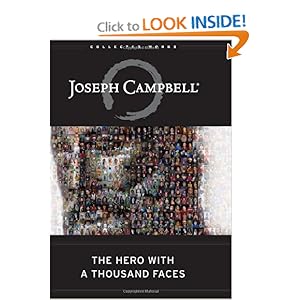
Joseph Campbell cut his academic teeth in the late 1940s with the book The Hero with a Thousand Faces, a comprehensive study of hero myths throughout the ages. He told Bill Moyers in The Power of Myth about the universal characteristics of the  "journey," actual or metaphorical, taken by the mythic hero. The hero sets out on a perilous quest, often in order to locate someone or something of great importance, such as the Holy Grail, that is lacking/missing/lost in the day-to-day world the hero knows. On his (or possibly her) journey, he undergoes many trials, tests, and ordeals; he may have close brushes with death; and, first with the help of wise mother figures and then of demanding father figures, he ultimately succeeds in his quest. After he wins, despite great adversity, he closes the circle of his journey, returning home with a boon in tow. The boon can be tangible or intangible, yet it must always be something beneficial to the hero's community. The benefit can be internal (spiritual) or external (physical, practical).

The latter sort of boon might be a sign that the hero has "performed a courageous act in battle or saved a life." The former kind is more subtle:

" ... the spiritual deed, in which the hero learns to experience the supernormal range of human spiritual life and then comes back with a message."

The Buddha
The beneficent "message" is like the one related by the Buddha, whose "journey" was partly geographic and partly a metaphorical one. After contemplating the true nature of reality while sitting under the famous Bo tree, he went around teaching others what he had discovered. Basically, the Buddha taught the various paths to a full "awakening" of the human soul.


* * * * *

A general description of the hero that Campbell gives to Moyers is:

"The hero is the one who comes to participate in life courageously and decently, in the way of nature, not in the way of personal rancor, disappointment, or revenge."

Another is:

"Even in popular novels, the main character is a hero or heroine who has found or done something beyond the normal range of achievement and experience. A hero is someone who has given his or her life to something bigger than oneself."

The hero can be a woman. Campbell, for example, tells Moyers:

"Giving birth is definitely a heroic deed, in that it is the giving over of oneself to the life of another."

The boon which the hero-mother carries back from her "journey" into childbirth is, of course, the child itself. The new human infant as a female hero's boon is a tangible reality as well as a spiritual one.

* * * * *

Yet the mythic hero, male or female, is not one who seeks ultimate union with "transcendence," a desideratum which Campbell identifies as the final destination of the human spirit. Rather:

"The hero’s sphere of action is not the transcendent but here, now, in the field of time, of good and evil — of the pairs of opposites."

The pairs of opposites? Why are they important in this discussion? Campbell says:

"Whenever one moves out of the transcendent, one comes into a field of opposites. One has eaten of the tree of knowledge, not only of good and evil, but of male and female, of right and wrong, of this and that, and of light and dark. Everything in the field of time is dual: past and future, dead and alive, being and nonbeing."

So the mythic hero operates in the dualistic "field of time," rather than seeking blissful unity with the eternal source of being. He is participating in life's game, says Campbell — a game which Campbell insightfully calls "a wonderful, wonderful opera — except that it hurts."

* * * * *

Joseph Campbell with
his wife, the dancer
Jean Erdman
Parallel with the distinction between, on the one hand, the field of time and its pairs of opposites, and, on the other hand, the eternal source of all that has being, there are two distinct aspects of mythic aware­ness. Campbell says:

"There’s a fine saying in India with respect to ... two orders of myths, the folk idea and the elementary idea. The folk aspect is called desi, which means 'provincial,' having to do with your society. That is for young people. It’s through that that the young person is brought into the society and is taught to go out and kill monsters. 'Okay, here’s a soldier suit, we’ve got the job for you.' But there’s also the elementary idea. The Sanskrit name for that is marga, which means 'path.' It’s the trail back to yourself. The myth comes from the imagination, and it leads back to it. The society teaches you what the myths are, and then it disengages you so that in your meditations you can follow the path right in."

The first aspect, desi — as in "Here’s a soldier suit, now go out and kill monsters ... " — seems to me to match up well with Richard Rohr's first-half-of-life description in Falling Upward: A Spirituality for the Two Halves of Life. Rohr even calls the transition to true second-half-of-life spirituality "discharging our loyal soldier," by which he means getting clear of that system of "impulse control" which has gotten us safely through the first half of life. Yet I think he misses, in this part of his discussion, the myth-hero aspect of wearing "a soldier suit" and slaying "monsters" which threaten the larger society.

Campbell does not miss it. He sees the value "for young people" of such soldier-suit heroism ... even if he, too, talks to Moyers more of the ultimate "trail back to yourself," or marga, that seems to me to correspond well with Rohr's notion of second-half-of-life spirituality.

* * * * *

My thought is that our churches and religions aren't teaching and supporting the "hero's journey" which our young people need first to set forth on, if they are ever to reach their "discharging their loyal soldier" transition into second-half-of-life spirituality. I believe (or so I suddenly find) that if religions did this, you wouldn't be able to keep the youngsters out of today's places of worship that are pretty much empty, or else filled with gray heads like mine.

Instead, the young are flocking to movie palaces to see the likes of Star Wars and Lord of the Rings, and The Chronicles of Narnia, and the "Harry Potter" series. All of these — and, I assume, newer films I have yet to see — are fundamentally about (you guessed it) heroes and their mythic journeys.

Some churches today are quite focused on teaching the (absent/not listening) youth "impulse control." By that I mean the traditional list of sins and taboos, sexual and otherwise. There's a very real place for that, of course, as necessary guidelines to keeping the hero's journey on track, rather than having it run off the rails. But "control" without "mission" is sterile; would-be heroes find it irrelevant to their needs.

* * * * *

Frodo Baggins
The mythic hero of J.R.R. Tolkien's Lord of the Rings trilogy is a Hobbit named Frodo Baggins. The Wizard Gandalf tells the diminutive Frodo that the land of Middle Earth is doomed to serve a power-mad, bodiless master of evil, Sauron, unless a certain golden ring is carried out of the Shire where the Hobbits have blissfully lived since time immemorial. The task falls to Frodo, who begins the story totally ignorant of any imminent danger. The danger now arises because Frodo's Uncle Bilbo had brought the One Ring back with him from his own youthful hero's journey.

The now-aged Bilbo knows full well he needs to relinquish the ring to his nephew, now that Bilbo is about to leave the Shire for the second time, to go off to Rivendell, elsewhere in Middle Earth, to write his memoirs. But somehow the ring keeps finding its way back into Bilbo's vest pocket — he hesitates to put it on his finger, because doing so renders him invisible to all but the maleficent Eye of Sauron. Gandalf has to remind Bilbo repeatedly to leave the ring behind.

The ring is a metaphor. It symbolizes, among other things, the psychological inertia that can keep us from crossing each necessary threshold into a new phase of life. Bilbo is about to enter the phase associated with old age, which, like all the successive stages of life, requires of him a new mindset. He will cultivate that mindset as he writes There and Back Again, recounting the tale of his first threshold-crossing when he as a young Hobbit set out on the hero's quest that Tolkien told of in his earlier book titled The Hobbit.

The One Ring
in Lord of the Rings
Once Frodo takes the ring, his own adventure begins. Accompanied by fellow Hobbit Samwise Gamgee, whom Gandalf adjures to keep watch over Frodo, and by two other Hobbits, Merry and Pippin, Frodo treks out of the Shire and soon has a near brush with death at the hands of the soulless Ring-Wraiths, who at Sauron's bidding seek to restore the One Ring to its evil master. To ward off his momentary demise, Frodo hastily puts the One Ring on his finger and disappears.This act, however, is the one thing Gandalf has told him he must never do, since it alone renders him visible to the archenemy.

This or any other use of the power of the ring, however well motivated, constitutes the equivalent of a sin; on this particular hero's journey, it is Frodo's taboo. Tolkien was a devout Roman Catholic, and although there is no reference to religion in Lord of the Rings, it is not hard to discern religious motifs just under the surface.

One such motif has to do with the self-sacrifice entered into willingly by Frodo, once it has become clear to him that he alone can carry the ring to the destroying fires of the Cracks of Doom, in Sauron's home realm of Mordor. Frodo ultimately succeeds in his arduous quest, but at the cost of losing his psychological ability to return to his home in the Shire and take up ordinary life there ever again. Instead, he goes off with the immortal Elven-folk as they retire from Middle Earth to the Undying Lands of the Valar.

The parallel in Christian belief is Christ's ascension into heaven. When Joseph Campbell tells Bill Moyers in The Power of Myth about the canonical adventure of the mythic hero, as found in all the world's mythologies, he includes Christ's birth, sojourn in the desert for 40 days, being thrice tempted by the devil, return to society with a message, death on a cross, resurrection, descent into hell to retrieve lost souls, and eventual ascension into heaven as an example of a mythic hero's journey.

Frodo can destroy the One Ring and save his Shire and all the other lands in Middle Earth only with the help of an extended band of heroes that include the four Hobbits; the Wizard Gandalf; Aragorn, the self-exiled King of Gondor; his steward Boromir and Boromir's brother Faramir; the Elf Legolas; and the Dwarf Gimli. This is the Fellowship of the Ring. Each member brings both weaknesses and strengths to what amounts to a mutually enabling "ring" of heroes who work together to destroy the physical One Ring, it's immaterial master Sauron, and Sauron's henchman, the turncoat Wizard Saruman.

The Eye of Sauron
So we have a symbolic contrast. The One Ring works to impede what might be called the soul's natural itinerary across life's thresholds toward ever greater consciousness, as Frodo finds when he learns one hard-to-accept truth after another over the course of his hero's adventure. His Fellowship of the Ring, by supporting him in his quest, nevertheless works to "unbind" all Middle Earth from the "One Ring to rule them all/And in the darkness bind them." Two "rings," as it were, exist: the first is a demonic parody of the life-affirming second.

The lesson here is that the greater conscious awareness each new life-stage brings — Campbell refers to it as an increased "experience" of being alive, and in the Bible we find the notion of attaining a greater "abundance" of life — is always paid for by some heroic sacrifice. Symbolically, when Aragorn's resumed reign at the end of the Lord of the Rings tale brings renewed joy to him and all his kingdom of Gondor, and when Sam Gamgee returns to the Shire to marry the true love who awaits him, it is due to Frodo's heroic self-sacrifice on behalf of all Middle Earth. The seeming distinction here between the hero and the beneficiary is, however, an arbitrary one. In actuality, just as we are all said to possess a "Christ within," we can likewise be said to possess a "Frodo within." Something old within us has to "die and go to heaven" each time something new is born.


Tuesday, July 09, 2013

A New Awakening, Part 17

I have in this ongoing series been investigating the wisdom of myth as it informs what I'm calling a hoped-for "new awakening" of spirituality in our society. I take as one of my main reference points the book and PBS television series The Power of Myth, in which, during the mid-1980s, Bill Moyers interviewed at great length the scholar of comparative mythology Joseph Campbell.

Fr. Richard Rohr's book Falling Upward: A Spirituality for the Two Halves of Life tells of a spiritual maturity that we gain only in, loosely speaking, the "second half" of our life. It is a fundamental change that sets how we act and think and what we are like apart from how we once acted and thought, and even who we once were. Yet first-half-of-life religion and second-half-of-life spirituality, however different they may seem on their face, are both absolutely valid and both equally needed.

That it is possible for us to shift gears spiritually, and that until we do so we never finally learn to do our own "sacred dance," is something of a riddle. In our early years — including much of our young-to-middle adulthood — we are, Rohr somewhat wryly says, understandably fixed on "externals, formulas, superficial emotions, flags and badges, correct rituals, Bible quotes, and special clothing, all of which largely substitute for actual spirituality." Only in our later years, if we have done our first-half task aright, does "this burning, this inner experience of God" become possible for us.

Richard Rohr
"Early-stage religion is largely preparing you," Rohr writes, "for the immense gift of this burning, this inner experience of God, as though creating a proper stable into which the Christ can be born." Put another way, "The first task is to build a strong 'container' or identity; the second is to find the contents that the container was meant to hold."

Yet, oddly enough, says Rohr, "Most of us are never told that we can set out from the known and the familiar to take a further journey. Our institutions and our expectations, including our churches, are almost entirely configured to encourage, support, reward, and validate the tasks of the first half of life."

That phrase, "further journey" crops up again and again in Rohr's text. It might well have been the author's alternate choice for the book's title. And here's a key thing: Before we can embark on our "further journey," we have to experience "some kind of falling," says Rohr. There has to be some sort of "necessary suffering." Accordingly: "In legends and literature, sacrifice of something to achieve something else is almost the only pattern. ... In Scripture, we see that the wrestling and wounding of Jacob are necessary for Jacob to become Israel ... and the death and resurrection of Jesus are necessary to create Christianity."

In his sadly now-out-of-print book Enchantments: Religion and the Power of the Word, Jesuit father Thomas M. King writes of a "second baptism," not by water but by "fire and spirit." It typically follows, he says, a parlous "night of the soul" in which old verities collapse and crumble around us. This "dark night" comes only after the bright day of our original devotion to God on High ... or to whatever other "enchantment" we have aligned ourselves with or been captured by. Our baptism by fire and spirit accordingly comes only after we have first undergone an intermediate time of questioning and disenchantment.

This is a paradox. First must come an "enchantment" — our original fealty to a religion, cult, or philosophy — after which our continued growth toward full spiritual maturity demands that we undergo a "disenchantment": we must leave behind all that originally brought us certainty, comfort, and security. Here we undergo the proverbial hero's journey. We need to journey far out of our original comfort zone, and then find that the problem we are actually called to solve in life isn't the one we initially confronted. Or, rather, we may find that it is the same problem, but that it is now somehow transformed.

This hero's journey, with a problem that we are called on to solve — and actually do solve — has a twofold outcome. The internal, spiritual result is that we finally learn to do our own "sacred dance." The external outcome is that we return from the journey with a boon to offer our community, our society, our land. Our compatriots — in Jesus's term, our "neighbors" — can now live life more abundantly in an everyday sense because we are now capable of living life more abundantly in an inner, spiritual sense.

Lord of the Rings author
J.R.R. Tolkien
I consider this the import of what happens to Aragorn in J.R.R. Tolkien's fantasy tale The Lord of the Rings. Aragorn is introduced as "Strider," a quasi-lowlife gifted in hunting, tracking, and living rough. It gradually becomes apparent that his present identity represents his fallen, "dark night" —or "dark knight"? — state, as he was born to be a king. He has for various reasons been dodging his destiny, but the quest of the Fellowship of the Ring to defeat the evil Sauron, along with his power-mad henchman Saruman, entangles Aragorn and elicits from him unstinting leadership and heroism. At the end of the narrative, he resumes his true identity and once more sits upon his rightful throne to rule his subjects in justice, abundance, and peace.

Aragorn's original "life problem" — whether and how to rule — can't be solved until he takes his hero's journey. When he comes home in triumph, the reality of his boon betokens that his original problem now has a solution, where it didn't before. Now he can reign over a peaceable kingdom that is no longer under dire threat from the forces of evil, personified by Sauron and Saruman.

All this sounds abstruse, stated baldly and without the candy-coating of mythical narrative. The mythical "hero's journey" — which Joseph Campbell ably documented in his 1949 book The Hero with a Thousand Faces — is, after all, but a metaphor. It symbolizes in narrative form the transition from first-half to second-half spirituality, from baptism by water to baptism by fire and spirit, inevitably by way of a dark night of the soul.

* * * * *

Clearly, Rohr considers his book to be mainly about second-half-of-life spirituality and the transition to it from the first half's distinctive preoccupations. Yet he does not short-shrift the first half of life. While we are young, he says, we must learn to "value law, tradition, custom, authority, boundaries, and morality of some clear sort. These containers give us the necessary security, continuity, predictability, impulse control, and ego structure that we need, before the chaos of real life shows up."

Put simply, our inner needs in the first half of life revolve around lawfulness. Rohr states, "Here is my conviction: without law in some form, and also without butting up against that law, we cannot move forward easily and naturally ... we have to have something hard and half good to rebel against."

This notion is indeed a subtle one. There has to be an authority figure who sets limits and boundaries for us, a set of rules, and a moral tradition that we take up in a respectful way. But we also must come to rebel against our society's "hard and half good" rules at some point.

Why the need for lawfulness and the need for rebellion, in proper sequence? Rohr says: "You need [to build] a very strong container to hold the contents and contradictions that arrive later in life. You ironically need a very strong ego structure to let go of your ego. You need to struggle with the rules more than a bit before you throw them out. You only internalize values by butting up against external values for a while. All of this builds the strong self that can positively obey Jesus — and 'die to itself.' "

What a conundrum! If what we ultimately seek, spiritually speaking, is to let go of our ego, how odd it is that we must start by creating a very strong ego in the first place. That clearly means we need to build our egos on something other than quicksand.

Writers on Christian spirituality
Richard Rohr and Thomas King
suggest they are all true,
in proper sequence ...
Yet we also need to, by acts of defiance and rebellion, chip away at the very foundation of our ego structure. That is what happens in our youth after we "butt up against" the norms of tradition that have been laid down for us by earlier generations. If we try to short-circuit the process by skipping over the crucial first stage, we will fail to gain the boon of the second stage.

Rohr states it this way: "In fact, far too many (especially women and disadvantaged people) have lived very warped and defeated lives because they tried to give up a self that was not there yet."

It seems that the full human "spirituality sequence" — the early preparation for our "hero's journey," the journey itself, and our ultimate return in triumph — is thus composed of a "baptism by water," early obedience to tradition, later rebellion, an inevitable "night of the soul," and then "baptism by fire and spirit" — at which point we have finally learned to do our own "sacred dance"!


Thursday, July 10, 2008

Jungian Wholeness, Part 3

I have been, in my Jungian Wholeness series of posts recently, exploring the thought of Carl Jung. Jung, who followed Freud in mapping the human psyche and discovered the potent patterns he dubbed archetypes in the collective unconscious, wanted to apply his insights to the Christian religion.

Specifically, he felt that the Christian emphasis on the trinitarian archetype, expressed in the Holy Trinity, needs to give way to quaternity, based on the archetype for wholeness. The God-symbol of three Persons, Father, Son, and Holy Spirit, admirably led us in the direction of psychological wholeness in the past, but then got us stuck on a quest for spiritual purity instead of finishing the task of bringing the whole structure of the self out of the unconscious depths.

A quest for spiritual purity had its place, Jung said, according to Jung's Treatment of Christianity: The Psychotherapy of a Religious Tradition, Murray Stein's book on how Jung wanted to heal the Christian church. But Jung felt that modern Christianity was coming in for a crash landing due to its failure to allow for the redemption of our bodies in their gross, even sinful material reality.

So the Trinity as a God-symbol set us up for splitting our psyche into what about it could be admitted into conscious awareness and what had to be pushed into the unconscious depths to become part of the Jungian "shadow": the dark döppelganger to the persona that we gladly expose to outward and inward scrutiny. In the shadow we would keep our knowledge of our carnal, animal, lustful, aggressive characteristics, at times conveniently projecting them outward onto people we identify as being "other" than our own kind — justifying holy wars, crusades, inquisitions, witch burnings, and the like.

Meanwhile, we would pursue a vision of our own spiritual purification, blessed by God. This was a valid strategy for constructing the civilization we called Christendom, Jung said, but the Renaissance and the Enlightenment drove a wedge between the erstwhile power of the Trinity God-symbol and the way we live our lives in the modern world today.

Jung's prescription for bringing the power back to our God-symbol was to evolve it into a quaternity in which the supposedly wicked physical part of our nature could also be redeemed.


It occurs to me that the transition from Trinity to quaternity patterns with the Dark Night of the Soul spoken of by the Jesuit Thomas M. King in his book Enchantments, which I dealt with at length in my Enchantments series of posts.

King meditates on the repeated pattern in human experience in which we undergo a "Night of the Senses" that baptizes us by immersion in water, as it were. The immersion in effect kills off our naive belief that the physical world alone can save us. At that point we begin a quest for spiritual elevation and purification which involves an "enchantment" by the Word of God. We do our utmost to hark to God's Word alone and leave the claims of the physical world behind.

At some point, though, we inevitably come crashing back to earth. The enchantment turns to disenchantment. We are crushed by the weight of a "Dark Night of the Soul." God's Word has turned to ashes in our mouth.

Suddenly, then, we can receive a "Zen enlightenment," similar to the one told of by the great Trappist monk Thomas Merton. The formerly distasteful physical world takes on its own aura of sanctity. We realize we have undergone a second baptism, by fire and Spirit this time, and we enter upon a new kind of spiritual quest entirely: one that in no way tries to deny the stuff of our physical bodies with its cravings and its supposedly unholy agenda.

This new spiritual orientation that follows the second baptism by fire and Spirit would seem to correspond to the bringing of the full Jungian structure of the self up out of the unconscious shadow to the level of conscious awareness.

King shows that the Dark Night of the Soul and the second baptism by fire and Spirit are fully consistent with Jesus' teachings and with longstanding Christian practice, such as that found in the Spiritual Exercises of the founder of the Jesuits, Ignatius Loyola. They are also consistent with the evolution of the philosophy of Plato, the subtexts of Cervantes' Don Quixote and the numerous Faust narratives, etc., etc., etc. We have many, many authorities that can be cited for the validity of the pattern ... and King, as I recall, does not even mention Jung.

Friday, January 26, 2007

Closed Circles

Thomas
M. King's
Enchantments:
Religion and
the Power of
the Word
In his book Enchantments, which I continue to pore over, Rev. Thomas M. King, S. J., speaks of how a verbal enchantment can make of those who are entranced by it a "closed circle" that excludes all who are not caught up in the enchantment. Such was the case with the words of the prophets in the Old Testament. When the Jews were in exile, they were sustained as a people by the likes of Isaiah, who wrote: "O my people, who dwell in Zion, be not afraid of the Assyrians" (10:24).

The prophets had foretold what actually happened: the destruction of Jerusalem by the Jews' pagan enemies. Yet, King writes (pp. 103-104):
If the prophetic words [had once] disheartened the nation, they sustained it when fortifications and arms were not to be had. In the Babylonian exile the captive Jews would have lost their hope, if they had not been supported by the prophetic word. And they would have lost their identity if their words had not made of them a "closed circle" ... with its familiar clichés. The words had a power to hold the community together and bring courage into being.

Words, even familiar clichés, can speak to us with power when
... all we see before us is "a grayish sea of ambiguity." We seem to be looking for something else — someone who will speak to us so that we will pass out of ourselves into the other. If that happens, everything is changed. At such a moment, the words spoken may be few, but they can change the direction of our life. (p. 105)

This, I think, is exactly what evangelicals experience when they say they have been "born again."


A new documentary, Friends of God: A Road Trip with Alexandra Pelosi, premiered last night on HBO. It depicts the lives and beliefs of the estimated 50 to 80 million evangelical Christians living in America today. Pelosi is an Emmy-wining filmmaker and the daughter of new Speaker of the House Nancy Pelosi. As I watched her interviews with leading evangelicals such as ...
Pastor Ted Haggard, who recently stepped down as president of the 30-million strong National Association of Evangelicals — the largest evangelical group in the U.S. — following allegations that he had sex with a male prostitute and bought illegal drugs (see the synopsis of the documentary here)

... I was struck by the way many of the interviewees talked as if they had been programmed by a cult. A very large cult. There was a notable absence of independent thought.

For example, when several interviewees were asked whether they believed in the theory of evolution, all responded to the effect that, no, they believed in the Bible and creation, and that it was evolutionists who could be accused of parroting a pre-programmed package of thought. Yet Pelosi's footage shows anti-evolutionist preachers and lecturers in action, feeding anti-evolution notions into the heads of Christian adults, teens, and pre-teens, in what I found to be a scary, chilling litany of vibrant, well-honed rhetoric and potent musical singalong.

In other words, the documentary showed me that if you're born again, you're apt to be subjected to religious and quasi-religious enchantments that serve to make all who are like you into a proverbial "closed circle," staunchly defending a party line on what is and is not true.


The born-again Christians in the documentary are not unlike the Jews held in captivity in Babylon, in the following sense. They feel they are a put-upon minority, strangers in a strange, secular land. Mouthing things like "America was founded by Christians" and "This is a Christian country," they feel they ought to be — and someday soon will be — the majority voice in the land.

According to my history books, the Founding Fathers indeed were mostly Christians of various stripes. But many of them were, as was Thomas Jefferson, deists who held that the Creator is no longer involved in human affairs. Some were of Puritan stock; it is not clear to me that the Puritans should be counted among the ranks of born-again evangelicals. Many were Anglicans, or what we now call Episcopalians. Quite a few were Lutherans or Catholics, neither denomination being particularly evangelical. There were Quakers and Methodists, Baptists and Anabaptists, Presbyterians and Calvinists ... but I am not aware of any signers of the Declaration of Independence who claimed to be born again.

Yet today's evangelicals are convinced we are on the threshold of a new Jerusalem.

This can take the form of expecting Jesus's imminent Second Coming. Different evangelicals have different notions of how the world's "End Days" are to play out, but there seems to be a general tendency to champion the cause of Israel's Jews, in furtherance of the prophecy in the Book of Revelation concerning their putatively necessary role in it all. If the Jews aren't living in Palestine, the thinking goes, it can't happen. But it has to happen, so we Christians need to do our part by making sure the Palestinians don't expel Jews from the Holy Land.

In other words, Israeli Jews have lately become members emeritus of an American evangelical "closed circle."


Looked at abstractly, evangelical belief seems to hold that the history of the confusing, chaotic, material world is about to be subsumed into that of the ideal world, directly under the will of God. Very soon now, those pesky differences between what is and what ought to be — the condition which I generally term worldly "injustice" — are going to go away. If we all hope real hard for this to happen, it will happen, and sooner rather than later.

I see this sort of thinking as a way to stave off the Second Baptism which King speaks of, the one that inaugurates in us a true spirituality of humanity and compassion. It staves it off by obviating the Dark Night of the Soul — the descent into a whirligig of confusion, doubt, and temptation — which necessarily precedes the Baptism of Fire and Spirit.

Not that evangelicals aren't compassionate. Toward others in their closed circle they are most caring indeed. As Ted Haggard pointed out in the documentary, when a member of his 14,000-member New Life Church phones 911 in a medical emergency, someone from the church community is likely to get there before the ambulance does. A megachurch, he says, is very much like an old-time village or township, providing all the fellowship and brotherhood those vanished institutions once did.

The problem, as I see it, is that the compassion is not universal. It does not extend much beyond the church community, or the larger community of American evangelicals ... with notable exceptions being made for members emeritus such as Israeli Jews and for those who are being evangelized in hopes that they will become initiates to the cult.

Those who clearly are not about to join the cult are in a different category. A personal anecdote: When I was about 16, I spent a summer with my cousin Susan's family in Cedar Rapids, Iowa. I was taken to Sunday School at their Southern Baptist church. With other kids my age I sat in, yes, a closed circle and heard the teacher/leader put the following question up for discussion: Now that we were reaching an age in which we would be going out on dates, was it a good idea to date people who did not share our religion?

I put up my hand and, as the guest, was called on first. I said it was fine to go out on dates with non-Christians such as Jews, as well as Christians of other denominations such as Catholics, because meeting them and their families would broaden our understanding of other types of people.

That turned out to be the wrong answer. The right answer was that dating non-Baptists could lead to knotty problems if marriage and children ensued, such as in what church to have the wedding and how to raise the offspring.


Extrapolating from that, I assume that in this view non-Baptists (or, at least, non-evangelicals) are to be evangelized, or, failing that, pitied. But pity is not the same as compassion. Pity is suffering for or about the woes of others. Compassion is suffering with others. Jesus did not teach pity. Jesus taught compassion.

His teaching of compassion, furthermore, went beyond the closed circle of his Jewish ancestry by virtue of the cross. King writes (p. 143):
The Gospels proclaim the Good News. Yet the good news is paradoxical, for the Gospels tell of God's chosen One going to a shameful death. In [the Gospel of] John the paradox is even more striking [in that it is] a stunning revelation of divine Glory. A contemporary exegete has explained the Jewish background of the term: "In the [Old Testament] the glory of God implies a visible and powerful manifestation of God to men" ... . For John the Glory of God was fully manifest only in the passion when Jesus was raised on the cross.

Late in his public ministry Jesus was told that some Greeks wanted to see him. This interest — from non-Jews, from those outside the closed circle — indicated to Jesus that his time of preaching was over. He responded, "The hour has come for the Son of Man to be glorified" (12:23). That is, his preaching was for a "closed circle" of listeners, those who shared a common book; hearing of the interest of the Gentiles he knew that his time of preaching was over; it was time for crucifixion and silence. Raised on the cross he would be present in the full absurdity of the human scene, but then his message would become universal; he continued, "I, when I am lifted up from the earth, will draw all men to myself" (12:23). The power of the crucifixion would extend beyond the "closed circle."

It would do so in a way beyond words and sense, beyond the clichés of the book faithful Jews held in common, beyond preaching and verbal enchantments. It would pose a riddle for one all to contemplate in the depths of the spirit: how could one so high be glorified by being brought so low as to be executed like an ordinary criminal? What does this paradox say to us?

Moreover, how does it say it to us? Not with words alone. King says (pp. 143-144):
As the passion began Jesus again spoke of it as his time of glory ("Now is the Son of Man glorified"). By his passion he would become a "visible and powerful manifestation of God" to all the world. His glory would be manifest on the cross where all power, all sense and meaning were defeated.

... Zen [Buddhist] masters ... lead their disciples to the point of illumination by proposing koans for their consideration. These koans [are] paradoxes which ... take the disciple beyond words. The most famous koan asks, "What is the sound of one hand clapping?" One is not able to conceive of one hand clapping, yet one meditated on this or other koans until one "saw" apart from meaning; phenomena apart from meaning was the illumination. The Jews lived in a world of meaning, for, having received the heavenly word, everything was meaningful. But by their book they also formed a "closed circle with their own clichés. During the days of his ministry Jesus was drawing those within the circle — the Gentiles would be drawn a different way. ... The phenomena itself would be the revelation, his time of Glory.

Think of it: according to John, the final glory of the Word of God, Jesus Christ, comes to all of us alike in beholding a phenomenon without words. A riddle, a paradox, a koan, an incomprehensible cross is needed to take us out of our hitherto closed circles and into an attitude of universal community and compassion. Here, then, is a crucial part of the Christian message which evangelicals seem to have forgotten!

Wednesday, January 24, 2007

Impulse Control

Thomas
M. King's
Enchantments:
Religion and
the Power of
the Word
In his book Enchantments, Fr. Thomas M. King, S. J., describes a spirituality of any type as a way of dealing with the impulses and urges within us, given that they lie outside the domain of the rational will. In general, an act is potentially sinful only to the extent that it is willful. If something wrong is done as a result of a mere impulse, uncensored by rational intent, it is in a different category of transgression.

Christian ethics and morality seek to train the will to want only right and proper things, but as King points out, none of us can suppress our urges and impulses entirely. We may dedicate ourselves to serving an ethical ideal. Then we may encounter a Dark Night of the Soul, when we realize that our chaotic inner impulses have refused to die. Oddly, the next stage of religious development is quite marvelous: a "second baptism" into a true spirituality.

Impulses are neither intrinsically good nor intrinsically bad. However, they need to be placed under some sort of control, some "decider" which tells us in which direction to move after an impulse has propelled us to make a change in our life, or even just to alter something in our momentary situation.

King suggests this is the province of the Spirit of God, which, the Bible says, "blows where it will." The Spirit, that is, does not adhere to rules that can be stated in words, in the way that a rational ethic does. (This is why King says that the Bible cannot always be read literally, as if all divine truth could be conveyed in flat, everyday prose.)

I am put in mind of a scene in the movie The Apostle where the protagonist, Robert Duvall, is kicked out by wife Farrah Fawcett for his philandering ways. He is nonetheless a holy man. As he motors along toward some sort of new life, he asks the Good Lord for direction by driving his car round and round in circles in a deserted intersection until an impulse tells him which highway to take.

I think this is something my evangelical/charismatic friends Chris and Dee (see Aspiration and Inspiration) are intimately familiar with. They are always talking about how God is "leading" them to do this or that, a locution which I interpret as meaning that the Spirit is moving them in a particular direction. Or, in terms of the urges and impulses that they feel as complex human beings, I think they are saying that they experience one particular impulse, among the riot of possibilities that well naturally up within them, which they feel has God's sanction and bears his blessing. It is that particular one which deserves to be followed. It is that one which marks the highway they need to take, at the proverbial crossroads.

Monday, January 22, 2007

Activating Compassion

Thomas
M. King's
Enchantments:
Religion and
the Power of
the Word
I wonder how many people, Christian or not, know of the Gospels' reference to a baptism that happens after the first, familiar one, that by water. The second baptism, of fire and spirit, is crucial to the understanding of the faith which is explicated by Thomas M. King, S.J., in his book Enchantments: Religion and the Power of the Word (available used from Amazon or from Alibris).

If the first baptism is the seal of righteousness, the second is the precondition of compassion. It is the guarantor that righteousness does not mean self-righteousness.

The first baptism is that of being spellbound by a verbal enchanter — Jesus was such a one — being taken up out of oneself to an ideal world above this one, a paradisal world of perfect justice in comparison to which our world of impure sense experience can seem utter darkness. We can be so taken by the Word that we seek wholly to abandon the World. This is the Night of the Senses. After it, as various knights-errant, we may devote ourselves to serving our ethical and moral ideals to the exclusion of giving free expression to our own needs and interests.

This typically brings on a Night of the Soul, since such purity of adherence to any impersonal verbal formula or set of commandments is ultimately, we tend to find to our chagrin, beyond our ability. Temptation intervenes in our lives, just as it did for Jesus when he was thrice tempted by the devil in the desert. That is when our baptism of fire can, if we are as steadfast as Jesus was, become a baptism of spirit, a germination of our inborn capacity for humanity an dhumility into the habit of compassion. Compassion, in which we confront the ways in which we are all equally prone to temptation and imperfection, to suffering and weakness, is seemingly the key to the kingdom of heaven on earth.

This is the paradigm of religious experience which King refines from his reading of scripture; from the spiritual biographies of Thomas Merton and Ignatius Loyola; from medieval mystical writings such as The Cloud of Unknowing; as well as from the Dialogues of Plato, Faust, Don Quixote, and a host of other works.

When I peruse King's book, I find it totally convincing. But after putting it down, I find myself asking questions. One of these is that with which I opened above: why is it that so few people think of the Christian faith as one in which the germination of humanity into full-fledged compassion is the crucial point?


We think of righteousness first, and only then (maybe) compassion as the prime directive of Christian living ... right? Righteousness, as in holiness, uprightness, rectitude, or probity; as in virtue, decency, goodness, honesty, integrity. As in being free of sin and going to heaven rather than hell when we die. If we serve God and not Satan, we do so first and foremost by our pious faith, by our turning away from sin, no? That is how we save our souls.

Not only does compassion come in a distant second to moral compunction, some even see religion as the enemy of compassion. In the current issue of TIME magazine, scientist Steven Pinker's article on "The Mystery of Consciousness" betrays such an attitude. Pinker suggests we may never be able to solve the "Hard Problem" about consciousness, no matter how much we learn about the workings of the brain. That problem is the one I talked about in my "Quickening to Qualia" series of posts (the last of which was "Mysterium Tremendum et Fascinans"). To wit, how does our brain give rise to the sheer experience of undergoing its own activity, as we internally monitor its subjective nature? Or, why is it like something to see the color green?

Pinker notes that the religious idea of the soul is akin to this notion that consciousness is an ethereal reality above and beyond the workings of the brain. Lewis Thomas wrote in The Lives of a Cell, according to this article on personal grief in a recent edition of The Baltimore Sun,

... that it would be odd for nature to waste anything as complex as consciousness. "I prefer to think of it as somehow separated off at the filaments of its attachment, and then drawn like an easy breath back into the membrane of its origin, a fresh memory for the biospherical nervous system, but I have no data on the matter."


If that's what consciousness is, severable at the filaments of its attachment, then maybe that's also what the soul is. But Pinker nixes that easy identity of soul with consciousness — without going so far as to deny the validity of the Hard Problem, as does philosopher Daniel Dennett, who is a much more impassioned atheist than Pinker is.

Pinker expresses his own distaste for religious belief in his final section, "Toward a New Morality." He finds the scientific impenetrability of consciousness to be an aid to compassion. If each person knows that he or she is conscious as a mysterious property of brain functioning — however unprovable that fact of one's consciousness may be to skeptical others — then every other person with demonstrably similar brain function must be seen also a like vessel of conscious experience, entitled to the same consideration we give to ourselves: "Hath not a Jew — or an Arab, or an African, or a baby, or a dog — a cerebral cortex and a thalamus? The undeniable fact that we are all made of the same neural flesh makes it impossible to deny our common capacity to suffer."

Religion with its concern for the advancement of the individual soul to the afterlife is, to Pinker, the enemy of such a recognition. It can promote cruelty, not compassion: "Just remember the most famous people in recent history who acted in expectation of a reward in the hereafter: the conspirators who hijacked the airliners on 9/11."

I'd say that's a caricature — nay, a corruption, a demonic parody — of the idea of religion. Yet it's one to which many religious practitioners are prone, in the name of God or Allah. It's simply incorrect for Pinker to fall into the trap of identifying a thing with its demonic parody. Yet it's understandable that he and others do so. In fact, I'd say it's far more important for someone to find his or her own compassion than to be right about religion.

Monday, January 15, 2007

Beyond Enchantment: A Spirit of Compassion

Thomas
M. King's
Enchantments:
Religion and
the Power of
the Word
I focus once again on Thomas M. King's Enchantments: Religion and the Power of the Word (available used from Amazon or from Alibris). The more I read it (or, actually, re-read it) the more convinced I become that King puts his finger on the true pulse of what a mature Christian life is all about. Specifically, it is about compassion.

I have talked in earlier posts about the idea of the unavailability of perfect justice in this world, taken as a cornerstone of Christian understanding. I found I was having a hard time pinning down exactly what I mean by justice ... or, rather, by injustice. It gradually dawns on me that my definition of injustice is this: anything that is capable of evoking our compassion.

It seems to me that most of us begin life pretty much blind to injustice ... except, of course, when we ourselves are its victim. Nor does real, human compassion exist as much more than a seed of potentiality within us. What causes that seed to germinate? King suggests an answer: we become "enchanted" by a verbal text, seek to exemplify it fully and to live by it perfectly, and eventually run aground on the sheer impossibility of ever doing so completely.

Then ensues a Dark Night of the Soul, followed by a Second Baptism. The First Baptism, that of Righteousness, is what happens when we take up the task of living strictly by a verbal rule or text. The Dark Night is what overtakes us when we find that such rules from on high — in Christian terms, the Word of God — cannot fully subdue either our sense-experience of this world or our impulses to do otherwise than obey rules. Only then are we ready for a Baptism of Fire and Spirit.

These are things spoken of in the Gospels and by Christian mystics down through the ages. But we hear very little about them from the pulpit today. A Second Baptism? Why, even the First Baptism tends to take place in infancy, in most churches, prior to the onset of mature experience. Not much commitment at that stage to living righteously, in accordance with a verbal text.

Yet there are in the Gospels the experiences of Two Baptisms. The second one, the Baptism of Fire and Spirit, corresponds to Jesus's threefold temptation in the desert by Satan, after his own First Baptism at the hands of John the Baptist. At that time Jesus had consented to live solely by his Father's word: Christians now call that body of text the Old Testament. A voice from Heaven had proclaimed, "This is my Son, in whom I am well pleased."

Yet Jesus would have to do more than live that Word. As Flesh, he would have to suffer and die. He would be the victim of such a colossal injustice that his death and resurrection would save us all. Extrapolating from what King says about this, one feels justified in imagining it could not have been possible had Jesus the Man not learned to get beyond the mere enchantment of the divine Word. He had to understand what it was like for us, in an unjust world, in which every verbal formula eventually stubs its toe on the hard rock of woe.

Compassion is only possible when we see that words and formulas alone don't bring full justice to this material world. Righteousness can be taught by rote. Compassion cannot. Perhaps paradoxically, the Christian answer to this difficult truth is not cynically to abandon all words and formulas and rotes, but to travel beyond them as a creature of Word and Spirit, of righteousness and compassion.

Sunday, December 31, 2006

Justice Versus Chaos

Thomas
M. King's
Enchantments:
Religion and
the Power of
the Word
Thomas M. King in Enchantments: Religion and the Power of the Word (available used from Amazon or from Alibris) discusses Jesus' temptation in the desert by the devil at some greater length than the actual story that is presented in the synoptic gospels of Matthew, Mark, and Luke. The version of Matthew 4, verses 1 through 11, is perhaps the longest and most canonical one.

Jesus has just been baptized in the Jordan by John the Baptist and heard a voice from heaven saying, "This is my beloved Son, with whom I am well pleased." He has accordingly consented to hitch his personal destiny to the living out of a text, specifically, the first Servant Song of the Book of Isaiah as cited by Matthew 12:8: "Behold, my servant whom I have chosen, my beloved with whom my soul is well pleased. I put my Spirit upon him, and he shall proclaim justice to the Gentiles."

Before that can happen, though, Jesus must be tested. Like all who attempt to live by a book, he must receive a second baptism, that of fire and Spirit. It is only thus that he, the Son of God, can fully identify with human weakness while still embodying the Word.

So Jesus fasts in the desert for forty days, led or driven there by the Spirit of God, and is tempted thrice by Satan. Satan first tempts him by seeing whether, in his grievous hunger, he will easily abandon the Word in order to assuage his nagging appetite by turning the very stones into loaves of bread. Jesus passes this test: "Man shall not live by bread alone, but by every word that proceeds from the mouth of God."

Changing tactics as befits his role as spiritus vertiginis, the spirit of confusion, Satan then tempts Jesus to do the exact opposite: to dismiss the reality of the physical world in which bread is necessary at all. Satan recommends that Jesus be like an angel and soar across the sky. But Jesus rejects the implicit bifurcation of his bodily experience: "You shall not tempt the Lord your God."

Jesus is in danger of being torn in two by competing extremes — fidelity to the Word, and giving in to the necessities of life in the material world. The sciences of chaos have shown that bifurcation, pressed to the extreme, can in fact turn order to chaos.

King is spot on here: "The mind becomes a whirligig of identities: at one moment one is a bodily appetite and the ideal does not count, then one identifies with the ideal and the body does not count. The mind is caught in a witch's dance — a dance wherein one does not know if he is there and the witch is absent, or if the witch is there and he is absent. Half-real identities alternate with increasing rapidity." Such is the run-up to total chaos, science shows.

Satan's third temptation is thus his most cunning: cynical acquiescence in the chaos of a whirligig world. Satan urges Jesus to, as his worshipful viceroy, seize power over the nations. Instead of proclaiming a single justice to the Gentiles — to the "nations," in the Jewish term — he will merely rule them, one and all, in their disunited multiplicity.

But the science of chaos also shows that there is a hidden new order that can emerge out of sheer chaos, if it is pressed to extreme — a third way between the horns of the dilemma of Word versus world, as it were. Jesus found that way when he refused to kneel to Satan: "You shall worship the Lord your God, and him only shall you serve."

Hence Jesus, having passed the third and last test, "would give first place to the Word of God; secondly, he would understand the weakness of human flesh (for the word is not everything); and, finally, he would never worship the powers of this world," whose legion competing injustices sow chaos (p. 120).

Chaos is accordingly a stand-in for the devil's own confusion as the enemy of not only order but final divine justice. We in our human weakness live in a world that turns whirligig too easily, yet in which a not-quite-yet rule of divine, uniting justice is always "at hand." It behooves us, King writes, to experience the two baptisms Jesus experienced: the first of water and Word, and the second of fire and Spirit.

It admittedly seems a tall order, in a cynical and chaotic world. Yet faith tells us that justice will prevail.

Wednesday, December 20, 2006

Justice Theology II

Thomas
M. King's
Enchantments:
Religion and
the Power of
the Word
In Justice Theology I started (actually, continued) weaving ideas I got from Thomas M. King in Enchantments: Religion and the Power of the Word (available used from Amazon or from Alibris) into a semblance of a Christian theology based on the idea that the key to understanding the Bible is its concern with justice.

By justice I mean ... what? Intuitively, I'd say, justice is whatever is "meant to be" by God. The world, to the extent that it is not what God had in mind for it, is unjust.

That's a pretty big extent. Injustice, as I think of it, either is co-extensive with evil, or it subsumes it. We hear an awful lot about sin and evil from the pulpit, or at least we used to before religion began downplaying these harsh ideas to keep people in the pews. Nowadays, we have to read theology books to hear much about Christianity's take on evil.

Yet as soon as you start reading up on the "problem of evil" in a theology book, you immediately run into a hitch. Evil is always discussed as a concept within a particular systematic approach to theology. If you read a theology book based on a different systematic approach, you get a different take on evil.

But the people who first spoke the words of the Hebrew Bible, even before they were written down — and the auditors who first listened to them — didn't have a systematic theology. They had an experience of injustice, having been held captive in Egypt, and later in Babylon. The destruction of the First Temple in Jerusalem at the hands of pagan foreigners smacked of the possibility that the Jews' just God had punished or deserted them. How to keep their unique faith intact and hold themselves together as a people was more than an intellectual question for them. Their concern for justice was their very identity.


King's book tells us, in speaking about John the Baptist, that
His message concerned justice, and like any good ethician, he spelled it out in detail: "He who has two coats, let him share with him who has none"; tax collectors were told to "collect no more than is appointed," and soldiers were to "rob no one by violence" (Lk 3:11). John was preaching social justice as the [Old Testament] prophets had before him. ... His baptism of "righteousness" called for confession of sins, a washing in the Jordan, and a moral reform. ... [One must begin] the transformation with a moral reform: one committed oneself to the careful observance of a law. Only after the moral reform did one go to the second baptism, a Baptism of Fire and Spirit. John did not administer the second baptism, but he promised another who would (p. 116).

The second baptism would be administered by Jesus, whom John did not yet know when he said, "I baptize you with water for repentance, but he who is coming after me is mightier than I, whose sandals I am not worthy to carry; he will baptize you with the Holy Spirit and with fire" (Mt 3:11).

Jesus submitted himself to John's baptism first, before embarking on his own mission. He did this "to fulfill all righteousness." A prophesy of Isaiah thus came true: "Behold, my servant whom I have chosen, my beloved with whom my soul is well pleased. I will put my Spirit upon him, and he shall proclaim justice to the Gentiles" (Mt 12:18).

As King points out, Jesus' baptismal commitment to harness his personal future to the preordination of a religious text was quickly put to the test by Satan, who tempted Jesus three times during his forty-day sojourn in the desert. Thus did Jesus prove he would hold fast, and would "give first place to the Word of God" in all its justice and righteousness. From that point on, though, he would also "understand the weakness of human flesh (for the word is not everything)" (p. 120).

Accordingly Jesus, in identifying fully with human weakness, went beyond justice without undermining justice in the slightest. How it is even possible for anyone to do that — especially one like Jesus, who was divine — is a riddle, a conundrum, and a paradox.

King likens Jesus' temptation by the devil to the dark night of the soul spoken of by later Christian mystics. After an enchantment by the word of God or any other ethical text, the believer inevitably founders on the shoals of an eventual disillusionment. Ultimately the "difficulties in identifying with a text" come to the fore. Good! As long as the believer does not renounce the Word, the Second Baptism — of fire and Spirit — ensues. Only then does one's true spiritual life really begin.

Parallels with koans used to provoke Zen enlightenment are manifest. The Zen postulant is given by his master a riddle, perhaps "What is the sound of one hand clapping?" This is the koan he must decipher. But it is undecipherable by any normal sort of logic. Good! Only once that is come to grips with is spiritual transformation possible.

But the Zen seeker doesn't just knock on the door of a monastery and get handed a koan right away. He is subjected first to the severest form of discipline, for a very long time, in a sort of religious boot camp. He has to measure up to the highest standard: a stern ethic of right behavior. Only after the Zen master senses the postulant is total in his devotion to the ethic of servitude does the master begin to treat the seeker with any sort of decency.

Likewise, King says, the baptism into righteousness offered by John the Baptist came along with the insistence on an ethical standard of behavior, a submission of the ego and the will to exacting norms. Still and all, "John and his baptism were not final; they were the first and lesser part of a double process" (p. 116). The second and greater part involved a riddle, a Jewish koan if you will. How could a God of pure righteousness and perfect justice identify himself with our own human weakness, even unto death on a cross?

Monday, December 18, 2006

Justice Theology

Thomas
M. King's
Enchantments:
Religion and
the Power of
the Word
In Poetic Justice I took up the subject of justice as the root question of all Western religion, taking up themes broached by Thomas M. King in Enchantments: Religion and the Power of the Word (available used from Amazon or from Alibris). In More about Justice I extended my remarks to say that injustice is endemic to our world of experience, both internal or external to the personal soul.

King contrasts the world of sense experience with the Word of God which is spoken to us — and spoken of — in the Bible. "In the beginning was the Word, and the Word was with God, and the Word was God," the gospel of John begins. The point of the gospel is that Jesus Christ is that pre-existent Word.

Words, whether scriptural or not, can enchant us. Stories take us to "another world." In such a story world, justice can win out in the end. Peace and harmony can prevail at last. Order can expunge chaos. What is "meant to be" will actually come to pass in a "new world order."

That is the Bible story in a nutshell. The Bible starts out — after the poetry of God's creation of the universe in Genesis, chapter 1 — in an Eden of peace, harmony, order, and perfect justice. When Adam and Eve eat the forbidden fruit, it is as if a primordial symmetry has been broken. Dynamic change has become possible. The bad news is that dynamic change potentiates conflict, disharmony, chaos, and injustice. The good news (gospel means "good news") is that God, at great personal cost, restores peace, harmony, order, and perfect justice at the "end of days."

Symbolically, perfect justice comes when Christ as the "bridegroom" weds his "bride" — us! We are God's partners in bringing justice to the world!


How are we to understand such things as the "fall," the "redemption," the "end times," and the "kingdom that is to come"? If we take these phrases literally, we may look for an actual, tangible, physical "end of the world" ... and quite soon, since the Bible always talks of God's kingdom as imminently arriving. I don't take them literally. Like King, I take them far too seriously to restrict them to their literal meanings. Instead, I take the Bible's "narrative arc" as a template that can be applied again and again to everyday experience.

I am just beginning to apply it in what is for me a new way. I call it "justice theology."

Justice theology sees injustice as the overriding issue of human experience. By injustice, I mean anything other than what is meant to be by God. It can be social or economic injustice, but it can just as well be interpersonal or even sexual injustice.

It can even be intrapersonal injustice. If I don't deal justly with myself — if, for example, I try to be more of an ultra-pure Pharisee than the admittedly flawed Christian that I really am — then a grievous wrong has been done in the world.

Justice theology, accordingly, doesn't believe in whitewashing the world, any more than it believes in whitewashing the soul. It sees injustice as an unavoidable concomitant of the capacity of the world for evolution and change. The idea is to right wrongs wherever they pop up — not to expect to keep them from popping up in the first place.


You can't right wrongs unless you have an ethical standard, and you can't have an ethical standard if you, in King's phrase, "go native" and elevate "the deed" (i.e., whatever happens) over "the word" (the source of the ethical standard: God). Still, you can be enchanted by the phantasmagoria of events, too.

A phantasmagoria of events is a chaos: ever new, ever fresh, ever purposeless. The Word of God never changes. Ethical standards are, at root, absolute, as are divine purposes. These bespeak immutable order, but we, in our lives, live in territory between order and chaos: the edge of chaos.

This is indeed what science shows today. There are dynamical systems that embody order, pure and simple. There are chaotic systems, like the weather. And then there are systems which, like life on earth, are located between order and chaos. These last systems are the only ones that evolve gracefully. Pure order produces nothing new. Pure chaos cannot sustain that which is produced. Only at the edge of chaos can novelty both appear and be sustained.

Justice theology recognizes that systems at the edge of chaos are continually subject to perturbations and hiccups that push them into chaos proper. That's unjust ... but justice can be restored when the system recovers its poise at the edge of chaos. Result: positive evolutionary change.

Justice on earth is dynamic, because events on the evolving earth are dynamic. We are called by Jesus to be "salt of the earth." Salt ... as in the substance used for preserving meat in Jesus's time. By seeking justice in all of its guises and ramifications, we help bring our world out of chaos, time after time after time.

Sunday, December 17, 2006

More about Justice

Thomas
M. King's
Enchantments:
Religion and
the Power of
the Word
In Poetic Justice I took up the subject of justice as the root question of all Western religion, taking up themes broached by Thomas M. King in Enchantments: Religion and the Power of the Word (available used from Amazon or from Alibris). From the Old Testament prophets to Jesus, from the letters of St. Paul to Revelation, the message is always that a godly kingdom of heaven, divine and just, is near at hand. The obdurate injustice of our world, of our everyday human experience, will give way to the order, harmony, and peace of a new world ruled by the Word of God.

It is hard for me to speak about this crucial biblical idea — the idea that God's justice wins! — without seeming to say that I have an inerrant sense of what is or is not just in God's eyes. I really don't. All I'm truly saying is that Jesus told the Pharisees, and others who challenged him, about real justice, which was not at all the kind of divine favoritism the Pharisees presumed their holy scriptures promised to them especially.

The Pharisees — and I fear I am pretty much a latter-day Pharisee myself, deep down — sought to export from their closed circle whatever woes living in an unjust world might otherwise bring them. They did this by vilifying and excluding those "unclean" Jews who were poor, ill-educated, crippled, leprous, or otherwise existing outside the Lord's obvious ambit of favor. Along came Jesus and reproached them, the Pharisees, for attempting in that way to immunize themselves against all worldly grievance.

Remember: among Jews at the time the idea of an afterlife was not particularly prominent. If one was not right with God, presumably one knew it by how blessed one was in this life. But God's blessing was not upon the individual so much as upon the nation. Ergo, the Pharisees said, our best bet for a happy life as a people is to cast out from among us whomever seems most infected with God's displeasure.

"Wrong," Jesus preached. "Injustice is part and parcel of the present world. You cannot, in a futile attempt to secure God's favor, export it from your midst by means of excluding the poor and all others whom you don't particularly like from your pristine circle. In fact, that just perpetuates worldly injustice and blocks God's kingdom."

At least for latter-day Pharisees like me, that preaching of Jesus goes against reflex. I admit it ... when I see someone who is sick or deformed or filthy, my first reflex is to get as far away as I can from ... yes, from such signs of injustice. What is less just than being born missing an eye or a limb? What is more foul than being unwashed and having no home to wash in?


It is not hard for me — now, after no small amount of reading and reflection — to see how wrong, how un-Christian, that attitude is ... and how difficult it is to eradicate from my soul.

It begins to look to me as if Jesus knew exactly how difficult it is when he said it is easier for a camel to pass through a needle's eye than for a rich man to enter heaven. By rich, he meant those not poor, not visibly unclean, not seemingly out of favor with the Lord. Injustice pervades the inner world just as it does the outer world. Injustice is endemic to our world of experience, whether internal or external to the soul.

If that weren't so, the Bible would make no sense. Everything in the Bible revolves around the notions of justice and injustice. Why is the world so full of injustice and woe? Because of what happened in the Garden of Eden. What can be done about it? Get right with God. How? Follow the commandments. How best to do that? Love God and treat all his people as any "neighbor" ought to be treated. How? Do unto others as you would have them do unto you. Which means what, exactly? Treat them with justice.


In short, make the kingdom of heaven real, make it come to earth. The Jews speak of this by the Hebrew phrase tikkun olam: "repairing the world." Christians call it "good works." But it's not just about doing good external deeds — it's a spiritual healing of one's inner world as well. As King shows in Enchantments, it requires (metphorically speaking) two baptisms, the first of water and the second of fire and spirit. The first baptism — not the physical act but the inward mark it bestows — gives us our chance at faith, our capacity to become enraptured by the Word of God. The second baptism allows us to re-enter earthly experience, not blinded by the divine light, but changed and charged for the task of reparing the world.

Saturday, December 16, 2006

Poetic Justice

Thomas
M. King's
Enchantments:
Religion and
the Power of
the Word
Thomas M. King's Enchantments: Religion and the Power of the Word (available used from Alibris) touches (p. 112) on what I think may be the root question of all Western religion, why do bad things happen to good people?

We, each one of us, have a built-in sense of rightness, of justice. The evidence of this is that we are all capable of being enchanted by stories whose outcomes are somehow "meant to be":
... the verbal world (especially the world of fiction) is ruled by a "poetic justice" (justice underlies most novels and has a strong rhetorical appeal). A verbal world is a world of form wherein all is regulated by Principle. Accordingly, in a novel, hidden goodness and hidden wickedness eventually become manifest and everyone is suitably rewarded (p. 110).

We have an instinct for a just outcome in a perfect world. Outcomes in this, our world, however, so often fail to satisfy it. Bad things happen. Worse, they happen to good people, for no defensible reason. Not everyone is suitably rewarded. Possibly no one gets perfect justice.


As a Christian who most of the time doesn't really "get" his religion all that well, I find I am prone to making a very bad mistake. It is possible to react to "not being suitably rewarded" by assuming as I do, quite erroneously, that one is in fact being fairly treated in life. If one does not feel all that happy with one's lot, he then may (consciously or unconsciously) imagine he has not been "good" enough to deserve better. The remedy would seem to be to live a "holier," more sin-free life.

But reforming one's life can be taken only so far. After enough of that, one becomes not a good Christian but a latter-day Pharisee, "a whitewashed tomb full of dead men's bones and all uncleanness." Clamping down too hard on the "bad" impulses we all carry around inside us is not what Jesus wants of us.

But why not? Ultimately, the answer seems to be that we and the world we live in are so constituted that we and it cannot be perfectly just, perfectly righteous, perfectly good. As I said in an earlier post, The Problem of the Two Souls, we are all like Faust, with "two souls" dwelling in our bosom. Only the first embodies our sense of perfect justice. The second wants ever fresher and more intense worldly experience, at the expense of any guiding ethic or moral purpose.

King calls it an ongoing conflict between Word and World. The divine Word tells us of a perfect World, not yet ours. But these two worlds, the perfect one and the real one we see and experience, coexist; both are real:

The prophetic wrtings [in the Old Testament] regularly affirm that the two worlds (Word and experience) are not ultimately separate: the God of whom they spoke practices "justice and righteousness in the earth" (Jer 9:24). In making this claim, the prophets had to face the immense difficulty that confronts every theologian: why do bad things happen to good people? If God rules the world in justice, why is injustice so evident? (p. 112)


Sometimes the Hebrew prophets promised retribution soon to come, yet:
... the good continued to suffer and the retribution did not always occur. The World seemed victorious over the Word ... The evident power of the wicked had overcome the sense of justice. But [still the prophets insisted] the Lord would come soon ...

"The great day of the Lord is near and hastening fast," wrote the Old Testament prophet Zephaniah (1:14). In the New Testament, Jesus in the Gospels spoke also of the imminent coming of the kingdom of heaven to earth, saying "not a stone would be left upon a stone (see p. 113). Saint Paul advised in 1st Corinthians 7:31 that "the form of this world is passing away." And the author of the Book of Revelation, the last book in the Bible, sees "a new heaven and a new earth, for the first heaven and the first earth had passed away" (21:1).

Whatever this kind of talk may mean — King takes it seriously, but not literally — it clearly has to do with the idea that the words of power that God poured into the prophets will ultimately come true: poetic justice will somehow prevail in the end, here for us on earth.


We all are capable of being put under a verbal spell by a prophet or preacher, today as in earlier ages, and of resonating with such a message. This is King's main point. The enchantment itself is the best "evidence" of the prophetic message coming true:
But what evidence did the prophets present? The enchantment itself. That is, the message of the prophet — the visible world will pass and be replaced by another — tells of the auditors' experience as the prophet speaks. As the people listen, the visible world fades and a new world, a new heaven and a new earth, rise from the scroll of the prophet. The Word replaces earth and sky, for these "roll up like a scroll" and, as long as the spell remains, they are not even remembered (p. 113).

When the spell is later broken — as it is bound to be — how do we react? This, says King, is the principal question of all spiritualty. Do we continue to grant any primacy whatever to the spellbinding Word?

If not, injustice wins. At the end of the day, this is why I insist Judeo-Christian religion has not yet, and never will, grow obsolete.