Showing posts with label Consciousness. Show all posts

Tuesday, December 30, 2008

Going Out on a Limb (Human Conscious Experience II)

In Human Conscious Experience I I talked about two ideas concerning what human consciousness is. The first came from Douglas Hofstadter's I Am a Strange Loop. Hofstadter shows that human self-awareness is a "strange loop," a property of any sufficiently complex system of information processing which allows the system to turn right around and process itself.

The other idea about consciousness came from David Chalmers' book The Conscious Mind, which holds that consciousness "supervenes" on physical brain processes. Consciousness as such is powerless to affect events in the physical world, just as the occupant of the sidecar of a motorcycle cannot steer the motorcycle.

For Hofstadter, consciousness qua consciousness is an illusion. All we really have is self-awareness, in the form of a self-referential strange loop. For Chalmers, consciousness is real, but (at least to a first approximation) it is "epiphenomenal." We wouldn't possess it were it not for the "extra work" that God (figuratively speaking; Chalmers is an agnostic) must have done to institute certain non-physical laws of nature, above and beyond the physical laws, that cause consciousness to supervene on physical brain states.

If you believe Hofstadter, we have no soul.

If you believe Chalmers, there is a wisp of a soul — but it can't do anything except enjoy its own inner conscious experience.

In my previous post, I tried to sketch out an alternative view of the conscious soul. It holds that the conscious mind or soul is an emergent property of the brain. As such, it is more than a limp epiphenomenon; it exerts "downward causation," also known as "top-down causality" or "whole-part influence."


That means it is like emergent properties of all sorts of complex systems. In theories of emergence, the whole world can be seen as one big complex system containing many complex subsystems that themselves each contain many complex subsystems, and so on and so on until a minimum level of complexity is reached. Each level of complexity emerges from the lower level. Each is the result of bottom-up causality in which the parts assemble themselves (or are assembled by some external force) into a whole that is greater than their sum, thereby causing something "extra" to exist above and beyond their own existence as parts.

An arch possesses such "extra" being, above and beyond the stones it is made of.

These emergent wholes, in turn, exert whole-part influence or downward causality on the parts at the next lower level. If the conscious mind is an emergent whole that springs forth from physical brain activities, it in turn causes events to happen at the physical level of the brain, and via the brain the body, and via the body the whole wide world.


One upshot is to believe that the conscious mind, contrary to Chalmers, is the natural result of human biological evolution. It did not arise because God did "extra work" in instituting non-physical laws of nature. It arose because evolution has just naturally produced ever-increasing embodiments of complexity at higher and higher levels of emergence.

I do not suggest that my view is an atheistic one, though. I think it is very theistic — as long as you are willing to entertain the notion that evolution is part of God's plan.

I'd like now to go out on a limb and try to show why believers in God might put aside any initial distaste for evolution and see these ideas as friendly to their point of view.

My argument is to the effect that the core of human consciousness is our ability to have personal inner experience. That is, we experience what we are conscious of in ways that differ from one individual to the next, but in all cases involve personal inner experience. If we were androids like Lt. Cmdr. Data on Star Trek: The Next Generation, that wouldn't be true. Our experiences, plural, would register upon the screen of our mental awareness, but they would not generate inner experience, singular.


Experience as I am using the word is hard to define. Philosophers of mind have spoken of it as knowing "what it is like to be/do/know X," where X is just about anything that an entity is able to be, or do, or know. If a bat were conscious, it would know "what it is like to be a bat."

When we see a red tricycle, we feel we somehow know "what it it like to be, or at least to see, red." "Consciousness," "experience," and "feeling" are synonyms. In such philosophies, these terms imply more than awareness, more even than self-awareness. Chalmers gives this very sort of description to conscious experience or feeling; it is just that he does not ascribe causal efficacy to it, as I do.

For Hofstadter, there is nothing higher or loftier than strange-loop self-awareness. To him, such notions as "consciousness," "experience," and "feeling" are illusions of the strange loop inside the workings of the brain.


I hinge my argument that both Chalmers and Hofstadter miss the boat on the ideas of the great Jewish theologian Martin Buber about (in the title of his most famous book) I and Thou.

Buber's ideas in I and Thou are if anything even more abstruse than the ideas about consciousness I just talked about. I'll give my interpretation here.

When I encounter another person, I can treat that person as Thou or as It. The I-It relationship is deadening, and it doesn't matter whether I say I-He or I-She instead of I-It. Only an I-Thou relationship is a true, life-affirming dialogue.

In fact, the "I" of I-It is a different "I" than the "I" of I-Thou.

I interpret this as meaning that when I experience another person as Thou, what emerges into consciousness from the strange loop of my own self-awareness is a different existent than that which emerges when I experience the other person as It.

There are accordingly two "I" experiences: "I" of I-Thou and "I" of I-It. Ergo, the strange-loop "I" of Douglas Hofstadter's soulless philosophy is not the end of the story.

Moreover, unless these two seemingly very different inner "I" experiences make no difference to what actually happens in the physical world, Chalmers is equally off base. It seems to me, contrariwise, that a rich I-Thou dialogue will have different worldly consequences than a sterile I-It relationship. For example, the former is far more conducive to a healthy marriage and plenteous children.


It seems decidedly contrived, then, to claim that the inner, experiential distinction between "I" of I-Thou and "I" of I-It isn't somehow responsible for altering the stream of physical events in the world.

To go along with Chalmers is to imagine that the physical world is hermetically sealed off from mental phenomena — if mental phenomena exist at all. Hofstadter takes the position that there are no mental phenomena; what seem to be mental phenomena are but illusions of the strange loop. Chalmers says nearly the same thing, except that there are epiphenomenal manifestations of consciousness which exert no downward force on events.

Hofstadter accuses Chalmers of being a dualist, but I'd say Chalmers is nearly as much of an anti-dualist or materialist as Hofstadter is. Materialism is non-dualistic; it holds that the only reality is made of material, physical stuff. When the only exception to that rule is Chalmers' notion of "superveneient" consciousness which makes no difference at the level of physical events, in my book that's materialism with an asterisk.

In my book, consciousness as an emergent mental phenomenon possesses downward force and exerts whole-part influence. That is dualism par excellence.

The anti-dualism of Hofstadter can give no account of how the I-Thou experience and the I-It experience can have different "I's."

The anti-dualism of Chalmers (with an asterisk) cannot show how the I-Thou experience produces a different world than the I-It experience does.

Could this "different world" of the I-Thou experience be, by the way, what Jesus meant when he said the Kingdom of Heaven is at hand (Matthew 10:7)?

Friday, December 19, 2008

Human Conscious Experience I

Douglas Hofstadter's I Am a Strange Loop has been a hot topic of this blog recently and in the past. The book tries (and, I think, succeeds) in explaining the ability of the human mind to conceive of itself in the first-person, as an "I." It does this by recourse to ideas broached in early-20th century mathematics and symbolic logic to the effect that all symbol-manipulating systems above a certain low threshold of complexity, of which the human brain is one, are intrinsically "incomplete."

There are, inescapably, truths concerning these symbol-manipulation systems themselves that have to be true, Hofstadter shows, but nonetheless cannot be derived as theorems from within the system. Hofstadter calls the ability of a system to contain countless truths beyond its own ability to prove them a "strange loop." A strange loop arises from the ability of a system to refer to itself. Hofstadter shows, convincingly, that the "I" in the human mind is nothing more than just this sort of strange loop.

Once that much has been established, he extends it in quite a lovely way to show that we humans build up in our minds over the course of time (albeit imperfect) copies of the "I-loops" of other persons whom we love ... and they harbor copies of our "I-loops." When one of us dies, an "I-loop" copy lives on in the brains of their mourners.


After saying that much, I think Hofstadter misses an opportunity. He tries to show that what philosophers of the mind call "consciousness" (or "feeling," or "experience") is nothing more than the working of the strange "I-loop" in the brain. To the extent that consciousness and "soul" have been conflated historically in our thinking about thinking, the soul, too, is just the strange "I-loop," nothing more.

Hofstadter contrasts this view with that of David Chalmers, whose book The Conscious Mind I have dealt with in earlier posts. Chalmers' take on human consciousness is that it "supervenes" on the physical workings of the brain in a way that makes it a very real but nonphysical phenomenon.

Hofstadter won't embrace the views of Chalmers (who is a personal friend and former student of his) because they are dualistic: they require that not all things having being in this world be part of the physical order of things. Specifically the mind, to the extent that it is possesses consciousness, is nonphysical.

Here, in the Chalmers view as opposed to Hofstadter's, we have a way for the "soul" to be real but nonphysical and immaterial — though not necessarily God-given in any supernatural way. Hofstadter admits to puzzlement and even outright revulsion at such dualistic philosophies of mind.

Hofstadter even comes right out and lampoons Chalmers' views, accusing him of positing that there has to be an immaterial substance out of which consciousness is made: "feelium." Feelium really exists, Chalmers implies, but it is incapable of exerting causal influence over the physical stuff of the universe, including the matter in the brain. Or, as Hofstadter puts it pithily, feelium cannot "push anything around."

There has never been in the life of the entire universe any object, molecule, atom, or quark whose trajectory has been altered by the exertions of feelium. Rather, feelium is naught but the putative stuff of human inner experience — "stuff" which Hofstadter feels is a grand illusion. Philosophers have in the past not so frequently in the present) held that consciousness is bound up with categories of experience called qualia (sing. quale, a two-syllable word pronounced KWAH-lay). Whenever we see a red tricycle, the quale for redness is invoked in our minds, thus providing us with our inner experience of the redness of the tricycle. In this view, all of our inner experience is qualia-based. If there were no qualia, there would be no conscious experience.

So the qualia exist as the "atoms and quarks" of our conscious inner experience, as it were, but they never push "real" atoms and quarks around.


This Chalmers view is one which takes as a given the idea that the universe is "causally closed." In other words, all physical effects have causes, and all the causes that account for all the effects in the whole physical universe are contained within the physical universe itself. There is no room for the laws of nature to be guided from above, as it were.

It is the insistence on a causally closed universe which — paradoxically, since neither Chalmers nor Hofstadter believes in a supernatural God — winds up providing Hofstadter with his greatest occasion for heaping scorn upon Chalmers. Chalmers builds up an elaborate theory that there could be, at least in concept, an alternate universe in which humanoid beings who are outwardly our exact twins wholly lack conscious inner experience.

These "zombie twins" of ours have evolved in the same Darwinian way that Homo sapiens did in our universe, Chalmers asserts, but since in their universe our "extra" laws of nature — those above and beyond our merely physical laws, that gave us conscious inner experience that supervenes on our brain function — don't hold. In the absence of these "extra" laws, our zombie twins have evolved without what Hofstadter sneers at by calling it an inner store of feelium.

Yet, since the physical laws of nature are identical in both worlds, and since the zombie world, like ours, is causally closed, every physical event that happens in Z-world precisely mirrors its twin event in our world. So when one of us utters the words, "I am having conscious inner experience of a red tricycle," our zombie twin mouths the exact same words ... and, as we do, fully believes them! His brain's "belief" circuitry functions just as ours does — a necessary consequence of the assumption that the feelium in our heads (but absent in those of our zombie twins) cannot push anything around, not even the particles whose interactions result in the activity of the neural circuits of our brain.

In short, if a universe is causally closed, and if, accordingly, any purported conscious experience that exists within that universe is wholly unable to influence its physical events, there is absolutely no way for that universe's denizens (much less any outside observers) to know for sure whether purported conscious experience is real or not. The denizens could be total zombies, and not even know it themselves! (And so could we!)


Hofstadter pokes great fun at Chalmers for this necessary upshot of his, Chalmers', theory of consciousness as supervening in a wholly acausal way upon the physical workings of the brain, and therefore of the material universe. But it seems to me all this silliness about zombie twins dissipates once you eliminate the assumption that the physical universe — ours, that is — is closed to nonphysical (i.e., mental) causes.

My guess is that:


(a) "feelium" exists in our universe

(b) it is an emergent property of the physical brain's functioning

(c) it can exert downward causal influence on physical events

(d) its downward causal influence is always mediated through physical intermediaries


To say (a) is true is to say that there really is "mind stuff," in addition to physical matter in the universe. Consciousness, feeling, experience: these are all real.

To say (b) is true is to say that this "mind stuff" or "feelium" emerges from our brain states and neural activities, but is distinct from those merely physical phenomena and events. An analogy: an arch is an emergent property: in this case, of an arrangement of stones. When by means of a scaffolding we stack stones in just the right way and then drop a keystone in place among them, we can remove the scaffolding and the arch stands. It possesses an integrity of its own and merits being called an arch rather than just a stack of stones. The arch qua arch is real. It exists.

Likewise, the mind that emerges from brain states and functions has an integrity of its own, merits being called something more than a brain, is real, exists.

To say (c) is true is to say this real, existent entity we call the mind can actually, in Hofstadter's words, "push stuff around" in the physical world. It is not merely the limp "epiphenomenon," or some such thing, that Chalmers believes it to be. In Chalmers' view, the notion that the conscious mind "supervenes" on the physical brain is what renders it unable to "push stuff around," and is what opens the door to the possibility of a zombie world (and to the possibility that ours is the zombie world!).

(d) is the most important of the four points: To say (d) is true is to say that the mind, though real, can't cause physical things to happen all by itself. Mental causation requires mediation through the brain and the body.

In other words, mentalists like Uri Geller who claim to be able to bend spoons with their minds alone are a sham.

I don't know what good a bent spoon is anyway. Still, there are times when we intend to bend things for practical purposes, such as when (a long time ago) I used to straighten a paper clip in order to insert its end in a little hole in front of my computer's floppy disk drive (remember those?) to get it to eject a stuck disk. That seems such a practical task, but I can remember my relief at getting the disk out ... and that it was my anticipation of such relief which impelled me to do the paper clip trick in the first place.

I contend that relief, as a type of feeling, qualifies accordingly as a type of conscious experience. And it is an emergent property of a situation or activity organized/witnessed/anticipated/remembered by the brain. It was anticipated relief which impelled me to (a) remember how to do the paper clip trick and (b) actually use it. But the paper clip would not straighten itself, would not poke itself into the little hole, and would not press firmly on the mechanism inside. My mind had to tell my brain to tell my body to accomplish those things. My mind exerted a "downward causation" on parts of the physical world — specifically, on my computer. There was a causal sequence. That causal sequence, though it arose in my (nonphysical) mind, was mediated by certain parts of the physical world: my brain and body.


What I'm really trying to get at with all this abstruse talk about consciousness is the idea that our conscious experience counts for something. It is real, and it changes everything. It "pushes stuff around" in the physical world in ways that wouldn't otherwise happen. And it is the core of who we are.

Hofstadter disagrees, saying it's all an illusion. Chalmers, too, disagrees, saying it's real but can't push anything around physically.

I say it's real, and it pushes stuff around.

Taking the position I take has some real advantages. For one thing, systems that have "emergent properties" (as opposed to limp "epiphenomena") are generally "complex" systems. The sciences of complexity apply to the complex system of the brain and mind, once you assume that the conscious mind is an emergent property of the brain.

Emergent properties are quite real; the quality that makes two stacks of stones into a standing arch (once a keystone is in place) is an emergent property, and an arch-qua-arch is real.

Systems that have emergent properties put a different spin on the notion of causation. They embody bottom-up causation and top-down causation. Top-down causation is sometimes called whole-part influence. The whole is not only more than the sum of the parts, it influences the parts' very behavior: it causes things to happen.

If the mind is an emergent property of the brain, then mental states cause, or change, physical events. Those physical events occur initially in the brain, but they spread to the body and then, via the body, to the world around us.

Another advantage of assuming the conscious mind to be an emergent property of the brain is that it leverages complexity science's ability to explain the quantity of diversity of the natural world. Complexity science helps explain why Darwinian biological evolution sometimes produces new species by the droves, and later watches as small, medium, and large extinction events take place, wiping out most or all of the species.

For example, the sizes of species extinction events are not random, it turns out. Plotting the event's sizes (the numbers of species eliminated in any given event) against the frequencies of events of each size yields a curious result: when so-called "log log" axes are used, the plot turns out to be a straight line!

In nature, evolution originates and destroys biological species over time in a way that Darwin's theory alone couldn't have predicted: it is as if the earth's biosphere were a "complex adaptive system," and one that is not as "random" as once assumed. Because of (albeit difficult to explain) top-down causation/whole-part influence, the pageant of speciation and extinction is more orderly than even Darwin assumed.


The same "dynamics of diversity" apply to human conscious experience, I would speculate. That's why our experiences are the most real things we know: experience is a very real, downward-causative property of the mind that emerges from, and then influences, the workings of the physical brain.

I am put in mind of that extra-special event Christians sometimes call their "conversion experience." It is also sometimes called their experience of being "born again."

It can be argued that there is no experience more central to the Christian belief than being born again, accepting Christ as one's personal savior, or other verbal descriptions of the same inner phenomenon.

The Christian New Testament is an account of historical events in the style called, by those who know such words, kerygma. "Preaching the gospel of Christ in the manner of the early church"; "the Apostolic proclamation of religious truths, especially as taught in the Gospels"; "the element of proclamation in Christian apologetic, as contrasted with didache, or its instructional aspects": these are all formal definitions of kerygma. Less formally, I would put it this way: kerygma is preaching designed to produce in the listener a born-again conversion experience.

The born-again experience is one of the vast number of "species" of experience that the conscious human mind is capable of. Especially to the evangelical Christian, no experience could be more important than the born-again, conversion experience.

Saturday, December 06, 2008

Salt of the Earth

In A Strange-Loops Religion? I cast Douglas Hofstadter's I Am a Strange Loop as the founding text of a secular religion. The book argues that a soul arises in each of us only after — and due to — a long skein of mental perceptions of outward and inner reality, an ongoing process of registration that characterizes our early childhood development.

During that process, the soul gradually emerges as a "strange loop" within the brain, a functional, non-physical structure which, as it emerges, becomes able to develop an ever-more elaborate awareness of the brain's own activity. As it, the brain, processes the set of symbols which its, the brain's, perceptions build up over time, this "I"-loop — this soul, this emergent internal observer of our inner dance of symbols — becomes the most complex symbol of all, as it is aware of itself. It is, in fact, what we speak of when we use the word consciousness.

Our individual "I"-loops, inasmuch as they are symbols in the brain, are transmitted as "lower-resolution copies" to the brains of those we love, who in return bestow on us copies of their own "I"-loops. When one person dies, the "I"-loop copies in the brains of the deceased's beloveds who are left behind live on. In that way, no soul is an island: no one who loves and is loved ever truly dies.


All this talk of souls, love, and an afterlife is reminiscent, of course, of religion. But in all this religion-like talk of Hofstadter's there is no hint of anything mystical or supernatural. Hofstadter, in particular, rejects dualism, the philosophical position which holds that there are spiritual or metaphysical realities, not just physical ones.

Consciousness, the hallmark of the human condition which has been equated by religious believers to the supernatural soul, accordingly possesses an entirely physical basis, to Hofstadter. Although symbols in the brain are not themselves physical entities, they arise from physical matter in wholly non-mystical ways. Hofstadter's main brief in this book is to show how that can happen.

Yet, for all that, there is a spiritual dimension to Hofstadter's worldview:

It seems to me ... that the instinctive although seldom articulated purpose of holding a funeral or memorial service is to reunite the people most intimate with the deceased, or to collectively rekindle in them all, for one last time, the special living flame that represents the essence of that beloved person, profiting directly or indirectly from the presence of one another, feeling the shared presence of that person in the brains that remain, and thus solidifying to the maximal extent possible those secondary personal gemmae that remain aflicker in all these different brains. Though the primary brain has been eclipsed, there is, in those who remain and who are gathered to remember and reactivate the spirit of the departed, a collective corona that still glows. This is what human love means. The word "love" cannot be separated from the word "I"; the more deeply rooted the symbol for someone inside you, the greater the love, the brighter the light that remains behind. (p. 274)


Still, if that's all that is going on, the soul of the departed that the funereal rekindling keeps aflicker eventually dies out as those doing the rekindling die out. Not exactly a recipe for immortality.


To get to immortality, you have to take it a step further.

Consider what it takes for someone to be remembered as a "wonderful" person — not just in the formulaic pieties you always hear at funerals, but in the sense that the mourners actually felt (and still feel) that way about the one who is being mourned. This was the case at my most recently attended funeral: for Bruce, a man taken from his family and friends far too young by cancer. Everyone at the funeral, everyone who delivered encomiums and eulogies there, could have summed up his rich life in four words: "salt of the earth."

That Bruce embodied that biblical adjuration could not have happened were it not for the fact that Bruce's "I"-loop and that of so many other people had become mutually entwined in exactly the way Hofstadter speaks of in his book. Because Bruce was so constituted mentally and psychologically as to admit of the possibility of love, he was a good man.

Think of the many unfortunates in this world who are closed off from such soul-entwinement and live destructive lives as a result. They die alone, perhaps in a drive-by shooting. One feels they did not receive the right kind of love as children, lost the ability to share souls with other humans as adults, turned to crime and dissolution, and died having lived in vain.

They are anything but salt of the earth — a phrase that Jesus used to indicate that those who enter his "kingdom" do so for having done what salt does for meat: preserve it, keep it from rot.

The soul-sharing that Hofstadter's "soul as strange loop" concept enables also enables the good works of a lifetime that forever keep the world-as-God's-kingdom from rotting. The shared "I"-loop as flickering "gemma" may die out after one or two generations, but the good works and the personal decency of ones like Bruce who are called "salt of the earth" live on in the form of a tolerable world that would otherwise cease to exist.

In other words, there is an alchemy here: a strange-loop soul, when shared because it was sharable and love was possible, gets transmuted not into gold but into the salt of the earth. Because the kingdom does not cease to live, the soul, having attained that form, does not die.

Saturday, November 29, 2008

I Am a Hologram

Douglas Hofstadter's book I Am a Strange Loop tells of the author's unutterable sorrow at the death, during the time the book was being written, of his wife Carol.

The book itself is a summing up of his earlier Gödel, Escher, Bach: an Eternal Golden Braid. The two books together present Hofstadter's insights into how it is that the human mind can be aware of itself and can give itself a name: "I."

As the Strange Loop dust jacket puts it:
For each human being, this "I" seems to be the realest thing in the world. But how can such a mysterious abstraction be real — is our "I" merely a convenient fiction? Does an "I" exert genuine power over the particles in our brain, or is it helplessly pushed around by the all-powerful laws of physics?

Hofstadter shows the "I" to be a virtual reality, an illusion. It doesn't really exist. It can't push electrons around in our brain. It's isn't a physical entity, a group of neurons or pathways in the brain, and the laws of physics alone can't account for it.

What actually happens is that, at a level higher than the physical, the mind is full of symbols. Symbols are not anything mystical; Hofstadter shows how they can arise in something so humdrum as the busyness of an ant colony.

Yet, as we know, symbols can be manipulated in logical ways, according to various formal systems of mathematical inference. These formal systems are, the Austrian mathematician Kurt Gödel showed, inherently — and somewhat disappointingly — "incomplete." Surprisingly, there are, inside each of them, not just one true statement but an infinite number of true statements that the systems themselves are incapable of deriving.

As a body of theorems, every formal system is constructed from the ground up by means of applying rules of inference to a starter set of axioms. The non-derivable theorems would seem to be just as accessible to the logic and mechanics of theorem generation as are the derivable ones.

Yet they cannot be generated — though they are inescapably true. They can't be shown to be true within the system, but if you stand outside the system and think about these unprovable statements, you can see that their being false would introduce a fundamental inconsistency into a formal system that is absolutely allergic to any whiff of inconsistency. Hence, they must be true.

In short, all formal systems based on the logical manipulation of symbols to derive provable theorems based on a set of axioms are incomplete.

Hofstadter extends this basic insight to show how the set of symbols that the human mind manipulates, day in and day out, as it goes about doing its basic mental operations, is just the same. In the human mind, as in every formal system, the provable and the derivable do not exhaust the true. It is this actuality that opens the door to the possibility of a self-aware mental being, an "I" which stands outside the formal logic of our basic mental operations and independently discerns truth.

If Gödel had been wrong about the intrinsic incompleteness of formal systems, we would be living in a zombie universe in which there can be no "I," no self-awareness. Thank God Gödel was right!

Moreover, this "I"-ness of ours is, at its core, a "strange loop": the logical operations of the brain that would ordinarily constitute a straightforward hierarchy of symbol manipulation at higher and lower levels of abstraction turns, in the end, into a feedback loop. The Dutch artist M.C. Escher captured the strangeness of such loops in Drawing Hands (right).

If the above were all Hofstadter had to say, his books would be compelling. That they are also profound has to do with how he extends his basic insight into a discussion of how the unique "I"-loop of each of the people we love inhabits, in greater or lesser degree, our brain, and we, our individual "I," theirs. Again, the dust jacket gives a capsule summary:
How do we mirror other beings inside our mind? Can many strange loops of different "strengths" inhabit one brain? If so, then a hallowed tenet of our culture — that one human brain houses one human soul — is an illusion.

This notion is something the loss of Carol Hofstadter brought home to Douglas. As acute as the pain of separation was for him for a very long time, it ultimately morphed into an awareness that Carol's "I" was still alive — in Doug's brain! Also, in the brains of their children. Also, at lesser strengths, inside the brains of everyone who had ever known Carol personally!

Get it? Each of us has an "I" that is not real, in neither the physical nor the metaphysical sense, and is quintessentially strange in the way that all "strange loops" are strange. What's more, there is a spare copy of our unique "I" inside the brain of every person who knows us and loves us.

Likewise, we carry around copies of the "I"-loop of all whom, to adopt the locution of Martin Buber in I and Thou, we say "Thou" to. Depending on the depth of the mutual, personal, I-Thou relationship, the "strength" of the "I"-loop copy varies ... but it is present in every case.

Because we carry our own copies of others' "I"-loops, we learn to "see things through their eyes," as it were. We share their experiences vicariously and empathically. We "channel" these other people, in the popular parlance — as long as channeling is understood as being something neither mystical nor supernatural.

Not only can we channel those who are close to us during their lifetimes, we remain able to channel them after they're gone. My father has been dead for 20 years, my mother for 23, but scarcely a day goes by without my channeling one or the other of them, or both of them, within the confines of my own imagination.


Hofstadter uses the analogy of the strange loop to show how an "I" can exist within us and be transmitted to others. My own favorite analogy for the situation in which friends and loved ones share copies of one another's "I"-loops is the hologram. I don't claim to have a detailed understanding of holography, but my impression is that when a certain kind of light is bounced off an object onto a piece of photographic film, the light's waves form an interference pattern — criss-crossing ripples — which the film records. Then when the film is developed and the same kind of light is passed through the interference patterns on it, a virtual image of the original object appears before the eye. This image is as three-dimensional as the original object.

Interestingly, if you cut the photographic slide that records the interference pattern in half, each half can reproduce the full image of the object, all by itself. There is some minor loss of fidelity, but basically, all the information in the original slide is present in each half. If you continue to subdivide the halves, each subdivided hologram again contains the entirety of the original body of information, if in yet more attenuated fidelity, and can again reproduce the full image.

We can think of Carol Hofstadter's "I" as having been a hologram at full size and strength in her, while she was alive. Meanwhile, Doug's brain created a smaller (but nearly full-sized) copy of the "I-of-Carol" hologram during his and Carol's life together. When she passed on, his smaller copy of the hologram, which provided him with ongoing access to an only-slightly-attenuated "I-of-Carol," lived on.

Their children each possessed a like copy of the original "I-of-Carol" hologram. Innumerable friends and acquaintances of Carol and Doug also cherished "I-of-Carol" holograms at various scales and degrees of attenuation.


Moreover, the various and sundry "I-of-whoever" holograms rattling around in each of our brains modify the central "I-of-me" hologram each of us builds. I cannot tell you how many times I realize that one friend or another has imprinted something of himself or herself indelibly on my inner experience, my "I-of-me" hologram. I have one particular longtime friend, for example, whose love of our mutually shared Catholic Church dwarfs mine, I am a bit ashamed to admit. (I'll call her Mary, a pseudonym.) But I can look at the Church through Mary's eyes any time I want to, and when I do its beauty becomes instantly apparent to me.

In ways that I would not care to try to quantify, her Church-love has changed me.

That means the it has changed the copy of my "I"-hologram that is possessed by any other friend of mine, call him Joseph ... who may not know Mary at all. If my "I"-hologram changes Joseph in any way, then I have indirectly exposed Joseph to Mary's "I"-hologram as well.

Should, God forbid, Mary die tomorrow, she will live on in me, and in Joseph, whom I have touched in an I-Thou way, and in anyone Joseph touches in an I-Thou way ... and on and on and on, until the end of time.

And that is a thought that is truly marvelous to contemplate!

Sunday, October 05, 2008

On Secrets

A confession: I've been looking at porn on the Internet. Smut. Naughty stuff ... what used to be called, quaintly, "French postcards." Yet I've found that what you can see if you enter the right words in the Google Images search box goes way beyond naughty. And it isn't really all that much fun to look at, truth be told. The question is, why not?

An answer crossed my mind today as I pondered the nature of secrets.

Secrets are things we don't want to tell others, don't want them to see or know about. That much is unremarkable. What seems to me to be more remarkable about secrets is that each one is unique.

That's a big deal if you are like me and tend to agree with the protagonist of Muriel Barbery's award-winning novel The Elegance of the Hedgehog. Renée Michel is the concierge in a Parisian hôtel particulier who ponders thoughts above her station. At one point she glimpses the master's thesis of one of her tenants' daughters and is set to musing about the philosophy of William of Ockham.

Ockham held that there are no universals, just unique and particular entities that only seem to participate in a universal form or ideal. There is no such thing as the quintessence of table-ness, only this table, that table, this other table. The notion that the abstract idea of the table is real is a trick of the human capacity to use language, thereby to invent (non-existent) general categories.

But Renée Michel disagrees:

As far as Will of Ockham is concerned, things are singular, and the realism of universals is erroneous. There are only particular realities, generality is merely in the mind and to presume that generic realities exist is merely to make what is simple complicated. But can we be so sure? Was I not seeking congruence between Raphael and Vermeer only yesterday? The eye recognizes a shared form to which both belong, and that is Beauty. And I daresay there must be reality in that form, it cannot be a simple expedient of the human mind classifying in order to understand, and discerning in order to apprehend: for you cannot classify something that is not classifiable, you cannot put things together that cannot be together in a group, or gather those that cannot be gathered. A table cannot be a View of Delft: the human mind cannot create this dissimilarity, any more than it can invent the deep solidarity connecting a Dutch still life to an Italian Virgin and Child. In every table there is an essence that gives it its form and, similarly, every work of art belongs to a universal form that alone confers its seal upon the work. To be sure, we cannot perceive this universality directly: that is one of the reasons why so many philosophers have balked at considering essences to be real, for I will only ever see the table that is before me, and not the universal "table" form; only the painting, and not the very essence of Beauty. And yet ... and yet it is there, before our eyes: every painting by a Dutch master is an incarnation of Beauty; a dazzling apparition that we can only contemplate through the singular, but that opens a tiny window onto eternity and the timelessness of a sublime form.

Eternity: for all its invisibility, we gaze at it.

Yet, it seems to me, we can never gaze upon the essence of a secret, for a secret has no essence. A secret is what it is only by virtue of the intentions of the person who is keeping it.

Suppose you are gay, but keeping it a secret. Suppose also that you have a friend — not a lover — who is also in the closet. It may seem that you share the same secret, and that therefore secrets have universal essences.

But now imagine that your friend tells someone else that you and he (let's say your friend is male) are both gay. What will be your reaction? Isn't it apt to be that it's well and good for him to part with his own secret if he bloody well wants to, but he has no right whatsoever to betray your confidence?

Secrets belong only to their originators. Even if the gist of a secret is identical between two secret-keepers, each person's secret is an entirely separate entity. Ergo, secrets (though they have gists) have no essences.


It all has to do with consciousness. Animals don't have secrets, because they are not conscious. (Or, if they do possess consciousness at some level, it is only to that extent that they are capable of secrecy.)

Jung had it that human consciousness lies along an arc from the pre-conscious "participation mystique" of infancy to the advanced awareness of a guru on a mountaintop — which amounts to the same oceanic, all-is-one immersion, now at a fully conscious level.

If you are a pre-conscious infant, there can be no hiddenness, no secrecy. The same is true of the mountaintop guru, to whom all secrets are revealed. And the same goes for God, from whom no secrets can be kept. In fact, Jung spoke of the advanced stages of consciousness as the realization of the Self as the imago Dei, the image of God.

But most of us spend our days at stages of consciousness that are somewhere in between these endpoints. Everyday consciousness is secret-keeping consciousness. If our lives were open books to everyone who is not a baby or a guru, and their interior lives were equally open to our own view, life would be impossible to deal with.

I have often fantasized about what it would be like if one could see each innermost thought of another individual, blazoned on his or her forehead: "I don't really like Alice, but I have to pretend to since her husband is my husband's boss"; "I don't want the buddies I hang around with to know I like medieval French poetry"; "I'm planning to dump my girlfriend, but I'm not ready to tell her yet."

Those pieces of inner dialogue would be bad enough, if revealed to one and all. Far worse, though, would be thoughts about sex: "I'm sure horny today"; "I'm not horny, but would like to be — where can I score some Viagra?"; "I'm sleeping with my secretary and don't want my wife to find out"; "I can't keep my eyes off her breasts/his behind"; and so on.

Well, then ... why are thoughts about sex more secret than other thoughts? I think the answer is that secrecy is the essence of sex.


If not secrecy per se, then intimacy. Confidentiality. What goes on between us is nobody else's business. That sort of thing. Otherwise, it's just friction and heat, spanning and delving, pumping and orgasm.

The eternal essence of sex retches at the thought. The eternal essence of sex knows that sex involves holding, and being held, close. You aren't really holding someone close if you know that what the two of you are doing is being filmed and will wind up on the Internet.

So, from something without an essence — the secrets of the bedroom, as kept separately by those who share the bed — comes something with an essence and a universality: the beauty of real sex. Go figure.

Wednesday, October 01, 2008

What's Your Blick?

"What's Your Blick? God or Science?" is the title of a recent book review in Washington Post Book World. The book in question: Michael Novak's No One Sees God: The Dark Night of Atheists and Believers.

Reviewer Jacques Berlinerblau described the book as a riposte to the New Atheism of Christopher Hitchens, Sam Harris, Richard Dawkins, and Daniel Dennett, all of whom have recent bestsellers disparaging religion and belief in God. Novak, says the "unrepentant Jewish atheist" Berlinerblau, is a Catholic theologian who would like to have a "heart-to-heart chat with these Four Horsemen of the Apocalypse."

According to Berlinerblau,

To help frame the debate, Novak invokes the idea of a "blick," a "way of viewing reality that is not usually overturned by one or more pieces of countervailing evidence." Coined in about 1950 by the British philosopher R.M. Hare (who spelled it "blik"), the term refers to a mental filter through which people sift information, admitting some things as facts and rejecting others. To simplify somewhat, atheists and theists process information about the cosmos in radically different ways.


I'll take that "blick" idea a bit further. According to the late psychologist Carl Jung (see Quest for the Self, Part 2), human consciousness has at least five (and perhaps seven) stages of development:

  1. A stage in early infancy when the conscious mind as such has yet to develop, and we experience a "participation mystique" where we have no idea we are separate from the rest of the world.
  2. Then we learn to differentiate external persons and objects from ourselves — and right off we begin projecting the potencies of our inner unconscious mind outward upon them. A primitive sort of religious sense evolves, where the powerful archetypes, projected outward, seem to animate objects in the environment. Every tree is a god.
  3. Later, we start projecting our inner archetypes out upon upon abstract entities, such as our notion of God in Heaven. Now it is the One God who has the numinous power of all the archetypes.
  4. The next, fourth stage of conscious development is characterized by a seeming end to the proclivity to project the energy of our inner archetypes out onto persons and things, whether they be concrete and specific (Stage 2) or abstract and general (Stage 3). This is the stage atheists embody.
  5. Next, in Stage 5, the "modern man's" anomie, meaninglessness, and lack of spiritual center, typical of Stage 4, gives way to an ability to take the once-hidden potencies of the unconscious mind — the archetypes — and bring them under direct mental scrutiny and into conscious acceptance.
  6. In Stage 6 (see Quest for the Self, Part 3), the boundary between inside-the-mind and and outside-the-mind begins to crumble. This is a stage reached by mystics. The apparently inner structures which Jung called archetypes are seen to correspond, after all, to structures of being in the outer, nonpsychic world.
  7. Finally, Stage 7 consciousness has come full circle, back to the "participation mystique" of infancy in which we have not yet become aware that we are distinct from everyone and everything in our environment. The difference is that originally we did not understand the inner-outer distinction in the first place, while now we are fully conscious of having overcome it.

Few people get beyond Stage 4, and modern people who have strong religious beliefs remain at Stage 3. While Jung described these seven stages as coming in the indicated sequence, and he seemed to think later stages superior to earlier stages, I find it more useful to think of the stages as stations on a circular railroad line, none of which is privileged over any other.

Some people, as we know, get off the train at the third station. They are religious believers.

Other people, atheists, disembark at the fourth stop. (Many of them were seemingly asleep when the train let off passengers at Station 3.)

When and if someone stays on the train for the entire journey and disembarks only at Station 7, he has in effect arrived back where he started — but making the trip has elevated what was originally strictly unconscious in him, as the "participation mystique," to the level of full consciousness.


Now, add to that model the following: each stage from 2 through 4 involves an increasingly insistent act of repudiation:

  • Stage 2 repudiates the (pre-conscious) notion from Stage 1 that "all is one."
  • Stage 3 repudiates the idea that what are really our inner archetypes, projected outward, control the outside world — if we are in harmony with the gods, things go our way.
  • Stage 4 repudiates the notion that the same kind of thinking applies validly, but only to God Above, whom we can't see.

Then the final three stages involve successive reintroductions of the powers and relationships that were formerly repudiated:

  • Stage 5 reintroduces the inner powers (the archetypes) at the level of conscious belief.
  • Stage 6 re-links these powers with external potencies.
  • Stage 7 returns us to a (now-conscious) "all is one" awareness.


In this model, there are not two blicks, but seven.

Admittedly, only blicks 3 and 4 apply to most modern adults. Blick 5 is the one Jung advocated, in which adults, usually in the second half of their life spans, follow a path of "individuation" toward a goal of "Self-realization."

(The Self is the archetype-of-archetypes, the "image of God" in the soul. Self-realization involves paying attention to the symbols the archetypes propel into our dreams and fantasies, rituals and myths — symbols which link up with things treated by traditional religious believers as facts. Moses' burning bush is a fact to a traditional theist, a symbol to a Jungian.)

Perhaps the New Atheists and the champions of traditional religion could stop shouting at each other if they recognized that theirs are only two of the seven possible blicks!

Sunday, September 07, 2008

The God of Synchronicity

Carl Jung and Christian Spirituality: A Reader, edited by Robert L. Moore, contains an article that is required reading for anyone such as I who would like to bring Christian thought into harmony with Jungian psychological theory. Eugene C. Bianchi's essay "Jungian Psychology and Religious Experience" discusses five major points of conflict between traditional theology and Jungian imperatives. The first is the tension between the traditionalist view that the truths of Christ and his church are manifestly objective and historical, whereas Jungians emphasize the personal inwardness and subjectivity of all religious experience.

Bianchi admits he is biased in the Jungian direction, yet disturbed by the "discontinuities and inadequacies" of Jung's ideas about religion (p. 17). For example, he understandably feels Jungians' emphasis on pure spiritual inwardness "can lead to a diminishing of community responsibility ... [and] submerge social consciousness and civic responsibility" (p. 22).

Jung, for his part, held that universal archetypes common to all human beings produce images in the unconscious mind that show up always and everywhere in dream and myth. These images present themselves consciously as symbols. The conscious mind sees, not the archetypes themselves, but the symbols that the archetypes lie behind.

Furthermore, Jung found that there was often an uncanny coincidence between symbols appearing in our dreams and "real-world" events that transpire at roughly the same time. He called these coincidences "synchronicity."


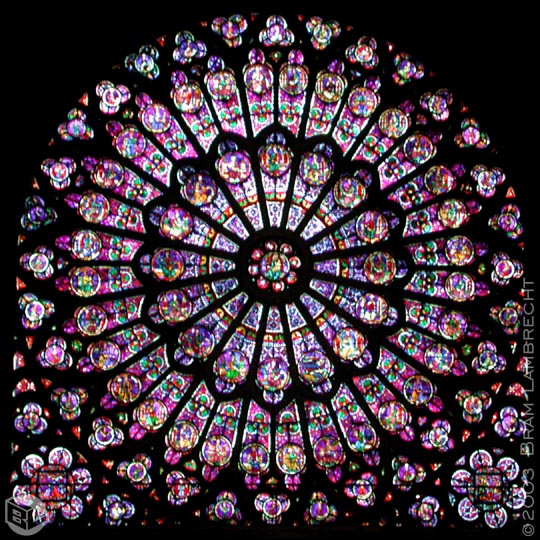
The cross of Christ is such an archetypally derived symbol. Because of its balanced shape, it is typical of all symbols of symmetry and wholeness. The rose window of Notre Dame Cathedral, depicted on the book's cover, is likewise a symbol of the archetype for wholeness.

Jung identified the archetype behind such wholeness symbols/images as the Self. The Self, if realized, is capable of bringing the psyche or soul into balance by harmonizing its internal tensions and bridging between its inherent pairs of opposites such as male-female or light-dark. It is the most important and potent of the archetypes ... and the most mysterious.

In earlier installments of my Quest for the Self series, I tried to show what the Jungian Self is all about. In the final two of those posts, I discussed the key related concept of "synchronicity." I believe this concept is capable of resolving Bianchi's doubts about joining Christian thought to Jungian.


Jung's idea of synchronicity covers many bases, to use a baseball metaphor. Jung's "first base of synchronicity," as it were, is the notion that there are uncanny coincidences between events that happen in the "real world" and events that happen in the psyche.

The events that happen in the "real world" are objective events that occur in time and space and are caused in the usual way. The events that happen in the psyche, often in visions and dreams, are archetypally produced images. The external events and the archetypal images, in confirming one another, give rise to a sense of deep meaning.

Such a synchronistic, confirming event occurred to my father at the time that his brother Ralph was released by death from his long, painful struggle against inoperable, incurable cancer. At the time that it happened, my father was away from home on the island of Guam, while Ralph was in Maryland with his family. My mother and I were living near Ralph Stewart and his family.

When Ralph finally succumbed to his terrible disease and was pronounced dead in the hospital by his doctor, it was night on Guam, and my father wakened from a dream — he later reported it to my mother — with the feeling of a great weight having been lifted from him. She and he calculated that his awakening from dream had taken place at very possibly the exact moment Ralph died. Thus the uncanny synchronicity of two events, one objective and "real," the other personal and psychic.

I never learned from Dad what the actual content of his dream had been, but in later years he often spoke of his fascination with widespread reports of near-death experiences, in which people who have almost died have come back to life saying they have "seen" a bright light at the end of a tunnel and even the figures of loved ones waiting to welcome them "to the other side." The contents of such near-death dreams and imaginings are so persistent and ubiquitous that they simply must be produced by archetypes, any follower of Jung would say. I wonder if Dad's synchronistic dream was not such an archetypally-driven near-death experience that he had on Ralph's behalf.


Extending the baseball metaphor to include Jung's "home plate of synchronicity," as I'll call it, involves making the assertion that the archetypes that "speak to us" so uncannily, in the guise of inexplicable coincidences between inner images and outer events, are objectively real in and of themselves. Furthermore, Jung said, they are "transgressive" — not in the sense of being sinful, but in the sense of traducing the ordinary boundaries of time, space, and causality.

Jung originally placed the archetypes in the individual's "collective unconscious," a part of the hidden psyche common to us all. Later, he came to realize that there was a distinction to be drawn between the archetypal images/ideas that well up in the deep unconscious of every individual human being, and the archetypes proper which produce them. The archetypes, he came to believe, must actually reside in a "psychoid" — i.e., psyche-like — region of the individual, a place outside the psyche per se which is part-mind, part-body.

Then, in expanding upon his "first base of synchronicity" idea, as I am calling it — the idea that external events and internal images uncannily co-occur — he said that archetypes actually exist on their own in a manner that is independent of the individual psyche. They pre-exist the psyche of any particular person, and they persist when each one of us dies.

Synchronicity writ large — my "home plate of synchronicity" — is Jung's idea that powerful, numinous, uncanny patterns show up in the world and its events, and are matched by similar events in the mind, because the archetypal potencies behind the events are godlike and very, very real.


Jung called these archetypal potencies "transgressive," a choice of terms that is not calculated to endear the idea to Christians for whom "transgression" and "sin" are synonyms. If he had called synchronicity's uncanny effects "miraculous" instead, ordinary believers might have welcomed Jung's ideas with open arms.

For what Jung had in mind by synchronicity was a way of explaining the "acausal orderedness" in the world.

That the world exhibits more order than it has any right to expect to have is a point of agreement between Christians and Jungians ... and, increasingly, among secular scientists who champion, say, Darwin's theory of evolution.

The secular point of view has it that the world is "causally closed," meaning that there is simply no way for a deity to reach into the intact causal chains by which events normally proceed and alter their outcomes.

If synchronicity were causal — bound by ordinary chains of cause and effect — it would violate that assumption. But Jung very carefully stated that synchronicity was at the opposite end of a conceptual axis from causality. Causality and synchronicity together explain events, Jung held, including the uncanny relationships between objective, factual, "real" events and internal, personal, psychic events.


In his article, Eugene Bianchi has trouble with what he perceives as a tendency among Jungians to overemphasize "symbolic causation," which "appears to proceed almost exclusively from the inward to the outward" (p.21), and underemphasize "external causality" (p. 22). Presumably, "external causality" is what the miracles, teachings, and life-death-resurrection of Jesus affirm to ordinary believers. That is, all that is told of in the Gospels actually happened and is objectively real ... even the miracles.

On the other hand, a Jungian perspective seems to Bianchi to suggest that such events as the Resurrection might have been dreamlike illusions, mere images welling up in the psyche of the Apostles due to the influence of internal archetypes.

But that is not what anyone who fully accepts Jung's ideas about synchronicity would hold, any more than they would hold that only in my father's dream did his brother Ralph die and "go to heaven." Ralph died objectively and really ... and may or may not now be in heaven, who can say? My father's dream did not cause his death. Nor did his death cause my father's dream. Rather, the two in their coincidence were an example of acausal order appearing in the world we know.

Likewise, for us believers to note that Jesus' Resurrection was an example of an archetypal image and a real-world event "falling together" need not imply that one of the pair was logically (or temporally) prior to, or any more "real" than, the other. Jung carefully insisted that in any such case of "falling together," the provision by an archetype of an internal image or symbol and the arranging by the same archetype of an external event whose meaning is given by the symbol are equally real.


Admittedly, this is an odd way for us to look at things. As creatures of modernity, we are so wedded to explaining things "rationally" by relying exclusively on ordinary notions of causality that there doesn't seem to be much room for synchronistically-based explanations.

This is in part why we, when we wear our hats as scientists, ascribe certain so-called "random" events to chance. The result of a flip of a coin is supposedly a chance event — either that, or we tend to go to elaborate lengths to qualify such a statement by saying that if we could only know all the factors leading up to the instant of the coin flip with sufficient precision, we would find the outcome to be as causally deterministic and predictable as the orbit of Jupiter.

Similarly, we say that the occurrence of genetic mutations in producing new types of organisms and accounting for biological evolution is chance or random, and has no cause.

In other words, all events have causes that arise naturally in a causally closed cosmos, or they have no cause at all, and are purely random.

Jung in effect said that causality (or its absence) isn't the whole story. Synchronicity plays a real, acausal, non-random role in explaining worldly events. And synchronicity is produced by archetypes that are as real as real can be. The archetypes, most notably the Self, are patterns that give meaning to what goes on in the world. They do so by influencing objective events and subjective ideas, in tandem with one another.

If Eugene Bianchi would have given full credit to Jung's ideas of the synchronistic workings of the Self, he might have seen that the Christian God of redeeming miracle and the Jungian God of uncanny synchronicity were one and the same God.

Sunday, August 31, 2008

Quest for the Self, Part 5

The final chapter of Murray Stein's book Jung's Map of the Soul: An Introduction, the ongoing concern of my Quest for the Self series of posts, is about synchronicity. This topic is the single most controversial one in the theory of the human psyche proposed by the late Swiss psychologist Carl Gustav Jung.

Jung, over a very long and productive lifetime as a psychologist and psychological theorist, came to believe many hard-to-believe things about how the psyche is constituted. For example, he found there to be, in addition to the personal unconscious mind that each of us instantiates individually, a collective unconscious that is the same from one person to the next.

In this deep, universal realm of the unconscious psyche he found a set of potent personifications: divine infant, hero, king, queen, mother, father, etc. — along with powerful images that are not personifications, such as the mandala and the cross familiar in the East and the West, respectively, as religious symbols.

These images make their presence known in our dreams and myths, our stories and our art, in every time and place and culture. Where do they come from?

Basically, Jung said, they come from the Self.

The Self is the master of all the archetypes. Many images come directly from it, including hero, king, queen, cross, and mandala images. Any archetypal image whose basic meaning is "wholeness" or "growth toward wholeness" comes from the Self. Thus, when we dream of a tree, it is the Self that hides behind it.


The human task during the first half of our normal lifespan of 80 years or so is to manifest the ego, the center of our conscious mind. During the second half, this changes. We are then on a quest to realize the Self.

But what is the Self?

An archetype, yes. As an archetype, it is a source of numinous power. It is by means of this power that the Self and the other archetypes provide the unconscious psyche with their archetypal images, which then gather strength and invade the conscious psyche in the form of symbols.

Provide? Invade? Yes. For the archetypes, including the Self, lie outside the psyche proper, in a "psychoid" region that builds bridges between the mind and the body.

In fact, the Self — and here is where controversy arises — exists independently of the psyche of the individual person. It exists independently of the body of the individual. It pre-exists each of us, and it goes on existing after we die.

Within each one of us, the Self represents the image of God, the imago Dei. As a Being that transcends our own limited being, the Self is like unto God himself.


The transcendent Self, furthermore, is the basis for synchronicity.

Jung defined synchronicity as coincidence with meaning. Life is filled with uncanny coincidences between external, objective events and internal, subjective events. Here is one such coincidence. Jung wrote of synchronicity in an essay called "Synchronicity: An Acausal Connecting Principle." It appeared in a book co-authored with physicist Wolfgang Pauli, whose contribution was an essay called "The Influence of Archetypal Ideas on the Expression of Scientific Theories of Kepler."

Whence the synchronicity? Today I perused Stein's chapter discussing these two essays; last night, by pure coincidence, I watched an episode of Carl Sagan's Cosmos series in which Sagan dramatized Johannes Kepler's life, spent in quest of an understanding of the planets' motion around the sun.

As of last night, I had no idea that Kepler's struggles were of Jungian import ... though I recognized that Kepler's original ideas, discarded only after a long, failed attempt to harmonize them with actual observations of planetary movements, were projections of Jungian archetypes onto the natural world.

Kepler spent his life trying to show how the world in its adherence to natural laws exemplifies ideas in the mind of God.

My watching a TV show about Kepler and the very next day reading of the importance of Kepler in Jungian discussions of synchronicity is itself an example of synchronicity: "the simultaneous occurrence of a certain psychic state with one or more external events which appear as meaningful parallels to the momentary subjective state" (p. 211).

Put more simply, synchronicity is a "falling together in time" of two events in such a way as to produce a subjective sense that the falling together is meaningful in some way. Synchronicity is coincidence with meaning.


In my example, the falling together of two "Kepler events" means subjectively to me that I'd better put aside my ordinary skepticism and take synchronicity seriously, as a sign of the Self.

Stein puts it all this way:

Synchronicity is defined as a meaningful coincidence between psychic and physical events. A dream of a plane falling out of the sky is mirrored the next morning in a radio report. No known causal connection exists between the dream and the plane crash. Jung posits that such coincidences rest on organizers that generate psychic images on one side and physical events on the other. The two occur at approximately the same time, and the link between them is not causal. Anticipating his critics, Jung writes: "Skepticism should ... be leveled only at incorrect theories and not at facts which exist in their own right ... " (p. 210)


Synchronicity is acausal. The internal image, a fact in its own right, does not cause the external event. Nor does the external event cause the associated appearance of the internal image.

In my example, the external event is the coincidence of two apparently unrelated "Kepler events." The internal image is, I'd say, another way in which the Self presents itself to the psyche: as a world which, in Jung-speak, is more of an unus mundus than we normally give it credit for. Things that go on in such a close-coupled world have meaningful, if surprising, connections. They have hidden "organizers" that generate coincidences that are uncaused but meaningful.

The Self is chief among these hidden organizers. From a Jungian perspective, the Self is God.

Saturday, August 30, 2008

Quest for the Self, Part 4

Murray Stein's book Jung's Map of the Soul: An Introduction, my ongoing focus of late, was last taken up in Quest for the Self, Part 3. The Self is perhaps the most mysterious component of the human psyche as mapped by the late Swiss psychologist Carl Gustav Jung.

The Self can be thought of as the most important of the "archetypes" of the collective unconscious shared by every member of species Homo sapiens. Each of the several archetypes we all possess within ourselves represents "an innate potential pattern of imagination, thought, or behavior" (p. 233), and, while this pattern itself remains outside our ordinary waking consciousness, it is capable of representing itself as images of various sorts that become symbols in dreams, myths, fairy tales, art, and religious icons.

One of the symbols the Self can employ in its ongoing mission to shape and reshape our lives is the mandala, such as the one pictured at right. Another is the Celtic Christian cross shown at left, or any other Christian cross. The Self uses such abstract symbols to transform our consciousness because they have a form that represents wholeness, symmetry, and balance.

When we start talking about the Self "using" images and symbols to provoke in us a greater consciousness and wholeness, things are admittedly getting really weird from the everyday rational perspective. In this post, I'd like to sort through some of these "weird" ideas.

Let me begin with this quote from Stein (p. 197):

... we can think of the self [note that Stein does not capitalize this and other Jungian terms, as I do] as a cosmic entity that emerges in human life and renews itself endlessly ... .


The Self is, Jung believed, an imago Dei, an image of God. The images that it introduces into the human psyche are images of this image of God.

One of these images generated by the Self from outside the psyche, but showing up in the psyche per se, is the idea of the Hero. Archetypal images can be personifications, as with the ideal of the Hero, or they can simply be transformative, as with abstract cross/mandala images, which if meditated on and otherwise taken seriously, can bring us to higher stages of consciousness and personal development.


The thrust of the Self as the prime archetype in the collective unconscious is, in fact, to bring itself fully into the light of consciousness. We start out life with very little consciousness indeed: what consciousness there is represents a sort of "participation mystique" in which we as newborn infants are unable to distinguish between our own selves and everyone and everything surrounding is in our immediate environment.

As we learn to make such careful distinctions, what Jung called the "ego" becomes the center of the conscious psyche. At this and subsequent stages of conscious development, it is necessary for the ego to banish huge portions of the original contents of the psyche into the unconscious depths. We lose touch with many of the things that are contained inside the mind, including the images and ideals of which the Self and the other archetypes — which, Jung showed, are actually working from a region outside and beyond the psyche proper — form the basis. Yet these images and ideals still make themselves felt, popping up in our dreams and fantasies, where they often become the raw material for myths.

The Hero ideal, a manifestation of the Self archetype, typically shows up for the first time while we are children. It personifies what our inbuilt expectations of the hero are. Mythic heroes and those of film, TV, and popular fiction — think Superman — typically adhere to these expectations. Each of us goes through several stages of life in which we are particularly susceptible to Hero images.


There are many stages of conscious development and associated archetypal images that reflect the guidance of the Self. Stein lists some of these (p. 194): "the divine infant, the hero, the puer and puella, the king and queen, the crone and the wise old man [are all] expressions of this single archetype." (No, I don't know what the "puer" and "puella" represent, but I do know these are the Latin words for "boy" and "girl," respectively.)

As we go through these various stages and respond to these images and the ideas associated with them, Jung said we cycle repeatedly through four basic levels of conscious development. I won't try to describe these levels and cycles in detail here, but I mentioned the levels briefly in Quest for the Self, Part 3. The four levels are defined by the five circles of available psychic wholeness: Anthropos, humankind's spiritual ideal, the highest circle of attainable wholeness; Homo, our everyday ideal of humanistic perfection; Serpens, the serpent, symbolically the root of all animal wisdom; Lapis, representing the integrity associated with plant life and mineral formations; and Rotundum, the position in the hierarchy of wholeness which roots the entire hierarchy in the abstract place where physical matter emerges from pure energy.

Rotundum and Anthropos, surprisingly, coincide. Thus, any ascent or descent through these (actually) five levels, as we grow in wholeness during the course of a lifetime, turns out to be a repeated circular movement through four stages. This fact of circular movement that has to be repeated over and over again adds immeasurably, of course, to the great mystery of the realization of the Self.


Again, the main point to keep in mind is that by "realizing the Self" Jung means bringing it, the Self, to conscious awareness. The ego, therefore, has to accommodate itself to the entry of the (capital-S) Self into the realm of consciousness. This is something the ego is not about to permit without a struggle. Jung characterizes the process of "individuation" by which the Self is gradually realized as, per Stein, "not fundamentally a quiet process of incubation and growth [but] a vigorous conflict between opposites" (p. 189).

The "opposites" which together form the psyche are the conscious mind, centered on the ego, and the unconscious mind, wherein the archetypal images form. These two realms are engaged in, says Jung himself, "open conflict and open collaboration at once." Jung's great desideratum is that consciousness and unconsciousness be allowed to engage in, in Jung's own words,

... a fair fight with equal rights on both sides. Both are aspects of life. Consciousness should defend its reason and protect itself, and the chaotic life of the unconscious should be given its chance of having its way too — as much of it as we can stand. ... It is the old game of hammer and anvil: between them the patient iron is forged into an indestructible whole, an "individual." (Stein, ibid.)


This is why Self-realization through the process Jung called individuation has to proceed according to anything but a straight line. There are cycles within cycles, wheels within wheels. The Self feeds archetypal images and ideals into the hopper of the unconscious mind, which turns them into symbols that appear in our dreams and imaginings. The symbols alone are visible to ego-consciousness; the archetypes and their images remain hidden. If we respond to the symbols in the way that the Self, as the image of God, intends, we will in effect transform the hidden Self itself!

Jung schematized this Self-transforming process as a repeating cycle of letting each symbolized image or idea pass through the four levels of conscious development, ultimately arriving mysteriously back at the original level, in such a way as to cumulatively "change the originally unconscious totality [i.e., the Self] into a conscious one":

... an archetypal image enters the psychic system at the archetypal end of the spectrum [corresponding to both Anthropos and Rotundum as levels of conscious development] and an integration process ensues on each of the other three levels. (p. 195)


This integration process first arranges for the incipient idea corresponding to the archetypal image that generates it to "become clearer." Then this bright, shiny new idea shifts to the "shadow level," where it must be lived out in the real world — where the new idea inevitably "casts shadows" and provokes conflicts of a light-vs.-dark type. Other people, not given to accept the darker manifestations of the Self, are apt to start registering their disapproval of us at this point — as, I might add, are we ourselves. This seems to be why Self-realization is such a hammer-and-anvil affair.

If we can get beyond such tensions, the clarified and shadow-beset idea next descends to a yet lower level in the consciousness hierarchy, the "level of physis, which is extremely deep in the material substrate of the body, and the body itself begins to change" (p. 196).

Finally, at the fourth level, "the energy level itself is reached ... the submolecular and subatomic level of energy and the forms which shape it" are altered. Owing to the third and fourth stages, the imago Dei, if and when fully realized, is able to in effect move the proverbial mountain to Mohammad and generate the energy of a thousand splendid suns.

Jung, furthermore, likened the whole cyclic process, with its four repeating stages, to "a process of restoration and rejuvenation" — and not just of the individual human person as bearer of the imago Dei. Stein calls the Self, instead,

... a cosmic entity that emerges in human life and renews itself in its rotations through the psyche. Perhaps it relies on human individuals to become conscious of itself, to incarnate in the three-dimensional world of time and space, and also to rejuvenate itself and extend its existence. It subsists in the universe beyond the psyche. It uses our psyches and the material world, including our bodies, for its own purposes, and it continues after we grow old and die. We provide a home where it can emerge and reside, yet in our pride and ego inflation we take far too much credit for its genius and beauty. (p. 197)


Manifestly, this is the Jungian vision of God.

Tuesday, August 26, 2008

Quest for the Self, Part 3

I continue to work my way through Murray Stein's book Jung's Map of the Soul: An Introduction. In my last post, Quest for the Self, Part 2, I talked about five stages of consciousness that Carl Gustav Jung, the Swiss theorist of the human psyche, posited we members of the species Homo sapiens are capable of traversing.

We start out, as infants, experiencing a "participation mystique" in which we have not yet become aware that we are distinct from everyone and everything in our environment.

In ensuing stages we become more and more "rational," as we learn to differentiate between ourselves and the outside world; as we stop projecting our inner sources of psychic energy, the Jungian "archetypes," out onto entities in our immediate environment; and then as we stop projecting them onto abstract entities such as religious doctrines about God or more secular bastions of allegiance, devotion, and fidelity.

Yet by the time we have become maximally rational, we often find the need to go a step further and deal rationally with all these archetypal fountains of inward energy. This, Stage 5 of the development of consciousness, is the mark of Jungian Self-realization. In this stage, we find it behooves us to interpret the meaning of the symbols that our unconscious mind throws out, into the light of consciousness, by way of our dreams, our fantasies, our preoccupations, and our myths.

Taking symbols seriously, we may even find our way to a conscious understanding of the prime archetype of all, the Self, which is the taproot and guiding force of Jungian "individuation." Individuation is the process by which we are able to become more and more complete as conscious human individuals.

But this level of consciousness, Jung's Stage 5, is not the be-all and end-all. Jung hypothesized that there may be two more stages. Stein writes:

Officially Jung stopped at Stage 5, although ... he contemplated further advances beyond it. There are suggestions in his writings for what could be considered a sixth and even a seventh stage. For example, in his Kundalini Yoga Seminar, given in 1932, Jung clearly recognized the attainment of states of consciousness in the East that far surpass what is known in the West. While he is dubious about the prospects for Westerners to achieve similar stages of consciousness in the foreseeable future, he nevertheless does grant the theoretical possibility of doing so and even describes some of the features such stages would have. The type of consciousness revealed in Kundalini could be considered a potential Stage 7. (Stein, p. 186)


Kundalini yoga is a system of meditation which seeks to carry the practitioner's awareness ever upward to higher and higher centers of energy, called "chakras" (see image at left). The highest chakra, Sahasrara, visualized as residing at the top of the head, represents ultimate consciousness — Stage 7 in Jung's hierarchy.

I envision the attainment of the Sahasrara chakra as mirroring the Buddhist goal of Nirvana.

Stein continues:

Backing up a bit, there is a type of consciousness that is more accessible to the West and would occupy the place between Stage 5 and this putative Stage 7. Later in his own life when he explored the structure and function of the archetypes in the context of synchronicity, Jung suggested that perhaps these apparently inner structures correspond to structures of being in the nonpsychic world. ... [A] possible sixth stage of consciousness would be one that takes into account the wider ecological relation between psyche and world ... a state of consciousness that recognizes the unity of psyche and the material world. (p. 187)


Synchronicity, says Wikipedia, is "the experience of two or more events which are causally unrelated occurring together in a meaningful manner."

My mental model of synchronicity has to do with the death of my Uncle Ralph. In the early 1960s my father was not at home with us in Maryland when his brother was diagnosed with incurable cancer. Dad was on the Pacific island of Guam gathering information to write a report on the U.S. territory's public safety institutions. While Dad was away, over several long months my uncle declined steadily, in great pain, and Dad was heartbroken that he could not be with him. Finally, the end came. When my mother called Dad to inform him, Dad told her he had had the most uncanny dream the night before, in which all the burdens of life seemed abruptly lifted from his shoulders. He woke up joyously convinced that his dream had signaled the end of brother Ralph's great misery, at long last. And so it had done. Calculating the time difference between Maryland and Guam, my mother and father figured Dad's dream had occurred at just the moment that Ralph passed on.

Jung saw synchronicity as, alongside causality, a patterning of events in this world. The events that can only be explained by synchronicity are the uncanny things we encounter in life.

A world where synchronicity is real is a world, said Jung, where (in Stein's words) "apparently inner structures correspond to structures of being in the nonpsychic world." The archetypal potencies we find thrusting their way into our unconscious minds, first, and then via symbols into our conscious awareness are not just inner potencies. They exist in the outer, nonpsychic world as well.


Here, then, is the reason why Jung was careful to say that the archetypes are not actually contained in the psyche per se. They impinge on the psyche from what he termed the "psychoid" gray area between the physical body and the nonphysical mind. If there is indeed a "unity of psyche and the material world," it stands to reason that there must be some interface between the two. Jung's psychoid region is this interface.

To me, these ideas are earthshaking ones, that the patterns of the inner world of the psyche are also patterns hidden in the exterior world; and that these hidden patterns in the exterior world produce meaning through synchronicity, where mere causality as a mode of scientific explanation can produce none.

It is as if these ideas of Jung's about Stages 6 and 7 of the growth of consciousness imply that in Stage 6 the boundary between inside-the-mind and and outside-the-mind begins to crumble; as if the Beatles' lyric "Your inside is out, and your outside is in/Your outside is in, and you inside is out" makes sense. (This lyric is from "Everybody's Got Something To Hide Except For Me And My Monkey" on the "White Album.") At Stage 6 we begin to see that. At Stage 7 we are completely sure.

It is as if Stage 7 consciousness has come full circle, back to the "participation mystique" of infancy in which we have not yet become aware that we are distinct from everyone and everything in our environment. The difference is that originally we did not understand the inner-outer distinction in the first place, while now we are fully conscious of having overcome it.

It is as if the same Beatles song gets it right when it says "the deeper you go, the higher you fly, the higher you fly, the deeper you go." To Jung, the highest circle of attainable wholeness is Anthropos, the spiritual ideal. Next lower in the hierarchy of circles of wholeness is Homo, our everyday ideal of human perfection, rooted in our ordinary ego-consciousness. Below that is Serpens, the serpent, the symbolical root source of all animal wisdom. The lower two circles of wholeness are Lapis, the integrity associated with minerals and plant life, and Rotundum, the circle which roots the hierarchy of wholeness in the place where physical matter emerges from pure energy.

A neat vertical axis of the growth of wholeness and unity, no? Well, Jung also illustrated it as coming full circle and having its South Pole, Rotundum, meet its North Pole, Anthropos (see Stein, p. 167). The deeper you go, the higher you fly, the higher you fly, the deeper you go.