Showing posts with label Lord of the Rings. Show all posts

Sunday, August 18, 2013

A New Awakening, Part 18

I have in this ongoing series been investigating the wisdom of myth as it informs what I'm calling a new awakening of spirituality in our society. I take as one of my main reference points the book and PBS television series The Power of Myth, in which, during the mid-1980s, Bill Moyers interviewed at great length the scholar of comparative mythology Joseph Campbell.

Now that I've finally finished reading Fr. Richard Rohr's excellent book Falling Upward: A Spirituality for the Two Halves of Life, I've been racking my brain trying to see how to sell its insights, along with a vaunted "new awakening" of myth-oriented spirituality, to a skeptical younger generation. In the middle of the night recently I awoke with an answer: the hero's journey.
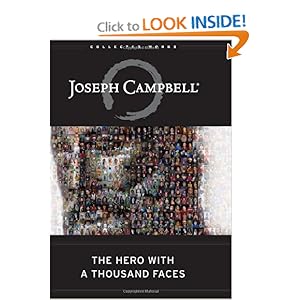
Joseph Campbell cut his academic teeth in the late 1940s with the book The Hero with a Thousand Faces, a comprehensive study of hero myths throughout the ages. He told Bill Moyers in The Power of Myth about the universal characteristics of the  "journey," actual or metaphorical, taken by the mythic hero. The hero sets out on a perilous quest, often in order to locate someone or something of great importance, such as the Holy Grail, that is lacking/missing/lost in the day-to-day world the hero knows. On his (or possibly her) journey, he undergoes many trials, tests, and ordeals; he may have close brushes with death; and, first with the help of wise mother figures and then of demanding father figures, he ultimately succeeds in his quest. After he wins, despite great adversity, he closes the circle of his journey, returning home with a boon in tow. The boon can be tangible or intangible, yet it must always be something beneficial to the hero's community. The benefit can be internal (spiritual) or external (physical, practical).

The latter sort of boon might be a sign that the hero has "performed a courageous act in battle or saved a life." The former kind is more subtle:

" ... the spiritual deed, in which the hero learns to experience the supernormal range of human spiritual life and then comes back with a message."

The Buddha
The beneficent "message" is like the one related by the Buddha, whose "journey" was partly geographic and partly a metaphorical one. After contemplating the true nature of reality while sitting under the famous Bo tree, he went around teaching others what he had discovered. Basically, the Buddha taught the various paths to a full "awakening" of the human soul.


* * * * *

A general description of the hero that Campbell gives to Moyers is:

"The hero is the one who comes to participate in life courageously and decently, in the way of nature, not in the way of personal rancor, disappointment, or revenge."

Another is:

"Even in popular novels, the main character is a hero or heroine who has found or done something beyond the normal range of achievement and experience. A hero is someone who has given his or her life to something bigger than oneself."

The hero can be a woman. Campbell, for example, tells Moyers:

"Giving birth is definitely a heroic deed, in that it is the giving over of oneself to the life of another."

The boon which the hero-mother carries back from her "journey" into childbirth is, of course, the child itself. The new human infant as a female hero's boon is a tangible reality as well as a spiritual one.

* * * * *

Yet the mythic hero, male or female, is not one who seeks ultimate union with "transcendence," a desideratum which Campbell identifies as the final destination of the human spirit. Rather:

"The hero’s sphere of action is not the transcendent but here, now, in the field of time, of good and evil — of the pairs of opposites."

The pairs of opposites? Why are they important in this discussion? Campbell says:

"Whenever one moves out of the transcendent, one comes into a field of opposites. One has eaten of the tree of knowledge, not only of good and evil, but of male and female, of right and wrong, of this and that, and of light and dark. Everything in the field of time is dual: past and future, dead and alive, being and nonbeing."

So the mythic hero operates in the dualistic "field of time," rather than seeking blissful unity with the eternal source of being. He is participating in life's game, says Campbell — a game which Campbell insightfully calls "a wonderful, wonderful opera — except that it hurts."

* * * * *

Joseph Campbell with
his wife, the dancer
Jean Erdman
Parallel with the distinction between, on the one hand, the field of time and its pairs of opposites, and, on the other hand, the eternal source of all that has being, there are two distinct aspects of mythic aware­ness. Campbell says:

"There’s a fine saying in India with respect to ... two orders of myths, the folk idea and the elementary idea. The folk aspect is called desi, which means 'provincial,' having to do with your society. That is for young people. It’s through that that the young person is brought into the society and is taught to go out and kill monsters. 'Okay, here’s a soldier suit, we’ve got the job for you.' But there’s also the elementary idea. The Sanskrit name for that is marga, which means 'path.' It’s the trail back to yourself. The myth comes from the imagination, and it leads back to it. The society teaches you what the myths are, and then it disengages you so that in your meditations you can follow the path right in."

The first aspect, desi — as in "Here’s a soldier suit, now go out and kill monsters ... " — seems to me to match up well with Richard Rohr's first-half-of-life description in Falling Upward: A Spirituality for the Two Halves of Life. Rohr even calls the transition to true second-half-of-life spirituality "discharging our loyal soldier," by which he means getting clear of that system of "impulse control" which has gotten us safely through the first half of life. Yet I think he misses, in this part of his discussion, the myth-hero aspect of wearing "a soldier suit" and slaying "monsters" which threaten the larger society.

Campbell does not miss it. He sees the value "for young people" of such soldier-suit heroism ... even if he, too, talks to Moyers more of the ultimate "trail back to yourself," or marga, that seems to me to correspond well with Rohr's notion of second-half-of-life spirituality.

* * * * *

My thought is that our churches and religions aren't teaching and supporting the "hero's journey" which our young people need first to set forth on, if they are ever to reach their "discharging their loyal soldier" transition into second-half-of-life spirituality. I believe (or so I suddenly find) that if religions did this, you wouldn't be able to keep the youngsters out of today's places of worship that are pretty much empty, or else filled with gray heads like mine.

Instead, the young are flocking to movie palaces to see the likes of Star Wars and Lord of the Rings, and The Chronicles of Narnia, and the "Harry Potter" series. All of these — and, I assume, newer films I have yet to see — are fundamentally about (you guessed it) heroes and their mythic journeys.

Some churches today are quite focused on teaching the (absent/not listening) youth "impulse control." By that I mean the traditional list of sins and taboos, sexual and otherwise. There's a very real place for that, of course, as necessary guidelines to keeping the hero's journey on track, rather than having it run off the rails. But "control" without "mission" is sterile; would-be heroes find it irrelevant to their needs.

* * * * *

Frodo Baggins
The mythic hero of J.R.R. Tolkien's Lord of the Rings trilogy is a Hobbit named Frodo Baggins. The Wizard Gandalf tells the diminutive Frodo that the land of Middle Earth is doomed to serve a power-mad, bodiless master of evil, Sauron, unless a certain golden ring is carried out of the Shire where the Hobbits have blissfully lived since time immemorial. The task falls to Frodo, who begins the story totally ignorant of any imminent danger. The danger now arises because Frodo's Uncle Bilbo had brought the One Ring back with him from his own youthful hero's journey.

The now-aged Bilbo knows full well he needs to relinquish the ring to his nephew, now that Bilbo is about to leave the Shire for the second time, to go off to Rivendell, elsewhere in Middle Earth, to write his memoirs. But somehow the ring keeps finding its way back into Bilbo's vest pocket — he hesitates to put it on his finger, because doing so renders him invisible to all but the maleficent Eye of Sauron. Gandalf has to remind Bilbo repeatedly to leave the ring behind.

The ring is a metaphor. It symbolizes, among other things, the psychological inertia that can keep us from crossing each necessary threshold into a new phase of life. Bilbo is about to enter the phase associated with old age, which, like all the successive stages of life, requires of him a new mindset. He will cultivate that mindset as he writes There and Back Again, recounting the tale of his first threshold-crossing when he as a young Hobbit set out on the hero's quest that Tolkien told of in his earlier book titled The Hobbit.

The One Ring
in Lord of the Rings
Once Frodo takes the ring, his own adventure begins. Accompanied by fellow Hobbit Samwise Gamgee, whom Gandalf adjures to keep watch over Frodo, and by two other Hobbits, Merry and Pippin, Frodo treks out of the Shire and soon has a near brush with death at the hands of the soulless Ring-Wraiths, who at Sauron's bidding seek to restore the One Ring to its evil master. To ward off his momentary demise, Frodo hastily puts the One Ring on his finger and disappears.This act, however, is the one thing Gandalf has told him he must never do, since it alone renders him visible to the archenemy.

This or any other use of the power of the ring, however well motivated, constitutes the equivalent of a sin; on this particular hero's journey, it is Frodo's taboo. Tolkien was a devout Roman Catholic, and although there is no reference to religion in Lord of the Rings, it is not hard to discern religious motifs just under the surface.

One such motif has to do with the self-sacrifice entered into willingly by Frodo, once it has become clear to him that he alone can carry the ring to the destroying fires of the Cracks of Doom, in Sauron's home realm of Mordor. Frodo ultimately succeeds in his arduous quest, but at the cost of losing his psychological ability to return to his home in the Shire and take up ordinary life there ever again. Instead, he goes off with the immortal Elven-folk as they retire from Middle Earth to the Undying Lands of the Valar.

The parallel in Christian belief is Christ's ascension into heaven. When Joseph Campbell tells Bill Moyers in The Power of Myth about the canonical adventure of the mythic hero, as found in all the world's mythologies, he includes Christ's birth, sojourn in the desert for 40 days, being thrice tempted by the devil, return to society with a message, death on a cross, resurrection, descent into hell to retrieve lost souls, and eventual ascension into heaven as an example of a mythic hero's journey.

Frodo can destroy the One Ring and save his Shire and all the other lands in Middle Earth only with the help of an extended band of heroes that include the four Hobbits; the Wizard Gandalf; Aragorn, the self-exiled King of Gondor; his steward Boromir and Boromir's brother Faramir; the Elf Legolas; and the Dwarf Gimli. This is the Fellowship of the Ring. Each member brings both weaknesses and strengths to what amounts to a mutually enabling "ring" of heroes who work together to destroy the physical One Ring, it's immaterial master Sauron, and Sauron's henchman, the turncoat Wizard Saruman.

The Eye of Sauron
So we have a symbolic contrast. The One Ring works to impede what might be called the soul's natural itinerary across life's thresholds toward ever greater consciousness, as Frodo finds when he learns one hard-to-accept truth after another over the course of his hero's adventure. His Fellowship of the Ring, by supporting him in his quest, nevertheless works to "unbind" all Middle Earth from the "One Ring to rule them all/And in the darkness bind them." Two "rings," as it were, exist: the first is a demonic parody of the life-affirming second.

The lesson here is that the greater conscious awareness each new life-stage brings — Campbell refers to it as an increased "experience" of being alive, and in the Bible we find the notion of attaining a greater "abundance" of life — is always paid for by some heroic sacrifice. Symbolically, when Aragorn's resumed reign at the end of the Lord of the Rings tale brings renewed joy to him and all his kingdom of Gondor, and when Sam Gamgee returns to the Shire to marry the true love who awaits him, it is due to Frodo's heroic self-sacrifice on behalf of all Middle Earth. The seeming distinction here between the hero and the beneficiary is, however, an arbitrary one. In actuality, just as we are all said to possess a "Christ within," we can likewise be said to possess a "Frodo within." Something old within us has to "die and go to heaven" each time something new is born.


Tuesday, July 09, 2013

A New Awakening, Part 17

I have in this ongoing series been investigating the wisdom of myth as it informs what I'm calling a hoped-for "new awakening" of spirituality in our society. I take as one of my main reference points the book and PBS television series The Power of Myth, in which, during the mid-1980s, Bill Moyers interviewed at great length the scholar of comparative mythology Joseph Campbell.

Fr. Richard Rohr's book Falling Upward: A Spirituality for the Two Halves of Life tells of a spiritual maturity that we gain only in, loosely speaking, the "second half" of our life. It is a fundamental change that sets how we act and think and what we are like apart from how we once acted and thought, and even who we once were. Yet first-half-of-life religion and second-half-of-life spirituality, however different they may seem on their face, are both absolutely valid and both equally needed.

That it is possible for us to shift gears spiritually, and that until we do so we never finally learn to do our own "sacred dance," is something of a riddle. In our early years — including much of our young-to-middle adulthood — we are, Rohr somewhat wryly says, understandably fixed on "externals, formulas, superficial emotions, flags and badges, correct rituals, Bible quotes, and special clothing, all of which largely substitute for actual spirituality." Only in our later years, if we have done our first-half task aright, does "this burning, this inner experience of God" become possible for us.

Richard Rohr
"Early-stage religion is largely preparing you," Rohr writes, "for the immense gift of this burning, this inner experience of God, as though creating a proper stable into which the Christ can be born." Put another way, "The first task is to build a strong 'container' or identity; the second is to find the contents that the container was meant to hold."

Yet, oddly enough, says Rohr, "Most of us are never told that we can set out from the known and the familiar to take a further journey. Our institutions and our expectations, including our churches, are almost entirely configured to encourage, support, reward, and validate the tasks of the first half of life."

That phrase, "further journey" crops up again and again in Rohr's text. It might well have been the author's alternate choice for the book's title. And here's a key thing: Before we can embark on our "further journey," we have to experience "some kind of falling," says Rohr. There has to be some sort of "necessary suffering." Accordingly: "In legends and literature, sacrifice of something to achieve something else is almost the only pattern. ... In Scripture, we see that the wrestling and wounding of Jacob are necessary for Jacob to become Israel ... and the death and resurrection of Jesus are necessary to create Christianity."

In his sadly now-out-of-print book Enchantments: Religion and the Power of the Word, Jesuit father Thomas M. King writes of a "second baptism," not by water but by "fire and spirit." It typically follows, he says, a parlous "night of the soul" in which old verities collapse and crumble around us. This "dark night" comes only after the bright day of our original devotion to God on High ... or to whatever other "enchantment" we have aligned ourselves with or been captured by. Our baptism by fire and spirit accordingly comes only after we have first undergone an intermediate time of questioning and disenchantment.

This is a paradox. First must come an "enchantment" — our original fealty to a religion, cult, or philosophy — after which our continued growth toward full spiritual maturity demands that we undergo a "disenchantment": we must leave behind all that originally brought us certainty, comfort, and security. Here we undergo the proverbial hero's journey. We need to journey far out of our original comfort zone, and then find that the problem we are actually called to solve in life isn't the one we initially confronted. Or, rather, we may find that it is the same problem, but that it is now somehow transformed.

This hero's journey, with a problem that we are called on to solve — and actually do solve — has a twofold outcome. The internal, spiritual result is that we finally learn to do our own "sacred dance." The external outcome is that we return from the journey with a boon to offer our community, our society, our land. Our compatriots — in Jesus's term, our "neighbors" — can now live life more abundantly in an everyday sense because we are now capable of living life more abundantly in an inner, spiritual sense.

Lord of the Rings author
J.R.R. Tolkien
I consider this the import of what happens to Aragorn in J.R.R. Tolkien's fantasy tale The Lord of the Rings. Aragorn is introduced as "Strider," a quasi-lowlife gifted in hunting, tracking, and living rough. It gradually becomes apparent that his present identity represents his fallen, "dark night" —or "dark knight"? — state, as he was born to be a king. He has for various reasons been dodging his destiny, but the quest of the Fellowship of the Ring to defeat the evil Sauron, along with his power-mad henchman Saruman, entangles Aragorn and elicits from him unstinting leadership and heroism. At the end of the narrative, he resumes his true identity and once more sits upon his rightful throne to rule his subjects in justice, abundance, and peace.

Aragorn's original "life problem" — whether and how to rule — can't be solved until he takes his hero's journey. When he comes home in triumph, the reality of his boon betokens that his original problem now has a solution, where it didn't before. Now he can reign over a peaceable kingdom that is no longer under dire threat from the forces of evil, personified by Sauron and Saruman.

All this sounds abstruse, stated baldly and without the candy-coating of mythical narrative. The mythical "hero's journey" — which Joseph Campbell ably documented in his 1949 book The Hero with a Thousand Faces — is, after all, but a metaphor. It symbolizes in narrative form the transition from first-half to second-half spirituality, from baptism by water to baptism by fire and spirit, inevitably by way of a dark night of the soul.

* * * * *

Clearly, Rohr considers his book to be mainly about second-half-of-life spirituality and the transition to it from the first half's distinctive preoccupations. Yet he does not short-shrift the first half of life. While we are young, he says, we must learn to "value law, tradition, custom, authority, boundaries, and morality of some clear sort. These containers give us the necessary security, continuity, predictability, impulse control, and ego structure that we need, before the chaos of real life shows up."

Put simply, our inner needs in the first half of life revolve around lawfulness. Rohr states, "Here is my conviction: without law in some form, and also without butting up against that law, we cannot move forward easily and naturally ... we have to have something hard and half good to rebel against."

This notion is indeed a subtle one. There has to be an authority figure who sets limits and boundaries for us, a set of rules, and a moral tradition that we take up in a respectful way. But we also must come to rebel against our society's "hard and half good" rules at some point.

Why the need for lawfulness and the need for rebellion, in proper sequence? Rohr says: "You need [to build] a very strong container to hold the contents and contradictions that arrive later in life. You ironically need a very strong ego structure to let go of your ego. You need to struggle with the rules more than a bit before you throw them out. You only internalize values by butting up against external values for a while. All of this builds the strong self that can positively obey Jesus — and 'die to itself.' "

What a conundrum! If what we ultimately seek, spiritually speaking, is to let go of our ego, how odd it is that we must start by creating a very strong ego in the first place. That clearly means we need to build our egos on something other than quicksand.

Writers on Christian spirituality
Richard Rohr and Thomas King
suggest they are all true,
in proper sequence ...
Yet we also need to, by acts of defiance and rebellion, chip away at the very foundation of our ego structure. That is what happens in our youth after we "butt up against" the norms of tradition that have been laid down for us by earlier generations. If we try to short-circuit the process by skipping over the crucial first stage, we will fail to gain the boon of the second stage.

Rohr states it this way: "In fact, far too many (especially women and disadvantaged people) have lived very warped and defeated lives because they tried to give up a self that was not there yet."

It seems that the full human "spirituality sequence" — the early preparation for our "hero's journey," the journey itself, and our ultimate return in triumph — is thus composed of a "baptism by water," early obedience to tradition, later rebellion, an inevitable "night of the soul," and then "baptism by fire and spirit" — at which point we have finally learned to do our own "sacred dance"!


Wednesday, September 17, 2008

Jungian Web Links

In recent weeks, in overlapping topics whose labels appear at the bottom of this post, I've been blogging about the psyche as mapped by Carl Jung, the Swiss psychologist who died in 1961. Through reading several books which I've mentioned in these posts, I have become convinced that Jung's insights speak volumes about our human capacity for spirituality — including my own Christian and Roman Catholic spirituality.

This post contains links to valuable information I've found on the Web concerning Jung's ideas.

The first link is to a lengthy but extremely readable article on "The Organization Leader as King, Warrior, Magician and Lover: How Jungian Archetypes Affect the Way Men Lead Organizations." This article, in addition to describing various organizational leadership styles in terms of Jungian archetypes, is a good introduction to the idea of archetypes in general:

Archetypes, in Jung's thought, are as basic as, and very similar to, instincts. They are power centers that are "hard-wired" into the psyche of every human being, whether male or female, that largely control, or at least provide channels for, our thought, speech and behavior ...

The purpose of this essay is to enlighten and empower male leaders and their male and female coworkers by describing how the positive and negative aspects of the King, Warrior, Magician, and Lover archetypes influence male behavior, the way men lead, and the way they follow leadership.


The second link is to the Symbol Watcher website, dedicated to "the search for meaning in cultural, artistic and dream imagery." A tasty appetizer for the smorgasbord of this site is the short, succinct "The Projection of Sarah Palin," which tells how the country has projected the archetype of the Great Mother upon the governor of Alaska, who has been tapped as the Republican nominee for vice president:

... the Great Mother is at once container, cherisher and guardian of life, as well as ruler, possessive controller/destroyer and seductress. ... we seem to have thrust some — if not all — of the Great Mother’s expansive powers onto Gov. Palin.


To me, the very fact that almost no one is neutral about Palin is indicative of the strength with which we are archetypally projecting an image onto her — whether or not we like the image! One of the advantages of a Jungian approach to understanding ourselves is that it allows us to step back and know that we are projecting. Giving full rein to our subjectivity and irrationality, then looking at it through Jungian eyes, can be the first step in reclaiming our reason and our objectivity.

My Roman Catholic faith calls me to be rational. The Church teaches the fundamental rationality of God above. Yet, paradoxically, for us the way to rationality can be through the chaos of the unconscious and its archetypal wisdom. Jungian Web links such as these may serve seekers as guideposts through the chaos and beacon lamps in the darkness.

Saturday, August 23, 2008

Quest for the Self, Part 1

At the bottom of this post there are a number of labels. If you click on any one of them, you'll see a list of earlier posts I've made. In many cases, the same posts show up in more than one list. That's because they all revolve around the thought of the late Swiss psychologist Carl Gustav Jung.

Jung mapped the depths of the human psyche. Among the things he found buried there, according to Murray Stein in his book Jung's Map of the Soul: An Introduction, are a "plurality of unconscious images and fantasies" (p. 153).

One of these images, or as Jung called them, "archetypes," depicts from the perspective of any male of our species an idealized bearer of humankind's feminine qualities: the perfect woman, so to speak. This female-ideal is the Anima (see Addressing the Anima). Jung's own Anima, once he had addressed it sufficiently and at great length — a process that took several years — led Jung to a interior experience of an even deeper archetype: the Self.

Stein calls the Self the "most fundamental feature of [Jung's] theory" of the human soul, as well as its "capstone" (p. 151). But the Self is even harder to describe than the Anima (or, in women, the Animus, an image of the masculine ideal which likewise serves its female possessor as a "spirit guide" to the Self).


The Self is, in fact, exquisitely hard to talk about precisely. Specifically because of what Jung called the Self's "transcendence," every correct statement that can be made about the Self is to some extent inadequate to conveying the Self's full truth in its entirety. (Stein, by the way, does not capitalize terms like "Self"; I usually do because I think it makes the discussion clearer.)

"Transcendence" is a term of convenience Jung used to suggest a realm of thought and experience past all opposites, beyond every either-or polarity. Jung thought of the Self as transcendent in this specific sense: if we say the Self is this, we naturally need to add that the Self could not also be that, where that is the opposite of this. But in the case of the Self, Jung taught, such conclusions are unwarranted, precisely because the Self is by its very nature a bridge uniting — or, again, transcending — all the various polarities of our human identity.

First of all, the Self lies beyond the usual subjectivity-objectivity divide, the conceptual opposition between our personal, subjective attitudes and what purports to be the objective truth about the world. For example, Stein writes:

For Jung, the self is paradoxically not oneself. It is more than one's subjectivity, and its essence lies beyond the subjective realm. The self [instead] forms the ground for the subject's commonality with the world, with the structures of Being. In the self, subject and object, ego and other are joined in a common field of structure and energy. (p. 152)


In Jungian terms, the "ego" is the part of the conscious mind we ordinarily think about whenever we say "I": it is what we believe (in the end, erroneously) to be the center of our being. Our own identity is intrinsically different, or so we think, from that of every other being, and any assertion that "ego and other are joined in a common field of structure and energy" is bunk. Hence, much of what we do in life is aimed at furthering the apparent needs of this supposedly unique ego which rules our individual consciousness, potentially at the expense of failing to serve or even opposing the true needs of our fellow men and women. We might be by virtue of our evolutionary heritage self-serving in the way any animal is self-serving, but we couldn't be truly selfish without having evolved an ego.

Yet Jung's interior experience, documented in his autobiography and in his many other writings, went beyond such ego/other oppositions to the realization that:

When the ego is well connected to the self, a person stands in relationship to a transcendent center and is precisely not narcissistically invested in nearsighted goals and short-term gains. In such persons there is an ego-free quality, as though they were consulting a deeper and wider reality than merely the practical, rational, and personal considerations typical of ego consciousness. (Stein, p. 152)


It is one of my preoccupations, in the many posts I've been making and continue to make about Jung in this blog, to try to peer into what his thought has to say about my Christianity, such as it is.

I say "such as it is" because it is regrettably an attenuated notion of God that I find I have in my personal experience, just now in my life.

Yet when I read books like Stein's and the several others I've mentioned in this group of posts about Jung, I find that contemplating Jung's ideas about the Self helps me regain something of the wonder and awe I formerly associated with my contemplation of a Judeo-Christian God.

Why? What's the connection? At a basic level, the answer is a simple one: Jung spoke of the Self as the imago Dei, the image of God within each one of us. Christian theology has it that we all bear such a stamp or spark of divinity, and Jung affirms the exact same thing in different terms:

At the most immediate level [in the hierarchy of agencies within the depths of the psyche] is the shadow, and over this the anima/animus ... stands as a superior authority and power. Presiding over the entire psychic government is the self, the ultimate authority and highest value: [Jung wrote that] "unity and totality stand at the highest point on the scale of objective values because their symbols can no longer be distinguished from the imago Dei." Jung contends that every one of us bears the God-image — the stamp of the self — within ourselves. We carry the mark of the archetype: typos [in Greek] means a stamp impressed on a coin, and arche means the original or master copy. Each human individual bears an impression of the archetype of the self. This is innate and given.

Since each of us is stamped with the imago Dei by virtue of being human, we are also in touch with [per Jung] "unity and totality [which] stand at the highest point on the scale of objective values." When needed, this intuitive knowledge can come to our assistance ... (Stein, pp. 158-9)

This idea that our intuitive, archetypal knowledge of God as imago Dei comes to our assistance when needed is like, to me as a Christan, the answer to a prayer.


Let me try to be as clear as I can: to Jung the Self is the imago Dei, a supreme, supernal archetype which in turn enshrines certain values above all others: unity, totality, and wholeness.

Bringing the Self into the field of conscious awareness takes power away from the unconscious Shadow by bringing it, too, into the province of ego-consciousness. The Shadow, which represents our "lower" nature — basically, the urges we inherit from our evolutionary forebears — is not destroyed, but it is "depotentiated" and brought into harmony with our other, "higher" nature, our spiritual destiny.

Realizing the Self likewise defuses the power of the Anima or Animus, in its destructive, negative aspect, to take over and ruin the personality.

In short, there is nothing in the psyche, no matter how unsavory at first blush, which cannot be redeemed through Self-realization. Parallels with the Christian message of redemption are obvious here.


Which leads me to the subject of Sin and Evil. (These words are not part of the Jungian vocabulary per se, but I am capitalizing them in deference to their importance in the Christian lexicon.)

It seems likely to me that many Christian theologians as well as lay believers would feel uncomfortable with the implications of Jung's theory towards traditional religious notions of Sin and Evil. In order to try to put my finger on why there would be such controversy, such resistance, let me begin by discussing Jung's thoughts about serpent-symbols.

According to Stein (pp. 162-168), Jung constructed an elaborate schema of wholeness as it pertains to the human soul. There are four levels represented by four three-dimensional double pyramids. I won't go into detail about those four structures, but these doubled pyramids, each pair having a single base in common, are bounded by five separating or terminating circles, each representing a level of attainable wholeness. It is the circles I want to concentrate on.

The highest circle of attainable wholeness is Anthropos, Jung's name for the spiritual ideal he identifies also as the ultimate goal of Self-realization. In Christian terms, Anthropos corresponds to angels, saints, and us after we die and go to heaven, or are redeemed and resurrected into a heaven-come-to-earth. Next lower in the hierarchy of circles is Homo, which corresponds to our everyday ideal of human perfection, rooted in our ordinary ego-consciousness. Below that is Serpens, the serpent, which is the symbolical root source of all animal wisdom and (perhaps surprisingly) deserves its own circle of wholeness on the diagram. The remaining two levels are Lapis, the wholeness associated with minerals and plant life, and Rotundum, the circle which roots the hierarchy of wholeness in the place where physical matter emerges from pure energy.

Of these five levels of wholeness which humans can know or experience, the serpent, according to Stein:

... symbolizes the self in its strongest and most blatant paradoxicality. On the one hand, it represents everything that is "snaky" in human nature: cold-blooded instincts of survival, territoriality, base physicality. On the other hand, it symbolizes the wisdom of the body and the instincts — somatic awareness, gut intuitions and instinctual knowledge. The serpent has traditionally been a paradoxical symbol, referring both to wisdom and to evil (or to the temptation to do evil). The serpent therefore symbolizes the most extreme tension of opposites within the self. (p. 165)


Christians know, of course, that Jesus advised his followers to be "wise as serpents and harmless as doves” (Matthew 10:16). Yet it is a serpent who tempts Eve, and through her, Adam, in the Garden of Eden.

In his schematic diagram of psychic wholeness, Jung placed the Serpens circle on a line or axis whose extremes are labeled Christus and Diabolus, Christ and the Devil. To me this line is evocative of a very natural Christian ambivalence toward the serpent-symbol. One the one hand, we have Christ affirming the wisdom of serpents. On the other, the Devil disguises himself as a serpent to tempt humankind into original sin.


As a Catholic Christian, I am attuned to Catholic ideas about Sin and Evil, which are different in nuanced ways from Evangelical ideas. Yet as the son of (lapsed) Baptist and Methodist parents, I respond to Evangelical ideas, too. When Pastor Rick Warren, during his Saddleback Civil Forum (see transcript here), asked presidential candidates Barack Obama and John McCain, "Does evil exist? And if it does, do we ignore it, do we negotiate with it, do we contain it, do we defeat it?", I pricked up my ears.

As one who is interested in following Jung's recommendations for heightened Christian awareness through Self-realization, I find I am made uncomfortable by the does-evil-exist question. Upon reflection, I have come up with this as an explanation. Christians who are deeply concerned with how presidential candidates answer such questions are, I imagine, intensely concerned to stay on the safe side — the "Christ side" — of the Christus-Diabolus line.

I find that staying on the "Christ side" of the line and not worrying about straying over to the "Diabolus side" is of less and less concern for me personally, on the other hand, as my spiritual trajectory takes me more and more into a Jungian perspective.

The Serpens circle is right in the middle of this Christus-Diabolus crucial line, though, and out of it spring the higher levels of Jungian wholeness represented by Homo, and then, above that, Anthropos. In bringing Jung's ideas about wholeness into my conscious awareness, I find I have already had to get used to the idea that what we might term the vertical axis of wholeness, the one that passes down through Anthropos, Homo, Serpens, etc., is located as close to Diabolus as it is to Christus.

Some years ago, I found my imagination stimulated by the new scientific ideas concerning chaos and, specifically, the "edge of chaos." The latter is an abstract dynamical region between predictable order and unpredictable chaos; evolution takes place there. The unique dynamics of the edge of chaos are such that rank novelty can emerge gracefully there, embodied in new life forms, and then be sustained indefinitely as life evolves into forms of greater and greater complexity.

In those days I wrote incessantly about the edge of chaos and made repeated mental pictures of it. I now believe these word pictures and mental images were versions of a standard Jungian symbol of the Self. For I imagined the evolutionary "tree of life" as being planted smack at the edge of chaos. To Jung, the tree, in that it represents growth and ascent, is a Self-symbol.

I quickly got hung up, though, on what seemed to me an obvious problem: the edge of chaos is as close to chaos, which is seemingly bad, as it is to order, which is seemingly good. The symbolism, in fact, precisely mimics the notion that in Jung's wholeness diagram, Serpens is equidistant from Christus and Diabolus.

I'll deal with the implications of that in Part 2 of this series.

Thursday, August 14, 2008

Middle-earth: It's a Jung World

According to psychologist Timothy R. O'Neill's 1979 book The Individuated Hobbit: Jung, Tolkien and the Archetypes of Middle-earth, J.R.R. Tolkien's fantasy world of Middle-earth is rife with symbolism. There is an intricate web of symbols in The Lord of the Rings, The Hobbit, and Tolkien's several other books, O'Neill writes. They evoke the theme of Self-realization.

In the theory of the human mind advanced by the Swiss psychologist Carl Gustav Jung (1875-1961), the Self archetype is a crucial component. Among the several archetypes in the collective unconscious, the Self is preeminent. To employ an Olympics metaphor, the realization of the hidden Self is the Jungian gold medal in the event of Life.

The Self is a King whose return is sorely needed. As the "potential controlling and organizing force of the personality" (p. 179), the Self starts out like Strider/Aragorn does in LOTR: without a throne. The conscious ego which seems to be the center of the personality is only a steward, à la the stewards of Gondor.

The ego-steward, however, is out of touch with the deep-seated forces of the unconscious. Left to their own devices, these deep-buried potencies can "inflate" into the conscious ego and, in combination with the ego which has become their puppet, rule the psyche in the way that Sauron as Dark Lord of Mordor did the wizard Saruman, and (were it not for the heroism of Frodo and the Fellowship of the Ring) nearly did all of Middle-earth.


In particular, the most worrisome potency in the unconscious depths is the Shadow. This archetypal nucleus serves to cluster together the attitudes and attributes we don't dare admit into everyday consciousness, and certainly not into the facade we put up for other people's benefit, the one which Jung called the Persona. The traits we deprecate in ourselves and others often stem from urges we have inherited from our evolutionary forebears. If animals do it and humans aren't supposed to do it, it is held in the unconscious Shadow.

Frodo's Shadow is personified as Gollum, aka Sméagol. Once an ordinary Hobbit like Frodo, Sméagol chanced upon the long-lost Ring that Frodo now inherits as LOTR begins. The Ring's inscription

One Ring to rule them all, One Ring to find them,
One Ring to bring them all, and in the darkness bind them

has the coda

... in the Land of Mordor, where the Shadows lie.

The Ring is emblematic of the power of the unconscious, for good or for ill. Those who merely covet its power to inflate the ego — the lust for which power has long since caused Sméagol to degenerate into the craven Gollum — wind up being destroyed by the Ring.

Yet the Ring, in its circular and golden perfection, is also a symbol of the Self in its ability to confer wholeness on the psyche, bringing all erstwhile oppositions into harmonious counterpoise. When Frodo destroys the One Ring in the Cracks of Doom, he "depotentiates" the destructive power of the Ring. Its health-conferring power remains, however, personified by the return of King Aragorn, crowned as Elessar to rule over the incipient Fourth Age of Middle-earth. (Elessar means "Elf-stone"; precious stones, jewels, and crystals, in their symmetry and perfection, serve Tolkien as symbols of the Self.)


O'Neill's is a lovely interpretation of Tolkienesque fantasy — to those of us who are inclined to believe in things Jungian, that is.

There aren't all that many of us these days. It is an interesting, and sad, commentary on the extent to which Jung's once well-received ideas have been declared radioactive by intellectual leaders of today and sealed off in watertight subterranean vessels of thought, that despite the massive popularity of the recent Lord of the Rings films, O'Neill's excellent 1979 book has not been reprinted by its publisher.

The basis of Jungian thought is that we, all of us, have certain inbuilt predispositions to response and belief. Jung called them "archetypes"; O'Neill relabels them "affect-images." O'Neill says in his glossary, under "affect-image":

A more contemporary name for the archetype; affect refers to the emotional domain of behavior, hence the term suggests the self-personification of an emotional complex. (p. 169)


A "complex," in turn, is "a cluster of thoughts, emotions and predispositions, which cluster together and share energy because of similarity" (p. 171).

At the center of each complex in the psyche is a particular archetype or affect-image, the source of the cluster's energy or numen. Jung called that energy "numen" to emphasize that it can seem to us an act of "divine will or divine power" (p. 176) when an archetypal complex emerges symbolically from the unconscious and becomes a source of conscious conviction and overt enthusiasm. Such irresistible powers are, indeed, the ones we are in the habit of calling "numinous."

So archetypes or affect-images are inbuilt numinous powers that predispose us to believe in certain things and respond in certain ways. They typically cloak themselves in symbols, in the way that God appeared to Moses behind a burning bush. There can be symbols within symbols: Jung called God or Yahweh — bush-covered or not — a symbol of the Self.


The things we believe in as a result of archetypal affect-images exerting influence over our conscious minds via symbols tend to be the symbols themselves, not the underlying archetypes: the Self-hiding Yahweh, not the hidden Self.

Most of the symbols we believe in — including, Jung thought, God as an incompletely specified symbol of the Self — tend to lead us down a garden path to "one-sidedness," unfortunately. O'Neill defines this as:

Over-emphasis on conscious pursuits, to the exclusion of unconscious creative promptings, which amounts to a denial of the non-conscious personal and collective personality, [that] produces a ... state of imbalance ... [which is] associated with disorder in Jungian theory. (p. 177)


Self-realization, per Jung, is the ultimate remedy to one-sidedness. It is achieved by a long, winding process of "individuation," the arduous task of becoming the unique individual one was "meant to be" — so-called because we usually start from a position of ceding too much power to the conscious Persona, the mask representing a collective, cultural, social idea of how we ought to behave, rather than the individual, personal imperatives of how we really are.


There is one other key potency in the unconscious mind. It is to me the most mysterious of all: the Anima.

The Anima is personified in Lord of the Rings by, among others, Galadriel, the royal Elf-lady who co-rules the forest realm of Lothlórien along with her husband, Lord Celeborn. In the early stages of Frodo's journey toward Mordor and the Cracks of Doom, Galadriel serves him as a sort of "spirit-guide" (p. 104), giving Frodo a look into her mirror that "reveals past and future" (p. 132).

Galadriel gives Frodo, as a talisman, a phial of light — a "beacon of consciousness" (p. 134) — which he will later use to good advantage "against the suffocating gloom" of the bloated arachnid Shelob, who tries to devour Frodo. (The female Shelob represents the Anima in its negative aspect.)

The light itself is symbolic of the male principle, but the vessel containing it is "associated with the female aspects of the [male] psyche, and reveals the transcending and guiding nature of the Lady of the Forest" (p. 132). In the male psyche, then, the Anima is the locus of the image of ideal femininity.

There is a parallel structure in the depths of the female psyche: the Animus. The Animus, in the depths of a woman's psyche, is the ideal image of masculinity.

So men have an Anima, and women have an Animus, and in both sexes the Anima/us is the gateway to the Self. We need to address our hidden Anima or Animus before Self-realization can happen.

When Frodo confers, late one night, with Galadriel, and looks into her magic mirror, he is addressing his Anima. Galadriel's "vision is long." As her mirror shows past and future to Frodo, she "peers into the unconscious with her all-seeing eyes" (p. 132). Here, "past and future" is symbolic of knowledge of the forgotten, unrevealed unconscious. When we have that, we are well on our way to Self-realization.


The Self-realization wrought by the sacrifice Frodo will eventually make at the Cracks of Doom is, alas, not to be his own.

Frodo and Sam make their way to the fiery mountain where the One Ring was forged, knowing that the only way to depotentiate (in Jungian terms) the negative aspect of its shadowy power and (in Tolkien's terms) to thwart Sauron is to return the Ring to whence it came. It must be consumed by the fire that made it.

As Tolkien relates the events, Frodo has to be helped by Sam even to get close to the Cracks of Doom, despite his erstwhile resolve. Then, at the last instant, he balks at throwing the Ring away ... as up pops Gollum, the personification of Frodo's own Shadow. Gollum tries to seize the Ring for himself before it ceases to exist. As Gollum and Frodo struggle, Frodo puts the Ring on his finger so as to disappear from view. Gollum proceeds to bite Frodo's finger off, and in so doing Gollum loses his balance and falls into the fire along with the Ring he has so haplessly claimed.

Symbolically, what has happened is that Frodo's Shadow, personified as Gollum, has perished along with the Ring symbolizing, potentially, the health-bringing, psyche-balancing, redeeming aspect of his own interior Self. In Jungian Self-realization, the Shadow is revealed to the ego and brought into balance with the other forces of the psyche; it is not destroyed or made to vanish. Accordingly, with Gollum gone, gone too is any hope for Frodo's own personal Self-realization.

This is why Frodo must depart for the Western Isles at the end of Lord of the Rings, along with Gandalf and the superannuated Elven folk. He must leave his beloved Shire behind. His sacrifice has made it possible for Middle-earth as a whole to find the peace and balance of Self-realization, under Aragorn's rule in the Fourth Age. Ironically, though, Frodo, though he is Middle-earth and the Shire's savior figure, must as a result of his heroism forever forego all hope of personal individuation.


We can respond to Tolkien's fantasy tales in Lord of the Rings and his other books as ripping good yarns, nothing else. We don't have to believe in the actual existence of Middle-earth, Hobbits, Elves, Dwarves, Orcs, wizards, magical incantations associated with rings, or any of the other counterfactual paraphernalia of the stories.

Yet Tolkien has charmed three-generations-and-counting with his renderings of what Jung called the archetypes of the collective unconscious. I do not count myself among the most susceptible, by any means. I never read or idolized Tolkien in my youth, the way some of my contemporaries did. I remember sitting in a theater in late 2001, not long after the Sept. 11 attacks, watching The Fellowship of the Ring. Next to me — our late-arriving group had had to split up into individual seats, owing to the vast popularity of the film — was a young woman, a stranger. She treated the scene where a dying Boromir admits that Aragorn, whose leadership he has resisted, is "My Captain, my King" as a three-hankie affair. In Jungian terms that I know now but didn't then, her archetypes were being "constellated." Translation: her buttons were being pushed, bigtime.

Jung mapped the deep parts of the soul where the buttons are situated. These are the very parts of the soul that Tolkien mined for his Ring trilogy and other Middle-earth tales. It's as simple as that.