Tuesday, July 09, 2013

A New Awakening, Part 17

I have in this ongoing series been investigating the wisdom of myth as it informs what I'm calling a hoped-for "new awakening" of spirituality in our society. I take as one of my main reference points the book and PBS television series The Power of Myth, in which, during the mid-1980s, Bill Moyers interviewed at great length the scholar of comparative mythology Joseph Campbell.

Fr. Richard Rohr's book Falling Upward: A Spirituality for the Two Halves of Life tells of a spiritual maturity that we gain only in, loosely speaking, the "second half" of our life. It is a fundamental change that sets how we act and think and what we are like apart from how we once acted and thought, and even who we once were. Yet first-half-of-life religion and second-half-of-life spirituality, however different they may seem on their face, are both absolutely valid and both equally needed.

That it is possible for us to shift gears spiritually, and that until we do so we never finally learn to do our own "sacred dance," is something of a riddle. In our early years — including much of our young-to-middle adulthood — we are, Rohr somewhat wryly says, understandably fixed on "externals, formulas, superficial emotions, flags and badges, correct rituals, Bible quotes, and special clothing, all of which largely substitute for actual spirituality." Only in our later years, if we have done our first-half task aright, does "this burning, this inner experience of God" become possible for us.

Richard Rohr
"Early-stage religion is largely preparing you," Rohr writes, "for the immense gift of this burning, this inner experience of God, as though creating a proper stable into which the Christ can be born." Put another way, "The first task is to build a strong 'container' or identity; the second is to find the contents that the container was meant to hold."

Yet, oddly enough, says Rohr, "Most of us are never told that we can set out from the known and the familiar to take a further journey. Our institutions and our expectations, including our churches, are almost entirely configured to encourage, support, reward, and validate the tasks of the first half of life."

That phrase, "further journey" crops up again and again in Rohr's text. It might well have been the author's alternate choice for the book's title. And here's a key thing: Before we can embark on our "further journey," we have to experience "some kind of falling," says Rohr. There has to be some sort of "necessary suffering." Accordingly: "In legends and literature, sacrifice of something to achieve something else is almost the only pattern. ... In Scripture, we see that the wrestling and wounding of Jacob are necessary for Jacob to become Israel ... and the death and resurrection of Jesus are necessary to create Christianity."

In his sadly now-out-of-print book Enchantments: Religion and the Power of the Word, Jesuit father Thomas M. King writes of a "second baptism," not by water but by "fire and spirit." It typically follows, he says, a parlous "night of the soul" in which old verities collapse and crumble around us. This "dark night" comes only after the bright day of our original devotion to God on High ... or to whatever other "enchantment" we have aligned ourselves with or been captured by. Our baptism by fire and spirit accordingly comes only after we have first undergone an intermediate time of questioning and disenchantment.

This is a paradox. First must come an "enchantment" — our original fealty to a religion, cult, or philosophy — after which our continued growth toward full spiritual maturity demands that we undergo a "disenchantment": we must leave behind all that originally brought us certainty, comfort, and security. Here we undergo the proverbial hero's journey. We need to journey far out of our original comfort zone, and then find that the problem we are actually called to solve in life isn't the one we initially confronted. Or, rather, we may find that it is the same problem, but that it is now somehow transformed.

This hero's journey, with a problem that we are called on to solve — and actually do solve — has a twofold outcome. The internal, spiritual result is that we finally learn to do our own "sacred dance." The external outcome is that we return from the journey with a boon to offer our community, our society, our land. Our compatriots — in Jesus's term, our "neighbors" — can now live life more abundantly in an everyday sense because we are now capable of living life more abundantly in an inner, spiritual sense.

Lord of the Rings author
J.R.R. Tolkien
I consider this the import of what happens to Aragorn in J.R.R. Tolkien's fantasy tale The Lord of the Rings. Aragorn is introduced as "Strider," a quasi-lowlife gifted in hunting, tracking, and living rough. It gradually becomes apparent that his present identity represents his fallen, "dark night" —or "dark knight"? — state, as he was born to be a king. He has for various reasons been dodging his destiny, but the quest of the Fellowship of the Ring to defeat the evil Sauron, along with his power-mad henchman Saruman, entangles Aragorn and elicits from him unstinting leadership and heroism. At the end of the narrative, he resumes his true identity and once more sits upon his rightful throne to rule his subjects in justice, abundance, and peace.

Aragorn's original "life problem" — whether and how to rule — can't be solved until he takes his hero's journey. When he comes home in triumph, the reality of his boon betokens that his original problem now has a solution, where it didn't before. Now he can reign over a peaceable kingdom that is no longer under dire threat from the forces of evil, personified by Sauron and Saruman.

All this sounds abstruse, stated baldly and without the candy-coating of mythical narrative. The mythical "hero's journey" — which Joseph Campbell ably documented in his 1949 book The Hero with a Thousand Faces — is, after all, but a metaphor. It symbolizes in narrative form the transition from first-half to second-half spirituality, from baptism by water to baptism by fire and spirit, inevitably by way of a dark night of the soul.

* * * * *

Clearly, Rohr considers his book to be mainly about second-half-of-life spirituality and the transition to it from the first half's distinctive preoccupations. Yet he does not short-shrift the first half of life. While we are young, he says, we must learn to "value law, tradition, custom, authority, boundaries, and morality of some clear sort. These containers give us the necessary security, continuity, predictability, impulse control, and ego structure that we need, before the chaos of real life shows up."

Put simply, our inner needs in the first half of life revolve around lawfulness. Rohr states, "Here is my conviction: without law in some form, and also without butting up against that law, we cannot move forward easily and naturally ... we have to have something hard and half good to rebel against."

This notion is indeed a subtle one. There has to be an authority figure who sets limits and boundaries for us, a set of rules, and a moral tradition that we take up in a respectful way. But we also must come to rebel against our society's "hard and half good" rules at some point.

Why the need for lawfulness and the need for rebellion, in proper sequence? Rohr says: "You need [to build] a very strong container to hold the contents and contradictions that arrive later in life. You ironically need a very strong ego structure to let go of your ego. You need to struggle with the rules more than a bit before you throw them out. You only internalize values by butting up against external values for a while. All of this builds the strong self that can positively obey Jesus — and 'die to itself.' "

What a conundrum! If what we ultimately seek, spiritually speaking, is to let go of our ego, how odd it is that we must start by creating a very strong ego in the first place. That clearly means we need to build our egos on something other than quicksand.

Writers on Christian spirituality
Richard Rohr and Thomas King
suggest they are all true,
in proper sequence ...
Yet we also need to, by acts of defiance and rebellion, chip away at the very foundation of our ego structure. That is what happens in our youth after we "butt up against" the norms of tradition that have been laid down for us by earlier generations. If we try to short-circuit the process by skipping over the crucial first stage, we will fail to gain the boon of the second stage.

Rohr states it this way: "In fact, far too many (especially women and disadvantaged people) have lived very warped and defeated lives because they tried to give up a self that was not there yet."

It seems that the full human "spirituality sequence" — the early preparation for our "hero's journey," the journey itself, and our ultimate return in triumph — is thus composed of a "baptism by water," early obedience to tradition, later rebellion, an inevitable "night of the soul," and then "baptism by fire and spirit" — at which point we have finally learned to do our own "sacred dance"!


Monday, July 01, 2013

A New Awakening, Part 16

I have in this ongoing series been investigating the wisdom of myth as it informs what I call a potential "new awakening" of spirituality in our society. I take as one of my main reference points the book and PBS television series The Power of Myth, in which, during the mid-1980s, Bill Moyers interviewed at great length the scholar of comparative mythology Joseph Campbell.

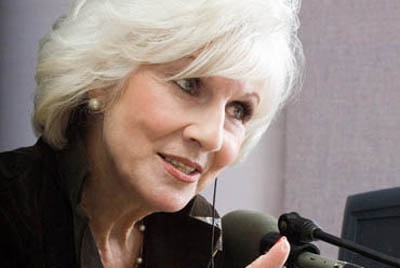
Diane Rehm of NPR
President Obama, before leaving on his recent tour of Africa, gave an address laying out new administrative policies to address climate change. The World Bank similarly called for concrete steps to combat global warming. I heard one reporter, Ruth Marcus, speaking on the Diane Rehm show on National Public Radio, call Obama's plans "the sleeper story of the week" — in view of Supreme Court decisions affirming gay marital rights but casting a shadow over minority voting rights, and of the Senate's passage of a comprehensive immigration bill.

Granted that gay rights, the voting rights of ethnic minorities, and immigration are issues of the first rank, why does the environment rate below them in prominence? Why does having the president finally sign on to controversial, long-awaited climate initiatives deserve a "sleeper" designation? Why is the environment always number eleven on the top ten list of urgent areas of political concern?

Is this "the environment"?
Where are we humans?
There are all sorts of contributory reasons, but I think the root cause is revealed by a careful scrutiny of the word "environment." The word suggests that the world is neatly divided into two parts: us, and everything around us. Everything other than us is "the environment," meaning something that is akin to a house that we live in, but are not of. We can modify our house at will to suit our likes and dislikes, or we can let the whole thing fall down around us if we want. After all, a house is just a thing.

Our instrumentalist view of the world is, however, just an illusion fostered by our religious orientation, Joseph Campbell tells Bill Moyers in The Power of Myth. They are discussing the ubiquity of snakes and serpents in various cultures' creation myths. In other cultures, Campbell says, the serpent represents “immortal energy and consciousness engaged in the field of time, constantly throwing off death and being born again.” The serpent in those cultures does not betoken evil.

But that changes in the Genesis account of Adam and Eve in the Garden of Eden:

Genesis 3:1: "Now the serpent was more subtil
than any beast of the field which
the LORD God had made."
“MOYERS: In the Christian story the serpent is the seducer.

“CAMPBELL: That amounts to a refusal to affirm life. In the biblical tradition we have inherited, life is corrupt, and every natural impulse is sinful unless it has been circumcised or baptized. The serpent was the one who brought sin into the world. And the woman was the one who handed the apple to man. This identification of the woman with sin, of the serpent with sin, and thus of life with sin, is the twist that has been given to the whole story in the biblical myth and doctrine of the Fall. ... The idea in the biblical tradition of the Fall is that nature as we know it is corrupt, sex in itself is corrupt, and the female as the epitome of sex is a corrupter.”

Our culture has, of late, done a great deal to X-out the traditional ideas that sex is corrupt and that women, temptresses all, are corrupters of men. But the Genesis idea that nature itself has been corrupted by Original Sin continues to encourage us to treat the natural world as a somehow tainted thing that we can legitimately scorn and at the same time exploit.

But this view of nature inherently distorts our understanding of who we are and what our life is all about, in Campbell's view. We as a species spring, via evolution, from what we now characterize as "the environment." Campbell says that the Garden of Eden, in a myth-aware view, symbolizes a state of being that is prior to the splitting of a primordial, eternal, timeless unity into a series of pairs of opposites: man and woman, life and death, good and evil, and so on. Thus do we live in a world where everything has its opposite. In our world of time, and of death following life, says Campbell, “the essence of life is this eating of itself! Life lives on lives ... .”

Chief Seattle
of the Duwamish Indians
The spirituality of cultures outside the orbit of the Book of Genesis, Campbell tells Moyers, encourages “the reconciliation of mind to [these] conditions of life.” Genesis, though, points us as Peoples of the Book — as Jews, Christians, and Muslims — toward a life outside this temporal world. It is a longed-for life, but it is one in which we can no longer say, along with Chief Seattle:

“The perfumed flowers are our sisters. The bear, the deer, the great eagle, these are our brothers. The rocky crests, the juices in the meadow, the body heat of the pony, and man, all belong to the same family.”

If this world is not our true home, all of what Chief Seattle wrote is nonsense. But if our true home is right here in this Earthly Kingdom, we had better find ways of inflecting our traditional religions toward the urgency of saving and preserving our "environment." And that isn't going to happen, I don't believe, unless and until there is a new awakening of myth-aware spirituality in the land.


Wednesday, June 26, 2013

A New Awakening, Part 15

I have in this ongoing series been investigating the wisdom of myth as it informs what I call a potential "new awakening" of spirituality in our society. I take as one of my main reference points the book and PBS television series The Power of Myth, in which, during the mid-1980s, Bill Moyers interviewed at great length the scholar of comparative mythology Joseph Campbell.

What will it take to have a new awakening of spirituality — a devotion to a newly hatched myth of the society of the entire planet, precisely as the late Joseph Campbell envisioned?

Chief Seattle
of the Duwamish
To me, the answer is clear — or, rather, I see it intellectually, even if I don't yet live it spiritually. The answer is set forth eloquently in the famous letter the Indian chief Seattle wrote to the U.S. Government as a reply to its offer to purchase the land in the Pacific Northwest long lived on by the chief and his tribe of Native Americans, the Duwamish. Campbell reads that letter to Bill Moyers in The Power of Myth, having first stated, “Chief Seattle was one of the last spokesmen of the Paleolithic moral order.”

I take that to mean that we moderns of European descent have to cast our minds all the way back to the Stone Age — Old, not New — to locate our Old World ancestors who thought like Chief Seattle.

The Central Pacific's engine Jupiter
and the Union Pacific's engine No. 119
meet on May 10, 1869,  at Promontory Summit, Utah.
Seattle wrote his letter to the white man's government in about 1852, seventeen years before the first transcontinental railroad was completed and the hegemony of white men in North America was there and then cemented into place. But Chief Seattle, even if we weren't listening, had informed us:

We are part of the earth and it is part of us. The perfumed flowers are our sisters. The bear, the deer, the great eagle, these are our brothers. The rocky crests, the juices in the meadow, the body heat of the pony, and man, all belong to the same family.

Later in the letter, in these words, he elaborated:

Will you teach your children what we have taught our children? That the earth is our mother? What befalls the earth befalls all the sons of the earth.

This we know: the earth does not belong to man, man belongs to the earth. All things are connected like the blood that unites us all. Man did not weave the web of life, he is merely a strand in it. Whatever he does to the web, he does to himself.

One thing we know: our god is also your god. The earth is precious to him and to harm the earth is to heap contempt on its creator.

And finally:

As we are part of the land, you too are part of the land. This earth is precious to us. It is also precious to you. One thing we know: there is only one God. No man, be he Red Man or White Man, can be apart. We are brothers after all.

Thomas Harrison Matteson,
The Last of the Race, 1847
His key points are accordingly: that all of us are brothers (and sisters), the whole world round; that no people's God is more true than any other people's God; that there is a single web of life on this Earth that unites all people and natural things and makes them all sacred; and that if we despoil the Earth, we defile ourselves.

Well, we have despoiled the Earth. Look at any belching smokestack and say otherwise. Concomitantly, we have spiritually defiled ourselves: to wit, only a minority of us seem to care all that much about the despoliation of the planet.

I'm not even sure how much I myself really care.

How  too much CO2
enters the atmosphere
After all, I look at that belching smokestack and imagine the coal that is being burned so that I personally can have the electricity I need to charge my iPad and run the computer I'm using to write this with. It bothers me that the CO2 in the coal-fired smoke warms the planet and endangers Chief Seattle's (and our) delicate "web of life," a web in which my own life is but one single strand.

It bothers me, yes ... but it doesn't bother me enough.

I know intellectually that every part of nature connects to every other sacred part, but the reason that I don't know it spiritually is that I don't have — we don't yet have — a myth of the whole planet that informs us of that fact, deep in the marrow of our bones.


Tuesday, June 18, 2013

A New Awakening, Part 14

I have in this ongoing series been investigating the wisdom of myth as it informs what I call a potential "new awakening" of spirituality in our society. I take as one of my main reference points the book and PBS television series The Power of Myth, in which, during the mid-1980s, Bill Moyers interviewed at great length the scholar of comparative mythology Joseph Campbell.

Joseph Campbell tells Bill Moyers in The Power of Myth that a new mythology is needed today. Even Campbell doesn't know what precisely it will be:

“You can’t predict what a myth is going to be any more than you can predict what you’re going to dream tonight. Myths and dreams come from the same place. They come from realizations of some kind that have then to find expression in symbolic form.”

Planet Earth
Still, the broad outlines of what that new myth will be are plain. It will be, Campbell says, a mythology of the whole planet:

“And what it will have to deal with will be exactly what all myths have dealt with — the maturation of the individual, from dependency through adulthood, through maturity, and then to the exit; and then how to relate to this society and how to relate this society to the world of nature and the cosmos. That’s what the myths have all talked about, and what this one’s got to talk about. But the society that it’s got to talk about is the society of the planet. And until that gets going, you don’t have anything.”

"The society of the planet" is something of which Campbell's prognosticated mythic conception was dealt a near-mortal blow when al-Qaeda hijacked American jets and crashed them into the Twin Towers of the World Trade Center in New York on 9/11/2001.

New Amsterdam in 1664
Campbell's view that there is a planet-encompassing society a-forming, one which will be accompanied by an appropriate planet-wide mythos, is cosmopolitan — as cosmopolitan as New York City has historically been, actually and symbolically, since a Dutch colony called New Amsterdam was founded as a trading center on Manhattan Island in 1625.

I'd say we today remain collectively unmoored, spiritually speaking, so long as we don't yet have a myth of the whole planet serving to anchor us in a symbol-rich narrative of who we are today.

The headlines on this particular day find President Obama in Europe attending a summit of G-8 leaders at which they wish to discuss new trade agreements to promote mutual prosperity. They will likely find themselves distracted by scuffles over such matters as the two-year-old civil war in Syria, with its attendant spillover of refugees and angst into neighboring countries, including Greece as a portal into a wider Europe; the looming problem of global warming and climate change, which no one seems able to find the political will to address substantively; and other issues such as what to do about the lingering economic woes in Europe and the United States.

Ground Zero
At home, Obama is still wrestling, so far unsuccessfully, with how to fulfill his promise to close the prison for suspected Islamist terrorists at Guantanamo Bay, Cuba. We quite understandably fear the rise of Islamism in today's world, which is our basic context for understanding recent events in Syria, in Libya, in Egypt, in Iran, in Iraq, in Afghanistan, in Bosnia. It is hard to dream big enough to generate a new mythos as long as we are haunted by the spectre of Ground Zero, no?

Islamism is not — repeat, not — representative of Islam, the great religion of which it is a demonic parody. Yet Islam is an Abrahamic religion rooted in the same prehistory that gave us the Hebrew and Christian scriptures. Campbell says of that scripture that it — unfortunately, if we need to radically change mythic course today — saddled us with a "biblical condemnation of nature”:

“God is separate from nature, and nature is condemned of God. It’s right there in Genesis: we are to be the masters of the world.”

If Biblical myth is holding us back today, what's the antidote? Campbell tells Moyers:

“But if you will think of ourselves as coming out of the earth, rather than having been thrown in here from somewhere else, you see that we are the earth, we are the consciousness of the earth. These are the eyes of the earth. And this is the voice of the earth.”

Gaia in Greek Mythology
Science has told us, Moyers mentions, of the Gaia Principle. Campbell calls it the notion of “the whole planet as an organism.” Gaia (pronounced GUY-uh or GAY-uh) was the Greek goddess of the Earth. The Gaia Principle is the somewhat controversial scientific hypothesis that all things on Earth, living or nonliving, are interconnected in such a way as to (says Wikipedia) form “a self-regulating, complex system that contributes to maintaining the conditions for life on the planet.” So when we humans get too big for our britches and start polluting the atmosphere with carbon dioxide, the oceans respond by taking up carbon and becoming more acidic — which is fine for some sea creatures but very bad for coral reefs.

If we see ourselves as "masters of the world," do we care about the odd coral reef here and there? We ought to. We are suffering from a spiritual "vitamin deficiency." We can't regain full health until we dream our new myth.

Yet we can't do that while the civilized world is fighting off jihadists at every turning, killers wedded to a twisted version of the old scriptural mythos that seems to nominate a singular, beloved-of-God "us" and an infidel "them," where the "them" must be stamped out by any means whatever. Jihadists insist on being "masters of the world" on their own bloody terms.

Meanwhile, Gaia herself is in huge trouble, climate-wise. Stay tuned for more fallout from that ...


Tuesday, June 11, 2013

A New Awakening, Part 13

I have in this ongoing series been investigating the wisdom of myth as it informs what I call a potential "new awakening" of spirituality in our society. I take as one of my main reference points the book and PBS television series The Power of Myth, in which, during the mid-1980s, Bill Moyers interviewed at great length the scholar of comparative mythology Joseph Campbell.

Gay marriage flag
In my previous post in this series, I talked about the touchy subject of moral issues that vex Catholics today. I mentioned abortion on demand, gay marriage, birth control paid for by universal health coverage, and in vitro fertilization. These are just a few of many such areas of concern, and their moral implications trouble serious non-Catholics as well as Catholics. Since I wrote that last post, I have found myself bothered by the question of just how the "new awakening" of myth-aware spirituality that I am recommending ought to deal with such issues of morality.

Birth control pills
Certainly, much of the discourse about religion we encounter in the media today tends to characterize religion as first and foremost a fount of moral teaching. Thus, if the Catholic Church objects to birth control mandatorily paid for by universal health insurance, and if such a policy on the part of the U.S. government appears to a majority of Americans to be right and proper, so much the worse for that church and for religion in general. Ergo, since I personally support birth control paid for by universal health coverage, my vaunted "new awakening" would seem to be injurious to my own Catholic Church and to religion in general.

That is not, however, what I really would like to happen.

What I have in mind is the hope that a boost to publicly visible, mythology-aware spirituality in our society would tend to keep people on track morally. Spiritual people, if their spirituality is properly grounded in the wisdom encoded in myth, are, I would hope, less prone to sin.

Yet that notion itself needs hasty qualification. Manifestly, people who remain immature and unformed morally are not likely to make that come true in their lives. Moreover, even relatively mature young adults are often subject to temptations that can swamp their moral inclinations and that older people are not as beset by or are more able to resist.

My belief is that there is a qualitative difference in what both mythology and religion can tell us about the two halves of a human lifetime. Setting aside our childhoods per se, our lives today split into, first, a period of years in which we are establishing our identity as independent adults, pursuing an education and gaining a livelihood, finding a marriage partner, producing our children, and so on. Then comes the second half of life, which begins sometime after the children have grown up and left the nest.

Fr. Richard Rohr
and his book
These ideas were crystallized for me, by the way, by reading Falling Upward: A Spirituality for the Two Halves of Life, by Fr. Richard Rohr. Rohr is a Franciscan friar and priest who has written a number of books of spiritual advice. I find his thinking to be pleasantly compatible with the insights of Joseph Campbell about the wisdom of myth.

Rohr's discussion of the two halves of life focuses, at least in the book's early going, mainly on life's second half. The reason is that institutional religion — my own Catholic Church and most other faiths — principally addresses the needs of those in life's first half. And, says Rohr, strong moral instruction and encouragement are clearly requisite for the younger faithful.

Rohr says that, spiritually if not practically, the first half of life is mainly for building a structure: specifically, creating a "container" for the aspect of the human psyche that psychologists label our ego. The second half of life is for "filling" that ego-container, once it has been set up. Rohr uses, from the teachings of Jesus, the analogy of the old wineskin that is expected to hold new wine.

Things change radically for us, Rohr says, as we enter life's second half, so radically that Jesus said our old wineskins will — quite shockingly — not suffice to hold our new wine. New wine, Jesus said, needs new wineskins. Rohr interprets this as meaning:

“The second half of life can hold some new wine because by then there should be some strong wineskins, some tested ways of holding our lives together. But that normally means that the container itself has to stretch, die in its present form, or even replace itself with something better. This is the big rub, as they say, but also the very source of our midlife excitement and discovery.”

There is, of course, a big paradox in the notion that the old container has to "replace itself with something better." (Myths and metaphors are good at presenting us with paradoxes.) Our “tested ways of holding our lives together” — the moral precepts we have incorporated into our original wineskins  — seem now to have to dissolve. Something else, some other force, has to step in to keep our new wine from spilling on the ground. That something else is represented, Rohr says, by the mature version of our human spiritual potential.

Rohr's book is to me as a 65-year-old a convincing argument that:

“ ... the task of the first half of life is to create a proper container for one's life and answer the first essential questions: 'What makes me significant?' 'How can I support myself?' and 'Who will go with me?' The task of the second half of life is, quite simply, to find the actual contents that this container was meant to hold and deliver.”

What in religion facilitates life's first-half task? One of the facets which does so is an absolutist approach to moral issues. For instance, it becomes that much harder for us to find the one who will "go with us" down the path of marriage and family if our church or society equivocates about sexuality. Moral rules against greed and thievery are needed to constrain our choices as to how we may support ourselves. Like teachings insist that we never inflate our own significance at the expense of other individuals, or of society at large.

Even so, says Rohr, when we get to life's second half we find — and here's where the big paradox comes in — that moral absolutism turns out to have its limits:

“We all want and need various certitudes, constants, and insurance policies at every stage of life. But we have to be careful, or they totally take over and become all-controlling needs, keeping us from further growth.”

"Metamorphoses of Amymone,"
scene from Greek mythology
(painting by Andrea Mantegna)
So when I say that a boost to publicly visible, myth-aware spirituality would tend automatically to keep people on track morally in our society, I have to quickly qualify it by adding that I'm referring generally to the mature, second-half-of-life version of our human spiritual potential.

Society's myths and spiritual metaphors, with all their attendant paradoxes, are of course shared by young and old alike. We can't conceal from the young the seeming contradiction that "growing up spiritually," as Rohr calls it, entails setting aside the rock-solid moral absolutism which youth quite properly hears from church pulpits. At the same time, the possibility of attaining spiritual maturity — constructing a new wineskin — depends crucially on our first having made and properly utilized the old, absolutist wineskin. And we can't do that without accepting the moral teaching appropriate to the first half of life, prior to the time when our human nature begins inexorably to fashion for us a whole new container for our spiritual wine.


Saturday, June 08, 2013

A New Awakening, Part 12

I have in this ongoing series been investigating the wisdom of myth as it informs what I call a potential "new awakening" of spirituality in our society. I take as one of my main reference points the book and PBS television series The Power of Myth, in which, during the mid-1980s, Bill Moyers interviewed at great length the scholar of comparative mythology Joseph Campbell.

In The Power of Myth, Joseph Campbell tells Bill Moyers that myth has four functions: the mystical, the cosmological, the sociological, and the pedagogical. The mystical function (a.k.a. the metaphysical function) is meant to lead us to awe before the mystery of creation, after which “the universe becomes, as it were, a holy picture.”

Carl Sagan, whose
Cosmos TV series
brought us a sense of awe
in the face of the discoveries

of modern science
The cosmological function of myth is to tell us “what the shape of the universe is, but showing it in such a way that the mystery again comes through.” At its best, Campbell says, our scientific awareness today is all about that.

The sociological function is for the purpose of “supporting and validating a certain social order,” Campbell says. “And here’s where the myths vary enormously from place to place. You can have a whole mythology for polygamy, a whole mythology for monogamy. Either one’s okay. It depends on where you are. It is this sociological function of myth that has taken over in our world — and it is out of date.”

Finally, the pedagogical function tells us “how to live a human lifetime under any circumstances. Myths,” according to Campbell, “can teach you that.”

Moses, who gave us the
Ten Commandments handed
down by God
Campbell makes clear throughout The Power of Myth that he strongly urges us to reclaim the fourth function of myth — and to an equally great extent, the first and second functions — and not so much the third. The validation of a particular social order boils down to, Campbell somewhat disparagingly says, “Ethical laws. The laws of life as it should be in the good society. All of Yahweh’s pages and pages and pages of what kind of clothes to wear, how to behave to each other, and so forth, in the first millennium B.C.” But those ancient laws are, he says, “out of date” today.

Many Catholics today would have a problem with that attitude. They would re-label the "ethical" the "moral" and instead insist on a "new evangelization" in behalf of the church as the teaching authority responsible for promulgating traditional moral rules that Campbell might call into question. (See this story in The Washington Post.) If polygamy is "okay," depending on "where you are" — on your social circumstances, that is — then such things as abortion on demand, gay marriage, birth control paid for by universal health coverage, and in vitro fertilization become moral questions whose answers are relative to time and place.

I personally find problematic any pooh-poohing of the sociological function of our religions and their underlying mythologies. My main reason is that we can't very well have a "new awakening" of spirituality based on the four functions of myth if one of the functions is effectively relegated to the trash heap.

Let me be as clear as I can about that touchy subject. I personally support such hot-button moral choices as abortion on demand, gay marriage, birth control paid for by universal health coverage, and in vitro fertilization. I think such moral questions are relative to time and place. But I recognize that such issues need to be resolved, over time, within a framework of sociological authority grounded ultimately in all four functions of myth. We can't completely peel off our ethical/moral debates from any "new awakening" of spirituality that might occur as we rediscover the "power of myth."

Friday, June 07, 2013

A New Awakening, Part 11

Bill Moyers introducing
The Power of Myth
I have in this ongoing series been investigating the wisdom of myth as it informs what I call a potential "new awakening" of spirituality in our society. I take as one of my main reference points the book and PBS television series The Power of Myth, in which, during the mid-1980s, Bill Moyers interviewed at great length the scholar of comparative mythology Joseph Campbell.

Campbell, who died not long after the series was completed, hoped for a new awareness of the importance of myth in human history and spirituality. But he was doubtful that that could occur any time soon. My hope is that perhaps, a quarter-century later, the time is now ripe.

Joseph Campbell
on The Power of Myth
PBS series
Campbell, as I am, was a Catholic. Unlike my own upbringing, which was not Catholic, Campbell's was in the Irish-American Catholic tradition. In talking to Moyers, he discusses what that meant to him:

“I was brought up as a Roman Catholic. Now, one of the great advantages of being brought up a Roman Catholic is that you’re taught to take myth seriously and to let it operate on your life and to live in terms of these mythic motifs. I was brought up in terms of the seasonal relationships to the cycle of Christ’s coming into the world, teaching in the world, dying, resurrecting, and returning to heaven. The ceremonies all through the year keep you in mind of the eternal core of all that changes in time. Sin is simply getting out of touch with that harmony.”

While still a young man, Campbell discovered other mythic motifs, such as those of the Delaware and Iroquois Indians. Moyers asks him whether their stories began to collide with his Catholic faith. Campbell responds:

“No, there was no collision. The collision with my religion came much later in relation to scientific studies and things of that kind. Later I became interested in Hinduism, and there were the same stories again. And in my graduate work I was dealing with the Arthurian medieval material, and there were the same stories again. So you can’t tell me that they’re not the same stories. I’ve been with them all my life. The themes are timeless, [while] the inflection is to the [particular] culture.”

Those particular cultures, though their mythic stories have common themes, can come into sectarian conflict in today's world. Campbell says:

“Look at Ireland. A group of Protestants was moved to [Northern] Ireland in the seventeenth century by Cromwell, and it never has opened up to the Catholic majority there. The Catholics and Protestants represent two totally different social systems, two different ideals.”

The solution? Campbell says:

The face of the Buddha
“Each needs [not a new myth but] its own myth, all the way. Love thine enemy. Open up. Don’t judge. All things are Buddha things. It is there in the myth. It is already there.”

I have to think Campbell's "own myth, all the way" orientation is crucial to us in this land of immigrants from all parts of the world who have brought diverse cultural outlooks here with us. We today, however, have taken the opposite approach to diversity and multiculturalism: the various mythic stories have been relegated to a set of private shelves in the public library, where they are never shared and compared. Secularism has replaced sectarianism in our public square.

My suggestion is that this approach has run its course, even though it has long seemed an entirely sensible strategy to keep the peace. Campbell refers to it this way:

“... in America we have people from all kinds of backgrounds, all in a cluster, together, and consequently law has become very important in this country. Lawyers and law are what hold us together.”

He is here lamenting that we'd be better off if held together by a shared "ethos":

“... in a culture that has been homogeneous for some time, there are a number of understood, unwritten rules by which people live. There is an ethos there, there is a mode, an understanding that, ‘we don’t do it that way.’ ”

Campell calls such an ethos an "unstated mythology":

“This is the way we use a fork and knife, this is the way we deal with people, and so forth. It’s not all written down in books.”

He implies, taking all this together, that we can bolster our ethos — our inbuilt sense of right and wrong — by figuring out how all our specific sectarian myths can together be taken "all the way": "Love thine enemy. Open up. Don’t judge. All things are Buddha things."

That notion of the ultimacy of "Buddha things" comes, of course, from Buddhism. Campbell has much to say to Moyers about Buddhism and "Buddha consciousness." That might seem a tilt in favor of one religion over all the others. Perhaps it is, but in Campbell's view the teachings of the Buddha and the lore of Buddhism represent something beyond ordinary religion. In fact, Campbell tells Moyers interprets the teachings of Christ as parallel to those of the Buddha. That is a subject I will explore further, later on.


Thursday, June 06, 2013

A New Awakening, Part 10

In this ongoing series, I've been considering how a "new awakening" of spirituality that is more aware of the wisdom of myth can benefit us today. I've been mentioning some of the problems we seem to be facing now, and then trying to show how a more myth-aware spirituality might help.

One of the leading problems today is climate change, a.k.a. global warming. Unlike problems such as sexual assault in the military or rising suicide rates among older age groups, climate change doesn't threaten us as individuals. It threatens us as communities, the whole world round. What can myth-aware spirituality say to us about such worries?

In "The Power of Myth," Joseph Campbell tells Bill Moyers that “there are two totally different orders of mythology. There is the mythology that relates you to your nature and to the natural world, of which you’re a part. And there is the mythology that is strictly sociological, linking you to a particular society. You are not simply a natural man, you are a member of a particular group.”

Our biblical traditions bequeath us a "strictly sociological" version of mythic awareness, not one that "relates you to your nature and to the natural world." Campbell says, “Usually the socially oriented system is of a nomadic people who are moving around, so you learn that’s where your center is, in that group.” The ancient Semites out of whose culture the Hebrews/Israelites emerged were nomads from the Arabian peninsula.

An artist's conception of
the Jewish patriarch Abraham
On the other hand, “The nature-oriented mythology would be of an earth-cultivating people.” The Semitic nomads conquered the earth-cultivating people in the Fertile Crescent to their north. Eventually the original Jewish patriarch Abram, who became Abraham, came out of that conquering culture. As a result, Campbell says that “the biblical tradition is a socially oriented mythology. Nature is condemned.”

Those of us whose heritage is European find, if we look back far enough into European prehistory, that nomads from the Asian steppes conquered the earth-cultivating peoples of the Mediterranean world. So later on, when biblical religion came to Europe, Europeans ultimately were (after centuries of resistance) receptive.

All that doesn't bode well for our times, given that we who are Jews, Christians, or Muslims today inherit that biblical, socially oriented mythology that thrived in the Middle East, in Europe, and in the Arab world.

We have tried to control nature during our history in Europe and on the North American continent. Our economic progress has depended on that effort. Campbell tells Moyers, “Nature religions are not attempts to control nature but to help you put yourself in accord with it. But when nature is thought of as evil, you don’t put yourself in accord with it, you control it, or try to, and hence the tension, the anxiety, the cutting down of forests, the annihilation of native people. And the accent here separates us from nature.”

So it would seem that any real attempt to deal with climate change will demand that we switch to the kind of mythological awareness that, in Campbell's words, "relates you to your nature and to the natural world."

A Japanese garden
Campbell contrasts the traditional Japanese nature religion, Shinto, with our biblical orientation. He says, “One of the Shinto texts says that the processes of nature cannot be evil. Every natural impulse is not to be corrected but to be sublimated, to be beautified.” That, he says, is why Japanese gardens are so lovely. “But in the Bible,” Campbell, says, “eternity withdraws, and nature is corrupt, nature has fallen. In biblical thinking, we live in exile.”

“We need myths that will identify the individual not with his local group but with the planet,” Campbell says about what is required now. Equivalently, we need new gods. “A god is a personification,” says Campbell, “of a motivating power or a value system that functions in human life and in the universe—the powers of your own body and of nature. The myths are metaphorical of spiritual potentiality in the human being, and the same powers that animate our life animate the life of the world.”

That's a different view of things than we are used to today. If the myths we need today are representative of potentialities that exist within us naturally, and if the gods we need personify nature's and our own human motivating powers, what happens to our traditional idea that we need to remain true to our God whom we picture as "out there" somwhere, sitting in judgment on us?


Wednesday, June 05, 2013

A New Awakening, Part 9

As I said in my last post in this ongoing series on how a "new awakening" of spirituality that is more aware of the wisdom of myth can benefit us today, elevated suicide rates among baby boomers following midlife are a symptom of the spiritual deficit faced by our society. We today are not exposed in a serious way to the old narratives that once informed the lives of people going back thousands of years. It shows up as an overweening emphasis on youth and a failure to learn how to properly move from youth into old age.

Confirmation that myths are crucial to our spirituality comes from Falling Upward: A Spirituality for the Two Halves of Life, a book by Fr. Richard Rohr:
Western rationalism no longer understands myths, and their importance, although almost all historic cultures did. We are the obvious exception, and have replaced these effective and healing story lines with ineffective, cruel, and disorienting narratives like communism, fascism, terrorism, mass production, and its counterpart, consumerism. ...
... myths proceed from the deep and collective unconscious of humanity. Our myths are stories or images that are not always true in particular but entirely true in general. They are usually not historical fact, but invariably they are spiritual genius. They hold life and death, the explainable and the unexplainable together as one; they hold together the paradoxes that the rational mind cannot process by itself. As good poetry does, myths make unclear and confused emotions brilliantly clear and life changing.
Myths are true basically because they work! A sacred myth keeps a people healthy, happy, and whole — even inside their pain. They give deep meaning, and pull us into “deep time” (which encompasses all time, past and future, geological and cosmological, and not just our little time or culture). Such stories are the very food of the soul ...
Fr. Richard Rohr
Rohr, who is a Franciscan friar and priest, calls the wisdom of myth "transrational," which means ...
... bigger than the rational mind can process; things like love, death, suffering, God, and infinity are transrational experiences. Both myth and mature religion understand this. The transrational has the capacity to keep us inside an open system and a larger horizon so that the soul, the heart, and the mind do not close down inside of small and constricted space. The merely rational mind is invariably dualistic, and divides the field of almost every moment between what it can presently understand and what it then deems “wrong” or untrue. Because the rational mind cannot process love or suffering, for example, it tends to either avoid them, deny them, or blame somebody for them, when in fact they are the greatest spiritual teachers of all, if we but allow them. Our loss of mythic consciousness has not served the last few centuries well, and has overseen the growth of rigid fundamentalism in all the world religions. Now we get trapped in destructive and “invisible” myths because we do not have the eyes to see how great healing myths function.
The blind Greek
poet Homer
Rohr interprets The Odyssey, the ancient epic by the blind Greek poet Homer about the journeys of the hero Odysseus, as mythic confirmation of the need for "a new and second journey," once the hero's first journey has been completed. The Odyssey is mostly about that first journey, but it hints at the second:
Instead of settling into quiet later years, Odysseus knows that he must heed the prophecy he has already received, but half forgotten, from the blind seer Teiresias and leave home once again. It is his fate, required by the gods.
Teiresias's prophecy had been stated this way by Homer:
Then came also the ghost of Theban Teiresias, with his golden sceptre in his hand.… When you get home you will take your revenge on these suitors of your wife; and after you have killed them by force or fraud in your own house, you must take a well-made oar and carry it on and on, till you come to a country where the people have never heard of the sea and do not even mix salt with their food, nor do they know anything about ships, and oars that are as the wings of a ship. I will give you this certain token which cannot escape your notice. A wayfarer will meet you and will say [your oar] must be a winnowing shovel that you have got upon your shoulder; on [hearing] this you must fix the oar in the ground and sacrifice a ram, a bull, and a boar to Neptune. Then go home and offer hecatombs [one hundred cattle] to the gods in heaven one after the other. As for yourself, death shall come to you from the sea, and your life shall ebb away very gently when you are full of years and peace of mind, and your people shall bless you. All that I have said will come true.
What does all that mean? Rohr points out that:
  • Odysseus had been traveling through Hades (the kingdom of the dead) when he heard the prophecy. In modern psychological understanding, Hades symbolizes the deconstruction of his conscious ego and his consequent ability to hear, and half-remember, Teiresias's words.
  • Teiresias's golden sceptre symbolizes the "divine source," the "authority from without and beyond," of Teiresias's message.
  • The "country where the people have never heard of the sea" symbolizes the need for the second journey to take Odysseus from his island home, Ithaca, to the mainland, i.e., it betokens that the "part" is being reconnected to the "whole." This is, Rohr says, "what makes something inherently religious: whatever reconnects (re-ligio) our parts to the Whole is an experience of God."
  • Going "inland" from the sea symbolizes the connection Odysseus must make to his "interior world, which is much of the task of the second half of life."
Rohr then interprets the further symbolism in the pithy prophesy of Teiresias, culminating in Odysseus ... 
... finally living inside the big and true picture; in Christian language, he is finally connected to the larger “Kingdom of God.” Odysseus ultimately will “live happily with my people around me, until I sink under the comfortable burden of years, and death will come to me gently from the sea.”
Odysseus is ready for death once he has made the second journey. The first journey was about his mastery of life's manifold challenges. The second, about his gaining the readiness for inevitable death.

Is this something that we in our culture are being taught today, by our formal religions or by the culture in general? Sadly, no.

More to come later ...


A New Awakening, Part 8

I continue my series of posts in which I try to show how a "new awakening" of spirituality that is more aware of the wisdom of myth, ancient and not-so-ancient — after all, J.R.R. Tolkien's Lord of the Rings trilogy is myth, as is George Lucas's Star Wars fantasy — can benefit us today:

"Baby boomers are killing themselves at an alarming rate, raising question: Why?" reads the headline of a Washington Post article of June 4, 2013. The article says that ...
... numbers released in May by the Centers for Disease Control and Prevention show a dramatic spike in suicides among middle-aged people, with the highest increases among men in their 50s, whose rate went up by nearly 50 percent to 30 per 100,000; and women in their early 60s, whose rate rose by nearly 60 percent (though it is still relatively low compared with men, at 7 in 100,000).
... psychologists and academics say [the trend] likely stems from a complex matrix of issues particular to a generation that vowed not to trust anyone older than 30 and who rocked out to lyrics such as, “I hope I die before I get old.”
“We’ve been a pretty youth-oriented generation,” said Bob Knight, professor of gerontology and psychology at the University of Southern California, who is also a baby boomer. “We haven’t idealized growing up and getting mature in the same way that other cohorts have.”
Even as they become grandparents and deal with normal signs of getting old, such as hearing and vision losses, many boomers are reluctant to accept the realities of aging, Knight said. To those growing up in the 1950s and ’60s, America seemed to promise a limitless array of possibilities. The Great Depression and World War II were over; medical innovations such as the polio vaccine and antibiotics appeared to wipe out disease and disability; the birth-control pill sparked a sexual revolution. The economy was thriving, and as they came of age, boomers embraced new ways of living — as civil rights activists, as hippies, as feminists, as war protesters.
“There was a sense of rebelliousness, of ‘I don’t want to live the way my parents did or their parents did,’ ” said Patrick Arbore, director and founder of the Center for Elderly Suicide Prevention at San Francisco’s Institute on Aging. “There was a lot of movement to different parts of the country. With that came a lot of freedom, but there also came a loss of connections. It was not uncommon to see people married three or four times.”
... Perhaps a little more adversity in youth could have helped prepare them for the inevitable indignities of aging, Knight suggested, adding that “the earlier-born cohorts are sort of tougher in the face of stress.” Despite the hardships of life in the first half of the 20th century, he said, older generations didn’t have the same kind of concept of being stressed out.
Older generations also had clearer milestones for success. “They won the Great War, they saved the world,” said David Jobes, a professor of psychology at Catholic University and a clinician at the Washington Psychological Center in Friendship Heights.
Baby boomers, on the other hand, have struggled more with existential questions of purpose and meaning. Growing up in a post-Freudian society, they were raised with a new vocabulary of emotional awareness and an emphasis on self-actualization. ...
... It doesn’t help to live in a society that continues to worship the young. “We don’t venerate our elders as some cultures do,” Jobes said.
A young
Joseph Campbell
Not "idealizing growing up and getting mature." Not "venerating our elders as some cultures do." Being "a pretty youth-oriented generation." Among the many factors the article mentions that explain the increase in suicide rates, these stand out to me as things which a myth-aware spirituality, à la the wisdom of Joseph Campbell in the PBS series and book The Power of Myth, might offset.

A young Bill Moyers
with President Lyndon
Baines Johnson
With respect to the culture of the ancient Greeks, Campbell points out to his interviewer, Bill Moyers:
There is a very strong accent on the human, and in the Greek myths, especially, on the humanity and glory of the beautiful youth. But [the Greeks] appreciate[d] age as well. You have the wise old man and the sage as respected characters in the Greek world.
How are we boomers supposed deal with "the inevitable indignities of aging," then? The lessons of myth-aware spirituality necessarily change between youth and old age. In The Power of Myth, Campbell and Bill Moyers have this exchange:
     MOYERS: So there are truths for older age and truths for children.
     CAMPBELL: Oh, yes. I remember the time [the interpreter of Indian religion] Heinrich Zimmer was lecturing at Columbia on the Hindu idea that all life is as a dream or a bubble; that all is maya, illusion. After his lecture a young woman came up to him and said, "Dr. Zimmer, that was a wonderful lecture on Indian philosophy! But maya — I don't get it — it doesn't speak to me."
     "Oh," he said, "don't be impatient! That's not for you yet, darling." And so it is: when you get older, and everyone you've known and originally lived for has passed away, and the world itself is passing, the maya myth comes in. But, for young people, the world is something yet to be met and dealt with and loved and learned from and fought with — and so, another mythology.
The young have "another mythology"! Put the other way around, the old have a different mythology than the young. Not only does our culture tend to suppress any awareness of the wisdom found in ancient myth; to the extent that such wisdom leaks through at all, the notion that the wisdom is different for those past midlife than for the young gets completely lost.

More on the wisdom of myth as it pertains to people in the second half of life in my next post, A New Awakening, Part 9 ...


Monday, June 03, 2013

A New Awakening, Part 7

In this series of posts I am re-exploring The Power of Myth, which is the title of the PBS TV series from the 1980s in which the scholar of myth Joseph Campbell was interviewed at length by Bill Moyers about why ancient sources of mythic wisdom ought to inform our spirituality today.

In this post I take a look at what the evolutionary history of the human brain tells us about the usefulness of myth.

Levels of the
cerebral cortex
The cerebral cortex of the human brain evolved over the span of evolutionary time with three main levels, and the human mind likewise has three levels. The two lower cortical levels were inherited from our reptilian ancestors (the lowest brain level) and from the earliest mammal species (the middle level). The topmost level is, among other things in the human, the seat of reason.

The top level is also the seat of the "I" — that is, the concept we each have of our unique individual self. Psychologists call it by the Latin pronoun for "I," "ego." The ego is not, in this way of speaking, the same thing as a swelled head. We all have egos, and we would not be human if we didn't.

Having three brain/mind levels opens us up, unfortunately, to conflicts among the three. Most of us let the topmost level take charge most of the time. The prerogatives of the "archicortex" (the oldest, "reptilian" brain) and the "paleocortex" (a.k.a. the "paleomammalian" brain) get trumped by those of the "neocortex" (the evolutionarily most recent, "neomammalian" addition which, among other things, makes us rational beings capable of civilized, moral behavior).

Yet if the neocortex is put entirely in charge, we become coldly analytical beings like the half-Vulcan Spock in "Star Trek" — except for those rare occasions when, at times of great stress, Spock's "human half" takes over.

The "Spock myth" tells us we are not fully human unless and until the older layers of the brain can be brought into harmony with the newest layer. Myths in general help with that. In fact, that may well be their prime function, as each of the four key functions of myth enumerated by Joseph Campbell are facets of the integration of the "self" that can take place if inner harmony is established:

  • The metaphysical function, awakening a sense of awe before the mystery of being, triggers an awareness of our role in the unfolding tapestry of time, as it helps put the individual ego in its proper (i.e., less absolute, more contingent) place with respect to the overarching claims of the eternal.
  • The cosmological function, explaining the shape of the universe, lets us come to see how the shape of our "inner universe" is echoed by the cosmos in its outward configuration.
  • The sociological function, validating and supporting the existing social order, tells us that we are not alone on the stage. We depend in every way on other people and on the stability of the society which we together create and maintain.
  • The pedagogical function, guiding the individual through the stages of life, takes us each along our personal "hero's journey" and lets us know what is and is not appropriate for us to be and do at each stage along the way.

Listening to myth in all four of those aspects, we can come to a sense of "the rapture of being alive," as Joseph Campbell described to Bill Moyers the ultimate spiritual destination we all seek. We put ourselves "in harmony with reality" precisely through our spirituality. "Myths," Campbell said, "are clues to the spiritual potentialities of the human life."

More later in this series ...


A New Awakening, Part 6

In this series of posts I'm exploring what it would take to have a "new awakening" of spirituality in America, along the lines of what Joseph Campbell prescribed for us back in the mid-1980s as he was interviewed at length by PBS's Bill Moyers for the TV series and book The Power of Myth.

Why study myth, Moyers asks Campbell? Campbell responds:
Myth helps you to put your mind in touch with this experience of being alive. It tells you what the experience is. Marriage, for example. What is marriage? The myth tells you what it is. It's the reunion of the separated duad. Originally you were one. You are now two in the world, but the recognition of the spiritual identity is what marriage is. It's different from a love affair. It has nothing to do with that. It's another mythological plane of experience. When people get married because they think it's a long-time love affair, they'll be divorced very soon, because all love affairs end in disappointment. But marriage is recognition of a spiritual identity. If we live a proper life, if our minds are on the right qualities in regarding the person of the opposite sex, we will find our proper male or female counterpart. But if we are distracted by certain sensuous interests, we'll marry the wrong person. By marrying the right person, we reconstruct the image of the incarnate God, and that's what marriage is. ...
I would say that if the marriage isn't a first priority in your life, you're not married. The marriage means the two that are one, the two become one flesh. If the marriage lasts long enough, and if you are acquiescing constantly to it instead of to individual personal whim, you come to realize that that is true — the two really are one.
If we have a problem today with rampant abuses of our sexuality in general, inter-gender sexual assaults, and rapes, can anyone imagine that problem to be completely separate from how we view marriage? We pay lip service to the idea of finding and marrying our soulmates, but admit it: our minds too often are "distracted by certain sensuous interests." How high does the divorce rate have to climb until we admit that we are generally at sea about finding that "spiritual identity" with the right person?

Campbell adds that marriage is not ultimately about sex or procreation:
There are two completely different stages of marriage. First is the youthful marriage following the wonderful impulse that nature has given us in the interplay of the sexes biologically in order to produce children. But there comes a time when the child graduates from the family and the couple is left. ... 
Marriage is a relationship. When you make the sacrifice in marriage, you're sacrificing not to each other but to unity in a relationship. The Chinese image of the Tao, with the dark and light interacting — that's the relationship of yang and yin, male and female, which is what a marriage is. And that's what you have become when you have married. You're no longer this one alone; your identity is in a relationship. Marriage is not a simple love affair, it's an ordeal, and the ordeal is the sacrifice of ego to a relationship in which two have become one.
Is a life of "doing one's own thing" inimical to marriage, Moyers then asks? Campbell responds that marriage ...
... is, in a sense, doing one's own thing, but the one isn't just you, it's the two together as one. And that's a purely mythological image signifying the sacrifice of the visible entity for a transcendent good. This is something that becomes beautifully realized in the second stage of marriage, what I call the alchemical stage, of the two experiencing that they are one.
Campbell then tells Moyers that our presumptive commitment at the altar to stay married "for better or for worse" is now only ... 
... the remnant of a ritual. ... If you want to find out what it means to have a society without any rituals, read the New York Times [for] the news of the day, including destructive and violent acts by young people who don't know how to behave in a civilized society.
I'm suggesting in this series (see "A New Awakening, Part 3") that a lot of today's crimes and personal misbehavior — bullying, sexual harassment, rape, etc. — are perpetrated by "adultescents," people who are well above the erstwhile threshold age of adulthood but are still only "half-adults." Another term for them is "post-adolescents."

One of the four primary functions of myth, Joseph Campbell said, is the pedagogical function: guiding the individual through the stages of life. That used to include stories which undergirded rites of initiation by which young people were ushered post haste into adulthood. It doesn't do so anymore ... which is one reason half-adult "adultescents" commit a plethora of depredations one would have thought rare in an "enlightened" society such as ours ...