Showing posts with label The Sibling Society. Show all posts

Wednesday, June 05, 2013

A New Awakening, Part 9

As I said in my last post in this ongoing series on how a "new awakening" of spirituality that is more aware of the wisdom of myth can benefit us today, elevated suicide rates among baby boomers following midlife are a symptom of the spiritual deficit faced by our society. We today are not exposed in a serious way to the old narratives that once informed the lives of people going back thousands of years. It shows up as an overweening emphasis on youth and a failure to learn how to properly move from youth into old age.

Confirmation that myths are crucial to our spirituality comes from Falling Upward: A Spirituality for the Two Halves of Life, a book by Fr. Richard Rohr:
Western rationalism no longer understands myths, and their importance, although almost all historic cultures did. We are the obvious exception, and have replaced these effective and healing story lines with ineffective, cruel, and disorienting narratives like communism, fascism, terrorism, mass production, and its counterpart, consumerism. ...
... myths proceed from the deep and collective unconscious of humanity. Our myths are stories or images that are not always true in particular but entirely true in general. They are usually not historical fact, but invariably they are spiritual genius. They hold life and death, the explainable and the unexplainable together as one; they hold together the paradoxes that the rational mind cannot process by itself. As good poetry does, myths make unclear and confused emotions brilliantly clear and life changing.
Myths are true basically because they work! A sacred myth keeps a people healthy, happy, and whole — even inside their pain. They give deep meaning, and pull us into “deep time” (which encompasses all time, past and future, geological and cosmological, and not just our little time or culture). Such stories are the very food of the soul ...
Fr. Richard Rohr
Rohr, who is a Franciscan friar and priest, calls the wisdom of myth "transrational," which means ...
... bigger than the rational mind can process; things like love, death, suffering, God, and infinity are transrational experiences. Both myth and mature religion understand this. The transrational has the capacity to keep us inside an open system and a larger horizon so that the soul, the heart, and the mind do not close down inside of small and constricted space. The merely rational mind is invariably dualistic, and divides the field of almost every moment between what it can presently understand and what it then deems “wrong” or untrue. Because the rational mind cannot process love or suffering, for example, it tends to either avoid them, deny them, or blame somebody for them, when in fact they are the greatest spiritual teachers of all, if we but allow them. Our loss of mythic consciousness has not served the last few centuries well, and has overseen the growth of rigid fundamentalism in all the world religions. Now we get trapped in destructive and “invisible” myths because we do not have the eyes to see how great healing myths function.
The blind Greek
poet Homer
Rohr interprets The Odyssey, the ancient epic by the blind Greek poet Homer about the journeys of the hero Odysseus, as mythic confirmation of the need for "a new and second journey," once the hero's first journey has been completed. The Odyssey is mostly about that first journey, but it hints at the second:
Instead of settling into quiet later years, Odysseus knows that he must heed the prophecy he has already received, but half forgotten, from the blind seer Teiresias and leave home once again. It is his fate, required by the gods.
Teiresias's prophecy had been stated this way by Homer:
Then came also the ghost of Theban Teiresias, with his golden sceptre in his hand.… When you get home you will take your revenge on these suitors of your wife; and after you have killed them by force or fraud in your own house, you must take a well-made oar and carry it on and on, till you come to a country where the people have never heard of the sea and do not even mix salt with their food, nor do they know anything about ships, and oars that are as the wings of a ship. I will give you this certain token which cannot escape your notice. A wayfarer will meet you and will say [your oar] must be a winnowing shovel that you have got upon your shoulder; on [hearing] this you must fix the oar in the ground and sacrifice a ram, a bull, and a boar to Neptune. Then go home and offer hecatombs [one hundred cattle] to the gods in heaven one after the other. As for yourself, death shall come to you from the sea, and your life shall ebb away very gently when you are full of years and peace of mind, and your people shall bless you. All that I have said will come true.
What does all that mean? Rohr points out that:
  • Odysseus had been traveling through Hades (the kingdom of the dead) when he heard the prophecy. In modern psychological understanding, Hades symbolizes the deconstruction of his conscious ego and his consequent ability to hear, and half-remember, Teiresias's words.
  • Teiresias's golden sceptre symbolizes the "divine source," the "authority from without and beyond," of Teiresias's message.
  • The "country where the people have never heard of the sea" symbolizes the need for the second journey to take Odysseus from his island home, Ithaca, to the mainland, i.e., it betokens that the "part" is being reconnected to the "whole." This is, Rohr says, "what makes something inherently religious: whatever reconnects (re-ligio) our parts to the Whole is an experience of God."
  • Going "inland" from the sea symbolizes the connection Odysseus must make to his "interior world, which is much of the task of the second half of life."
Rohr then interprets the further symbolism in the pithy prophesy of Teiresias, culminating in Odysseus ... 
... finally living inside the big and true picture; in Christian language, he is finally connected to the larger “Kingdom of God.” Odysseus ultimately will “live happily with my people around me, until I sink under the comfortable burden of years, and death will come to me gently from the sea.”
Odysseus is ready for death once he has made the second journey. The first journey was about his mastery of life's manifold challenges. The second, about his gaining the readiness for inevitable death.

Is this something that we in our culture are being taught today, by our formal religions or by the culture in general? Sadly, no.

More to come later ...


A New Awakening, Part 8

I continue my series of posts in which I try to show how a "new awakening" of spirituality that is more aware of the wisdom of myth, ancient and not-so-ancient — after all, J.R.R. Tolkien's Lord of the Rings trilogy is myth, as is George Lucas's Star Wars fantasy — can benefit us today:

"Baby boomers are killing themselves at an alarming rate, raising question: Why?" reads the headline of a Washington Post article of June 4, 2013. The article says that ...
... numbers released in May by the Centers for Disease Control and Prevention show a dramatic spike in suicides among middle-aged people, with the highest increases among men in their 50s, whose rate went up by nearly 50 percent to 30 per 100,000; and women in their early 60s, whose rate rose by nearly 60 percent (though it is still relatively low compared with men, at 7 in 100,000).
... psychologists and academics say [the trend] likely stems from a complex matrix of issues particular to a generation that vowed not to trust anyone older than 30 and who rocked out to lyrics such as, “I hope I die before I get old.”
“We’ve been a pretty youth-oriented generation,” said Bob Knight, professor of gerontology and psychology at the University of Southern California, who is also a baby boomer. “We haven’t idealized growing up and getting mature in the same way that other cohorts have.”
Even as they become grandparents and deal with normal signs of getting old, such as hearing and vision losses, many boomers are reluctant to accept the realities of aging, Knight said. To those growing up in the 1950s and ’60s, America seemed to promise a limitless array of possibilities. The Great Depression and World War II were over; medical innovations such as the polio vaccine and antibiotics appeared to wipe out disease and disability; the birth-control pill sparked a sexual revolution. The economy was thriving, and as they came of age, boomers embraced new ways of living — as civil rights activists, as hippies, as feminists, as war protesters.
“There was a sense of rebelliousness, of ‘I don’t want to live the way my parents did or their parents did,’ ” said Patrick Arbore, director and founder of the Center for Elderly Suicide Prevention at San Francisco’s Institute on Aging. “There was a lot of movement to different parts of the country. With that came a lot of freedom, but there also came a loss of connections. It was not uncommon to see people married three or four times.”
... Perhaps a little more adversity in youth could have helped prepare them for the inevitable indignities of aging, Knight suggested, adding that “the earlier-born cohorts are sort of tougher in the face of stress.” Despite the hardships of life in the first half of the 20th century, he said, older generations didn’t have the same kind of concept of being stressed out.
Older generations also had clearer milestones for success. “They won the Great War, they saved the world,” said David Jobes, a professor of psychology at Catholic University and a clinician at the Washington Psychological Center in Friendship Heights.
Baby boomers, on the other hand, have struggled more with existential questions of purpose and meaning. Growing up in a post-Freudian society, they were raised with a new vocabulary of emotional awareness and an emphasis on self-actualization. ...
... It doesn’t help to live in a society that continues to worship the young. “We don’t venerate our elders as some cultures do,” Jobes said.
A young
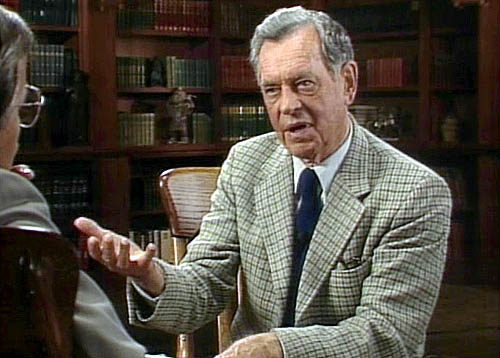
Joseph Campbell
Not "idealizing growing up and getting mature." Not "venerating our elders as some cultures do." Being "a pretty youth-oriented generation." Among the many factors the article mentions that explain the increase in suicide rates, these stand out to me as things which a myth-aware spirituality, à la the wisdom of Joseph Campbell in the PBS series and book The Power of Myth, might offset.

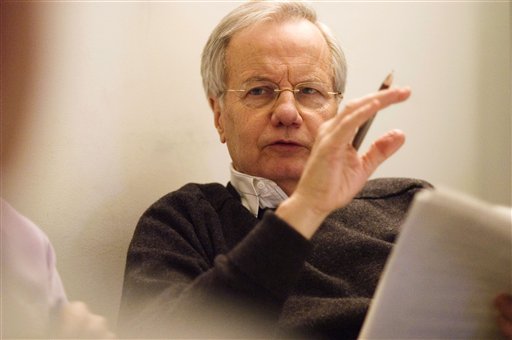
A young Bill Moyers
with President Lyndon
Baines Johnson
With respect to the culture of the ancient Greeks, Campbell points out to his interviewer, Bill Moyers:
There is a very strong accent on the human, and in the Greek myths, especially, on the humanity and glory of the beautiful youth. But [the Greeks] appreciate[d] age as well. You have the wise old man and the sage as respected characters in the Greek world.
How are we boomers supposed deal with "the inevitable indignities of aging," then? The lessons of myth-aware spirituality necessarily change between youth and old age. In The Power of Myth, Campbell and Bill Moyers have this exchange:
     MOYERS: So there are truths for older age and truths for children.
     CAMPBELL: Oh, yes. I remember the time [the interpreter of Indian religion] Heinrich Zimmer was lecturing at Columbia on the Hindu idea that all life is as a dream or a bubble; that all is maya, illusion. After his lecture a young woman came up to him and said, "Dr. Zimmer, that was a wonderful lecture on Indian philosophy! But maya — I don't get it — it doesn't speak to me."
     "Oh," he said, "don't be impatient! That's not for you yet, darling." And so it is: when you get older, and everyone you've known and originally lived for has passed away, and the world itself is passing, the maya myth comes in. But, for young people, the world is something yet to be met and dealt with and loved and learned from and fought with — and so, another mythology.
The young have "another mythology"! Put the other way around, the old have a different mythology than the young. Not only does our culture tend to suppress any awareness of the wisdom found in ancient myth; to the extent that such wisdom leaks through at all, the notion that the wisdom is different for those past midlife than for the young gets completely lost.

More on the wisdom of myth as it pertains to people in the second half of life in my next post, A New Awakening, Part 9 ...


Monday, June 03, 2013

A New Awakening, Part 7

In this series of posts I am re-exploring The Power of Myth, which is the title of the PBS TV series from the 1980s in which the scholar of myth Joseph Campbell was interviewed at length by Bill Moyers about why ancient sources of mythic wisdom ought to inform our spirituality today.

In this post I take a look at what the evolutionary history of the human brain tells us about the usefulness of myth.

Levels of the
cerebral cortex
The cerebral cortex of the human brain evolved over the span of evolutionary time with three main levels, and the human mind likewise has three levels. The two lower cortical levels were inherited from our reptilian ancestors (the lowest brain level) and from the earliest mammal species (the middle level). The topmost level is, among other things in the human, the seat of reason.

The top level is also the seat of the "I" — that is, the concept we each have of our unique individual self. Psychologists call it by the Latin pronoun for "I," "ego." The ego is not, in this way of speaking, the same thing as a swelled head. We all have egos, and we would not be human if we didn't.

Having three brain/mind levels opens us up, unfortunately, to conflicts among the three. Most of us let the topmost level take charge most of the time. The prerogatives of the "archicortex" (the oldest, "reptilian" brain) and the "paleocortex" (a.k.a. the "paleomammalian" brain) get trumped by those of the "neocortex" (the evolutionarily most recent, "neomammalian" addition which, among other things, makes us rational beings capable of civilized, moral behavior).

Yet if the neocortex is put entirely in charge, we become coldly analytical beings like the half-Vulcan Spock in "Star Trek" — except for those rare occasions when, at times of great stress, Spock's "human half" takes over.

The "Spock myth" tells us we are not fully human unless and until the older layers of the brain can be brought into harmony with the newest layer. Myths in general help with that. In fact, that may well be their prime function, as each of the four key functions of myth enumerated by Joseph Campbell are facets of the integration of the "self" that can take place if inner harmony is established:

  • The metaphysical function, awakening a sense of awe before the mystery of being, triggers an awareness of our role in the unfolding tapestry of time, as it helps put the individual ego in its proper (i.e., less absolute, more contingent) place with respect to the overarching claims of the eternal.
  • The cosmological function, explaining the shape of the universe, lets us come to see how the shape of our "inner universe" is echoed by the cosmos in its outward configuration.
  • The sociological function, validating and supporting the existing social order, tells us that we are not alone on the stage. We depend in every way on other people and on the stability of the society which we together create and maintain.
  • The pedagogical function, guiding the individual through the stages of life, takes us each along our personal "hero's journey" and lets us know what is and is not appropriate for us to be and do at each stage along the way.

Listening to myth in all four of those aspects, we can come to a sense of "the rapture of being alive," as Joseph Campbell described to Bill Moyers the ultimate spiritual destination we all seek. We put ourselves "in harmony with reality" precisely through our spirituality. "Myths," Campbell said, "are clues to the spiritual potentialities of the human life."

More later in this series ...


A New Awakening, Part 6

In this series of posts I'm exploring what it would take to have a "new awakening" of spirituality in America, along the lines of what Joseph Campbell prescribed for us back in the mid-1980s as he was interviewed at length by PBS's Bill Moyers for the TV series and book The Power of Myth.

Why study myth, Moyers asks Campbell? Campbell responds:
Myth helps you to put your mind in touch with this experience of being alive. It tells you what the experience is. Marriage, for example. What is marriage? The myth tells you what it is. It's the reunion of the separated duad. Originally you were one. You are now two in the world, but the recognition of the spiritual identity is what marriage is. It's different from a love affair. It has nothing to do with that. It's another mythological plane of experience. When people get married because they think it's a long-time love affair, they'll be divorced very soon, because all love affairs end in disappointment. But marriage is recognition of a spiritual identity. If we live a proper life, if our minds are on the right qualities in regarding the person of the opposite sex, we will find our proper male or female counterpart. But if we are distracted by certain sensuous interests, we'll marry the wrong person. By marrying the right person, we reconstruct the image of the incarnate God, and that's what marriage is. ...
I would say that if the marriage isn't a first priority in your life, you're not married. The marriage means the two that are one, the two become one flesh. If the marriage lasts long enough, and if you are acquiescing constantly to it instead of to individual personal whim, you come to realize that that is true — the two really are one.
If we have a problem today with rampant abuses of our sexuality in general, inter-gender sexual assaults, and rapes, can anyone imagine that problem to be completely separate from how we view marriage? We pay lip service to the idea of finding and marrying our soulmates, but admit it: our minds too often are "distracted by certain sensuous interests." How high does the divorce rate have to climb until we admit that we are generally at sea about finding that "spiritual identity" with the right person?

Campbell adds that marriage is not ultimately about sex or procreation:
There are two completely different stages of marriage. First is the youthful marriage following the wonderful impulse that nature has given us in the interplay of the sexes biologically in order to produce children. But there comes a time when the child graduates from the family and the couple is left. ... 
Marriage is a relationship. When you make the sacrifice in marriage, you're sacrificing not to each other but to unity in a relationship. The Chinese image of the Tao, with the dark and light interacting — that's the relationship of yang and yin, male and female, which is what a marriage is. And that's what you have become when you have married. You're no longer this one alone; your identity is in a relationship. Marriage is not a simple love affair, it's an ordeal, and the ordeal is the sacrifice of ego to a relationship in which two have become one.
Is a life of "doing one's own thing" inimical to marriage, Moyers then asks? Campbell responds that marriage ...
... is, in a sense, doing one's own thing, but the one isn't just you, it's the two together as one. And that's a purely mythological image signifying the sacrifice of the visible entity for a transcendent good. This is something that becomes beautifully realized in the second stage of marriage, what I call the alchemical stage, of the two experiencing that they are one.
Campbell then tells Moyers that our presumptive commitment at the altar to stay married "for better or for worse" is now only ... 
... the remnant of a ritual. ... If you want to find out what it means to have a society without any rituals, read the New York Times [for] the news of the day, including destructive and violent acts by young people who don't know how to behave in a civilized society.
I'm suggesting in this series (see "A New Awakening, Part 3") that a lot of today's crimes and personal misbehavior — bullying, sexual harassment, rape, etc. — are perpetrated by "adultescents," people who are well above the erstwhile threshold age of adulthood but are still only "half-adults." Another term for them is "post-adolescents."

One of the four primary functions of myth, Joseph Campbell said, is the pedagogical function: guiding the individual through the stages of life. That used to include stories which undergirded rites of initiation by which young people were ushered post haste into adulthood. It doesn't do so anymore ... which is one reason half-adult "adultescents" commit a plethora of depredations one would have thought rare in an "enlightened" society such as ours ...


A New Awakening, Part 5

So far in this series, I've suggested that much of the bad behavior that makes headlines today could be quelled if we have a "new awakening" of spirituality in America.

Bill Moyers
By spirituality I mean an outlook that is aware of the wisdom of ancient myths, which were stories that told us humans of who we are and what we are doing here. The late scholar of myth Joseph Campbell told PBS's Bill Moyers of that wisdom in 1985 and '86, in a series of interviews that became the TV series and book The Power of Myth.

Campbell, according to Moyers's introduction to the book ...
... believed there is a "point of wisdom beyond the conflicts of illusion and truth by which lives can be put back together again." Finding it is the "prime question of the time."
By "the conflicts of illusion and truth," I assume Campbell meant that, inasmuch as we are all heirs to the European Enlightenment, our modern tendency to be skeptics has been taken to an unfortunate extreme. We tend to pooh-pooh the idea of seeking ultimate spiritual truth. We say the various "masks of God," as delineated by Campbell in his twenty or so books, are but illusions and wishful thinking; they don't stand up to empirical investigation. Yet Moyers quotes Campbell as saying that every religion, every ritual, every myth presents us with  ...
... "the masks of eternity" that both cover and reveal "the Face of Glory."
What, then, is "the Face of Glory"? Is it God? Or is God himself a "mask of eternity"? Such questions necessarily lead us away from certainty and into the realm of mystery. Moyers's fuller quote is:
A spiritual man, [Campbell] found in the literature of faith those principles common to the human spirit. But they had to be liberated from tribal lien, or the religions of the world would remain — as in the Middle East and Northern Ireland today — the source of disdain and aggression. The images of God are many, he said, calling them "the masks of eternity" that both cover and reveal "the Face of Glory." He wanted to know what it means that God assumes such different masks in different cultures, yet how it is that comparable stories can be found in these divergent traditions — stories of creation, of virgin births, incarnations, death and resurrection, second comings, and judgment days. He liked the insight of the Hindu scripture: "Truth is one; the sages call it by many names." All our names and images for God are masks, he said, signifying the ultimate reality that by definition transcends language and art. A myth is a mask of God, too — a metaphor for what lies behind the visible world. However the mystic traditions differ, he said, they are in accord in calling us to a deeper awareness of the very act of living itself. The unpardonable sin, in Campbell's book, was the sin of inadvertence, of not being alert, not quite awake.
Since Moyers wrote that paragraph in his introduction to The Power of Myth well over twenty years ago, Northern Ireland has found peace ... but the Middle East has not. There, "disdain and aggression" and "tribal lien" yet rule. We in America are far better off, at first glance, than those who live and die in the Mideast. Yet we, too, have "tribes" across whose boundaries mutual suspicion is the order of the day. Just ask anyone who is a member of one of the "tea party" groups, or anyone involved in the recent Occupy Wall Street movement.

Meanwhile, many of our youths are addicted to the "disdain and aggression" and "tribal lien" embodied in their incredibly violent video games and in much of rap music. They would be well-served, in Campbell's view, to study and internalize the "comparable stories can be found in [our] divergent [faith] traditions."

But many of us believe such stories to have been quite properly discredited by science. Can we find a way past the seeming aversion of science to spirituality? Toward the end of his life, Moyers tells us in his introduction, Campbell strove "for a new synthesis of science and spirit." Sadly, I have to think he passed away without having found it. Maybe we can find it now.

Moyers writes:
"The shift from a geocentric to a heliocentric world view," [Campbell] wrote after the astronauts touched the moon [in 1969], "seemed to have removed man from the center — and the center seemed so important. Spiritually, however, the center is where sight is. Stand on a height and view the horizon. Stand on the moon and view the whole earth rising — even, by way of television, in your parlor." The result is an unprecedented expansion of horizon, one that could well serve in our age, as the ancient mythologies did in theirs, to cleanse the doors of perception "to the wonder, at once terrible and fascinating, of ourselves and of the universe." He argued that it is not science that has diminished human beings or divorced us from divinity. On the contrary, the new discoveries of science "rejoin us to the ancients" by enabling us to recognize in this whole universe "a reflection magnified of our own most inward nature; so that we are indeed its ears, its eyes, its thinking, and its speech — or, in theological terms, God's ears, God's eyes, God's thinking, and God's Word."
Can we now be "rejoined to the ancients," incorporating the breakthroughs of modern science into a truly inclusive spiritual awakening? Can we set aside "disdain and aggression" and "tribal lien"? Can we assume our destined roles as "God's ears, God's eyes, God's thinking, and God's Word"? Taken together, those truly amount to the "prime question of the time."

A New Awakening, Part 4

In earlier installments of this series, I've talked about the need for a "new awakening" of spirituality in America that would reunite us and bestow on us once again as a society the four primary functions of a mythological understanding of who we are and what we're doing here. According to the late Joseph Campbell, who spent a lifetime studying the wisdom of ancient mythological beliefs, mythology can have a fourfold function in human society even today:
  1. The metaphysical function: awakening a sense of awe before the mystery of being.
  2. The cosmological function: explaining the shape of the universe.
  3. The sociological function: validating and supporting the existing social order.
  4. The pedagogical function: guiding the individual through the stages of life.
Myth-aware understandings informed the spirituality of Europeans during medieval times and even into the Renaissance. Yet on the whole, the Renaissance set the stage for the eighteenth-century Enlightenment whose purpose was "to reform society using reason, challenge ideas grounded in tradition and faith, and advance knowledge through the scientific method. It promoted scientific thought, skepticism and intellectual interchange and opposed superstition, intolerance and ... abuses of power by the church and the state."

Accordingly, mythology was out. I'd like to see it come back into spiritual focus, in ways that Campbell discussed with PBS's Bill Moyers in the series of mid-1980s interviews collected as The Power of Myth.

But here's the rub. The Renaissance and the Enlightenment stand in sequence as successive engines of Western progress, or so the history books tell us. If, during the Renaissance, Europeans didn't engage in the Age of Discovery, there would be no America today. If not for the Enlightenment, science, industry, and technology could not have transformed the way we live.

Never mind that there have been no truly magnificent cathedrals built since the Middle Ages — a thought that was brought out by Campbell in his interviews with Moyers:
You can tell what's informing a society by what the tallest building is. When you approach a medieval town, the cathedral is the tallest thing in the place. When you approach an eighteenth-century town, it is the political palace that's the tallest thing in the place. And when you approach a modern city, the tallest places are the office buildings, the centers of economic life.
We all depend today more on office buildings than on "political palaces," and more on political palaces than on cathedrals. The twin towers of the World Trade Center that were destroyed in the September 11, 2001, attacks were apt symbols of what I'd call our "office-building priorities" in the present age.

U.S. Capitol
at night
Political palaces were quite common in post-medieval Europe. In our American context, we can think of the U.S. Capitol in Washington, with its lovely dome, as a sort of political palace.

Of course, the Washington Monument is taller, and as an obelisk, it reminds us of ancient Egyptian structures which held, for their builders, a symbolic significance. Obelisks, in the religion of ancient Egypt, were phallic or penis symbols related to the Egyptian Sun god, Ra. I personally have no objection to a spirituality that encompasses such frank symbolism. Yet I have to admit that many Christians would blanch at that idea.

What I'm seeking, hence, is a spiritual awakening that is open to the resonances of myths and symbols which Christianity has shut out for 2,000 years.

In the sixteenth century, there were of course Christian saints such as Teresa of Ávila and John of the Cross who, as mystics, taught a kind of spirituality that invests arcane symbols with profound significance for faith. Yet this is not the sort of teaching most Christian people are brought up to believe in today.

Joseph Campbell's thought encouraged just such an outlook. Here we have, unfortunately, the makings of a stark controversy in which defenders of the faith as it presents itself today will line up on one side, and "Campbellites" such as myself will line up on the other.


* * * * *

That's one major source of resistance to the kind of spiritual awakening I'm urging. Another is the very fact that our vaunted progress in the West has grown out of, as I say, attitudes the Enlightenment has imbued in us. We are consequently, as a culture, quite rich materially. Though some of us are indeed downright poor, most of us in America are far better off materially than most people who have lived in any other society that ever existed.

Plus, as beneficiaries of that material wealth, we today enjoy a great deal of freedom and personal sovereignty. Most of the impetus for the breaking of old taboos has been, indeed, a widespread search for ever greater individual freedom.

I'm recommending a spiritual awakening that would intrinsically serve to rein us in. It would do so not by forcing the old externally imposed no-no's on us, as much as by revivifying the systems of stories, teachings, and observances that would (as Joseph Campbell hoped) guide the individual through the various stages of life from early childhood to approaching death. With the right sort of guidance, as we ought to remember from past human experience, the individual soul can grow over its lifetime to incorporate, and ultimately render unnecessary, the requisite external strictures.

What, after all, is supposed to keep male members of the armed forces from bullying, harassing, assaulting, and even raping women in uniform? That's a question that is of major importance today, both in and of itself and because it can be taken to represent the entire gamut of misbehaviors, sexual and otherwise, that we read about in the papers every day. Wall Street greed? It, like a vast array of sexual crimes, grows out of the urges of the "lower" psyche, if those urges fail to be harnessed to the good of the community by shared belief systems that rein us in and keep us "on the line."

So, on the one hand, many religious conservatives will balk at what I am getting at, while on the other hand, those who are jealous of their material wealth and unfettered individual freedom will look askance.

But never mind. I intend to press ahead with my call for a "new awakening" of myth-aware spirituality in further posts in this series ...


A New Awakening, Part 3

In books such as The Power of Myth, a series of interviews conducted by PBS's Bill Moyers in the 1980s, the late Joseph Campbell laid out the wisdom he gained over a lifetime of studying human mythology. He said myths, rather than being disposable relics of ancient times, have four main functions even today:
  1. The metaphysical function: awakening a sense of awe before the mystery of being.
  2. The cosmological function: explaining the shape of the universe.
  3. The sociological function: validating and supporting the existing social order.
  4. The pedagogical function: guiding the individual through the stages of life.
In this series of posts I am exploring how a "new awakening" of myth-aware spirituality might help cure us of such ills as today's widespread acts of sexual harassment and assaults perpetrated by men on women in the military services, and other forms of sexual abuse and bullying in the wider society.

My personal entry point into this whole discussion has to do with what I consider today's near-total lack of Campbell's fourth function of mythology. Guiding us through the stages of life, according to the old myth-oriented way of organizing our lives, was accomplished by a system of regular celebrations that included rites of initiation. These were rituals that would swiftly convey teenagers from childhood into adulthood. They served to yank them into a new mode of being, after which the initiand would be able to participate as a full-fledged adult in the existing social order.

Poet and social critic
Robert Bly
My belief is that an awful lot of today's crimes of personal misbehavior — bullying, sexual harassment, rape, etc. — are perpetrated by "adultescents," people (not always males) who are well above the erstwhile threshold age of adulthood but are still (as Robert Bly calls them in The Sibling Society) "half-adults." Another term for them is "post-adolescents." Whatever they are called, many of them seem to be missing the internal constraints, seated within the personal soul, that traditionally put the brakes on our tendencies to misbehave.

The old codes of adult behavior reined in the "lower" aspects of the human psyche, those which are responsible for various behaviors, good and bad, associated with self-preservation, sexuality, aggression, and so forth. Those aspects of the psyche are fine in their proper context, the old codes said, but they need to be tempered by the "higher" aspects of the soul that give us
  • compassion, tenderness, and a capacity for unconditional love
  • a capacity for growth and maturation, including a sense of inner security amid life's chaotic vicissitudes
  • balance, inner guidance, and the ability to see the real, but hidden, relationships among things
  • ultimately, a sense of universal consciousness and unity
The personal misbehavior "graph" of our society has climbed steeply in recent decades, I am convinced. Yet I believe it was already climbing well before the onset of the "sexual revolution" in the 1960s, when kids such as myself looked around us and said, in effect, why not? Why not go ahead and violate all the old taboos, including those that said no sex outside of marriage? Why not ascribe the old no-no's to superstitions associated with nearly defunct religions? Why not, then, a lot of us said, fully abandon those old religions?

The old religions and mythologies served to rein us in, or at least tried to. They invited us to instead take what Campbell called the "hero's journey." He said that "by overcoming the dark passions, the hero symbolizes our ability to control the irrational savage within us." If we successfully complete the hero's journey, we find we have tamed the lower, darker aspects of the psyche.

Chartres Cathedral
But our religions have long lost sight of how myths further that journey aspect of faith ... and now we find we have too many empty pews on the sabbath. I think our religions began to lose their grip on us Westerners as far back as the time of the Renaissance which took place in Europe during the fourteenth through seventeenth centuries. We have to go all the way back to medieval times to find an ethos in which the old myth- and ritual-based spirituality was still on top.

Those were the times when the great Gothic cathedrals were built. Joseph Campbell goes into raptures when he describes the most beautiful of all, the cathedral at Chartres in France. He tells Bill Moyers of his visits there:
I consider Chartres my parish. I've been there often. When I was a student in Paris, I spent one whole weekend in the cathedral, studying every single figure there. I was there so much that the concierge came up to me one noontime and said, "Would you like to go up with me and ring the bells?" I said, "I sure would." So we climbed the tower up to the great bronze bell. There was a little platform like a seesaw. He stood on one end of the seesaw, and I stood on the other end of the seesaw, and there was a little bar there for us to hold on to. He gave the thing a push, and then he was on it, and I was on it. And we started going up and down, and the wind was blowing through our hair, up there in the cathedral, and then it began ringing underneath us -- "Bong, bong, bong." It was one of the most thrilling adventures of my life ... 
I'm back in the Middle Ages. I'm back in the world that I was brought up in as a child, the Roman Catholic spiritual-image world, and it is magnificent ... That cathedral talks to me about the spiritual information of the world. It's a place for meditation, just walking around, just sitting, just looking at those beautiful things ... 
Why do we like to talk about these things again? Because it puts us back in touch with the essential archetypology of our spiritual life. Going through a ritual day after day keeps you on the line.
A everyday way of doing things that keeps you "on the line" is something sorely lacking in today's culture. That, in a nutshell, is my complaint.

A New Awakening, Part 2

In this series of posts I am calling for a "new awakening" of spirituality in America, as an antidote to the widespread bad behavior we see displayed in news headlines every day. In particular, recently we have been told of widespread acts of sexual harassment and assaults perpetrated by men on women in the military services. I believe reform of how the military treats such cases is long overdue, but even the most far-reaching reforms won't cure the problem. The underlying problem, I think, is society-wide. It is, at base, a spiritual deficit.

A new awakening of spirituality would radically boost the spirituality quotient of us Americans, leading to a reduction in bad sexual behavior and in unwonted aggression such as bullying.

What that new awakening would precisely be like, though, I scarcely know. This is in part, for me, an ongoing investigation. Often, it is the negatives of the quest that tend to worry me.

One negative would of course be that of whose spirituality, whose religion, would be elevated. I'd like to see a spirituality that would transcend and unite the various separate religions. It's possible to bridge the gaps between religions, I firmly believe. All one has to do is read the works of Joseph Campbell, for instance, and take what he has to say to heart.

Joseph Campbell talking
to Bill Moyers
A good place to start is The Power of Myth, a book-length series of television interviews that PBS's Bill Moyers conducted not long before Campbell's death in 1987. Campbell spent a lifetime studying and comparing humankind's various systems of mythology, both past and present, and finding numerous common threads among our various religious beliefs.

Campbell held that our monotheistic religions (Judaism, Christianity, and Islam) are in fact myth-based — which is not to say the religions are untrue and therefore disposable. Yet he said that these religions that were once so dominant in the West have lost sight of their connections to the ancient mythologies and their concomitant modes of spirituality.

Campbell taught that mythology has a fourfold function in human society:
  1. The metaphysical function: awakening a sense of awe before the mystery of being.
  2. The cosmological function: explaining the shape of the universe.
  3. The sociological function: validating and supporting the existing social order.
  4. The pedagogical function: guiding the individual through the stages of life.
I'd say that we've pretty much lost sight of all four. The shape of the universe is now the province of science. The scientific discovery of the big bang as the origin of the universe commands our attention, no doubt, but for most of us it does not command our awe.

Awe and wonder may still strike us from time to time, such as when we go outdoors and look at a clear night sky ... provided we can get away from the bright lights and smog of cities and suburbs. But we've tossed away any sort of narrative that would validate and confirm that sense of wonder.

Meanwhile, we look to secular notions to support our social order. For us Westerners, those notions have their roots in the eighteenth-century Enlightenment in Europe. According to Wikipedia, the Enlightenment's purpose was "to reform society using reason, challenge ideas grounded in tradition and faith, and advance knowledge through the scientific method. It promoted scientific thought, skepticism and intellectual interchange and opposed superstition, intolerance and ... abuses of power by the church and the state."

That word "enlightenment" is likewise used in the East, in Buddhism, to mean the ultimate spiritual destination of human beings. Yet in the European Enlightenment, also called the Age of Reason, spiritual notions were rudely cast aside.

I believe that today we need to recover a broad-based spirituality that can reunite us and bestow on us as a society once again the four primary functions of a mythological understanding of who we are and what we're doing here. More on that in later posts in this series ...


A New Awakening, Part 1

Captain Anu Bhagwati
Former Marine Captain Anu Bhagwati writes in The Washington Post of May 26, 2013:


As a woman officer, Capt. Bhagwati sought to bring men in uniform who had committed rapes, sexual assaults, and sexual harassments to disciplinary justice. But the commanders above her — all of them were men — typically stonewalled her. Capt. Bhagwati tells us she wants to see more females in the higher ranks today, as a way of cutting through male officers' intransigence.

That's a good idea, but I think an insufficient one. Military culture abets and magnifies the problem of men treating women abominably. But I think the real problem is society-wide, and I think it can be remedied first and foremost through a spiritual awakening.

For various reasons, we today find ourselves in a society that is at a spiritual deficit. This has to do with much more than what's going on in our various formal religions — many of which are bearing up under woes not unlike the ongoing liberal-conservative contention within my own Roman Catholic Church. Polling by the Pew Forum on Religion & Public Life shows that a sizable proportion, about 14 percent, of Americans today are "nones," meaning many of them (68 percent of the "nones") believe in God, yet they are nonetheless unchurched.

Many of those who are unchurched are undoubtedly just fine spiritually, as are many of those who attend a church or a synagogue. Yet we see way too much bad behavior all around us. A lot of it is bad sexual behavior, pure and simple, but a lot comes in the form of unwonted aggression. Bullying, for instance, is unwonted aggression — and a lot of the nominally "sexual" offenses Capt. Bhagwati complains of in the military are actually a form of bullying.


It is one of the functions of spirituality to tame and redirect the energies that can otherwise manifest themselves as crimes of sex and aggression such as rape, sexual assault, and plain old bullying. That's why I'm calling for a "new awakening" that would radically boost the spirituality quotient of us Americans.

This is the first in a series of posts in which I will talk more about that.

Monday, May 20, 2013

The Sibling Society, Part 3

Washington Post writer
Sally Quinn
Robert Bly's 1996 book The Sibling Society: An Impassioned Call for the Rediscovery of Adulthood: does it have any relevance to the problem discussed by The Washington Post's Sally Quinn in her latest "On Faith" column? The column is titled "Sex assaults in the military: An epidemic that is being ignored," and its prime concern is that "there were about 26,000 incidents of sexual assault in the military last year ... an astounding average of more than 70 per day."

Why does the military, Quinn would like to know, seem to be unable — or unwilling — to ferret out and prosecute the miscreants who commit these heinous crimes? The writer seeks that there be "people ... going to jail" and "a court-martial in every case, and more people in power ... not just sputtering with outrage, but acting out of outrage."

Air Force Chief of Staff
Gen. Mark Welsh
But she sneers at a claim made by Air Force Chief of Staff Gen. Mark Welsh, in a hearing before Sen. Kirsten Gillibrand (D-N.Y.) and the Senate Armed Services Committee, that "roughly 20 percent of the young women who come into the Department of Defense and Air Force report they were sexually assaulted in some way before they came into the military. So they come in from a society where this occurs. Some of it is the hook-up mentality of junior high, even, and high school students now, which my children can tell you about from watching their friends and being frustrated by it.”

Quinn is wrong to sneer. According to Wikipedia, "In the United States, several studies since 1987 have shown that one in four college women have survived rape or attempted rape at some point in their lifetime ... It has been estimated that one in six American women has been or will be sexually assaulted during her life." Yes, the military culture can and does magnify the problem of sexual assaults and rapes, and yes, it also has means of investigating, prosecuting and punishing such crimes that do not apply in civilian affairs. But the underlying problem is society-wide, and just focusing on the situation in the military misses that.

Poet/social critic
Robert Bly
Robert Bly would say that the perpetrators of sexual assaults and rapes remain "half-adults," most of them. They, like the huge numbers of young people who do not commit such crimes, share the attribute of not being fully brought to maturity by the time they are nominally all grown up. That happens in part because our society has come to disparage the initiation rituals of old, the ones that were once associated with our world's primary religions, ancient mythologies, traditional folk customs, and the like.


The "sibling society" is Bly's metaphor for a world where "adults regress toward adolescence" and "adolescents . . . have no desire to become adults"; where admiration for elders has disappeared, tradition has eroded, ancestors have been forgotten; where the family is being destroyed everywhere, by everyone; where children's brains are addled by day-care and TV; where adolescents, lost and self-destructive, dwell in bastions of boredom called high schools; where parents, particularly fathers, have abdicated their archetypal roles; where mass culture provides not elders but movies about infantile "grumpy old men"; and where respect for ancient myths and tribal ritual has been replaced by the cynical self-centeredness of "do your own thing."

A "kingdom without a king," as Gerzon puts it, is a recipe for chaos, in Bly's view. I would add that it is also a recipe for "anything goes" when it comes to how half-adult men treat girls and women.

Michael Gerzon, author
of A House Divided:
Six Belief Systems
Struggling for America’s Soul
Never mind that I fully agree with Gerzon that:

By the time Bly reaches his epilogue, he seems to sense the one-sided quality of his argument. He allows himself to muse that perhaps there is "some good" or a "gift" buried in this flattening of hierarchy and questioning of authority. If so, he never finds it. Instead, he portrays everything through the same bitter, despairing lens.

Bly's book is a flawed vessel for an important idea: we need to reinvent the faith-based, spiritual, religious wisdom that can form us properly as human beings, so to head off the various sorts of misbehavior that boil over, in the military and outside it, as sexual assaults and rapes.


Monday, May 13, 2013

The Sibling Society, Part 2

Poet and social critic
Robert Bly
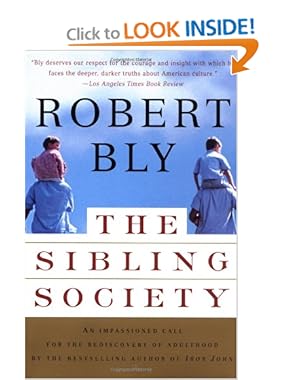
I like Robert Bly's 1996 book The Sibling Society: An Impassioned Call for the Rediscovery of Adulthood because it is a sweeping indictment of our culture for having lost sight of what human spirituality is really all about. I dislike the book for the very same reason.

I dislike that Bly aims his book at intellects as grand as his own; most of us are well below that mark. And his very premise confirms it: we in our culture have been actively divested of our ability to interpret poetry, scripture, myth, timeless folktales, and traditional fairy stories, an ancient ability that our great-great-great grandparents took for granted.

This divestiture has come at the hands of several groups of people who have imposed their alternate views of reality on us — secularists, all of them, first and foremost. They object to enshrining the "vertical dimension" of mythology, as Bly calls it, because it leads us away from pursuing the rational and the scientific.

Some of those who have stood in the way of Bly's call for revitalizing a cultural "verticality" have been feminists who, Bly maintains, entirely misunderstood Bly's earlier book, Iron John: A Book About Men (right), which its author says was not about resurrecting patriarchal values and such like.

Religious fundamentalists who interpret scripture with absolute literalness are likewise anti-Bly, for the simple reason that Bly is resolutely anti-fundamentalist. To interpret, say, the first chapter of Genesis literally is to miss what it really has to say to us about divinity and power.

In the realm of high-falutin' literary theory the proponents of "deconstruction," the notion that no written text possesses any iota of external authority, come in for Bly's scorn. In fact, Bly's very prose style is intrinsically authoritative, and his premise can be summarized as that human children, both male and female, need exposure to fatherly authority if they are to grow up properly.

Such things, admittedly, make me cringe. Why couldn't Bly have chosen a topic less radically opposed to the way our society has been moving in my lifetime?

But they also make me cheer, because deep down I agree with Bly in these matters.


Sunday, May 12, 2013

The Sibling Society, Part 1

Robert Bly's 1996 book The Sibling Society: An Impassioned Call for the Rediscovery of Adulthood has a lot to say to us now, as we try to sort out such matters as the lead story in today's print edition of The Washington Post, "Abuse cases up in military." The story informs us that "The Pentagon, using anonymous surveys and sampling research, estimated that 26,000 personnel experienced 'unwanted sexual contact' last year, up from about 19,300 in 2010, according to an ongoing Defense Department study." That's a two-year increase of 34.7 percent.

Furthermore, the "chief of the Air Force’s sexual assault prevention branch [Lt. Col. Jeffrey Krusinski] was arrested by Arlington County police early Sunday and charged with [wait for it ... ] sexual battery." Krusinski, while drunk at 12:30 a.m. last Sunday morning in a parking lot in Crystal City, Virginia, allegedly grabbed the breasts and buttocks of a civilian woman he did not know. She managed to fend him off and call 911. A 41-year-old officer, he's been relieved of his duties and will either be tried in a civilian court or court-martialed.

The Post story details the ways in which the Defense Department, the military, and Congress are suddenly trying to crack down on sexual assaults and rapes in the armed forces. My attitude is: Good! It's about time!

But it's also, I believe, just putting fingers in a dike that has sprung countless, and enormous, leaks in our society in recent decades. That's where Bly's book comes in.

I've been reading the book for some weeks now and trying to figure out how best to paraphrase it. Bly's notion of a "sibling society" is admittedly hard to grasp. Sibling is, of course, a word that includes our blood brothers and sisters. Bly now extends it outward to include all our age peers. And he says we are now, many or all of us, just "half-adults." (I prefer to call such people "post-adolescents" or "adultescents" instead.)

Bly calls us "siblings" to indicate that we in the last several generations have silenced the erstwhile voices of authority who, traditionally, handed down to us when we were children the norms and ethos of our ancestors. Those norms, that ethos, was derived from the word of God if we are Jews, Christians, or Muslims. If we are from other cultures such as that of the Hindus in India, they came down to us from the small-g "gods."

We've set all that aside, in part because we've become predominantly rationalist-secularist-humanist, and in part because it bears the stink of paternalism. The authority figures that passed along to us the norms and the ethos of our society have always been male — in particular, when we were growing up, our fathers. Today's feminists have labored long and hard to "deconstruct" that aspect of our culture.

Bly applauds feminism and the women's liberation movement — most of it. But he thinks we've tossed the baby out with the bathwater by abolishing the idea of the strong father who lives with his wife and children in a two-parent home and helps initiate his sons and his daughters into true adulthood.