Showing posts with label I and Thou. Show all posts

Tuesday, June 12, 2007

Douglas Hofstadter Is a Strange Loop

Douglas
Hofstadter's
I Am a
Strange Loop
I've begun reading Douglas Hofstadter's new book, I Am a Strange Loop. It takes up where his classic book Gödel, Escher, Bach left off almost 30 years ago — I talked about it in several earlier posts, most recently with "Brains and Thoughts." In Strange Loop, as in GEB, Hofstadter lays out a theory of how our brains work to produce a sense of self or "I."

In his introduction to the new book, Hofstadter restates the "overarching goal" of the former book: "to relate the concept of a human self and the mystery of consciousness to [Austrian mathematician/logician Kurt] Gödel's stunning discovery of a majestic wraparound self-referential structure (a 'strange loop,' as I later came to call it) in the very midst of a formidable bastion from which self-reference had been strictly banished by its audacious architects" (p. xiii).

The "formidable bastion" Hofstadter refers to was devised by mathematician/philosopher Bertrand Russell. Russell made an attempt to exorcise self-reference from the formal-logical system that he hoped to show could be made the basis of all mathematics: set theory. For that to happen, mathematical sets that contain themselves — as in "the set of all non-empty sets (including this one)" — had to be eliminated. They were seen by Russell as seeds of logical inconsistency. Banning them from set theory was, Hofstadter says, a counterproductive move which stripped Russell's Principia Mathematica, written with Alfred North Whitehead, of practical utility.


Gödel proved that formal systems of logic like Russell's either must harbor logical inconsistency, or else be "incomplete": unable to represent in symbolic fashion all knowable truths about themselves.

In accomplishing his remarkable proof of this insight Gödel found a way to arrange (see I Am a Strange Loop, p. xiii) for the "miraculous manufacture of self-reference out of a substrate of meaningless symbols."

Translation: formal systems of logic do nothing more than define "meaningless symbols" that can be combined in certain ways to make up symbol strings. Strictly speaking these strings, although they can often be mapped to statements in everyday language, are entirely devoid of meaning.

In a formal system there are also rules by which new symbol strings can be properly generated from existing, equally meaningless symbol strings.

In the proof of his so-called "Incompleteness Theorem," Gödel showed how these ordinarily semantically vacuous symbol strings could be co-opted to represent meaningful statements of truth ... truths about the very formal systems within which they exist.

By analogy, Hofstadter maintains, our "I"-ness likewise represents "the miraculous appearance of selves and souls in substrates consisting of inanimate matter" (p. xiii). Here, the substrate is not meaningless symbols but the physical material of the human brain. Hofstadter hopes to show how Gödelian self-reference might account for the arising, within that substrate, of the epiphenomenon of the self that we each call "I."


My initial problem with what Hofstadter is saying about the origin of our self-awareness is that he conflates that property of the human mind with "consciousness," and thus with "soul" itself.

As I discussed in a series of posts starting with "Quickening to Qualia, or Taking Consciousness Seriously" and ending with "The Mind's Enigmas," there are legitimate philosophical reasons for disagreeing with Hofstadter in his assumption that everything about the mind is physical — everything, that is, including the fact that we humans seem to be ineffably conscious.

In other words, we have subjective experiences. Philosophers of mind refer to the things we experience consciously and subjectively as "qualia" or "raw sensations." Why do we have these raw sensations of "what it is like" to (for instance) see the color red?

David J.
Chalmers's
The
Conscious
Mind
Such philosophers of mind as David J. Chalmers, author of The Conscious Mind: In Search of a Fundamental Theory, argue persuasively that our conscious awareness plays zero role in causing actual behavior on our parts. Everything we do, we would also do if we were "zombies" lacking consciousness entirely. Consciousness is accordingly not physical at all, to Chalmers. It supervenes on the physical, but it is wholly mental — "mind" and "matter" are to this extent different.

That's not to say that Chalmers thinks consciousness equates to soul, in the religious or theological sense of the word. As far as I can tell, he does not believe in God or the soul.

So a good question is, what are people like myself who believe in a God-given soul to make of Hofstadter's (or Chalmers') view of the mind?


Here's one possibility. Suppose we start from the notion that a soul is conferred upon each of us by virtue of the fact that God sees us from the first moment of our conception — and as he does so, he sees us as "Thou," not "It."

By "Thou," I mean what Martin Buber was getting at in I and Thou, the seminal work of philosophy in which he posits an "I-Thou" dialogue between man and God. No dialogue can happen unless each participant confers upon the other the status of "Thou" rather than "It." To see another as "It" is to treat that other as a thing, an object. In contrast, the ideal served by the Judeo-Christian belief in a God who is a person and not just a being is to treat the other — God himself, another human person — as we would wish to be treated, i.e., as "Thou."

For me to confer "Thouness" upon you, first I have to impute consciousness or sentience to you. I know that I have conscious experiences, and I assume you do too. It is that assumption which unlocks the door to conferring "Thouness."


Hofstadter, for instance, talks in Strange Loop of how he became a vegetarian. It all had to do with musings, which he started as a teenager, about what it means to have a self, or be an "I." In the course of thinking about the human self or soul, he became convinced that animals have souls, too — albeit, in some sense, "smaller" ones than we have. He posits a hierarchy of "interiority" or "souledness" such that mammals have "larger" amounts of it than chickens and other birds ... whose mini-souls are in turn larger than those of, say, mosquitoes. Over the course of several years he came to believe that to swat a mosquito is not wrong, but to eat a chicken is.

In the language of "Thouness," Hofstadter decided that he would confer the status of "Thou" rather than "It" on all animals that we customarily eat as meat — which meant he could no longer countenance eating them.


To have a soul is, then, to qualify as "Thou." If "soul" and "spirit" are the same, then God has a soul — the Holy Spirit — and is to be seen as "Thou." God sees each of us as "Thou"; ergo, we each have a soul. Maybe it's as simple as that — however hard it may be for us to keep this truth in mind as we go about our daily business.

If that's right, then the fact that each of us is conscious — has an interior sense of self, has subjective experiences, has sentience — makes us think of every other person as equally conscious. That is an essential prerequisite of our ability to confer "Thouness" on anyone who would otherwise be seen as "It."

Friday, October 27, 2006

I-Weaving-Thou?

Martin
Buber's
I and Thou
Martin Buber, in I and Thou, talks of "relation" as taking precedence over objects in the grand scheme of things. He identifies the two "vital primal words" out of which all "primal experiences" emerge as I–affecting–Thou and Thou-affecting-I (see pp. 21-22, Ronald Gregor Smith translation). These primal words get "split asunder" by us, in our wrongheadedness. The participle affecting is "given eminence as an object." The primal relation between oneself (I) and another (Thou) mutates into using Thou as a means to an end, the end usually being some sort of personal gratification. Thus does a separate "I" arise from I–Thou and thenceforth try to control things. In consequence, each Thou becomes an It: an object.

The Walter Kaufman translation of I and Thou pictured here renders these two words of primal relation as "I–acting–You" and "You–acting–I" (p. 73). Kaufman says in a footnote that the German original for "I–acting–You," Ich–wirkend–Du, is "as odd as the translation [he gives] above."

The German verb wirken means to act, to take effect, to operate, to weave. What if we think of Buber's primary words as connoting "I–weaving–You" and "You–weaving–I"? That would make it seem as if our separate and individual beings are somehow illusory, that each being has to be "woven" by another, and vice versa, out of the relation of one to the other that paradoxically takes precedence over being itself. Each relatant may possess some sort of intrnisic, inert substance — or not. But the intrinsic, inert substance of the individual relatants should not be confused with the reality they weave when they act together, one with another.


Thomas
M. King's
Enchantments:
Religion and
the Power of
the Word
The primacy of relation over being is a main concern of Thomas M. King in Enchantments: Religion and the Power of the Word.

In Plato's writings, the dialogue titled The Sophist has a protagonist named, simply, "the Stranger" (see pp. 168ff.) "The Sophist" is the Stranger's interlocutor. The Sophist uses verbal trickery to demonstrate that the higher world of Pure Being is All — so much so that the "lower world" in which we think we live is an illusory nonentity! There is no material world. There is only the true world of abstract ideas.

The Stranger dissents. He offers a different, albeit odd definition of what it means to exist (pp. 172-3):
My notion would be, that anything which possesses any sort of power to affect another, or to be affected by another, if only for a single moment, however trifling the cause and however slight the effect, has real existence; and I hold that the definition of being is simply power ([Greek] dunamis). ...

We said that a being was an active or passive energy, arising out of a certain power which proceeds from elements meeting with one another.

Here, the "elements meeting with one another" would seem to correspond to Buber's I and Thou. Power, dunamis (the Greek word from which we get dynamic), active or passive energy: these formulations contrast starkly with the everyday notion of brute objects or elements existing independently of relations, and only then entering into various relations with one another.


My limited understanding of quantum physics suggests to me that this is the message here as well: there are really no fixed "things" at the bottom of material existence. Rather, there are dynamic relationships among entities we (erroneously) think of as solid things.

These "things" are the quarks (the constituents of protons and neutrons) and the leptons (such as an electron). They are elusive, uncertain, indeterminate beings ... until, that is, we engage them, in the act of observing them. Our observation somehow "weaves" them into the sort of hard, firm, measurable existence we need them to furnish to us.


Another analogy comes from the world of music. A simpleminded view of music would be that it is made up of notes. Yet the real truth is that music is composed of relationships among notes.

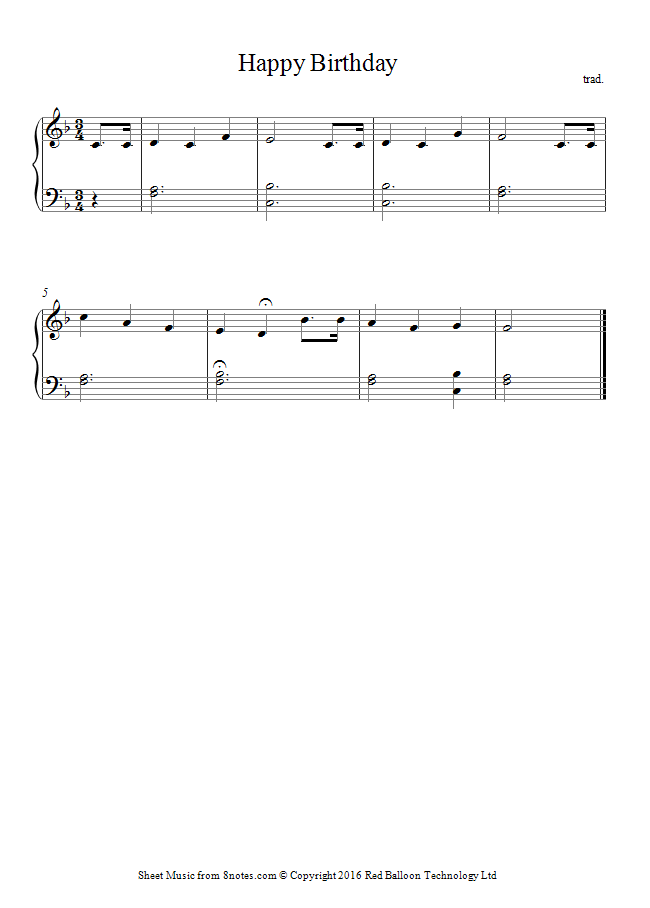
Take "Happy Birthday":Music readers can see that the first phrase ("Happy birthday to you...") has the notes C–C–D–C–F–E. Music theorists know that these represent tones 5–5–6–5–8–7 of the F Major scale, where, in effect, 8 (F) equals 1, the F an octave lower. The entire song ends on 8 or F. This is the tonal center of the song when the song is played in the key of F Major. The other tones — for instance, 5 or C — "want" to arrive at the tonal center.

Yet there is nothing intrinsic to C that makes it want to arrive at F. It is only the relationships that are set up among the various tones as the melody unfolds that make it clear to the ear that the final destination is, and has to be, F.

If "Happy Birthday" is transposed into the key of C Major, then the final destination becomes C. Tone 5 of that new scale is G. So all the C notes in the notation above become G notes, all the F notes become C notes, and so on — yet the tune, the tones, and the dynamic relationships remain the same!

Conclusion: whatever the intrinsic properties (if any) of the notes, what really counts is the dynamic relationships that are set up among the notes of the melody, even as it unfolds. It is as if the tones of the melody weave one another out of the material — the "yarn" or "thread" — of the otherwise inert notes.

Sunday, October 15, 2006

Consciousness, Relational Processes, and Immaterial Substance (Q2Q XIII)

David J.
Chalmers's
The
Conscious
Mind
This is the 13th in my "Quickening to Qualia" series of posts, the most recent of which was Mysterium Tremendum et Fascinans (Q2Q XII). One main topic has been the ideas of the philosopher of mind David J. Chalmers in The Conscious Mind: In Search of a Fundamental Theory. Chalmers's topic is consciousness, a.k.a. sentience or subjective experience.

An idea of what he means by consciousness comes from the question, "What is it like to see the color red?" The fact that it is "like" something to see red, says Chalmers, is odd enough to deserve explanation in and of itself, above and beyond any explanations that can be given of merely physical/functional brain activities.

Chalmers gives a lengthy philosophical argument as to why we ought to accord consciousness an unusual sort of existence: purely mental, in that the explanation of consciousness cannot be reduced to the level of workings of the merely physical or material constituents of the brain, i.e., the neurons.

He also argues to the conclusion that there is nothing logically necessary about consciousness's "supervenience" on physical facts: an imaginable "zombie world" just like ours except that our doppelgangers have no inner, subjective experience would be, he says, entirely possible. If we met these doppelgangers, their lack of sentience would by no means be apparent to us.

Ergo, Chalmers says, there must be a natural law associating conscious experience with the cognitive processing of information in such a way that it makes no difference to how we actually function in the world ... for if consciousness did make a difference, then we'd surely be able to tell our zombie doppelgangers weren't exactly like us.


I'd like to raise a possible objection to his arguments, but before I do so I'd like to mention my ulterior motive in doing it. It's a subtle one, and at the moment I'm not even quite sure whether my objection actually is going to serve its interests.

In my previous posts on the subject, I mentioned that Chalmers believes there is a special law of nature linking consciousness to cognition. That helps bolster the case for the God hypothesis, I felt. Chalmers himself, though not biased in favor of religion, speaks figuratively of God having to do "extra work" to introduce such a law into his creation. I simply removed the word "figuratively" from that thought and credited God with having made such a law so he could (eventually, once evolution had done its work) commune with creatures as sentient as he.

Since laying out my own arguments along those lines, I've been nagged by doubts. The notion of God doing "extra work" to establish a cognition-consciousness link makes him into a sort of artisan who, when he finds he needs an extra tool, proceeds to make one on the spot. In this case, the tool is an additional law of nature and not a tangible object in the material domain. Yet the picture is one of an ad hoc, tool-fashioning artisan.


Artisans manipulate and exploit things: objects, not subjects; in Martin Buber's lingo, they live off the domain of It, not in the domain of Thou.

Martin
Buber's
I and Thou
In his book I and Thou, Buber shows that God as "eternal Thou" looks for us to stand in I–Thou relationship with him. We, on the other hand, are apt to apply the "primary word" I–It to that and every other relationship we have. The first pronoun I in each of these primary words is not the same as the I in the other. The I of I–Thou is what God wants of us, not the I of I–It.

So, at least intuitively, it seems decidedly odd that God would start things off, creation-wise, by assuming an artisan-like I–It posture toward his creation. Such a posture, per Buber, does not rise to the level of true relation – as in, "In the beginning is relation" (see p. 18, Ronald Gregor Smith translation). For Buber, "relation" implies encounter and dialogue. But only one-way understanding and artisan-style exploitation are possible, when Thou collapses into It.


The way Chalmers speaks of consciousness makes an It of it, so to speak. By that I mean that in Chalmers's view sentience is but a glorified thing: a mental thing, true, but still a thing. It exists by virtue of a natural law or laws, just as material things come into being by virtue of the operation of natural laws. In the latter case, the laws are those of physics; in the former, they are putatively laws of mind. Still, the mechanism of conferring existence is the same. A law or laws exploits existing facts to create further facts. Nothing gets created ex nihilo. What already exists is merely refashioned and given new qualities.

To Buber, only I–Thou, or standing in mutual relation, is truly creative. I–It is but a cobbler, an artificer. Relation takes precedence over existence. (As for essence or being-qua-being, existent entities – relatants such as you or I and the eternal Thou – do possess it, it looks like, but it is unfathomable to us in this life; see pp. 86ff.)

My ulterior motive in challenging Chalmers is accordingly to take God out of the artisan business. I would prefer consciousness itself to be, in some sense, relational.


My takeoff point in trying to refute Chalmers comes from a fact about music. To wit, what it is like to experience hearing a note or a chord depends on its tonal context.

Most Western music is tonal. It sets up a key: a certain note, say C or D-flat, is established early on as the tonal center of the piece, the note to which the melody inevitably gravitates. Typically at the end of the piece, or of a section within the piece, the melody returns to the tonic note, leading the listener to experience a feeling of release of tension, resolution, and completion.

In addition to the melody, each piece of music has a harmonic structure, typically expressed as a series of chords accompanying the melody. This set of chord "changes" — also known as the chord "progression" — is as important to the musical experience as is the melody which the progression serves to set off. Each chord is usually based on one of the degrees of the scale defined by the key of the piece.

If the key is C Major, for example, the notes of the ascending melodic scale are C, D, E, F, G, A, and B, before the scale returns to the tonic C an octave higher. A chord based on the first scale degree, C, is said to be a (Roman numeral) I, or "one," chord. A chord based on the fifth scale degree, A, is a V, or "five," chord. So the chord Amaj ("A Major") is a V chord when the key is C Major.

A chord like Amaj is experienced differently when it is a V chord than when it is a I chord. The ear "hears" it as a source of tension and not a source of resolution. Same chord + different context = different experience.

The same is true of a single note. In C Minor, the note A brings tension and suspense, the high point of the melodic roller coaster. In the key of A Major, the very same note, A, signifies the end of the ride.

It is as if the experience of music is constituted by the associated contextual relationships. If it can be said that "consciousness exists" — which is in fact one of Chalmers's most basic assumptions — then perhaps existence per se is constituted by relation: perhaps the inner nature of reality itself is that it is constituted by dialogue!

Perhaps the information processing centers of the brain, as they encounter a piece of music that is being auditioned, are in dialogue with one another, and out of this dialogue pops conscious experience!

Or, maybe consciousness is dialogue. By virtue of it, the notes of the music can be said to be "talking to one another" within the mind somehow, and we experience that dialogue as "what it is like to hear music."

Consciousness might accordingly be the "shadow" of the relationships that arise among the various physical components of the mind as they go about their separate-but-intertwined information-processing duties. If so, then Chalmers may be wrong: there are no actual "facts" of conscious experience (see p. 161). Conscious experiences would lack facts and properties as well, because they are only the "shadows" of relations.


According to Chalmers, the "properties" of consciousness are its qualia: the qualitative "feels" that are associated with our subjective experiences. If we see something that is red, the quale (sing. of qualia) it invokes accounts for "what it is like to see red." Each quale in the mind might be thought of as a distinct "chunk" of consciousness, waiting to be invoked as a particular experience.

These qualia seemingly exist on a non-causal plane of immaterial existence: they play no role in the "closed causal loop" of the physical world. Still, qualia form what Chalmers might call the "substance" of consciousness. Substance is what makes things things, rather than empty placeholders. For example, according to him (see p. 153) things that exist in the physical world would be nothing but empty placeholders, were it not for their intrinsic properties: their substance. To him, intrinsic properties equal substance.

And (see p. 125) "conscious experience involves properties," as well — the qualia — even though consciousness is mental, not material. In Chalmers' philosopher-speak, intrinsic properties are ontological; they confer existence. The very first premise of Chalmers's entire argument (see p. 161) is, in fact, that consciousness exists. Hence, consciousness must be constituted by some sort of ontological chunks that give it its substance.

So I now see that I must dispute Chalmers at his very first reasoning step. I am not at all certain that consciousness exists, in the sense of having ontological substance. I'd say a thing might be real without yet existing, if it is entailed by a relation.

The idea of reality-in-relation, I think Martin Buber is saying, precedes and is different from the idea of reality-in-being. For example, in Christian theology the mutual love between the Father and the Son is at first real-in-relation and only then (as Holy Ghost) real-in-being. The second kind of reality "proceeds from" the first, in the same way that the Nicene Creed says the Holy Ghost "proceeds from the Father and the Son," the first two divine Persons who, it is sometimes said, "abide in" one another.

If reality-in-being proceeds from reality-in-relation, and if consciousness is pure reality-in-relation, then Chalmers starts out on completely the wrong basis. We can take consciousness very, very seriously, indeed, without ascribing to it existence, being, or ontological substance.


Buber provides yet another possible way to look at it, though. It comes amid a lengthy discussion of how his thought compares and contrasts with Buddhism (pp. 83-95, Smith translation). He warns us that some of the interpretations that have been given to the Buddha's teachings in effect violate the primal I–Thou relation. Yet he also finds the Buddha's life in itself to be anything but contradictory to his thesis. It is as if Buddha was intentionally silent about what he himself knew about I–Thou in order to present a teaching to men that would take them beyond I–Thou to the annulment of suffering: "of becoming and passing away" (p. 139, Kaufman translation). This happens by virtue of absorption or immersion into True Being.

Buber disdains such absorption or immersion as a proper goal of life as really lived. Yet Buber can also commend the Buddha:
The Buddha knows saying You to man — that is clear from his greatly superior, but also greatly direct, intercourse with his disciples — but he does not teach it: to this love, which means "boundless inclusion in the heart of all that has become," the simple confrontation of being by being remains alien. In the depths of his silence he certainly knows, too, the You-saying to the primal ground, transcending all the "gods" whom he treats like disciples; it was from a relational process that became substance that his deed came, clearly as an answer to the You; but of this he remains silent. (p. 140, Kaufman, in which the translator uses "You" instead of "Thou").

Whatever the merits of Buber's dispute with Buddhism, it is clear from the above that for Buber, a relational process can in fact become substance. He is saying that the Buddha first engaged in a dialogue with the eternal You. This was a relational process. It was then turned into the (immaterial) substance of the Buddha's actual teaching.


If a relational process in the domain of I–Thou can become a (possibly immaterial) substance within the I–It domain, then perhaps this is where the so-called qualia of consciousness come from. Perhaps each time we hear a piece of music which uses, say, the A major chord as a V chord, the relational process between us–as–I and the music-as-Thou simply turns the notes of the A major triad into the immaterial substance of "what it is like to hear a V chord," just for the present moment.

This appears to be a valuable formulation of the situation we live in. It allows qualia-as-substance to exist, if only ephemerally. It accounts for why consciousness per se is not part of the closed loop of physical-world causality. That would seem to please Chalmers.

Yet it also allows a Martin Buber to extol "how I [that is, any person] cause my attitude of soul to the world to grow to life, to life that acts upon the world" (p. 94, Smith). The relational process which becomes substance is, for Buber, the only thing that is truly creative of new reality.


However, it appears that this formulation might not totally satisfy Chalmers, who insists that consciousness is not absolutely entailed by what goes on in the brain, or transpires between the brain and the sensory world. There could, after all, be a Zombie World in which the denizens possess no conscious experience.

It looks to me as if Buber would say, if confronted with such a claim as Chalmers', that the crucial distinction is, rather, this: an I–Thou relational process will always produce, in the It domain, the (possibly immaterial) substance of a new reality. On the other hand, an I–It relational process will not yield a new reality, only (at best) the reconfiguration of an existing substance. For Buber, a Zombie World in which no relational process yields consciousness is a world of nothingness; it could never even conceivably exist.

Friday, October 13, 2006

In Search of Martin Buber (V)

Martin
Buber's
I and Thou
Yet again I take up the philosophy of Martin Buber, as represented in his 1923 work I and Thou. In the previous installment, In Search of Martin Buber (IV), and in its predecessor, In Search of Martin Buber (III), I mentioned how key the Book of Job is to Buber's view of God as Thou. Job's wealth, offspring, and repute were taken away from him by the Lord, who subjected Job to humiliation upon humiliation and woe upon woe, just in order to test him. Job cried out to God to respond to his plaints face to face, and God appeared to Job from a whirlwind. We learn from this Old Testament book that such dialogue with the Lord, no matter what evils may be visited upon one, is one's best and only refuge.

Joseph
Campbell's
The Hero with
a Thousand
Faces
The late myth guru Joseph Campbell also referred to Job in his 1948 book The Hero with a Thousand Faces, in his chapter on "Atonement with the Father":
In the Biblical story of Job, the Lord makes no attempt to justify in human or any other terms the ill pay meted out to his virtuous servant, "a simple and upright man, and fearing God, and avoiding evil." Nor was it for any sins of their own that Job's servants were slain by the Chaldean troops, his sons and his daughters crushed by a collapsing roof. When his friends arrive to console him, they declare, with a pious faith in God's justice, that Job must have done some evil to have deserved to be so frightfully afflicted. But the honest, courageous, horizon-searching sufferer insists that his deeds have been good; whereupon the comforter, Elihu, charges him with blasphemy, as naming himself more just than God.

When the Lord himself answers Job out of the whirlwind, He makes no attempt to vindicate His work in ethical terms, but only magnifies His Presence, bidding Job to do likewise on earth in human emulation of the way of heaven: "Gird up thy loins now like a man; I will demand of thee, and declare thou unto me. Wilt thou also disannul my judgment? Wilt thou condemn me, that thou mayst be righteous? Hast thou an arm like God? or canst thou thunder with a voice like him? Deck thyself now with majesty and excellency; and array thyself with glory and beauty. Cast abroad the rage of thy wrath: and behold every one that is proud and abase him. Look on every one that is proud, and bring him low; and tread down the wicked in their place. Hide them in the dust together; and bind their faces in secret. Then I will also confess unto thee that thine own hand can save thee." (p. 147)


The will of God, Campbell says, "derives from a center beyond the range of human categories." Buber would say that all such categories are from the world of It, not Thou, since categories are first and foremost tools that we use to keep things separate from one another and from ourselves, so that we can manipulate them. When we take our stand in relation to the eternal Thou — he who is, of course, the One God — all those categories are dissolved and all supposedly separate things are taken up into the global presence. In that exclusive presence, nothing in this world gets excluded!

"In the relation with God unconditional exclusiveness and unconditional inclusiveness are one," writes Buber (p. 78, Ronald Gregor Smith translation). "He who enters on the absolute relation is concerned with nothing isolated any more, neither things nor beings, neither earth nor heaven; but everything is gathered up in the relation."

Standing in such absolute relation to God-as-Thou produces one's life's meaning, one's destiny. This is what Job finds out when he is given a mission to "abase" the proud: to give what we would term a wake-up call to those who live in a self-sufficient world of manipulating and exploiting all the categories of It. Thus God needs something from Job, and this is why God tells Job, perhaps somewhat surprisingly to us, that "thine own hand can save thee."

Each person needs God; God needs each person. Buber has this to say (p. 82): "You know always in your heart that you need God more than everything; but do you not know too that God needs you — in the fullness of his eternity needs you? How would man be, how would you be, if God did not need him, did not need you? You need God, in order to be — and God needs you [in order to offer him] the very meaning of your life."

Sacrifice and prayer, Buber tells us (p. 83), "are set 'before the Face [of God]', in the consummation of the holy primary word that means mutual action: they speak the Thou [i.e., they say Thou to God, they call God by the second-person-familiar pronoun], and then they hear."


The consummation of the I–Thou relation with God in mutual action is, for Campbell, what Job underwent as "atonement with the Father," which is one key stage in the full canonical "hero's journey." The mythic hero in the mythos of every culture accomplishes the same basic trajectory:
    Departure:
    • Hero's call to adventure
    • Hero's initial refusal of call
    • Hero's receipt of aid from a supernatural personage
    • Hero's outbound threshold-crossing
    • Hero's figuratively re-entering the womb to experience a rebirth
    Initiation:
    • Trials of the hero
    • Meeting by the hero of "the Goddess"
    • Temptation of the hero by a woman, which must be resisted
    • Hero's atonement with the Father
    • Apotheosis (hero's becoming, as it were, godlike)
    • Hero's receipt of the "ultimate boon" or gift from the Father
    Return:
    • Hero's initial refusal of the return
    • Hero's "magic flight" away from the Father's house
    • Hero's rescue by someone outside the Father's house
    • Hero's crossing of the return threshold
    • Hero's return as "master of two worlds"
    • Hero's gaining the "freedom to live"
In his discourse on mutual action, Buber has this to say about freedom:
Yes; in pure relation you have felt yourself to be purely dependent, as you are able to feel in no other relation — and simply free, too, as in no other time or place: you have felt yourself to be both creaturely and creative. You had the one feeling then no longer limited by the other, but you had both of them limitlessly and together." (p. 82)

This, for Buber, is what the hero's "freedom to live" really means.

Monday, October 09, 2006

In Search of Martin Buber (IV)

Martin
Buber's
I and Thou
Once again I investigate the philosophy of Martin Buber in his 1923 book I and Thou. My previous installment in this series was In Search of Martin Buber (III).

There will be those who suspect the discussion in that last installment of trying to demote morality, especially as it pertains to God and religion. That is not my intent. To show why I don't think spirituality à la Buber imperils questions of right and wrong, I'd like to borrow and adapt an argument certain philosophers make about human sentience.

Why we have sentience or a capacity to have conscious experiences above and beyond the complex information processing we use to succeed in this world (the way Job succeeded before his downfall) is hard to explain. Philosophers of mind are not agreed on this, but some say conscious experience — "what it is like" to see the color red, for instance — simply cannot be explained with recourse to cause and effect in the physical domain of this world. There is also a mental sphere which is not physical but which "supervenes" on the physical.

A telling argument can be made to that effect by showing that there conceivably could have been an alternate world whose denizens are doppelgangers. They seem just like us, physically and behaviorally ... but they don't experience anything. This so-called "zombie world" would be externally indistinguishable from our own. We would have the uncanny experience of meeting up with our zombie twins if we went there, but we simply would not be able to tell that our zombie twins were having no experiences whatsoever!

I'd like to extend and adapt that same argument to suggest that there conceivably could be an alternate world in which our doppelgangers also lack what Buber calls "man's sense of Thou."

This "Thou-sense" might be what some philosophers imagine as a relational component of the mind, in addition to the physical component and the conscious component. Admittedly, I am not aware of any actual philosophers who consider this third component real — a lot of them don't even consider the second, conscious component real. Still, given how hard it is to argue for consciousness being real-though-immaterial, it's not surprising that philosophers would take a pass on asserting this sort of third component which Buber would call the "sense of Thou" or the "inborn Thou."

So let us simply stipulate, for the sake of this discussion at least, that there is in the mind such a third, relational component, a Thou-sense. Our zombie twins presumably might be lacking it as well as the second component, consciousness. When we observe these zombies in their hypothetical doppelganger world, would we be able to tell their Thou-sense was missing?

Perhaps yes, perhaps no. My main point here is that we wouldn't be able to tell, simply based on observing their moral behavior.

Remember, the zombies in this imaginary "Z-world" are just like us, physically and behaviorally. For instance, if we were to be able to peek into such a zombie world, we would not find our zombie twins acting as if it were a cardinal sin to fail to run down pedestrians in crosswalks whenever possible. Nor would we find proper crosswalk etiquette to be a matter of random chance, or momentary mood. Either of those two scenarios would be ruled out by our stipulation that our zombie twins behave just like us. They seem to observe moral standards and ethical rules as much (or as little) as we do.

The Thou-sense is not about morals or ethics. It is what it is like to know we would sooner die than never encounter our Thou, ever again. There's no way to be sure our zombie twins know what that feels like.


I think this Thou-sense is in fact a "component" of our minds, but only in the following way. Our capacity for subjective, conscious experience — our sentience — actually is a separate mental component, built atop of all of that physical information processing going on in our brains. It's separate because, strictly speaking, it doesn't have to exist — witness our zombie doppelgangers — and because, were it to be absent, every last one of the cause-and-effect events taking place in this material world with which we interact would still be exactly the same ... just as it is in the Z-world in which there is no Thou-sense.

The Thou-sense, though, is not really a third, separate mind component, but rather a relationship between the consciousness "module" and the information-processing "module" comprising the physical workings of our brains.

We can think of both of the paired brain-state modules, consciousness and information processing, as "things" in the It-world. On that view, even consciousness or sentience is an It. Conscious experience may not be wholly material, but it can still be looked on as a suitable object of scientific investigation.

But if Thou-sense were just another It, that would seem to be a contradiction in terms. To imagine that the eternal Thou is never an It, while the inborn Thou is only an It, simply doesn't compute.

Thinking of Thou-sense as a relation, not a truly separate module of the mind, sidesteps that problem and makes Thou-sense primary in the same way that Buber calls all relation primary when he says, "In the beginning is relation" (p. 18).

At another point (p. 22), Buber further qualifies the primary word I–Thou as "the vital primal words I–affecting–Thou and Thou–affecting–I." When the participle — the word affecting — has been "split asunder" from the pronouns and in itself "given eminence as an object," continues Buber, Thou degenerates into mere It, and the I of I–Thou is degraded to the I of I-It. I take this to mean that there is a difference between "affecting" in the domain of Thou and "causing" in the domain of It.

Extending that view, if consciousness is thoroughly acausal and the cognitive information processing of the brain alone is causal, then there can't be a domain of Thou, for us, without the existence of consciousness within us. No Thou-sense without sentience, in other words. So, if that thinking is correct, then our hypothetical Z-world, which lacks sentience, also lacks Thou-sense.

Which means the sense of Thou of which we are capable is as extraordinary as the sentience which we experience — if not more so.

Friday, October 06, 2006

In Search of Martin Buber (III)

Martin
Buber's
I and Thou
I continue to explore the philosophy of Martin Buber and his early-twentieth-century book I and Thou, along with how that outlook compares with the worldview of the late astronomer Carl Sagan. My previous installment in this series was In Search of Martin Buber (II).

To Sagan — though he was a non-believer in the God of his Judaic heritage — I attribute the accolade of having stood in I–Thou relation to the cosmos itself, to all that is and ever will be. Buber, who was a practicing Hasidic Jew, wrote (see p. 79 of the Ronald Gregor Smith translation, not the Walter Kaufman translation pictured here): "When you hallow this life you meet the living God." No one hallowed this life more than Carl Sagan.

I think Sagan was in contact with what Buber calls "the eternal Thou"; though irreligious, Sagan partook of what Buber terms "man's sense of Thou" via his scientific wonder and awe. Hence his cherishing of this vast cosmos we call the universe surely turned into, in Buber's words, "a discovering of the primal, of origin."

Buber writes of such a discoverer: "His sense of Thou, which cannot be satiated until he finds the endless Thou, had the Thou present to it from the beginning; the presence had only to become wholly real to him in the reality of the hallowed life of the world" (p. 80).


Carl
Sagan's
The Demon-
Haunted World
Sagan wrote, in The Demon-Haunted World: Science as a Candle in the Dark:
"Spirit" comes from the Latin word "to breathe." What we breathe is air, which is certainly matter, however thin. Despite usage to the contrary, there is no necessary implication in the word "spiritual" that we are talking of anything other than matter (including the matter of which the brain was made), or anything outside the realm of science. ... Science is not only compatible with spirituality; it is a profound source of spirituality. When we recognize our place in an immensity of light years and in the passage of ages, when we grasp the intricacy, beauty, and subtlety of life, then that soaring feeling, that sense of elation and humility combined, is surely spiritual. So are our emotions in the presence of great art or music or literature, or of acts of exemplary selfless courage such as those of Mohandas Gandhi or Martin Luther King, Jr. The notion that science and spirituality are somehow mutually exclusive does a disservice to both. (pp. 29-30).

Buber, for his part, held that "the world of sense does not need to be laid aside as though it were illusory. There is no illusory world, there is only the world — which appears to us as twofold in accordance with our twofold attitude" (p. 77). Or, again, "God cannot be inferred in anything — in nature, say, as its author, or in history as its master, or in the subject [i.e., the human person] as the [basis of the] self ... . Something else is not 'given' and God then elicited from it; but God is the Being that is directly, most nearly, and lastingly, over against us [i.e., it is God who most immediately faces us], that may properly only be addressed, not expressed" (pp. 80-81). It is this non-inferred, non-elicited, immediate God whom I think Sagan encountered.


So I think Buber and Sagan are saying the same things in different words. I think of it this way: the eternal Thou, God, whom we can address only in dialogue, can be engaged in many, albeit disparate, ways: religion, spirituality, science. If the stand we take (i.e., if our relational "attitude") is a proper one, the dialogue is real. Otherwise, we simply face nothingness.

It is as if there were an extra axis to reality. There are manifestly three axes of visible space, each orthogonal — at right angles — to the others. Science sees those. But there is also an axis of relationship, above and beyond length, breadth, and height. It is orthogonal to the other three ... which of course cannot be so unless you imagine an extra, unseen, spirit dimension, in a four-dimensional reality.

The "things" from which Buber says God cannot in any way be inferred or elicited exist entirely in the three non-spiritual dimensions. Science studies them and figures out how those things are produced by ordinary causes and effects. Meanwhile, our morality and ethics concern how we act in this, the material world of It — to use Buber's terms — rather than the relational world of Thou.

Reality's "extra" axis of relationship and dialogue — whenever we acknowledge our spiritual birthright and step forth along it toward the Thou — makes no difference to the material, causal world. Rather, it simply turns It into Thou for us. That ineffable act of stepping forth: it at one and the same time makes no difference materially and makes all the difference spiritually.


If morality and ethics relate only to the material domain of reality, does "being spiritual" excuse us from moral exigencies? Not at all. The domain of I-Thou relationality is distinct from morality, that's all. Distinct, but not separate.

This is what the Book of Job teaches us. Job was as upstanding as they come, as attested to by his copious offspring and material wealth. Yet God apparently wanted to "test" Job in order to see whether Job understood the distinction between mere uprightness and being in right relation with the eternal Thou. God visited no end of humiliation and woe upon the formerly wealthy patriarch, whose three friends tried to help him figure out what he had done wrong. Their explanations sounded pretty good to most people's ears, but they didn't satisfy Job. Instead of taking to heart these rationalizations from the sort of thinking done in the It-world, Job stepped forth into near-blaspemy, calling God himself into question. In Buber's terms, Job sought I–Thou dialogue with God.

And God at long last responded, appearing to Job out of a whirlwind and answering Job's charges face to face. The message here is that I–Thou dialogue with the Lord God is possible; indeed, it is indispensible ... and it trumps all considerations of righteousness, fecundity, and moral standing in the It world.

This is why Buber says "in the beginning" is relation (p. 18). Relation precedes all else: moral, ethical, material. Relation is primary.

Wednesday, October 04, 2006

In Search of Martin Buber (II)

In In Search of Martin Buber (I) I discussed my recognition that in some strange way I have been seeming to move beyond religion, with its emphasis on hard-and-fast precepts and sets of mandatory practices, to spirituality, in which precept and practice give way to, shall we say, presence.

Martin
Buber's
I and Thou
The recognition came in large part by way of my exposure to the philosophy of Martin Buber in his early-twentieth-century book I and Thou and to the worldview of the late astronomer Carl Sagan. To Sagan, though he was an atheist, I attributed the accolade of having stood in I–Thou relation to the cosmos itself, to all that is and ever will be.

Since that last post I have continued to read I and Thou with an eye towards blogging about it on a regular basis — and found all my erstwhile ability to write coherently about such arcane subjects oddly absent in this particular case.

This morning I woke up with, for the first time, an awareness of why. I realized that most of my blogging has been in service to just one partly hidden purpose: to try to persuade myself of something. For example, the stuff I've been posting about Carl Sagan was to persuade myself that Sagan indeed had a deeply spiritual outlook, despite his irreligion, and thus that religion is at best a scaffolding for constructing the cathedral of a "real" truth which lies at its spiritual center.

With Buber, once you develop some sort of rapport with his thought, it's different. Once you "grok" I and Thou — once you achieve complete intuitive understanding of it — it stands as self-evident.

That word, grok, comes from Robert A. Heinlein's 1961 science fiction novel Stranger in a Strange Land. It is the Martian verb for "drink," and figuratively it means "to drink in all available aspects of reality," "to become one with the observed." Buber might say that only a Thou can truly be grokked; we can experience and use an It, we cannot grok it.


I and Thou
can only be grokked. It can't really be explained or taught. Explaining and instructing in are actually forms of persuasion. If I explain to you, say, Einstein's theory of relativity, what I am basically intent upon doing is persuading you that your commonsense notions of time, space, and gravity aren't quite true. If I instruct you in Christian belief, I am seeking to persuade you that that Christian belief makes sense.

It isn't that way at all with Buber's thought, which goes right on past truth and sense — which after all are only from the world of It — to encounter. For Buber, the fulcrum of reality is in meeting, by way of whomever or whatever one's own Thou is — for Sagan, it was the entire cosmos — the eternal Thou. The latter is God.

I was about to say, just then, "The latter properly understood is the eternal Thou or God" But that would get the thought all wrong. Understanding, too, is just It. The correct formulation might be, "The latter properly met is Thou." To Buber, the relation between I and Thou, when the two properly meet, is primal. It comes before all else. That relation is not a matter of truth, sense, instruction, persuasion, or anything else from the world of It. It is, basically, a matter of dialogue.


In true dialogue, neither party tries to win the other over. Rather, there is a full sharing of the respective way or path which each party has trodden to arrive at their joint meeting place. To achieve full sharing, there must be mutual and unstinting acceptance of the other party in the exact moment of the I–Thou meeting, which is necessarily nothing other than the immediate present, the now. In the immediate present, an only in it, I and Thou abide together.

Each party to the I–Thou dialogue hallows the other: makes the other holy. Each party hails the other: makes the other hale, or whole in health. Or, what is hailed and hallowed, sanctified and made whole, is always the Thou which is affirmed in the mutual relation between the two parties who meet.

It can be said that the I and the Thou affect one another in this way — that is, they have such an effect on one another — but this is not the word "effect" as commonly used, as in "cause and effect." Cause and effect are from the world of It, not Thou. The I–Thou meeting does not set aside the It-world of cause and effect, the subject of Carl Sagan's beloved scientific understanding of the cosmos. Rather, it takes up into itself the whole of the It-world intact. There is no contradiction here. There is only the contradistinction between the two "attitudes" or "poles" we all have and move between. One attitude or pole gives us the I of I-It, and the other attitude or pole, if and when we manage to "take our stand" in Thou, gives us the entirely different I of I-Thou.

Buber says we can expect to take our stand in Thou only fleetingly and momentarily. The rest of the time, our I is closer to the I of I–It. My reading of that is that our individual I does not merge into an ethereal principle of universal awareness such as Brahman in Hinduism, or Buddha-consciousness in Buddhism. We come face-to-face with God as Thou; we do not "become God." We do not dissolve into something unnameable above and beyond the material world. For this reason, Buber does not care for what he calls "mysticism" or even what he calls "spirituality." Buber's thought could be called the distillation of Western monotheism.


So it would seem that, in view of the above, I actually do have a lot to say about Buber and I and Thou. But it remains hard for me to consider this a form of persuasion. You either grok it or you don't.

Thursday, September 28, 2006

In Search of Martin Buber (I)

Last night I awoke out of a deep sleep to a pre-dawn awareness that what I am presently in search of is spirituality, even more than religion.

Martin
Buber's
I and Thou
I immediately saw that all my recent interest in such things as the philosophy of Martin Buber in his book I and Thou and the worldview of Carl Sagan in all his works points in that direction (see Mysterium Tremendum et Fascinans and its eleven predecessors in my "Quickening to Qualia" series).

Yet I knew that the specific trigger was something I read in this news article in The (Baltimore) Sun. In a theater review of a one-man show about German theologian Dietrich Bonhoeffer, "who was hanged by the Nazis in 1945 for his participation in a plot to kill Adolf Hitler," came this clause:
[Bonhoeffer's] father, a psychiatrist, was "a cautious agnostic," and though his family was not particularly religious or political, they were spiritual.


On the face of it it seems odd, at least to me, to say that someone might be spiritual when he or she is not particularly religious. Even so, only a slight amount of reflection makes it clear that that is exactly what Carl Sagan was.

Carl
Sagan's
Contact
His television series Cosmos: A Personal Voyage was a spiritual love letter to all that is or ever will be. In his science fiction novel Contact, Sagan included a scene (pp. 302-307) in which several of his leading characters, including the scientists Ellie and Vaygay, are to dine with a Zen Buddhist Abbot named Utsumi. Ellie, Vaygay, and the other scientists are involved in building a Machine for space travel to somewhere in the cosmos to meet with the source of the interstellar Message giving the instructions for its, the Machine's, construction. On the way to the restaurant to meet Utsumi, Ellie asks Vaygay if Buddhists believe in God. Vaygay quips, "Their position seems to be that their God is so great that he doesn't even have to exist."

Godless or not, Utsumi is spiritual. During a consideration of the Vegans' reasons for communicating with Earth, Utsumi says, "I believe that we communicate out of love and compassion. ... I can communicate with a flower. ... I can talk to a stone.

The "innocent, almost childlike" Utsumi adds, "To communicate with a stone, you must become much less ... preoccupied. You must not do so much thinking, so much talking. When I say I communicate with a stone, I am not talking about words. The Christians say, 'In the beginning was the Word.' But I am talking about a communication much earlier, much more fundamental than that. ... To understand the language of the ants, you must become an ant."

The scientists describe the language of ants as traces of chemicals laid down on a path taken to food. Utsumi chides them, "Probably, that is the only way you know to become an ant." He asks why the study of ants and is told that scientists take pleasure in the understanding of them. "That is only another way of saying that they love the ants," he says.


Phiosophical though Martin Buber's I and Thou may seem, it too is basically spiritual. "The true community," writes Buber (p. 45), for example, "does not arise through peoples having feelings for one another ... but through, first, their taking their stand in living mutual relation with a living Centre, and, second, their being in living mutual relationship with one another."

This is very much like the passage in the Gospels where Jesus tells of the so-called Great Commandment and its sequel:
One of the scribes, when he came forward and heard them disputing and saw how well he had answered them, asked him, "Which is the first of all the commandments?" Jesus replied, "The first is this: 'Hear O Israel! The Lord our God is Lord alone! You shall love the Lord your God with all your heart, with all your soul, with all your mind, and with all your strength.' The second is this: 'You shall love your neighbor as yourself.' There is no other commandment greater than these." The scribe said to him, "Well said, teacher. You are right in saying, 'He is One and there is no other than he.' And 'to love him with your heart, with all your understanding, with all your strength, and to love your neighbor as yourself' is worth more than all burnt offerings and sacrifices." And when Jesus saw that he answered with understanding, he said to him, "You are not far from the kingdom of God." And no one had the courage to ask him any more questions. (Mark 12:28-34)

Buber, in a passage devoted mainly to showing that our feelings or emotions are not themselves a spiritual guide, in fact restates the two commandments of Jesus in terms not of God but of a "living Centre," adding:
The second has its source in the first, but is not given when the first alone is given ... The community is built up out of living mutual relation, but the builder is the living effective Centre.

That "builder" equates to Jesus's God. The "living Centre" is Thou, in Buber's scheme of the duality of human attitudes not It. The life of the spirit, one of these two attitudes, is in the subjective relationship I–Thou, not the objectification and exploitation which he calls I–It.

Jesus's own spirituality, clearly, was that of an I–Thou relationship with his Father in Heaven. Ellie, Vaygay, and the other scientists take their journey into the heavens where Ellie encounters her beloved father, long since deceased. Only he's not really her father, he's a godlike extraterrestrial with the ability to look like anyone in the memory bank of Ellie, whose mind he has read. He and his intergalactic coalition are so technologically advanced they can recreate the cosmos. For all intents and purposes, Ellie's faux-Papa is just like Jesus's: God.

The watchword of Ellie's faux-Papa is "lovingkindness" ... as was Jesus's. A watchword of Martin Buber's Thou as an innate, inborn drive is "tenderness." We start life knowing we seek "lovingkindness" and "tenderness" in, eventually, a spiritual Father. That is the essence of our search for spirituality.

Wednesday, September 20, 2006

The Mind's Enigmas (Q2Q XI)

Throughout my "Quickening to Qualia" series (see "Thouness" and Self) I've made a case for a God with whom we can be in meaningful dialogue. I've based it upon a nonreligious, philosophical argument that consciousness arises out of our brain's complexity for ineffable reasons that can perhaps be best ascribed to a God-given law of nature.

Steven
Pinker's
How
the Mind
Works
Steven Pinker is not one who would embrace such a position. The professor of psychology and head of the Center for Cognitive Neuroscience at MIT presents a range of other approaches to the mind's enigmas at the end of his excellent book How the Mind Works.

Pinker and I agree that consciousness, or sentience, defies explanation. Pinker deftly sets aside the other meanings of the word consciousness — self-knowledge and access to information. He then describes sentience as "subjective experience, phenomenal awareness, raw feels, first-person present tense, 'what it is like' to be or do something, if you have to ask you'll never know" (p. 135).

As I wrote in Water Into Wine, Pinker says that consciousness or sentience
has struck a great many thinkers as not just a problem but almost a miracle" (p. 132). One such thinker, Thomas Huxley, the English biologist known as "Darwin's bulldog" for defending the theory of evolution by natural selection, called it "just as unaccountable as the appearance of the Djin, when Aladdin rubbed his lamp." Philosopher Colin McGinn, adds Pinker, speaks of "the water of the human brain ... turned into the wine of consciousness."

Pinker asks, "How could an event of neural information-processing cause the feel of a toothache or the taste of lemon or the color purple? How could I know whether a worm, a robot, a brain slice in a dish, or you are sentient? Is your sensation of red the same as mine, or might it be like my sensation of green? What is it like to be dead?" (p. 558)

Further, "What good is consciousness? ... Is consciousness an impotent side effect hovering over the symbols [used in information processing], like the lights flashing on a computer or the thunder that accompanies lightning? And if consciousness is useless — if a creature without it could negotiate the world as well as a creature with it — why would natural selection have favored the conscious one?" (p. 132)


There are other features of the human mind, says Pinker, that are equally hard to explain. The imponderables include (pp. 558-559):

  • The self as a "unified center of sentience"
  • Free will or unforced choice in deciding among possible actions
  • The ability to know the meaning of abstract propositions such as "the set of natural numbers is infinite"
  • The ability to know the truth of universals such as "the square of the hypotenuse is equal to the sum of the squares of the other two sides, everywhere and for all eternity"
  • A sense of moral truth as something absolutely real: "How did ought emerge from a universe of particles and planets, genes and bodies?"

There are, says Pinker, five ways to deal with knotty issues such as these which "give us a sense of bewilderment, of intellectual vertigo" (p. 559). The first, the one I favor but Pinker eschews, is the God hypothesis. I'll talk more about it presently.

Numbers two through four on Pinker's list don't satisfy Pinker either. One can say, first of all, "that the mysterious entities are an irreducible part of the universe and leave it at that" (p. 560). That consciousness, will, selves, ethics, etc., are brute facts — just like space, time, matter, energy, and other things physicists study — is the "irreducibility theory." It, Pinker complains, offers no insight and leaves us feeling cheated.

Or, one can simply deny the problems exist by claiming that statements about consciousness, will, etc., don't even rise to the level of uncertainty. These statements are, rather, meaningless, since there is no way to verify them; the philosophical position is called positivism. Pinker says it "leaves us incredulous, not enlightened" (p. 561). Something we know as supremely well as the fact of our own consciousness simply "cannot be defined out of existence."

Third, one can claim that all these mental imponderables can successfully be reduced to problems we are able to solve, by recourse to physical causality. For example, "consciousness is activity in layer 4 of the cortex" (see p. 561). Pinker rejects this approach, as do I, by arguing that our free will and moral choice are ruled out by it. We cannot be held morally responsible for choices we make if they are just "the causal effects of the cingulate sulcus," a portion of the brain. Furthermore, if our moral sense is reduced, per evolution theory, to a matter of "kin selection and reciprocal altruism," whither then our "conviction, as unshakable as our grasp of geometry, that some acts are inherently wrong, even if their net effects are neutral or beneficial"?


Pinker's preferred way of dealing with the mind's imponderables is "cognitive closure": saying there is no particular reason to suppose the human mind even has the power to answer every question that perplexes it. Our cognitive faculties are closed off from these answers, says Pinker, by the sheer fact that an ability to settle such highfalutin' questions was not part and parcel of our evolutionary design, brokered by natural selection.

From this perspective, all the things that make us persons — consciousness, will, a sense of morality, of comprehensible meaning, and of invariate truth, etc. — exist in a higher stratum of reality than we can ever hope to account for or explain.


I find Pinker's preference for dealing with the range of mental imponderables as problematic as he finds all the other options. To show why, I'll need first to discuss his objections to the God hypothesis.

Pinker cites H.L. Mencken to the effect that "theology is the effort to explain the unknowable in terms of the not worth knowing" (p. 560). Allusions to the divine to explain the mind's imponderables simply, Pinker says, "pile equally baffling enigmas on top of the original ones. What gave God a mind, free will, knowledge, certainty about right and wrong?"

Pinker also asks, "How does he [God] infuse them [the enigmas] into a universe that seems to run just fine according to physical laws? Hoe does he get ghostly souls to interact with hard matter? And most perplexing of all, if the world unfolds according to a wise and merciful plan, why does it contain so much suffering? As the Yiddish expression says, If God lived on earth, people would break his windows."

The question about what accounts for God's own aspects of personhood — mind, free will, knowledge, certainty about right and wrong — is one I believe I can deal with. God would not be worthy of the name unless he is understood as self-revealing to humankind. In his self-revelation to Moses he called himself Yahweh: "I am that I am." He thereby tells us his existence requires no further explanation; there is no need to look for an infinite regress of causes atop causes, where the Most High is concerned.

Thus, not believing in the God hypothesis because it permits of no explanations of God's own existence or personal qualities is logically inconsistent. The God hypothesis is specifically one which says, right up front, that an uncaused God cannot and need not be explained or accounted for.


Furthermore, it is God's self-revealing personhood that, to this theist, counts as what's the most "worth knowing," of all that we can know.

If what's worth knowing is the criterion of choice, I don't see how Pinker's "cognitive closure" outstrips the God hypothesis. It puts all the personal attributes that theists say we share with God — consciousness, will, etc. — beyond a cloud cover impenetrable to cognitive inquiry. How does that tell us anything worth knowing?

True, it sidesteps questions such as that of human suffering. So I'll take a wild shot at that one: we suffer because we find ourselves hard put to cease saying the primary word I—It, instead of saying I—Thou (German Ich—Du). According to the Wikipedia subtopic on the philosophy of Martin Buber:
One key Ich—Du relationship Buber identified was that which can exist between a human being and God. Buber argued that this is the only way in which it is possible to interact with God, and that an Ich—Du relationship with anything or anyone connects in some way with the eternal relation to God.

Buber's philosophy is basically that I—Thou represents a relational attitude wholly different from I—It. In the latter, we simply use or are used by. One of the relatants is always an object. In the former, we are in a two-way dialogue. Our interlocutor is a subject whom we take to have independent moral stature, just as we do.

As I said in my previous posts, I consider Buber's philosophy profound, if hard to put into practice. I don't know how one could take it at all seriously without suspecting that the flaw in Steven Pinker's outlook is his tacit assumption that God, if real, is an It, like all the other candidate accounts of imponderable mental phenomena. Irreducibility theory, materialism, reducibility to the physical, and cognitive closure — all are It. God alone is Thou.

Suppose God:

  • is real
  • has personhood
  • possesses will, consciousness, moral sensibility, etc.
  • reveals himself to us as being/having all the above
  • wants us to speak to him always as Thou
Wouldn't that list of "facts" about God be wholly consistent with the problems of our mental imponderables, our suffering, etc.? Doesn't the very existence of these enigmas fairly cry out for us to put aside the I—It of ordinary thought for a relationship of fruitful dialogue with the Most High, or at least with his beloved creatures?


It is out of such dialogue that comes the one aspect of religion/spirituality which Pinker extols: "our higher, spiritual, humane, ethical yearnings" (p. 555). But Pinker quickly disparages religion for its faults, excesses, and inconsistencies. For example: " ... even the Ten Commandments, read in context, prohibit murder, lying, and theft only within the tribe, not against outsiders."

Yet it's my conviction that the late astronomer Carl Sagan, nominally an atheist like Pinker, had a spiritual, dialogic relationship with the universe, the subject of his 1980 television series Cosmos. Though not a religious man, he was manifestly a man of higher, spiritual, humane, ethical yearnings.

Carl
Sagan's
Contact
"It's hard to kill a creature once it lets you see its consciousness," a character says in Sagan's science fiction novel Contact (p. 153). The speaker, a biologist, has been asked what he will do with a caterpillar he has been keenly observing on a held twig: kill it? The scene is the Vietnam Memorial in Washington, where 55,000 names of the honored U.S. dead are engraved in black, reflecting granite. The allusion: the caterpillar is not a miniature monster, eligible for killing like an enemy soldier. Neither, really, is the soldier. Both are Thou.

Sagan quotes Albert Einstein in the epigraph to the same chapter: "I maintain that the cosmic religious feeling is the strongest and noblest motive for scientific research." With the right spiritual attitude, everything is Thou.

This is what I think Steven Pinker misses in speaking as disparagingly of religion as he does. Despite its blemishes, it is the strongest voice in history for consciousness of Thou.

Sunday, September 17, 2006

"Thouness" and Self (Q2Q X)

In The "Thou" of Revelation ... (Q2Q IX), my most recent post in this "Quickening to Qualia" series, I spoke of "Thouness" as the "qualitative feel" of encountering another self-aware, conscious, autonomous person.

Martin
Buber's
I and Thou
This is not just a matter of ordinary conscious experience. Martin Buber, in his 1923 book I and Thou, takes the idea of the Thou up out of the general realm of the experiential and into that of the relational. I believe Buber's idea of the relational depends as a necessary but not a sufficient condition on our experience of what it is like to have a self.

Robert
Wright's
Nonzero:
The Logic
of Human
Destiny
In my previous posts in this series, I started out by looking for solid reasons why Christians such as myself might applaud Darwin's theory of evolution. A clue came from Robert Wright in Nonzero: The Logic of Human Destiny, a book giving the author's interpretation of Darwinian evolution. In it, Wright finds the human experience we call consciousness extraordinary.

Wright says natural selection is indifferent to consciousness, since the latter has no causal or functional effect. Because it doesn't really "do" anything, it doesn't make us fitter in any Darwinian sense. So why does it exist?

David J.
Chalmers's
The
Conscious
Mind
That question pointed me toward David J. Chalmers's The Conscious Mind: In Search of a Fundamental Theory. Chalmers, whom Wright cites, agrees that consciousness — a.k.a. subjective experience — doesn't really "do" anything.

Furthermore, its existence can't be explained in a reductive manner by analyzing it functionally, structurally, etc., and then giving a purely physical explanation of the involved causation. Consciousness's basic nature is mental, not material.

So, says Chalmers, our conscious experience of such things as "what it is like to see the color red" can never be explained by a knowledge base, however complete, of all the physical facts. Should we one day learn everything there is to know about, say, bats at a physical, biological, neural level, we even then could not know for sure whether bats are conscious.


Hence, consciousness does not automatically emerge from physical facts in an ineluctable way, as a matter of priori logic. We ourselves could be physically and functionally identical to what we are and still, for all mere argument could tell us, we might lack consciousness. The fact that we don't lack consciousness can accordingly be attributed only to some natural law afforded to this world in the same way as all the other natural laws have been afforded.

The law might specify, for example, that if there is information processing going on at a functional, physical level, then associated with that processing there is a qualitative experience that occurs at a phenomenal level. That qualitative, phenomenal experience is consciousness.

A corollary law might hold that the experience of consciousness which is associated with the processing of information will be faint or rich, depending on how simple or complex the underlying information processing is. Because the human brain is more complex than that of a bat, human consciousness is markedly richer than putative bat consciousness.


Those who believe that natural laws come from God are, of course, free to agree with me that the law of consciousness comes from God also. Chalmers, who owns to no particular religious orientation, says God hypothetically had to do "more work" to add the necessary law of consciousness to the others he was ordaining for nature. In this way, Chalmers's argument that consciousness is naturally, not logically, supervenient on the brain's functions suggests, in my theistic view, that evolution by natural selection — the force which tailored the human brain's functionality — is OK with God.

Why so? Because in tuning human brain functionality to a high level of complexity, natural selection provided an opportunity for the application of the law of consciousness to humankind in a uniquely non-faint way.


The above, in itself, is far from the whole story. I find that Martin Buber goes to great lengths to differentiate experience in general from what he calls "the cradle of Real Life" (p. 9). Specifically he says, "I do not experience the man to whom I say Thou."

The qualitative feel of the experience I have when I encounter another person does not in and of itself deserve the label I have invented, "Thouness." It remains an experience, on my part, of an It, says Buber, a "thing among things" (p. 8). To say the primary word I–Thou to a human being or to any other interlocutor is, on the other hand, to transcend mere experience.

To say the primary word I–Thou to a human, to a spiritual being — to God — or even to a tree is relational, not merely experiential. It does not blot out ordinary experience, it goes beyond it. As consciousness is something "extra" vis-à-vis the human mind, I–Thou relationality is something "extra" vis-à-vis ordinary conscious experience. It is that which unites in a seamless and eternal whole all experiential events concerning the relatant to whom I can say Thou.

When Thou is present, says Buber, mere things are nonexistent. Things have qualities of which consciousness is cognizant. Through these qualities a thing can be discriminated from other things — which precludes I–Thou participation in wholeness and unity. In this sense, ordinary conscious experience affiliates more with the I–It attitude than with the I–Thou. Buber tersely writes:
— What, then, do we experience of Thou?
— Just nothing. For we do not experience it.
— What, then, do we know of Thou?
— Just everything. For we know nothing isolated about it any more. (p. 11)


In view of the above, "Thouness" cannot be taken to represent just another phenomenal quality among qualities — even if it is stipulated to be first-among-equals among all the qualia which may be presented as "raw sensation" to the conscious "inner mind."

The I–Thou encounter might at best be thought of as the completion of conscious experience in a relational fusion which admits of no further isolation or separation.

One could also say that I–Thou relationality is the limit of conscious experience, analogous to the limit of a mathematical function. For example, the limit of y=x, as x approaches infinity, is itself infinity. I–Thou relationality might be said to be the limit of personal consciousness as it approaches a sense of sheer totality.

Consciousness per se is a prerequisite of Buber's view of the relational. I—Thou awareness is perhaps the perfection of consciousness, with all of its usual localizations removed.


Bridging the idea of consciousness per se and Buber's notion of the Thou is the idea of self-consciousness. Chalmers discusses self-consciousness — the sense of self — as being subtly different from self-awareness, but in some views of consciousness they are the same. (This Wikipedia subtopic may be of help here.)

Chalmers says of the sense of self:
"One sometimes feels that there is something to conscious experience that transcends all [its] specific elements: a kind of background hum, for instance, that is somehow fundamental to consciousness and that is there even when all the other components are not. The phenomenology of self is so deep and intangible that it somehow seems illusory, consisting in nothing over and above specific elements [of ordinary conscious experience]. Still, there seems to be something to the phenomenology of self, even if it is very hard to pin down. (p. 10)

If we visualize this "background hum" of one's sense of self achieving its fullness or completion in meeting and engaging in dialogue with another Thou who likewise has such a personal "background hum," we may be getting very close to what Buber was talking about in I and Thou. We can see why Buber insisted that we do not merely "experience" the Thou: that would make it seem like "Thouness" is nothing over and above the list of specific qualities we sense in any old I–It (or I–He or I–She) experience.

An experience of "Thouness" would accordingly seem to be the submerging of one's own "background hum" in the larger, cosmic one, transcending all "ordinary" experience. One loses oneself, in speaking the primary word I-Thou, only if one has a self to lose. One has a self to lose only if one is richly conscious. One is richly conscious only if one has a highly evolved brain: so says the law of consciousness instituted by God.