Tuesday, September 13, 2011

Eating the Seed Corn, Post 1

I have been actively blogging to This Sacramental Earth since the middle of June 2011. It's now September 11, a special date. I think it's time I opened up more fully about my worldview and core beliefs.

It's a worldview that's about as radical as you can get.
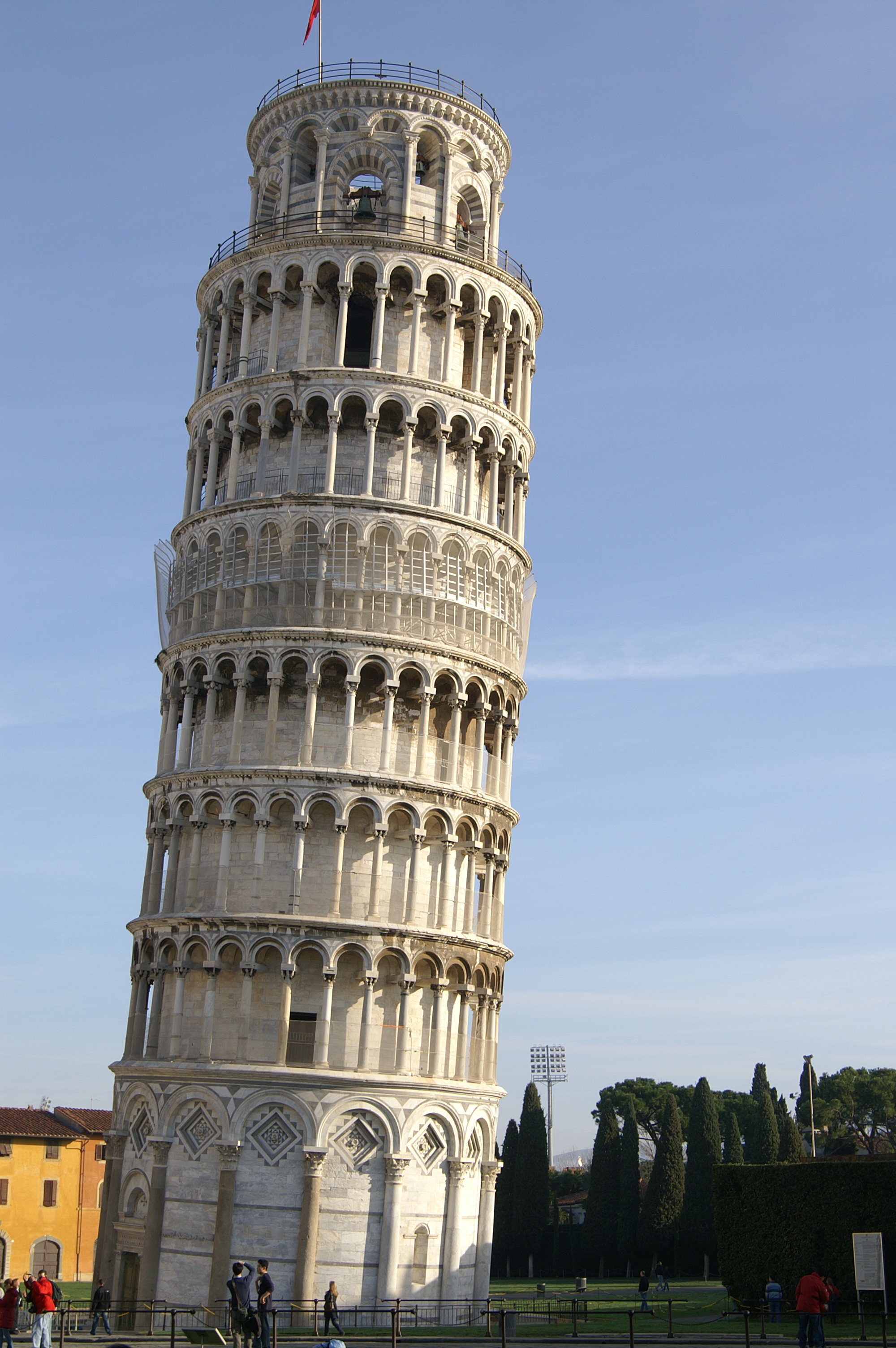
Leaning Tower
of Pisa
I think our economy, and indeed our whole culture, is a house built on sand. It's like the Leaning Tower of Pisa; the ground underneath is too soft. The edifice can't stand straight, and it keeps tipping over more and more as time goes on.

Why aren't things working out for us as we expected? Because we've gotten out of step with Mother Nature.

The natural world includes us ... we have forgotten that. We have accordingly forgotten that Mother Nature imposes her own hidden patterns on us, and we violate them at our peril.

It's as if we are coloring in Mother Nature's coloring book, and we have been heedlessly coloring outside the lines. Any time now, Mother Nature will have no choice but to take away our crayons.

That is what the present threat of manmade climate change amounts to. Ditto, our destruction of the planet's rainforests. Ditto, our pouring chemicals and silt into our bays, rivers, and wetlands. Ditto, our eradication of innumerable wonderful species that have evolved over millions of years. You name the environmental threat, and I'll include it in the list.


Dysfunctionality: Economic

As I've tried to show in earlier posts, our despoliation of the environment amounts to eating our seed corn. The ultimate source of our economic wealth is nature itself ... yet we forget, as fertile and self-renewing as nature is, that there are limits. The limits amount to the lines in Mother Nature's coloring book, and our greedy crayons continually dash outside those lines with heedless abandon.

So nature just cannot renew itself fast enough to keep up with our greed.

For example, when we take too many tuna and other food fish from the oceans each year, fish populations dwindle. Consuming the 'extra' fish we take each year is like eating our seed corn. We have great abundance now, but at some point down the road we'll impoverish ourselves.


Dysfunctionality: Other

That's an economic argument for deeper environmental awareness and concern. But I think our 'eating the seed corn' habit of consumerist greed makes us dysfunctional in non-economic ways as well.

Let there be no doubt: we are hugely dysfunctional. All you have to do is read the newspapers to see what I mean. Today's paper is, of course, full of recollections of 9/11. When I think of 9/11, I think of both heroism and dysfunction. The radical Islamist movement which spawned the 9/11 attacks was and is incomprehensibly vengeful and hateful. It's hugely dysfunctional. The world is not supposed to work that way.

Further along in today's Washington Post, one finds (it comes as no surprise) that we Americans continue to search for a solution to the Great Recession and an unemployment rate that won't come down. Meanwhile, the richer nations in Europe's 'euro zone' are once again contemplating (resisting?) bailouts for Greece and other poorer nations such as Italy and Spain. This is, of course, economic dysfunction. But it's also political and cultural dysfunction, when Greeks take to the streets in violent protest against their own government's necessary austerity measures, and when armchair pundits wonder why Germans who oppose bailing Greece out aren't taking to the streets as well ... yet.

The world isn't supposed to work that way, either. Why do our economic institutions seem poised on the edge of a precipice?


Dysfunctionality Headlines

A news story in today's paper bears the headline, 'Guns tied to a botched federal weapons-smuggling investigation have been recovered at a second Arizona crime scene ... '. A world in which there is weapons smuggling is bad enough, I'd say. A world in which the 'good guys' (our Bureau of Alcohol, Tobacco, Firearms and Explosives agents) botch investigations of same, and no one is really surprised to hear of it, is downright dysfunctional.

Another dysfunctional headline: 'Gunmen kill two, wound 22 at club'. 'Nuff said.

Another: 'In wildfire-weary Texas, crews expect an extended battle'. The drought and wildfires in Texas are a result of 'global weirding', which is a side effect of climate change. The companion headline 'Many Pa. flood evacuees return to their homes' is about how the same tropical storm, Lee, whose hot winds turned Texas trees into kindling wood, turned the mid-Atlantic states into flood zones.

The headline 'Search continues for oil workers missing off Mexican coast' has to do with the wrath of Tropical Storm Nate. Oil workers from a Texas-based company evacuated an oil structure in Mexico’s Bay of Campeche to elude Nate. Ten of them remained missing as of the filing of the article. They would not have been out on the bay at all, were we not so desperate for fossil fuel. Lives get lost that way. It's dysfunctional, in my view, to have to do so much risky offshore drilling.

Dysfunction is international: 'Fed up with violent crime, Guatemalans head to the polls/Front-runner has offered an iron fist in fight against drug gangs'

I just want to make clear at this point that I'm connecting a whole lot of dots as I try to make a case about how dysfunctional we are. I'm connecting the dots into a picture that isn't a very pretty one ... and then, as I hope it's already perfectly clear, I intend to argue that much or all of our current economic-cultural-political-social-religious dysfunctionality is a byproduct of our insatiable lust for an unsustainable level of material wealth.

It is that feeding frenzy which puts us out of step with Mother Nature, and it is that frenzy along with our maybe-we'll-save-the-environment-later-but-not-now cussedness that sows the seeds of our present dysfunctionality, in all its guises.

That's my core belief.


Saturday, September 10, 2011

The Royal Road to Harmony, Post 8

In my "The Royal Road to Harmony" Series, of which this is the eighth installment, I've been exploring the environmental wisdom of Prince Charles, author of Harmony: A New Way of Looking at Our World. His Royal Highness has written a book to clue all of us in to why we should care about nature and about all matters ecological.

One reason we should care is that our economies depend on ecological matters more than we know.

Honey bee colonies in Europe
and America, in so-called
'colony collapse disorder',
have been mysteriously vanishing
For example, the pollination of flowers by European honey bees (photo from the book at left) gives humankind many of our harvestable edibles. European honey bees are a species we imported from Europe. We did so on purpose. These bees are responsible for pollination of approximately one third of the United States' crop species, including such species as almonds, peaches, soybeans, apples, pears, cherries, raspberries, blackberries, cranberries, watermelons, cantaloupes, cucumbers and strawberries. Apiculture — beekeeping — is likewise vital to agriculture in Europe and Asia.

'One recent study suggests that the retail value of agricultural products produced in the UK with the help of honey bees pollinating flowers is about £1 billion per year,' Charles writes. But these super-valuable honeybee colonies are in mysterious decline in the UK and also here in the U.S.

'It is not clear yet why such a catastrophic decline is occurring,' writes Prince Charles, 'but, alongside disease epidemics, it seems that chemical pollution and intensive farming have possibly played an important role.'

'Colony collapse disorder' (CCD) is what has most devastated commercial beekeeping in recent years. Worker bees from a beehive or European honey bee colony abruptly, mysteriously, just disappear. It is the worker bees that collect nectar from flowers and pollinate the flowers as a side benefit.

If the workers vanish from the hive or colony, the result is disastrous. If they stop bringing home the sweet nectar which furnishes nutrition to the hive, the hive or colony winds up being abandoned by the remaining bees.

According to an important study, published in the year 2000:

For all of United States agriculture, the  ... value of the increased yield and quality achieved through pollination by honey bees alone ... was $9.3 billion in 1989 and is $14.6 billion today [in 2000, in non-inflation-adjusted dollars].

CCD started to destroy bee colonies in 2006. Colonies are generally transported by beekeepers from one food-growing location to another, a service paid for by farmers and agricultural interests. If the colonies disappear, it hits beekeepers, farmers, agribusiness, and food consumers right in the wallet.

Though commercial honey bee colonies are maintained by man, not nature, they are nonetheless subject to 'environmental stressors' such as mites, pathogens and pesticides. Possibly a contributory stressor is the fact that the colonies are forced by their keepers to migrate continuously to do their jobs.

So here is just one seemingly 'little' way in which we depend economically on other species. Yet — and this is a crucial point which Prince Charles features heavily in his book — when farmers have to charge more for the food they produce, owing to increased pollination expenses, it's counted as an increase in our Gross Domestic Product.

Meanwhile, the reduction in value of the honey bee colonies does not get figured into GDP.

There are innumerable examples like this, Charles says, in which the value of 'ecosystem services' in creating GDP is underrepresented, if it is counted at all.

Accordingly, when we damage the environment's ability to sustainably supply us with valuable ecosystem services — say, by indulging in overfishing in various nations' coastal waters or the deep ocean — the costs of the harm we are doing won't show up as offsets to GDP. If we take so many tuna from the ocean that tuna populations are condemned to a steep decline, we will at some point have to pay a lot more for the tuna we eat. But the resulting increase in commercial tuna prices will, one day down the road, be counted as an increase in Gross Domestic Product.

If manmade climate change gives us more and more natural disasters such as hurricanes and floods, the rising cleanup expenses serve to amplify GDP ... someone, after all, is getting paid to do the cleanup. But that's a perverse way to compute economic output, Charles says. We need another measure of economic productivity, one that adequately takes ecological costs into account.

Friday, September 09, 2011

The Royal Road to Harmony, Post 7

At left is an alternate cover for a marvelous book by His Royal Highness, the Prince of Wales. The 2010 book by the man known worldwide as Prince Charles is called Harmony: A New Way of Looking at Our World. I have been attempting to relate its wisdom in this, my The Royal Road to Harmony series of posts.

Our despoliation of the planet in the name of material progress has brought us to the verge of environmental and ecological ruin, says Charles, and so he urges us to recover the wisdom of the ancients to fuel a rebirth of feeling connected to nature — and, via nature, to the divine source of the natural world. If we feel intimately connected to nature and in that manner to God, we will naturally begin once again to treat the Earth sacramentally.

The book begins:
This is a call to revolution. The Earth is under threat. It cannot cope with all that we demand of it. It is losing its balance and we humans are causing this to happen.
In this series I am hoping to show my fellow Catholics in particular, and more broadly the rest of us, how we might respond to Charles's call.

For Catholics and others, there are many ports of entry into ecological awareness. Here's one that I'll adapt from Charles's discussion of the Fibonacci sequence.

If you start with the two numbers 0 and 1 and add them together, then keep adding each result back to the immediately previous one, you get:

0, 1, 1, 2, 3, 5, 8, 13, 21, 34, 55, 89, 144, 233, 377, 610, 987, …

This is the Fibonacci sequence. The uncanny thing is how often it shows up in nature. For example:


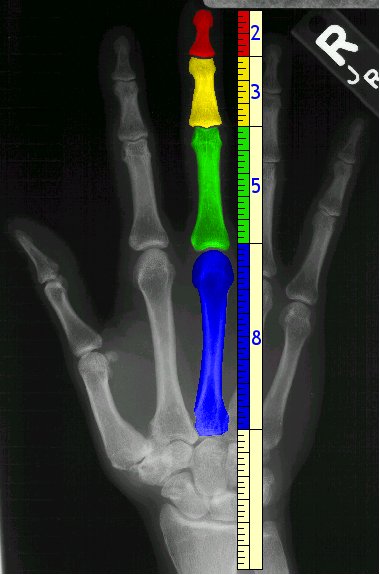
These are the bones of a human hand, which nature has produced by means of Darwinian evolution. The lengths of the bones leading from the tip of the middle finger to the bones of the wrist are in the ratio of 2:3:5:8. The numbers in the 4-way ratio are Fibonacci numbers, being the fourth through the seventh of the Fibonacci sequence above.

The ancients, starting with the Greek philosopher Pythagoras — or perhaps earlier, with the Egyptians — held there was a 'sacred geometry' which governed otherwise chaotic nature. The five-pointed pentagram was one of the geometric figures they adored:


It can be derived from a spiral that represents the Fibonacci sequence:


Here, the numbers in the boxes represent the length of each square's sides. They are consecutive Fibonacci numbers. By using higher and higher numbers from the Fibonacci sequence, the spiral can be extended indefinitely.


The Fibonacci Sequence in Nature

Some say that, in the natural world, the Fibonacci spiral matches up with the curvature of a nautilus shell:


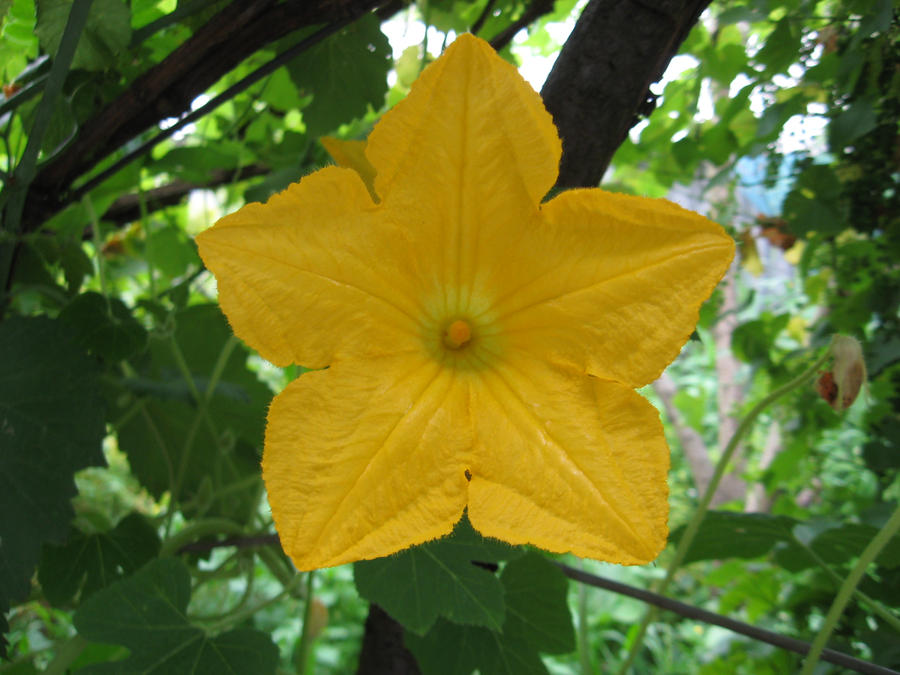
As for the Fibonacci-derived pentagram, it's found frequently in nature:


(Starfish)


(Seedless papaya)
(Remember, the human body was created by Mother Nature
as a product of Darwinian evolution.)

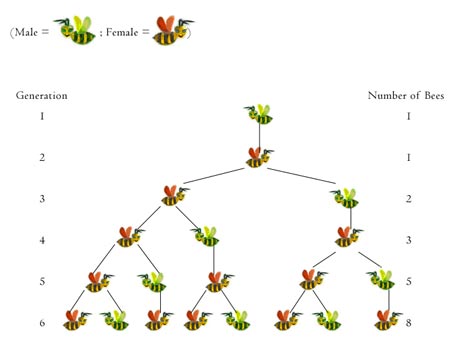
The Fibonacci sequence, from which the pentagram can be derived (see above), also shows up in natural processes such as the family tree of a bee:

(From an extended discussion called
'Deciphering Nature's Code' that is well worth reading.)

A male honeybee comes from an unfertilized egg and has only one parent, a female. A female honeybee comes from an egg laid by a female and fertilized by a male, so she has two parents. So the family tree of a male honeybee, with earlier generations shown as you go down the diagram, looks like this ... with the numbers of bees in the various generations forming a Fibonacci sequence.

Of course, not everything in nature is a Fibonacci stand-in. The point is really that nature is inhabited by often unseen number patterns and geometric forms, not that it is all number pattrens and forms. We humans are no different, in this respect, than animals, plants, and ... everything else that exists. There are, for example, demonstrable ways in which our intuitive notions of physical beauty in buildings, faces, and even music manifest an innate preference for Fibonacci-derived ratios.

If we know no more than that, we know there is no harmony to be found that does not respect and include all of physical nature. That is so because all of nature, including human nature, is grounded in the very same templates of reality, the hidden patterns which 'sacred geometry' is merely an effort to uncover.

Wednesday, September 07, 2011

The Royal Road to Harmony, Post 6

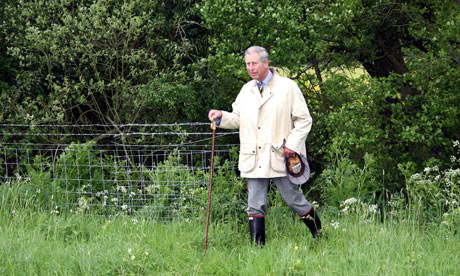
Prince Charles
Charles, Prince of Wales and heir to the Crown of the United Kingdom, is an environmental sage and prophet. He has written Harmony: A New Way of Looking at Our World as a way of disseminating his wisdom.

As I have reported in the earlier posts in this ongoing series about his book, some of the wisdom gets pretty arcane. He writes of a 'sacred geometry' that was known in ages past, at least from the time of the Greek philosopher Pythagoras (c. 570–c. 495 BC). You can start with a single circle, then replicate it, and then overlap the two circles such that the perimeter of each touches the center of the other. Then the overlapping portion forms a vesica:


This shape is seen everywhere in medieval religious art and architecture, since it symbolizes a sacred harmony which the Greeks called harmonia.

The first circle symbolizes the original unity, which we Christians may think of as God. Then the second circle, symbolic of duality, stands for the multiplicity of beings God creates. Until there is overlap of the circles so they touch at their respective 'heart points', i.e., their geometric centers, there is symbolically no harmony between God and His Creation. That's why the vesica piscis, as it is formally known — form the Latin for the 'air bladder of the fish', owing to the almond-shaped resemblance to a fish — is huge in Christian art.

Carry the geometric derivation of the vesica further, and you get:

The 'Seed of Life'

The 'Flower of Life'

These figures are so named because yet further geometric manipulations of them produces (two-dimensional representations of) each of the so-called 'Platonic solids'. The Platonic solids, says Charles, are ...
... the five essential geometric shapes – the cube, the pyramid (or tetrahedron) through to the twenty-sided icosahedron. These are the foundation shapes of all matter.
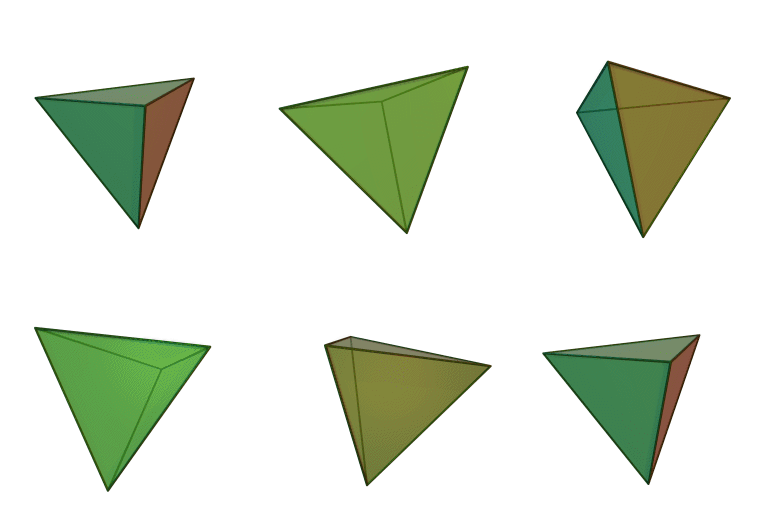
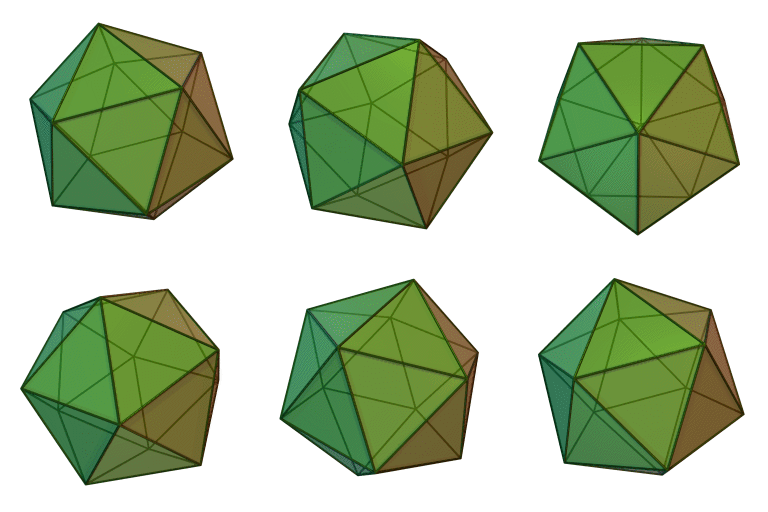
There are five Platonic solids:

Tetrahedron or Pyramid
(4 Faces)

Hexahedron or Cube
(6 Faces)
Octahedron
(8 Faces)
Dodecahedron
(12 Faces)
Icosahedron
(20 Faces)

These are the only 'perfect' solids — perfect in that all faces are identical 'regular' polygons, and all sides where faces come together have the same length.

This web page shows how the Platonic solids can be derived from the Flower of Life. First, select 13 non-overlapping circles from the Flower of Life to form the 'Fruit of Life':


Then, draw lines between the centers of every pair of the circles to form 'Metatron's Cube':

Metatron's Cube


(This one should be thought of as three-dimensional.) Now, pick out just the lines/sides/faces that pertain to each Platonic solid in turn:


Notice that the tetrahedron has been doubled to form two interpenetrating tetrahedrons, called a 'star tetrahedron'. It is the three-dimensional equivalent of the Star of David.

Notice also that only a very few of the vertices and lines of the dodecahedron correspond to vertices and lines of Metatron's cube.

That admittedly seems a weakness in the system. However, the point of the Platonic system as understood by Prince Charles is that nature often conforms in surprising ways to the various Platonic solids, however derived on paper. Mother Nature herself holds a mirror up to these forms.

Matter in general, Charles shows, favors the Platonic solids. He illustrates with a photo and caption:

A drop of mercury subjected to a stable soundwave. It is forced to form one of the basic geometric shapes known as the Platonic solids. [Here, the shape is a 6-faced hexahedron or cube, seen from above one of its vertices, with one vertex hidden.] If a different modulation [i.e., a different frequency of the soundwave] is used, so the drop changes its shape but it always conforms to the same grammar of harmony.

Geometry, then, is powerful. Certain of its forms infuse nature in a fundamental way. Traditionally, at the same time, these same geometric forms have been said to possess great symbolic and spiritual significance.


Monday, September 05, 2011

The Royal Road to Harmony, Post 5

His Royal Highness, Charles, Prince of Wales
Charles, Prince of Wales, has written a wonderful book, Harmony: A New Way of Looking at Our World, about which this continuing series of posts revolves.

The book gives us insight into the 'sacred geometry' which is responsible for the basic order we find in the natural world, as well as for the forms we see in much of our religious art and architecture. For example, as I showed in my last post, the shape formed when two circles overlap such that the perimeter of each touches the center of the other has a height-to-width ratio that governs the floor plan of Chartres cathedral:


The overlapped portion has a shape that is called a vesica or vesica piscis. Vesica piscis means 'the bladder of the fish', i.e., the almond shape of the overlap resembles the shape of a fish and accordingly of the large internal organ that allows the fish to float at any depth.

The early church used a modified vesica as its symbol:


As Pythagoras and other pre-Christian Greek philosophers knew, the symbolism of the vesica and the two circles from which it derives represents the sequence from unity (one circle) to duality (two circles) to harmonia or harmony (overlapping the two circles so that each touches the other's center or 'heart'). The overlapping of the circles in this way produces a 'third number' which Pythagoras called the first 'real number'.

These ideas are important to the budding Catholic environmentalist because, per Prince Charles, 'Pythagoras’s teaching was based upon the essential kinship of all living things'. In the Pythagorean view and that of the early/medieval church, the harmony symbolized by the vesica was all-inclusive.

As the folk song 'A Place in the Choir' puts the same idea:
All God's creatures got a place in the choir
Some sing low, some sing higher,
Some sing out loud on the telephone wire,
And some just clap their hands, or paws, or anything they got now ...

Combining the Circles

When six circles surround the first (symbolizing the 'six days of creation') you get the 'seed of life':


The central part or 'seed' can be 'tiled' to produce the 'flower of life':


With reference to this illustration from the book ...


... Charles writes:
From ‘the flower of life’ comes the pentagon and the five-pointed star, far left. As we shall see, Venus describes these shapes in the skies above us every eight years (or thirteen Venusian years). I wonder how much of a coincidence it is that the self-same five-pointed star and the relationships we will soon discover between Earth’s orbit and size and that of her nearest neighbours are to be found in so many plants and flowers on the ground around us?
I have to admit that I don't quite see how you get a pentagon or five-pointed star from four circles appropriately selected from the flower of life. Nor do I quite see how the resulting pentagon/five-pointed star, when superimposed on the flower in the second image, tells us much, since to my eye the flower has six, not five, groups of petals.

Maybe an image like this one would have been better:


But never mind. The overarching point is that one can derive various basic geometric figures such as the pentagon from a simple master figure such as circles overlapping to produce vesicas, and those figures govern and give order to nature.

In sacred geometry, then, the master figure consists of vesica-generating overlapping circles. That's significant for two reasons:

  1. The vesica, as I've tried to show, is a simple symbol that intrinsically represents an all-inclusive natural harmonia or harmony.
  2. The fact that nature adheres to a set of basic geometric figures tells us of a hidden governance within the natural order that offers us a powerful lens into the mind of its Creator.


Sunday, September 04, 2011

The Royal Road to Harmony, Post 4

In this ongoing series of posts about the book Harmony: A New Way of Looking at Our World, by His Royal Highness Prince Charles, I'm at a critical juncture. I now have to start to explain 'sacred geometry'.

From the days of early Greek philosophers such as Pythagoras, and from the times even before that when the pharaohs ruled Egypt, the ancients knew of a hidden correspondence between purely abstract mathematical ideas and the observable natural world. In Post 3 of this series, I showed how the swirls of a pine cone ...


... and those of the golden florets in the eye of a daisy ...


... sweep in clockwise and counterclockwise curves. The number of swirls in one direction and the number in the other are different. Yet both numbers are, and are bound to be, consecutive numbers in the Fibonacci sequence, which is:

0, 1, 1, 2, 3, 5, 8, 13, 21, 34, 55, 89, 144, 233, 377, 610, 987, …

In the Fibonacci sequence, each number (once you get past the 0, 1 'starter pair' at the left end) is the sum of the two preceding numbers.

In the pine cone shown above, the counterclockwise swirls shown in red number 13, and the clockwise swirls shown in green number 8. 8 and 13 are consecutive Fibonacci numbers. Moreover, the ratio of 13:8, which is 13 ÷ 8 = 1.625, is close to the quantity mathematicians honor as the Golden Ratio, officially 1.6180339887.

Each pair of adjacent Fibonacci numbers, such as 144 and 89, form a ratio that gets closer to the Golden Ratio as you move to the right in the Fibonacci sequence. For example, the ratio 144:89, which is simply 144 divided by 89, equals 1.61797753. It's already quite close to the official value of the Golden Ratio, 1.6180339887.

I haven't myself counted the clockwise and counterclockwise swirls in the daisy photo, but I guarantee that both numbers constitute consecutive Fibonacci numbers, and that the ratio of the larger number to the smaller is (close to) 1.6180339887.

Conclusion: There is a hidden order in nature. And it can be expressed mathematically.


The Wisdom of Pythagoras

Pythagoras, in his day (c. 570–c. 495 BC), knew that. He taught, as Charles writes,
... that there is a precise relationship between the arithmetic of number and the geometry of the physical space around us. In his view, chaos is ordered by number and Nature is made up of precise numerical patterns. ... He held that the nearest the human mind could get to the Divine Mind was through number and, thereby, the principles of proportion and harmony. ... It may seem an odd thing to say in this day and age, but Pythagoras taught that number expressed a divine quality.
Pythagoras urged his pupils, says Charles, to contemplate the patterns of the natural world, so to be "led into communion with the very source of number itself, which is unity."

Prince Charles writes:
Pythagoras considered that the first number represents the ultimate principle of unity. The universal symbol of unity is not the numerical figure 1. It is the sphere or the circle, which is made of a single, unbroken line that loops on itself eternally – ‘eternity’ in the strictest sense of the word means beginning-less and endless.
With statements like that, Charles is leading us away from our skeptical modern attitudes back toward what most of us today would consider a 'mystical' approach to nature. We need to revive the ancient Pythagorean notions, Charles says, such that we might learn once more to treat the natural world as a lens through which to contemplate divinity.


Sacred Geometry

But first we have to get past some rather difficult lessons in geometry.

It might help motivate us to do our lessons if we recognize that so-called 'sacred geometry' gives us insight into sacred art and architecture. For instance, here is a sculpture that can be seen at the medieval High Gothic cathedral that is at Chartres, in France:

'Christ in Majesty', a sculpture
above the Royal Gate of Chartres cathedral

The figure surrounding Christ that looks like an American football standing on end is called a vesica or vesica piscis. It is an almond shape that is formed when two identical circles are overlapped so that the perimeter of one circle touches the center of the other, and vice versa.

The vesica shape controls many aspects of the design of Chartres cathedral. For more about that, see this Huffington Post article at the New World Order website.

The vesica's distinctive height-to-width ratio even shows up in the dimensions of Chartres cathedral's floor plan, when the width is taken as the distance between the north and south entrances (at the sides below) and the height is taken as the distance from the 'West Front' entrance (at the bottom) up to the top of the semicircular apse:

Vesica piscis superimposed on Chartres floor plan,
with the top of the floor plan facing east

What's so special about the vesica's height-to-width ratio? As Charles notes, the height-to-width ratio of the 'Christ in Majesty' vesica is the square root of 3 or 265/153. 153 is 'the number of fish caught miraculously when the risen Christ appears before the Disciples', according to the Gospel of John. (In the name vesica piscis, vesica means 'bladder', the organ within a fish that fills with air and keeps the fish from sinking, and piscis means 'fish'.)

By the 'magic' of geometry, the 'root 3' ratio (i.e., the square root of 3, which is equal to 1.73205081) between the height of the 'Christ in Majesty' vesica and its width is maintained for the vesica superimposed on the Chartres floor plan in the illustration above, and indeed for every vesica that can ever be drawn.

If you want to represent the square root of 3 as the quotient of two whole numbers, 265/153 is as close as you can come. No quotient of smaller whole numbers is as close as 265/153 is to 1.73205081. That's why eyebrows go up at seeing 153 as the specific number of fish caught in John's gospel.

And it is in part why a slightly modified vesica was used to form the fish symbol that has represented Christ and His church since earliest times:


It is said that during the persecution of the early church, a Christian who encountered a stranger would draw a single arc in the sand. If the other person was a Christian, he or she would complete the drawing of a fish with a second arc.


Number and the Kinship of All Living Things

Prince Charles writes that sacred geometry Ă  la Pythagoras (and carried forward by his philosophical successor Plato):
... was based upon the essential kinship of all living things ... [and] it is the central cosmic importance he gave to number which has always fascinated me – a scheme which is not difficult to understand, but one which states quite clearly that we live in an integrated and harmonious universe.
Charles continues:
Pythagoras taught that there is a precise relationship between the arithmetic of number and the geometry of the physical space around us. In his view, chaos is ordered by number and Nature is made up of precise numerical patterns.
So a geometrical figure as simple as a vesica unites pre-Christian Greek philosophies such as that of Pythagoras with early and medieval symbols of Christianity.

Why is the vesica shape sacred, though? In Pythagoras's numerical scheme, as we have seen, the circle or sphere represents the number 1 or unity. Prince Charles writes:
... the second number is what happens once unity becomes more dynamic, once we get ‘duality’. This defines the difference between one thing and the other. And that instantly brings about the necessity for the third number which, for Pythagoras, was a most important number. In fact he called it the first ‘real’ number.
In Pythagoras's scheme, 1 stands for unity and 2 for duality. Duality is a stand-in for the multiplicity we find in this world. Two circles thus stand for multiplicity.

But when the circles are overlapped so the center of each is touched by the other's perimeter, something special happens: a 'third number' is born. There is then a sacredness to the circles' relationship that teaches us
... how life ‘becomes’ – how it unfolds from an indivisible unity – its Oneness – into a multiplicity of many, all of which can only be connected by there being a third element of relatedness. In other words, for the one thing to be known by another there must be a linking relationship, a ratio or ‘joining together’. The Greek word that means ‘joining together’ is harmonia.
The vesica, a 'joining together' of two circles, stands for harmonia, the antidote of chaos. The vesica has long been deemed sacred for that reason.

Charles puts it this way:
Pythagoras and much of the ancient Greek world that followed him knew very well that without harmonia there is no possibility of relationship between the one and the many and therefore no possibility of unity and wholeness.
It seems to me most appropriate that the sacred symbol that metaphorically restores harmony and wholeness is a pair of circles, each touching the other at its center — at its very 'heart', as it were.


Onward and Upward

I hate to say it, but our geometry lesson is about to get even more elaborate. For that, please see the next post in this series ...

Thursday, September 01, 2011

The Royal Road to Harmony, Post 3

This is the third post in my series on Harmony: A New Way of Looking at Our World, the marvelous book by His Royal Highness Prince Charles, son and heir of Queen Elizabeth II.

It's a special challenge to write this post clearly and helpfully. The subject this time is a complex and abstruse one.

Let me introduce the subject in my own fashion. The whole point of Charles's book is to show us a way to put our lives back into what he calls harmony and balance.

But keep in mind that the book's no self-help guide. It's about our culture's getting back in balance and harmony with nature.

It's a plea for the worldview known as environmentalism, and it's accordingly a guide that can help all of us budding environmentalists get in closer step with Mother Nature.


What Is Harmony?

But what, after all, is harmony? What is balance? Is there any way that a mere book can teach us that?

Yes, says Charles. There's a rich tradition of thought in the West, and also in many other cultures, traditional and advanced, which provides us with a truly objective, scientifically verifiable kind of wisdom about nature, harmony, and balance.

But (at least from my own point of view) certain problems immediately crop up. One of them is that this traditional wisdom gives us a "grammar of harmony" that demands a willingness to immerse ourselves in a daunting amount of mathematics, often in the form of numerous geometrical diagrams and their elaborate derivations. That's a great big step up for me, and I'll bet it's a big step up for you, too.

Before I get to the actual geometrical diagrams, I'll now try to give some indication of why they're important to the budding environmentalist. Look at this picture of a pine cone (which I borrow from here):


The red and green lines describe the swirling arrangement of the cone's individual scales. The green swirls swoop "clockwise"; they number 8. The red swirls sweep "counterclockwise," and there are 13 of them. Now, here's the big deal: the ratio of 13:8 is (approximately) equal to a very special number, 1.618. (The actual value of 13 divided by 8 is 1.625.)

Smaller pine cones have 5 "green swirls" and 8 "red swirls." The ratio 8:5 equals 1.6, a number that is likewise close to the very special number 1.618.

That number, 1.618, comes from the following procedure:
  • Start with the two numbers 0 and 1
  • Add them together, getting 1 as the third number in the sequence
  • Add the second 1 to the first, getting 2 as the next number
  • Add the 2 to the number before it, 1, getting 3 as the next number
  • Keep adding the most recent number to the number immediately preceding it to get the next number ...
...  and you get what mathematicians call the Fibonacci sequence:

0, 1, 1, 2, 3, 5, 8, 13, 21, 34, 55, 89, 144, 233, 377, 610, 987, …

The further you go in generating the Fibonacci sequence, the closer the ratio of a given number to its immediate predecessor gets to 1.618 (or, more accurately, to 1.6180339887... ). For example, 987:610 equals 1.6180327868852459 ... .

Mathematicians refer to 1.618 as the Golden Ratio, to show how special it is.


The Golden Ratio in Nature

But why is the Golden Ratio important to the budding environmentalist?

The numbers in the Fibonacci sequence, which are quite unsurprisingly called Fibonacci numbers, show up in nature all over the place. The 13:8 pine cone swirl ratio is just one example.

Another example can be seen in an illustration from Prince Charles's book:


Notice the daisy close-up in the center picture. The florets in the center of the daisy arrange themselves in clockwise and counterclockwise swirls, just like the scales of the pine cone.

It turns out that, for the daisy as for the pine cone, the ratio of the numbers of swirls in the two directions is always (approximately) the Golden Ratio.

Mother Nature seeks the Golden Ratio.

This is significant because it tells us of a correspondence between physical nature and a beautiful, abstract mathematical relationship made strictly of numbers. The correspondence shows up in pine cones, in daisies, and in many other things in the natural world.

So the "stuff" of nature has a hidden order to it. The Golden Ratio and the Fibonacci sequence can sometimes govern the wild world around us.

What about the other four parts of the illustration above?

Prince Charles uses them in his discussion of what he calls the "golden thread" that runs through many venerable sources of wisdom about the natural world. The thread is the "grammar of harmony." It consists of yet more correspondences between numerical or geometrical constructions we can write or draw on paper and how Nature herself is organized.

These correspondences are revealed in what has been called "sacred geometry." Prince Charles accordingly talks of such things as the perfect "Platonic solids" and how they can be constructed by first drawing a bunch of circles. I'll have more to say about sacred geometry in the next post in this series ...

Saturday, August 27, 2011

The Royal Road to Harmony, Post 2

His Royal Highness, Charles, Prince of Wales
If you were Charles, Prince of Wales, do you think you would just avoid rocking the boat, or would you take on big issues like the environment?

His Royal Highness (I'll stick to "HRH" for brevity's sake) has done the latter, in spades. His 2010 book Harmony: A New Way of Looking at Our World is evidence of that.

HRH tells us precisely why we need to save Nature from our own depredations. The book is both a sweeping indictment of our present anti-Nature economy and culture and a font of information about how we can change our mindset ... and exactly what mindset we need to change it to.

Why do we need to change at all? Because, says HRH, in our present way of doing things, we use a fallacious measure of (hopefully) rising economic prosperity: GDP growth. The Gross Domestic Product measures the value of all the goods and services produced in a year, and if GDP goes up from one year to the next, that's supposedly great news.

But it isn't, really. GDP fails to take into account the harm we do to the natural environment en route to generating greater economic "success" for ourselves.

Here's a telling example that HRH gives:
We have inadvertently created economic signals and measures [such as GDP] that regard many natural forms of capital as valueless ... . For example, some 75 per cent of the electricity produced in Brazil comes from large hydro-power dams.
The Itaipu hydroelectric facility on
the the ParanĂ£ River that lies between
Brazil and Paraguay. It is the largest
power station on Earth
.
[These hydroelectric power facilities] are totally reliant on rain which, in the main, is produced by the rainforests of the Amazon basin.
I'll Interrupt HRH briefly, because that last point deserves some explanation. The explanation comes from another passage in the book, one that talks about images taken from space by NASA satellites and edited into a film sequence:
From a vantage point in space, [the film] shows the annual pattern of cloud formation over rainforests. As the trees and other vegetation breathe and grow, so they exhale water vapour. Around twenty billion tonnes [a "tonne" or "metric ton" equals 1,000 kilograms] of water are released every day by the Amazon rainforests alone, and this condenses into great swirls of white cloud that then produce rain.
Here's a picture of the clouds that the rainforest produces:


Now, back to the original quotation from HRH's book:
Yet the forests have been cleared in pursuit of economic growth, and [the cost of having less rainfall in the Amazon basin] has not been factored into the future price of producing electricity. In other words, the short-term value of deforestation [in producing new farmland] is not set against the slightly longer-term rises in the price of power it will cause ...
Put more succinctly, our slanted GDP is a measure which fails to take into account the hidden economic value of such things as the rain clouds that fail to materialize when we wantonly cut down the trees of the Earth's rainforest!

Thursday, August 25, 2011

The Royal Road to Harmony, Post 1

I've discovered a wonderful book that expresses much that I myself believe about the sacredness of the natural world.

It's by His Royal Highness, the Prince of Wales. Prince Charles's book is titled Harmony: A New Way of Looking at Our World.

Co-written with Tony Juniper, an expert advisor to The Prince's International Sustainabilty Unit, and Ian Skelly, who regularly helps His Royal Highness articulate his vision in words, the book is truly Charles's personal vision, distilled after decades of working for environmental reforms. (For brevity, I'm going to take the liberty of referring to this well-known author and public figure by his first name alone, if I may be forgiven for doing so.)

The book is lavishly illustrated with color photographs, but it's no coffee-table book. It's a serious, highly personal revelation of Charles's own feelings and hopes for the planet.

To summarize his own sacramental attitude towards nature, Charles uses an epigraph from William Shakespeare's "As You Like It":

Finds tongues in trees, books in running brooks,
Sermons in stones, and good in every thing.

A fuller quotation is:

Now, my co-mates and brothers in exile,
Hath not old custom made this life more sweet
Than that of painted pomp? Are not these woods
More free from peril than the envious court?
Here feel we not the penalty of Adam,
The seasons’ difference, as the icy fang
And churlish chiding of the winter’s wind,
Which when it bites and blows upon my body
Even till I shrink with cold, I smile, and say
’This is no flattery. These are counsellors
That feelingly persuade me what I am.’
Sweet are the uses of adversity
Which, like the toad, ugly and venomous,
Wears yet a precious jewel in his head;
And this our life, exempt from public haunt,
Finds tongues in trees, books in the running brooks,
Sermons in stones, and good in every thing.
           (II.i.1–17)

Harmony is a deeply felt evocation of a marvelous outlook that I find myself sharing ... though mine is still a-forming, while Charles's has been in formation since he was a very young man.

Charles's Very Broad Discussion

Prince Charles's book is quite broad in its discussion of where we need to be going, environment-wise. It is spiritual and practical at the same time. Charles gives us a great deal of the history of how our anti-nature attitudes formed in the West. He also tells of the rich trove of traditional wisdom about nature that we can uncover when we look at other, non-Western societies down through the annals of time. In our own cultural tradition, moreover, there have long been what might be termed minority voices who've extolled what our dominant attitudes have disparaged.

I want to avoid, for the moment, trying to emulate the vast scope of Charles's vision and just pick out little pieces of it that help me, and I think will help others, get closer to seeing the earth as a sacrament.

The Beautiful Marbled Cone Snail

The first little puzzle piece comes from Charles's discussion of the sea snail called the "marbled cone," officially Conus marmoreus, and its many kindred species:


Here is what Charles has to say about these lovely marine predators, who are up to about six inches in length, and who are presently under very real threat of extinction:
One group of animals that appears to be especially rich in potentially useful compounds is cone snails. These predatory creatures live on tropical reefs and in mangrove forests, mostly in the South Pacific region. There are about 700 different species and each is believed to manufacture 100-200 different peptide toxins [a peptide is like a protein molecule, but shorter] to coat the paralyzing harpoons they use for hunting. Although only about six species and about 100 toxins out of a possible 140,000 have been studied in any detail, it seems they offer the enormous potential of providing the basis of future painkillers and treatments for epilepsy. Some scientists believe that cone snails may contain more useful medical compounds for humans than any other group of creatures on Earth. And yet they, too, are under threat because coral reefs are being eroded by development, pollution and climate change, and also because mangrove forests are being cleared to make way for shrimp farms and other coastal developments.

Beauty and Practicality

Why should we care about the fate of cone snails? The reasons are basically two:
  1. They're truly beautiful examples of the millions of living kinds that God has made.
  2. They have untold and untapped practical value to humankind, if we let them survive.
In other words, beauty and practicality are two sides of the same save-all-the-endangered-species "coin."

In the discussions I usually encounter of environmentalism, it's usually one or the other that gets emphasized. And when it's couched in terms of other than practicality, the discussion is often one that tells how "neat" or "cool" or "scary" a certain animal is ... as in many discussions one reads of sharks or snakes, for example.

It's not always easy to think of a shark or a snake or a barb-throwing venomous cone snail ("Cone-an the Barb-arian"?) as a thing of beauty.

Or, put better, as a sentient being of beauty, not just a thing. We don't exactly know how sentient a snake or a snail is, of course, but in my estimation there is some sentience in all critters. And that is a beautiful fact about the world we all live in together.