Showing posts with label The Royal Road to Harmony. Show all posts

Saturday, April 14, 2012

If You Want Peace and Justice ...

The familiar bumper sticker says, "If you want peace, work for justice," a quote from Pope Paul VI. Well, yes, but I think it goes deeper than that. "If you want peace and justice, work for harmony," I'd put it.

By "harmony" I mean the word as used by the Prince of Wales in his recent book Harmony: A New Way of Looking at Our World. It's basically a book to warm the cockles of any environmentalist's heart. Prince Charles says we are so out of harmony with the natural world, and so out of balance within our own collective human psyche, that we don't begin to comprehend how out of whack we really are.

I don't want to put words in Charles's mouth, and I don't claim to be wise enough to know how far beyond his meaning my thoughts lie. Yet I increasingly believe he'd agree: We have injustice and war because we are fundamentally off-center within our own human nature, when taken in its very complex totality.

Many ills are byproducts of our deep disharmony, I think. Take sex in its most negative aspects. Look at how many abortions there are each year. Look at how many single-parent households and broken homes we have. How many rapes. How many unmarried childbirths intentionally sought by misguided teens. How much time we spend debating supposedly "settled" issues like women's "right" to contraception.

And look at how het up we all get over hot-button, non-sexual issues, like whether the children of illegal immigrants deserve a legal path to a college education and U.S. citizenship — or, again, whether addictive drugs or gay nuptials or carrying a concealed weapon should be legal.

The plain fact is that we fundamentally disagree about so many things. Some of us "go to war" over them, putting on display our entrenched disagreements about what is, or is not, right or just.

Sociologist Charles Murray's most recent book says, via its title, that we are "coming apart" class-wise. The mores and lifestyles of the "new lower class" are today dangerously different from those of the (safely ensconced within their socioeconomic bubble) "new upper class."

Seemingly, the upper-crusters' ethos isn't so different from America's long-celebrated "founding virtues," to use Murray's term, while the bottom-dwellers' lives ways have "come apart" from our once-universal American mores. Crime, welfare dependency, opting out of the workforce, single parenthood, dropping out early from the educational trajectory — all these are symptoms of how our socioeconomic bottom-dwellers no longer find our "founding virtues" — industriousness, basic honesty, marriage, and religious faith — of great value.

But I think we non-bottom-dwellers live lives of incongruity, too. I call ours a "bikini-wax world." At the beach, women wear bikinis that are (warning: frank talk ahead) too tiny to conceal all of their pubic hair. So they pay someone to wax away the offending hair.

In a world of less incongruity, there might be a thorough covering up of the pubic region at the beach, or there might be brazen nudism in which everything is bared and no body fur need be removed. What with now-obsolete women's bathing dresses and the occasional nudist beach, we've seen both in our cultural history. And there are comprehensible philosophical underpinnings for both.

For teeny-weeny bikinis and paying good money for Brazilian wax treatments, though, not so much. Go ahead and try: give a comprehensive philosophical justification for bikini bottoms that conceal some, but not all, of nature's hairy endowments.

In a bikini-wax world, seemingly incompatible ideas simply coexist. It's no longer OK to go braless today — that's ostensibly "skanky" — but it's OK to let your bra straps show — that's ostensibly not "skanky."

Or, in a graver realm, it's OK to privately oppose abortion on moral grounds, but it's not OK to impose your beliefs on anyone else.

I contend our bikini-wax society has lately become obsessed with fighting — and yet, at one and the same time, with avoiding fights.

Notice how oriented toward clashes our popular culture has become. Look at just about anything on TV and, when sex isn't front and center, it's usually fighting, in one guise or another, that's on tap.

And yet ... as individuals we often decline to stand and deliver for what we believe in, i.e., a particular moral code. On issues concerning sexuality, social justice, war, the environment, and much else, many of us opt out of the debate entirely. Different strokes for different folks, we say. Your truth is not my truth, and there's no absolute truth anyway.

Except when we get het up over something. There's the actual truth, we think then, and there's also what the other side of the discussion falsely believes.

But both sides feel the same way, of course. Bothe sides think they alone have a handle on the truth.

A world of such incongruity is a fractionated world. In such a fractionated world, I believe, there's no real road to either justice or peace, unless and until we get back into some semblance of natural-societal-intrapersonal harmony.

Monday, September 26, 2011

The Royal Road to Harmony, Post 11

Prince Charles, who will one day sit on the throne of the United Kingdom, is the author of the book I am investigating in this ongoing series of postsHarmony: A New Way of Looking at Our World is the book's title, and its theme is that we, all of us, must quickly recover humankind's lost feeling of connectedness to nature. If we don't restore our erstwhile harmony with nature, environmental disaster looms. We need to get back in balance.


Harmony and balance, yes — but how did we ever get out of harmony with nature in the first place? Isn't it quite unnatural for us to have done so? Charles writes:
There are many factors that have shaped the modern Western attitude to Nature, but if I were to put my finger on the biggest ones, I would point to three: the fascinating changes in human perception caused by the Scientific Revolution of the seventeenth century, the impact on our outlook of the Industrial Revolution of the eighteenth century and the deliberate demolition job carried out on traditional culture by what became known as ‘Modernism’ in the twentieth century.

The Scientific Revolution and Its Legacy

Johannes Kepler (1571-1630). who
figured out how the planets
travel around the sun. 
The seventeenth-century Scientific Revolution still has us in its thrall. That transformation, Prince Charles writes,
'established the authority of a mechanistic approach to thinking'.

Nature, previously understood as something alive and possessed of an inner spontaneity, was now a machine. After the discoveries of Johannes Kepler (left), we knew the planets revolved around the sun in paths that we could now compute. We would one day use similar computations to send a man to the moon.

How powerful we were becoming ... and it all began with a new mode of thinking that reduced all things, planetary or otherwise, to systems in which every whole exactly equals the sum of its parts.

Once we decided the world was such a reducible system, all we had to do was analyze everything down to its tiniest parts and then discover the laws by which those infinitesimal parts behave.

Fast forward to the early twentieth century. Albert Einstein discovers the Laws of Relativity which mean that nothing whatsoever can travel faster than light.

Fast forward again to the very week in which this blog post is being written. Scientists in Europe have reported that their experiments with tiny particles called neutrinos seem to have revealed that these particles can in fact exceed light speed.

Science is marvelous ... but there is a greater depth to reality than science can yet plumb.

Yet, per Prince Charles, the ongoing legacy of the Scientific Revolution, with its insistence on reductionism, 'persuades us now to see the whole of the world as one of cold and separated utility'.

Aquinas's 'Eternal Law' and Dylan Thomas's 'Green Fuse That Drives the Flower'

In the thirteenth century, Prince Charles points out, Thomas Aquinas had a completely different point of view. Aquinas taught that
... the Creator was not separate from His creation. Instead, divinity was considered to be innate in the world and in us. The natural world itself was an expression of this sacred presence and in such a created unity, humanity had an active role as participant ... religion and science, mind and matter [were] all part of one living, conscious whole.
That Aquinan point of view, Charles says, is echoed in the Qu'ran of Islam, in Taoism in China, in the Vedic tradition of India, and in Stoic philosophy in ancient Greece. All have said that the natural world cannot be turned into a mere thing to be manipulated for Man's own advancement. To do so separates Man from Nature, and in so doing separates Man from God.

In this statue that adorns the Charles Bridge in Prague, Czech Republic,
the Virgin Mary with Christ Child in the center receives the
book of 'natural theology' from St. Thomas Aquinas at the right. Aquinas was
a Dominican whose order was founded by St. Dominic,
depicted on the other side of the Madonna.
Aquinas spoke of his core principle as that of Eternal Law. We've now mostly forgotten it.

Dylan Thomas (1914-1953)
Yet the Welsh poet Dylan Thomas (left) called the divine principle at the heart of the unfolding universe ‘the force that through the green fuse drives the flower' — so writes the Prince of Wales. The 'green fuse' has not been wholly forgotten, thank goodness.

The thought of Aquinas emphasized Creation's unity, putting mankind in a position of humility and recoverable harmony with nature. Yet that notion began to come apart in the very century in which Aquinas (1225 - 1274) lived and died. Charles writes:
At the heart of things, within a very short space of time, that all-important, timeless principle of participation in the ‘being’ of things was eliminated from mainstream Western thinking.
By the seventeenth century, seeds of thought planted in Aquinas's time four centuries before had sprouted into a mechanistic worldview that treated the material universe as inert, purposeless, manipulable raw material. Once the Scientific Revolution was in place we could, as instruments of God's will separable from the natural world, begin to master the universe.

In the eighteenth century in Britain came the inevitable result: the Industrial Revolution. (Our Industrial Revolution in the U.S. followed in the nineteenth century.)

Today, during the Great Recession, we are desperately trying to figure out why the various industries that produce stuff for us to buy, thus driving economic growth, aren't generating enough jobs. They used to, but no more. Those without jobs and wages cannot buy stuff. That's bad. Our economy is out of balance.

Yet few if any voices are raised to assert that the imbalance in the ecology of how we treat Mother Nature must be fixed if we are ever to get our economy back in balance and our people back to work.


Friday, September 23, 2011

The Royal Road to Harmony, Post 10

To Charles, Prince of Wales and heir to the throne of the United Kingdom of Great Britain and Northern Ireland, beauty and harmony are the same thing.

He says so in his recent book Harmony: A New Way of Looking at Our World. This is a book all budding environmentalists need to read, since it tells how we can fit our human strivings legitimately into a mindset that keeps Mother Nature — the environment — front and center. I've been musing over Charles's wisdom in this ongoing "The Royal Road to Harmony" series.

I'd now like to investigate what His Royal Highness means when he equates harmony and beauty.

I'll be talking about his views on architecture: specifically, how adherence to the 'way of patterns' renders buildings (and all other things) beautiful. I'll add to that a recent experience of mine which I think confirms Charles's insights when extended outward from architecture into the realm of public spaces. I'll take a look at an 'everything fits' harmony of lovely old houses, green spaces, and public gardens as they serve to make up the community of Guilford in Baltimore, Maryland.

Bradford in West Yorkshire, England

First, though, HRH's own thoughts. The Prince of Wales talks in his book about a project he underwrote in 'a fairly depressed part of Bradford in West Yorkshire'. Teens in Bradford were asked to identify and photograph the local buildings they most liked or disliked. Charles writes:

To my fascination, all the buildings they most disliked were built in the 1960s and 1970s of concrete, steel and glass and all the ones they liked were the few remaining, older buildings, like the town hall, church and library, together with the small area which had a pond and trees. When I talked with them about this they were unaware of their reasons why, but it seemed to me they were responding subconsciously to that inner, natural language of patterning I have been describing here that is so clearly reflected in the older buildings.
Here is Bradford Town City Hall, a building they liked:


Here is a car park in Gateshead, England, in the 'Brutalist' style which the teens hated:


The difference is clear.

Guilford in Baltimore, Maryland

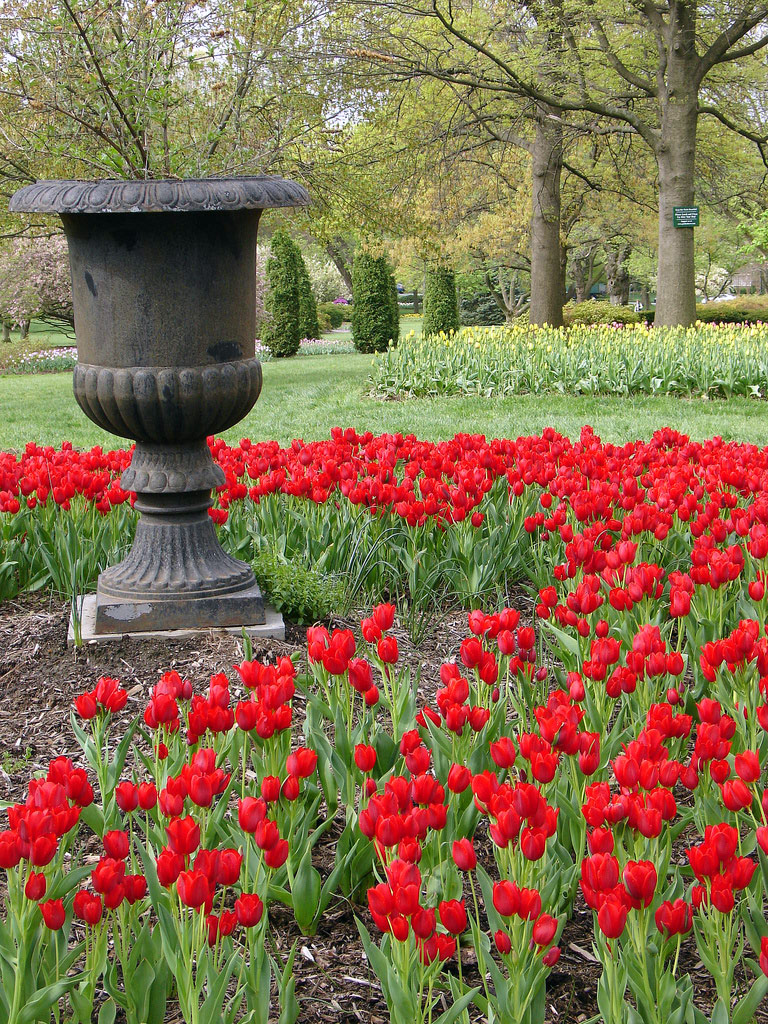
Tulips in Sherwood Gardens,
Guilford, Baltimore
Guilford is an anything-but-depressed residential neighborhood in Baltimore, MD, whose crown jewel, shown at left, is Sherwood Gardens. Guilford was designed by the firm of Frederick Law Olmsted, Jr., and his brother John Charles Olmsted, who inherited the nation's first landscape architecture business from their father Frederick Law Olmsted. It was under the immediate direction of Frederick Law Olmsted, Jr., that the Guilford community was laid out and planned.

Just before I read Prince Charles's discussion of beauty and harmony in architecture, I happened to be walking in Guilford with an old college friend. We were talking about the 'everything fits' harmony of the neighborhood, viewed on  foot. As we walked we found that we couldn't wait to find out what the next house looked like, and the next, and the next. There were no disappointments.

'Everything fits' means 'in accordance with patterns to which we respond subconsciously, thus to know beauty'. There is accordingly an 'inner, natural language of patterning' which tells us when not only a building, but also a garden or a neighborhood, is beautiful.

Another meaning is 'organic'. To the traveler on foot, Guilford feels organic, in the sense that there is never a feeling that anything is forced into a pre-existing mold.

Houses in the area around Sherwood Gardens are quite beautiful, and each is unique:


As you walk about in Guilford, as I said before, you can't wait to see what the next house looks like. The community feels 'organic' because there are no cookie-cutter houses.

Here's Sherwood Gardens itself:


Below is a Google Maps satellite view of the neighborhood around the gardens (you can click on it to enlarge it):


All the open space in the diamond-shaped area containing the red drop pin at the leftmost corner is Sherwood Gardens.

Notice that the streets that make the diamond-shaped area are not straight and do not meet at right angles. This, again, adds to the 'organic' feel of the neighborhood.

The blue drop pin in the Google Maps overhead view sits on the famed Sherwood Mansion:


The above rendition shows how it looks from the gardens themselves.

Organic Beauty

It's tough to get a planned community to look like it has grown organically. Prince Charles lauds the city of Florence, Italy, for having done so:

Florence, Italy. A city that grew organically. There is no zoning. It is an integrated complex of streets, alleyways and piazzas where work is done, lives are lived and children play, learning from being amid the work being done by their parents. It is a system of patterns, interdependent at many levels.

Florence did grow organically, over time, but Guilford was planned. According to the website of the Guilford Association:
The community reflects Olmstedian landscape design principles in its curvilinear streets and respect for existing topography and vegetation. Installation of utilities, streets, drains and other infrastructure were estimated by the Company's engineers to require an investment of the then [in 1911] tremendous sum of one million dollars.
Moral: it costs money to make an 'organic' community on purpose! Beauty and harmony don't come cheap when they're done by design.

My overarching point, though, is there is such a thing as 'organic' beauty. Nature produces it ... well, naturally. Humans produce it, too. Sometimes they do it by accident, as with Florence. Sometimes they do it by plan, as with Guilford, or as with any of the buildings which the Bradford teens extolled.

If we are to get back into harmony with nature, we are going to have to learn once more how to design things — buildings, neighborhoods, domains of regulation and governance — that have organic beauty. In order to do that, as I tried to indicate in earlier posts in this series, we can learn much from the ancient arts of 'sacred geometry'.

Sunday, September 18, 2011

The Royal Road to Harmony, Post 9

Here is the ninth in my "The Royal Road to Harmony" Series, in which I've been exploring the environmental wisdom of His Royal Highness Prince Charles, author of Harmony: A New Way of Looking at Our World. At left is the cover of the 32-page children's edition of the book. (We adults have the much more daunting task of wading through 336 pages of the print edition. I'm relying on an Amazon Kindle edition of the book!)

HRH is, in my opinion, a sage and a prophet. He's managed to show how we can fit our human strivings into a conceptual scheme that keeps Mother Nature — the environment — front and center. This is the right way to look at our world because we ourselves are Mother Nature's children.

The Prince's secret lies in understanding the 'way of patterns'.

In his chapter on 'The Golden Thread', Charles shows how patterns imbue all of nature with order. The very same patterns that underpin nature underpin our most glorious architecture. Yet to detect that, you have to know something about 'sacred geometry', which is what the last several posts in this series have attempted to introduce.

For example, a geometric shape made by overlapping two circles so each touches the other's center is called a vesica. The vesica governs much of the magnificent Gothic cathedral at Chartres, France: its floor-plan dimensions and much of its decorative art. This simple shape symbolized harmony in the eyes of the early Greek philosophers. When the early Christians wanted to devise what we would today call a logo, they chose a vesica with its two arcs extended to form a fish with a tail:


The overlapping circles from which the vesica arises can be replicated geometrically into a 'flower of life' and then into a 'fruit of life'. From those two figures may be derived all five of the 'Platonic solids'. Those perfect three-dimensional forms and the two dimensional patterns that beget them exist, often hidden, throughout the natural world. They can be like Easter eggs. If you know how to look for them, they'll pop out at you.

From Geometry to Harmony

Sacred geometry and the numbers underlying its shapes and dimensions are tough subjects to wrap the mind around. Fortunately, the very patterns which sacred geometry extols just so happen to be graven into our souls. We recognize and respond to them subconsciously wherever we encounter hints of them in our world. They secretly inhabit all things we call beautiful.

Labyrinth in
Chartres Cathedral
Chartres is transcendently beautiful, as all who have seen it will testify. When you go to Chartres, you don't have to know about vesicas and Platonic solids to know you are being enfolded in beauty.

At left is a photo of the labyrinth laid into the floor at Chartres. It fits within a circle, which in sacred geometry represents the primal geometric shape symbolizing unity. The 'flower of life' and 'fruit of life' are figures made entirely of circles.

The Chartres labyrinth has four quadrants. The number 4 represents 'earth' in the way that 3 represents 'heaven'. Walking the labyrinth symbolizes the twists and turns of this earthly life.

Our reward comes when we arrive at the rosette in the center of such a labyrinth, a six-petaled rose-shaped area:


The rose is a sign of beauty and love that dates as far back as the Egyptian myth of Isis. A rosette is akin to the 'seed of life' figure:


The 'seed of life' is a close cousin to the 'flower of life' and 'fruit of life' figures, likewise extolled in sacred geometry.

If you count the rosette at the center as one of the concentric circles, the Chartres labyrinth has 12 circles. 12 is the product of 4, representing 'earth', and 3, representing 'heaven'. In the language of the sacred arts, a figure with twelve concentric circles represents 'creation'.

The rosette and 'seed of life' remind us of how hexagons and six-pointed stars relate to a circle:


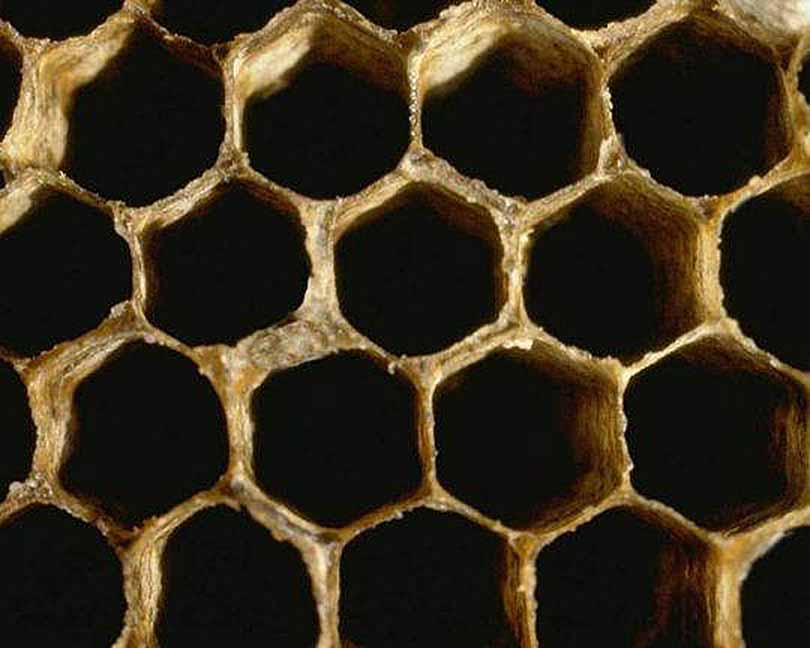
The point of looking into all this numerical/geometrical mumbo-jumbo is that not only cathedral architects but also Mother Nature herself reveres such figures as the hexagon, the rosette, and the six-pointed star:


Accordingly, the affinity we have for beauty in architecture is precisely the same as the inborn resonance we have with beauty in nature.


Saturday, September 10, 2011

The Royal Road to Harmony, Post 8

In my "The Royal Road to Harmony" Series, of which this is the eighth installment, I've been exploring the environmental wisdom of Prince Charles, author of Harmony: A New Way of Looking at Our World. His Royal Highness has written a book to clue all of us in to why we should care about nature and about all matters ecological.

One reason we should care is that our economies depend on ecological matters more than we know.

Honey bee colonies in Europe
and America, in so-called
'colony collapse disorder',
have been mysteriously vanishing
For example, the pollination of flowers by European honey bees (photo from the book at left) gives humankind many of our harvestable edibles. European honey bees are a species we imported from Europe. We did so on purpose. These bees are responsible for pollination of approximately one third of the United States' crop species, including such species as almonds, peaches, soybeans, apples, pears, cherries, raspberries, blackberries, cranberries, watermelons, cantaloupes, cucumbers and strawberries. Apiculture — beekeeping — is likewise vital to agriculture in Europe and Asia.

'One recent study suggests that the retail value of agricultural products produced in the UK with the help of honey bees pollinating flowers is about £1 billion per year,' Charles writes. But these super-valuable honeybee colonies are in mysterious decline in the UK and also here in the U.S.

'It is not clear yet why such a catastrophic decline is occurring,' writes Prince Charles, 'but, alongside disease epidemics, it seems that chemical pollution and intensive farming have possibly played an important role.'

'Colony collapse disorder' (CCD) is what has most devastated commercial beekeeping in recent years. Worker bees from a beehive or European honey bee colony abruptly, mysteriously, just disappear. It is the worker bees that collect nectar from flowers and pollinate the flowers as a side benefit.

If the workers vanish from the hive or colony, the result is disastrous. If they stop bringing home the sweet nectar which furnishes nutrition to the hive, the hive or colony winds up being abandoned by the remaining bees.

According to an important study, published in the year 2000:

For all of United States agriculture, the  ... value of the increased yield and quality achieved through pollination by honey bees alone ... was $9.3 billion in 1989 and is $14.6 billion today [in 2000, in non-inflation-adjusted dollars].

CCD started to destroy bee colonies in 2006. Colonies are generally transported by beekeepers from one food-growing location to another, a service paid for by farmers and agricultural interests. If the colonies disappear, it hits beekeepers, farmers, agribusiness, and food consumers right in the wallet.

Though commercial honey bee colonies are maintained by man, not nature, they are nonetheless subject to 'environmental stressors' such as mites, pathogens and pesticides. Possibly a contributory stressor is the fact that the colonies are forced by their keepers to migrate continuously to do their jobs.

So here is just one seemingly 'little' way in which we depend economically on other species. Yet — and this is a crucial point which Prince Charles features heavily in his book — when farmers have to charge more for the food they produce, owing to increased pollination expenses, it's counted as an increase in our Gross Domestic Product.

Meanwhile, the reduction in value of the honey bee colonies does not get figured into GDP.

There are innumerable examples like this, Charles says, in which the value of 'ecosystem services' in creating GDP is underrepresented, if it is counted at all.

Accordingly, when we damage the environment's ability to sustainably supply us with valuable ecosystem services — say, by indulging in overfishing in various nations' coastal waters or the deep ocean — the costs of the harm we are doing won't show up as offsets to GDP. If we take so many tuna from the ocean that tuna populations are condemned to a steep decline, we will at some point have to pay a lot more for the tuna we eat. But the resulting increase in commercial tuna prices will, one day down the road, be counted as an increase in Gross Domestic Product.

If manmade climate change gives us more and more natural disasters such as hurricanes and floods, the rising cleanup expenses serve to amplify GDP ... someone, after all, is getting paid to do the cleanup. But that's a perverse way to compute economic output, Charles says. We need another measure of economic productivity, one that adequately takes ecological costs into account.

Friday, September 09, 2011

The Royal Road to Harmony, Post 7

At left is an alternate cover for a marvelous book by His Royal Highness, the Prince of Wales. The 2010 book by the man known worldwide as Prince Charles is called Harmony: A New Way of Looking at Our World. I have been attempting to relate its wisdom in this, my The Royal Road to Harmony series of posts.

Our despoliation of the planet in the name of material progress has brought us to the verge of environmental and ecological ruin, says Charles, and so he urges us to recover the wisdom of the ancients to fuel a rebirth of feeling connected to nature — and, via nature, to the divine source of the natural world. If we feel intimately connected to nature and in that manner to God, we will naturally begin once again to treat the Earth sacramentally.

The book begins:
This is a call to revolution. The Earth is under threat. It cannot cope with all that we demand of it. It is losing its balance and we humans are causing this to happen.
In this series I am hoping to show my fellow Catholics in particular, and more broadly the rest of us, how we might respond to Charles's call.

For Catholics and others, there are many ports of entry into ecological awareness. Here's one that I'll adapt from Charles's discussion of the Fibonacci sequence.

If you start with the two numbers 0 and 1 and add them together, then keep adding each result back to the immediately previous one, you get:

0, 1, 1, 2, 3, 5, 8, 13, 21, 34, 55, 89, 144, 233, 377, 610, 987, …

This is the Fibonacci sequence. The uncanny thing is how often it shows up in nature. For example:


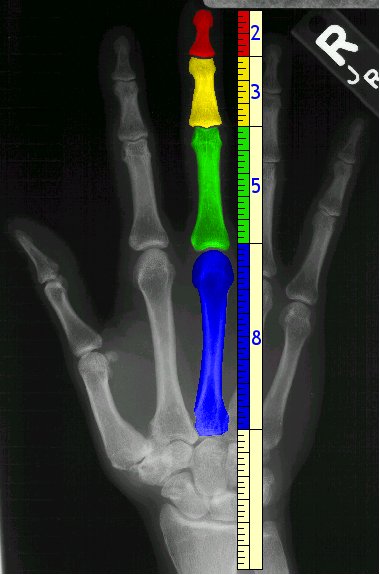
These are the bones of a human hand, which nature has produced by means of Darwinian evolution. The lengths of the bones leading from the tip of the middle finger to the bones of the wrist are in the ratio of 2:3:5:8. The numbers in the 4-way ratio are Fibonacci numbers, being the fourth through the seventh of the Fibonacci sequence above.

The ancients, starting with the Greek philosopher Pythagoras — or perhaps earlier, with the Egyptians — held there was a 'sacred geometry' which governed otherwise chaotic nature. The five-pointed pentagram was one of the geometric figures they adored:


It can be derived from a spiral that represents the Fibonacci sequence:


Here, the numbers in the boxes represent the length of each square's sides. They are consecutive Fibonacci numbers. By using higher and higher numbers from the Fibonacci sequence, the spiral can be extended indefinitely.


The Fibonacci Sequence in Nature

Some say that, in the natural world, the Fibonacci spiral matches up with the curvature of a nautilus shell:


As for the Fibonacci-derived pentagram, it's found frequently in nature:


(Starfish)


(Seedless papaya)
(Remember, the human body was created by Mother Nature
as a product of Darwinian evolution.)

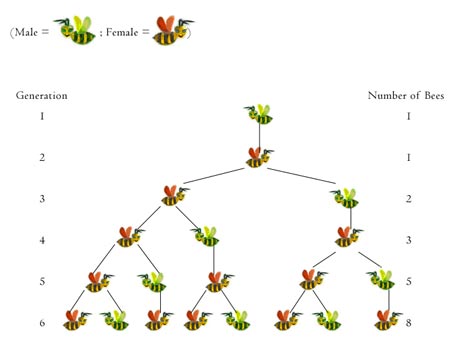
The Fibonacci sequence, from which the pentagram can be derived (see above), also shows up in natural processes such as the family tree of a bee:

(From an extended discussion called
'Deciphering Nature's Code' that is well worth reading.)

A male honeybee comes from an unfertilized egg and has only one parent, a female. A female honeybee comes from an egg laid by a female and fertilized by a male, so she has two parents. So the family tree of a male honeybee, with earlier generations shown as you go down the diagram, looks like this ... with the numbers of bees in the various generations forming a Fibonacci sequence.

Of course, not everything in nature is a Fibonacci stand-in. The point is really that nature is inhabited by often unseen number patterns and geometric forms, not that it is all number pattrens and forms. We humans are no different, in this respect, than animals, plants, and ... everything else that exists. There are, for example, demonstrable ways in which our intuitive notions of physical beauty in buildings, faces, and even music manifest an innate preference for Fibonacci-derived ratios.

If we know no more than that, we know there is no harmony to be found that does not respect and include all of physical nature. That is so because all of nature, including human nature, is grounded in the very same templates of reality, the hidden patterns which 'sacred geometry' is merely an effort to uncover.

Wednesday, September 07, 2011

The Royal Road to Harmony, Post 6

Prince Charles
Charles, Prince of Wales and heir to the Crown of the United Kingdom, is an environmental sage and prophet. He has written Harmony: A New Way of Looking at Our World as a way of disseminating his wisdom.

As I have reported in the earlier posts in this ongoing series about his book, some of the wisdom gets pretty arcane. He writes of a 'sacred geometry' that was known in ages past, at least from the time of the Greek philosopher Pythagoras (c. 570–c. 495 BC). You can start with a single circle, then replicate it, and then overlap the two circles such that the perimeter of each touches the center of the other. Then the overlapping portion forms a vesica:


This shape is seen everywhere in medieval religious art and architecture, since it symbolizes a sacred harmony which the Greeks called harmonia.

The first circle symbolizes the original unity, which we Christians may think of as God. Then the second circle, symbolic of duality, stands for the multiplicity of beings God creates. Until there is overlap of the circles so they touch at their respective 'heart points', i.e., their geometric centers, there is symbolically no harmony between God and His Creation. That's why the vesica piscis, as it is formally known — form the Latin for the 'air bladder of the fish', owing to the almond-shaped resemblance to a fish — is huge in Christian art.

Carry the geometric derivation of the vesica further, and you get:

The 'Seed of Life'

The 'Flower of Life'

These figures are so named because yet further geometric manipulations of them produces (two-dimensional representations of) each of the so-called 'Platonic solids'. The Platonic solids, says Charles, are ...
... the five essential geometric shapes – the cube, the pyramid (or tetrahedron) through to the twenty-sided icosahedron. These are the foundation shapes of all matter.
There are five Platonic solids:

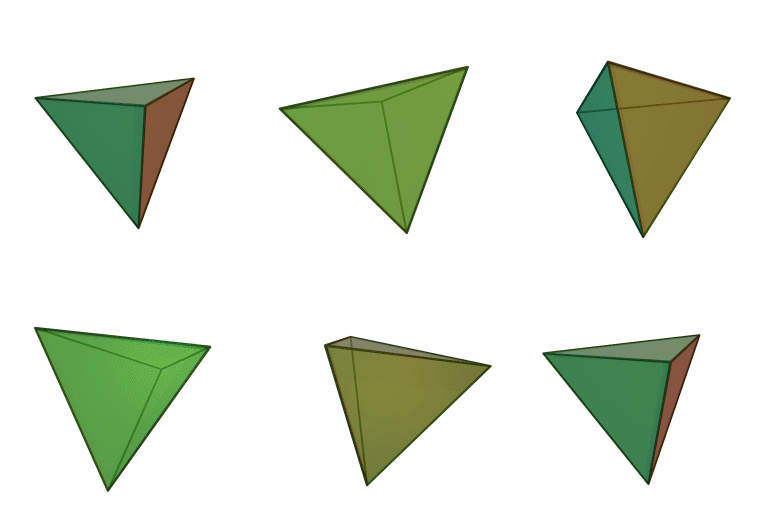
Tetrahedron or Pyramid
(4 Faces)

Hexahedron or Cube
(6 Faces)
Octahedron
(8 Faces)
Dodecahedron
(12 Faces)
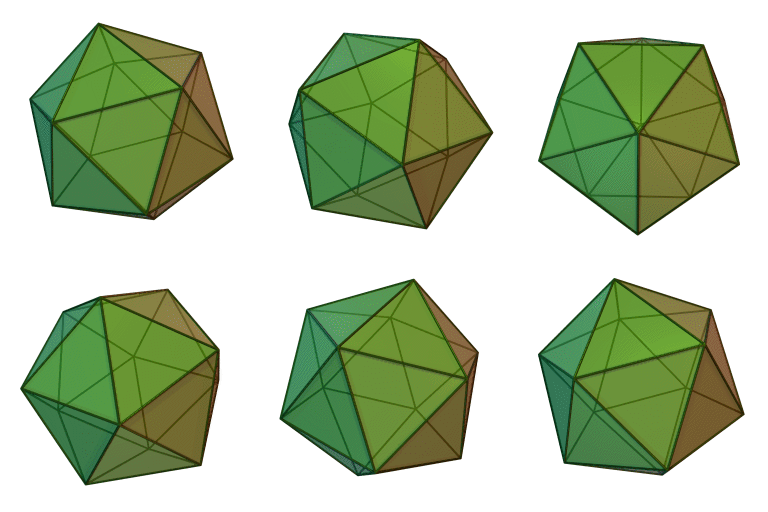
Icosahedron
(20 Faces)

These are the only 'perfect' solids — perfect in that all faces are identical 'regular' polygons, and all sides where faces come together have the same length.

This web page shows how the Platonic solids can be derived from the Flower of Life. First, select 13 non-overlapping circles from the Flower of Life to form the 'Fruit of Life':


Then, draw lines between the centers of every pair of the circles to form 'Metatron's Cube':

Metatron's Cube


(This one should be thought of as three-dimensional.) Now, pick out just the lines/sides/faces that pertain to each Platonic solid in turn:


Notice that the tetrahedron has been doubled to form two interpenetrating tetrahedrons, called a 'star tetrahedron'. It is the three-dimensional equivalent of the Star of David.

Notice also that only a very few of the vertices and lines of the dodecahedron correspond to vertices and lines of Metatron's cube.

That admittedly seems a weakness in the system. However, the point of the Platonic system as understood by Prince Charles is that nature often conforms in surprising ways to the various Platonic solids, however derived on paper. Mother Nature herself holds a mirror up to these forms.

Matter in general, Charles shows, favors the Platonic solids. He illustrates with a photo and caption:

A drop of mercury subjected to a stable soundwave. It is forced to form one of the basic geometric shapes known as the Platonic solids. [Here, the shape is a 6-faced hexahedron or cube, seen from above one of its vertices, with one vertex hidden.] If a different modulation [i.e., a different frequency of the soundwave] is used, so the drop changes its shape but it always conforms to the same grammar of harmony.
Geometry, then, is powerful. Certain of its forms infuse nature in a fundamental way. Traditionally, at the same time, these same geometric forms have been said to possess great symbolic and spiritual significance.