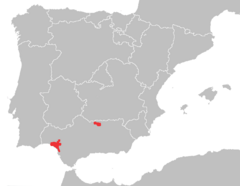
If in 1980 you visited the areas marked on this map in green in Spain or Portugal ...
... you may have been lucky enough to spot this animal:
The Iberian lynx is the world's most threatened species of cat, and it is the most threatened carnivore in Europe. By 2003, its range was down to:
This lynx was distributed over the entire Iberian Peninsula as recently as the mid nineteenth century. Six years ago, in March 2005, it was estimated that the number of surviving Iberian lynx was as few as 100, down from about 400 in 2000 and from 4,000 in 1960.
In addition to falling prey to feral dogs, to human poaching and poisoning, and to collisions with our automobiles, the Iberian lynx has lost out to to infrastructure improvement and urban and resort development. It wants habitats with a diversity of trees, so tree monocultivation, which serves to break the lynx's distribution area, has harmed it. It eats rabbits, which diseases such as myxomatosis and hemorrhagic pneumonia have ravaged.
As a result, the Iberian lynx is critically endangered. It and its habitat are fully protected, and it is no longer legally hunted.
SOS Lynx is a conservation charity based in Portugal, working to prevent the extinction of the Iberian Lynx. Its aim is to stop the declining of the Iberian Lynx and other lynx species.
Showing posts with label Our Earthly Cousins. Show all posts
Saturday, July 30, 2011
Monday, July 25, 2011
Our Earthly Cousins #3
My good friend who likes to take photos of our critter cousins has come through with a real gem:
The harpy eagle is the national bird of Panama and is depicted on its coat of arms. In its natural range ...
... there is a mostly rainforest habitat that the expansion of logging, cattle ranching, agriculture and prospecting has threatened to eliminate. In large parts of its range the bird has become a transient sight only; in Brazil, it has been all but totally wiped out from the Atlantic rainforest and is only found in numbers in the most remote parts of the Amazon Basin.
The clearing of the rainforest contributes mightily to carbon buildup in the atmosphere, which causes global warming. The harpy eagle has the honor of being a "poster child" in the fight against global warming and climate change. A harpy eagle named Hope, raised in captivity, was released into the Rio Bravo Conservation and Management Area in Belize. It was the fifteenth such eagle to be reintroduced into the Central American wild in hopes of reestablishing the species there. The timing of Hope's release was set to tie in with the United Nations Climate Change Conference in Copenhagen in 2009.
![]() |
| Harpy Eagle, in "Rehab" in Panama |
The harpy eagle is the national bird of Panama and is depicted on its coat of arms. In its natural range ...
| Range of Harpy Eagle |
... there is a mostly rainforest habitat that the expansion of logging, cattle ranching, agriculture and prospecting has threatened to eliminate. In large parts of its range the bird has become a transient sight only; in Brazil, it has been all but totally wiped out from the Atlantic rainforest and is only found in numbers in the most remote parts of the Amazon Basin.
The clearing of the rainforest contributes mightily to carbon buildup in the atmosphere, which causes global warming. The harpy eagle has the honor of being a "poster child" in the fight against global warming and climate change. A harpy eagle named Hope, raised in captivity, was released into the Rio Bravo Conservation and Management Area in Belize. It was the fifteenth such eagle to be reintroduced into the Central American wild in hopes of reestablishing the species there. The timing of Hope's release was set to tie in with the United Nations Climate Change Conference in Copenhagen in 2009.
Sunday, July 24, 2011
Our Earthly Cousins #2
More photos from my friend who takes excellent shots of our earthly cousins:
The bald eagle is the national bird and symbol of the United States of America. It nearly disappeared in the U.S. in the mid-20th century due in part to the thinning of egg shells attributed to human use of the pesticide DDT. It was also being illegally hunted. Plus, there was a widespread loss of suitable habitat. The use of DDT was banned in the wake of Rachel Carson's 1962 groundbreaking book Silent Spring, which energized the environmental movement, and the bald eagle was placed on the endangered species list and actively protected by new regulations. Its population has since rebounded. The bald eagle's recovery is testimony to the value of legally protecting threatened species at the federal level.
Common grackles are opportunistic birds that do well amid human populations. Often thought of as pests, they are actually marvelously beautiful birds in their form and plumage, and they are distinctive in that, like mockingbirds, they can mimic the sounds of other birds or even humans. They congregate in large groups, popularly referred to as a "plague."
In the U.S., they live everywhere east of the Rocky Mountains. In fact, they moved west with the pioneers as the primordial American forests were cleared to make land for farming. Grackles' natural predators are hawks or similar large birds of prey ... such as the bald eagle. To the extent that our activities have reduced concentrations of raptors, we are responsible for the large number of common grackles who turn right around and eat our crops.
American robins are beloved of Americans to roughly the same extent that common grackles are disliked. Robins are songbirds of the thrush family and, as migratory birds, are popularly called the "first sign of spring." Emily Dickinson wrote a poem, "I Dreaded That First Robin So," but most of us look forward to seeing robins return in the springtime — though, truth to be told, their annual southern migration for the winter removes them only from New England and the extreme north of the country. These baby robins hatched from distinctive eggs that give the name "robin's egg blue" to a particular color in the spectrum.
White-tailed deer, a.k.a. Virginia deer, inhabit virtually all of the continental U.S., along with much of Canada. They are found in Mexico, Central America, and northern South America. In the U.S., the species is the state animal of Arkansas, Illinois, Mississippi, New Hampshire, Ohio, Pennsylvania, Michigan, and South Carolina as well as the provincial animal of Saskatchewan. They are magnificent creatures, but there are far too many of them today.
A century ago, commercial exploitation, unregulated hunting, and poor land-use practices, including deforestation, severely depressed deer populations in much of their range. By about 1930, the U.S. population was thought to number only about 300,000. After an outcry by hunters and other conservation ecologists, commercial exploitation of deer became illegal and conservation programs along with regulated hunting were introduced. Recent estimates put the deer population in the United States at around 30 million — 100 times their 1930 numbers! Conservation practices have proved so successful that, in parts of their range, white-tailed deer populations currently far exceed their carrying capacity and the animal may be considered a nuisance. They are indeed a nuisance where I live, as they eat everyone's gardens.
Gray wolves, cougars, American alligators, and (in the tropics) jaguars are effective natural predators of adult deer. Bobcats, lynxes, bears, and packs of coyotes prey on deer fawns. Human activities have removed many of the deer's natural predators, and deer populations have grown too large.
![]() |
| Bald eagle, Skagit Valley, WA |
![]() |
| Common grackle, Anacortes, WA |
In the U.S., they live everywhere east of the Rocky Mountains. In fact, they moved west with the pioneers as the primordial American forests were cleared to make land for farming. Grackles' natural predators are hawks or similar large birds of prey ... such as the bald eagle. To the extent that our activities have reduced concentrations of raptors, we are responsible for the large number of common grackles who turn right around and eat our crops.
![]() |
| Baby American robins, Ann Arbor, MI |
![]() |
| Baby woodchucks, Ann Arbor, MI |
Woodchucks are also called groundhogs, whistle pigs, and land beavers. Their closest rodent relatives are the group of ground squirrels known as marmots. Groundhogs can be found everywhere in the eastern half of the U.S. except for the deep south, and all through Canada.
The groundhog prefers open country and the edges of woodland. Since the clearing of forests by the pioneers provided it with much suitable habitat, the groundhog population is probably higher now than it was before the arrival of European settlers in North America. Common predators for groundhogs include wolves, coyotes, foxes, bobcats, bears, large hawks, owls, and dogs. Most of those groups have had their populations diminished by human activity, so the groundhogs have flourished. We humans like to hunt them, but we don't take them in sufficient quantities to constrain their numbers.
![]() |
| White-tailed deer, Ann Arbor, MI |
![]() |
| White-tailed deer, Ann Arbor, MI |
White-tailed deer, a.k.a. Virginia deer, inhabit virtually all of the continental U.S., along with much of Canada. They are found in Mexico, Central America, and northern South America. In the U.S., the species is the state animal of Arkansas, Illinois, Mississippi, New Hampshire, Ohio, Pennsylvania, Michigan, and South Carolina as well as the provincial animal of Saskatchewan. They are magnificent creatures, but there are far too many of them today.
A century ago, commercial exploitation, unregulated hunting, and poor land-use practices, including deforestation, severely depressed deer populations in much of their range. By about 1930, the U.S. population was thought to number only about 300,000. After an outcry by hunters and other conservation ecologists, commercial exploitation of deer became illegal and conservation programs along with regulated hunting were introduced. Recent estimates put the deer population in the United States at around 30 million — 100 times their 1930 numbers! Conservation practices have proved so successful that, in parts of their range, white-tailed deer populations currently far exceed their carrying capacity and the animal may be considered a nuisance. They are indeed a nuisance where I live, as they eat everyone's gardens.
Gray wolves, cougars, American alligators, and (in the tropics) jaguars are effective natural predators of adult deer. Bobcats, lynxes, bears, and packs of coyotes prey on deer fawns. Human activities have removed many of the deer's natural predators, and deer populations have grown too large.
Friday, July 22, 2011
Our Earthly Cousins #1
I'm beginning this series on Our Earthly Cousins in order to highlight the family connections we humans have to all living species on earth. Here are two photos taken by a good friend of mine on a recent visit to Acadia National Park in Maine.
These two species have an inalienable right to be here — as do we, as do all other species on God's green earth. They are our cousins in that they, like us, are branches on one single tree of life on this evolving planet. We have a right to admire them and share the earth with them, but no right to destroy them or damage their habitat.
![]() |
| Fin Whale |
![]() |
| Cedar Waxwing |
These two species have an inalienable right to be here — as do we, as do all other species on God's green earth. They are our cousins in that they, like us, are branches on one single tree of life on this evolving planet. We have a right to admire them and share the earth with them, but no right to destroy them or damage their habitat.
Subscribe to:
Posts (Atom)