Showing posts with label Chesapeake Bay Region. Show all posts

Saturday, February 04, 2012

Washington Post Editorial: "Maryland’s power play"

I've been covering the Maryland Offshore Wind Energy Act of 2012, a legislative initiative of Maryland's Democratic governor, Martin O'Malley, in my Maryland Offshore Wind Power series. If passed in this year's General Assembly session, it's intended to subsidize an electric-power-producing wind farm 10 nautical miles out into the Atlantic Ocean, off Ocean City. It might look something like this:


A recent editorial in The Washington Post objected to the wind farm, which I whole­heartedly support. The editorial gives me information I hadn't known, though, and for which I'm grateful. Among the items I learned:
  • The proposed wind farm would eventually generate perhaps a third of the state’s electricity. I hadn't realized it would account for that much of our electric power.
  • Maryland lawmakers have already mandated that the state's utilities derive 20 percent of the state’s electricity from renewable sources by 2022. Renewable sources include wind, solar, and other technologies which don't consume fossil fuels, which we will eventually run out of, and do not contribute greenhouse gases, such as carbon dioxide, to the atmosphere, thereby abetting global warming.
  • The state’s renewables mandate already requires that utilities derive 2 percent of the state’s electricity from solar by 2022.
The proposed wind farm legislation apparently (see my earlier posts in this series) requires wholesale electricity suppliers to buy up to 2.5 percent of their megawatts from offshore wind generators. I interpret that to mean that 17.5 percent or more of the required 20 percent for renewables would come from other than offshore wind.

The Post editorial doesn't mind the renewables mandate per se, just the specific requirement of the proposed legislation that a certain-sized chunk of it come from offshore wind. That requirement would keep electricity suppliers from opting for cheaper alternatives.

The Post also wants natural gas to count, at least partially, as "clean energy," even if it is not strictly "renewable." Natural gas has become quite cheap in the last few years. Burning natural gas puts half the carbon in the atmosphere that burning coal does. So why shouldn't electricity suppliers be encouraged to buy from electricity producers who use gas, if that's a lot cheaper than the proposed offshore wind operation?

My answer is that an expensive-to-build offshore wind farm needs an initial ratepayer boost before it can hope to become price competitive with natural gas, with nuclear, or even with solar, sometime down the road.

As I understand it, building the proposed wind farm would start in 2017 and be finished in 2022 — barring delays. Once it was completed, its developer would have to pay off the steep financing for it, over some ensuing period of years. Meanwhile, if Maryland's residential electricity customers' bills are $2.00 higher than they would otherwise be, most of the extra money would get funneled into paying off the loans.

Someday, though, the wind farm's startup costs would have been paid off. At that point, the wind farm would become price competitive with other power plants, and might even be cheaper than a great many of them.


Wednesday, February 01, 2012

Maryland's Offshore Wind Power Initiative, Part 3

Maryland Governor
Martin O'Malley (D)
The Maryland Offshore Wind Energy Act of 2012: that's the name of the legislation Governor Martin O'Malley will introduce into Maryland's General Assembly this year, that, if it passes, will encourage building a "wind farm" in the Atlantic Ocean, 10 miles off the coast from Ocean City.

A wind farm (also called a "wind park") is a series of wind turbines — up-to-date windmills — that are set a-spin by the passing breezes, thereby producing electric power.

Wind farms are increasingly popular on dry land in the U.S., but apparently there are none yet built off America's shores. Here's a picture of one that sits off Copenhagen, Denmark:


I've already blogged twice about Gov. O'Malley's initiative, which I as a Maryland resident strongly support. Recent news coverage has added to my understanding of the proposal. Herein, I'll refer to the following sources:

  1. "O’Malley to try again for offshore wind development," Washington Post, Jan. 22
  2. "O'Malley to unveil new approach to wind power," Baltimore Sun, Jan. 23
  3. "New O'Malley wind farm proposal still a long shot," Baltimore Sun, Jan. 23
  4. "O'Malley Introduces Updated Offshore Wind Bill," Southern Maryland Online, Jan. 24

The governor, a Democrat, wants an as-yet-undetermined private outfit to build and subsequently own and operate the wind farm, the creation of which would be stimulated ultimately by an at-most-$2.00 increase on residential ratepayers' monthly electric bills. The increase for large commercial concerns would be limited to 2.5 percent.

The wind farm would create 1,800 jobs in the construction phase and 360 once a wind farm is operating, says the O'Malley administration (Source 2). It would be a way to produce "clean" electric power from a renewable source that does not pollute the atmosphere with carbon and thereby foster climate change.

Financial Details

I find the financial details of the plan a bit obscure, admittedly. Apparently, the wind farm as a "producer" would sell its electric power to "wholesale suppliers," who would in turn supply power to "utilities," who would then transmit it to homes and businesses. The bill would require suppliers, as middlemen, to "get a set amount of their power from wind, as they do now from solar sources" (Source 2).

Proof that the suppliers' requirement is being met would come in the form of "an offshore wind renewable energy credit allowing companies to earn certificates for demonstrating that they are using offshore wind as a certain percentage of their total energy generation" (Source 4).

The electric power from the wind farm would be sold to wholesale suppliers at rates determined on an open market. There would apparently be a secondary market for the renewable energy credits, i.e., the "certificates." "The price of the credits would fluctuate in tandem with market rates to ensure that offshore wind producers can continuously count on a stable profit" (Source 1).

I gather that that means a supplier that more than meets its renewable-energy requirements might wind up with excess credits, which could then be sold on the secondary market to suppliers who are under their quotas. That's how the price of credits would "fluctuate in tandem with market rates" that apply to the wind power itself. The more power the wind farm produces relative to demand, the lower the prices of the power and of the credits would normally be.

The prices for wind power/credits would be passed along, in whole or in part, to the ultimate consumers of the power as higher charges on their monthly bills.

Ostensibly, the prices must never go so low as to deny the wind farm operator — the "producer" — a reasonable profit. And they must not go so high as to exceed $2.00 a month for residential customers or the extra 2.5 percent for larger entities. How will we know in advance that the costs and prices will be so well-behaved?

Source 2 says:
Administration sources said the extra cost would be subject to a strict limit. If the Public Service Commission projects a cost of more than $2 a month — in 2012 dollars over 20 years — the project would be abandoned. ... the PSC would consider the [producer's] wind-power plan to ensure it was feasible and the price reasonable. Once it got the green light from the PSC, the [producer] could sell into a Maryland market with a guaranteed minimum demand built into the law. The PSC also would have to commission an independent study to verify that the program would produce a net benefit for the state.
Both the PSC and the independent commission would presumably have a go/no decision to make at some point down the road, based on (says Source 1) "on a 20-year prediction of future energy prices." That's "a term twice as long as the state’s Public Service Commission typically forecasts," Source 1 says, and it clearly imposes palpable risks.

The wind power would start flowing, Source 1 says, in 2017. The go/no-go decision would have to be made prior to that, and the underlying prediction would cover the 20-year period starting in that year. A big risk is that the 20-year prediction would be off target.

Costs of Building the Wind Farm

That's how the costs of operating the wind farm would be borne. These sources have far less to say about how the costs of building it in the first place would be met.

None of the sources says how much the wind farm would cost to build. Would the state itself subsidize any of the development costs? Seemingly not. Source 1 speaks of a "subsidy" from ratepayers ... but that's the $2-per-month I already mentioned.

Without mentioning any actual dollar amounts for development of the wind farm, Source 3, by Jay Hancock of the Baltimore Sun, gets down to brass tacks on how the building of the project might be financed: with federal "loan guarantees and tax subsidies for wind energy." Sadly, though, says Hancock, "Tax credits deemed crucial for wind development expire this year. Partisan rancor in Congress prompts many to fear they won't be renewed."

Accordingly, I assume the developer of the wind farm would get no up-front state or federal subsidies. It would raise capital the old-fashioned way, based on the supposition that operating the wind farm would produce a steady profit.

If there were any federal subsidies, fine. If not, fine too?

Chances of the Wind Farm Actually Being Built

Source 3 basically deals with Jay Hancock's estimate of the bill's chances of passage and the chances that the wind farm would really get built, assuming the bill does pass. He says the O'Malley bill may get through the legislature, but that doesn't mean the wind farm will actually get built. Why not? Because an offshore wind farm is hugely costly.

One official who is in the know is quoted by Hancock as saying, "We are not obligating our ratepayers to a single dime unless and until someone can figure out how to finance and build one of these things" under Maryland's ground rules. "If they don't figure it out, no harm, no foul."

Hancock continues:
But the ground rules are likely to prove too daunting for developers. Building pylons and turbines in corrosive water miles offshore is a risky and developing art. Delays and cost overruns are common. The more electricity customers are protected from that risk, the more wind farm developers have to assume it. And wind farm developers aren't looking especially daring these days.
And:
Even with federal support, there's no guarantee O'Malley's project works. Unlike last year's proposal, this one wouldn't have Baltimore Gas and Electric and other utilities buy offshore wind power directly. Instead, the [Maryland] Public Service Commission could require wholesale electricity suppliers to buy up to 2.5 percent of their megawatts from offshore wind generators. That's supposed to assure developers of long-term demand.
To clarify that once again: Baltimore Gas and Electric is a "utility" that transmits electric power to many Maryland customers. Since it does not itself produce electric power, it has to purchase the electric power it transmits to its residential and business customers. From whom does it purchase the power? From "wholesale electricity suppliers."

One of the "suppliers" I have dealt with in the past is Dominion Retail. I am now dealing with Stream Energy. There are several other electricity "suppliers" available in the deregulated Maryland market.

The "supplier," in turn, buys electricity from the likes of "offshore wind generators," among numerous other energy "producers" that may derive electric power from wind, solar, natural gas, coal, etc. It is the "suppliers" that would be mandated to buy "up to 2.5 percent of their megawatts from offshore wind generators," according to the O'Malley proposal.

If the offshore wind farm is hugely costly to build, and it would be, then once it is actually built and in operation, as an electric power "producer" it would begin passing along as much as it can of its large financing and construction costs to the wholesale "suppliers" — who would pass them along to the power transmission "utilities," who would pass them along to you as a customer. That is supposed to cause no more than a $2.00 increase in the monthly bills that "utilities" charge their residential customers, and at most a 2.5 percent increase for commercial ones.

But would those dollar or percentage limits actually work to let the the wind farm turn a profit, given the huge fixed costs of its initial investment in facilities and equipment which would have had to be initially financed by means of borrowing money at some perhaps high rate of interest? Hancock thinks not. Just as home buyers have to be pre-approved for their mortgages based on their incomes, the wind farm developer would have to be pre-approved by the PSC based on the likelihood that it could turn a profit under the ground rules of the legislation.

So the bill might pass and be signed by the governor ... and yet the PSC might be forced to nix the project sometime down the road, before the wind farm is actually committed to and built.


Tuesday, January 24, 2012

More on Maryland's Offshore Wind Power Initiative

As I reported in Is an Offshore Wind Farm in Maryland's Future?, Martin O'Malley, Maryland's Democratic governor, is moving ahead with a legislative proposal to subsidize a "wind farm" off the coast of our state. A cluster of wind turbines like these ...


... would be built off Ocean City, eleven miles out into the Atlantic, if the governor gets his way.

When the wind blows, the blades of wind turbines spin, generating electric power. But the offshore version of this relatively new technology is expensive and remains unproven to an extent that even many of O'Malley's fellow Democrats in Maryland's General Assembly remain unconvinced.

In The Washington Post of January 23, 2012, the article O’Malley to try again for offshore wind development, by Aaron C. Davis, talks about the governor's latest proposal.

I personally think the costs and risks are worth taking, because wind technology is clean and green. Wind power is solar power at one remove, in that the warmth from the sun is what makes the winds blow. No fossil fuels are used, no carbon is expelled into the atmosphere, and global warming is thus not facilitated.

* * *

According to Wikipedia's article on wind power, the United States already has (as of 2010) 40,180 megawatts of generating capacity from the wind, putting us in second place behind China, with 44,733 MW. "Offshore wind power can harness the better wind speeds," the article says, that exist out away from the land.

Governor O'Malley's immediate problem is that Maryland would have to subsidize the offshore wind farm, as it would be too expensive for private developers to build without financial incentives. Money, tax breaks, and/or loan guarantees would likewise need to come from the federal government. Maryland's monetary contribution would ultimately wind up being paid for by higher electric bills charged to residential households and large commercial accounts.

Legislation the governor introduced in the last General Assembly session, in 2011, would have charged residential households a flat $2.00 per month on their electric bills in the form of an explicit line item. That bill failed to pass. This year's version does not include a flat line item for customers. It assumes the costs of wind generation will be folded into the base electric rates customers pay.

It's still supposed to top out at $2.00 extra per month, but the Post article says there's a catch:

If solar [power] is any example, that means it could be nearly impossible for residents to calculate the cost of the subsidy. 
Although O’Malley’s bill would mandate that the cost be no more than $2 per month, that per-household price would have to be estimated up front on a 20-year prediction of future energy prices — a term twice as long as the state’s Public Service Commission typically forecasts. 
If the commission’s estimate is wrong, the subsidy for wind could be much higher or lower. 
“We could look like geniuses, or people could experience the price more” than $2, said one administration official, who spoke on the condition of anonymity to freely discuss the governor’s proposal.


How would the financial details work?

To make the bill more palatable to [Sen. Thomas M. Middleton, (D-Charles County), who chairs the Finance Committee, and his counterpart in the House, Del. Dereck E. Davis (D-Prince George's County)] O’Malley’s office also did away with a mandate in last year’s version that required utilities to buy wind power at a set price high above current market rates.
Rather, to ensure that developers can turn a profit, the state’s Public Service Commission, which regulates utilities, would set up a kind of commodities market. The electricity created from offshore wind would be sold at competitive prices. But the energy would also come with renewable-energy credits. The credits are needed by the state’s power generators to meet Maryland guidelines requiring them to obtain a growing share of their power from wind, solar and other renewable sources. The price of the credits would fluctuate in tandem with market rates to ensure that offshore wind producers can continuously count on a stable profit.

By "sold at competitive prices" I assume the Post means that an open market would determine the price of the wind power generated off Maryland's shore; there would not be a preset price. I further assume the the "renewable-energy credits" that "the state’s power generators" need to amass — according to what mandate I don't claim to know — would be bought and sold on a secondary market whose prices would "fluctuate in tandem" with those for the power itself.

I admit to having doubts, by the way, as to whether market-determined prices would indeed "ensure that offshore wind producers can continuously count on a stable profit." Just as agricultural farmers aren't always guaranteed profits each year, why is it thought that tomorrow's "wind farmers" would be able to count on profits?


Clearly, the mandate that "the state’s power generators" — i.e., existing power plants that use coal, natural gas, or nuclear power — amass credits that derive from wind power generation is key. The operator(s) of the wind farm would receive the proceeds of selling the credits, which would amplify the proceeds of selling the wind power itself.

But existing electric-power generators would surely pass the cost of the credits on to their customers, in whole or in part. Ideally, as I say, the governor anticipates that the passed-on cost would top out at $2.00 per residential customer per month, and at "2.5 percent for the state’s largest commercial and industrial businesses."


* * *
Two key questions, then, are (1) Will the legislature pass O'Malley's complex proposal? and (2) Would it work out the way the governor hopes, if it becomes law? My guesses are "yes" and "yes" — but don't bet the farm on it.


Wednesday, January 11, 2012

Is an Offshore Wind Farm in Maryland's Future?

Here's a picture of what may one day soon arrive off our Maryland coast, 11 miles out from the beaches of Ocean City:


It's an offshore wind farm. The propeller-like things are wind turbines. When the wind blows, the blades turn, generating electricity.

Electric power from the wind sends no carbon into the atmosphere and so does not contribute to global warming. It's a renewable, indeed eternal, source of electricity. But it's not presently as cheap as, say, burning coal to power our light bulbs, heating, air conditioning, and the like.

One reason wind power is relatively expensive is that technologies to harness it are new. They have not yet moved "down the cost curve" to the degree experts expect over time.

So building an offshore wind farm today is costly ... and also risky, in that the market for wind power may fail to develop the way experts hope. Yet the only way to move wind power down the cost curve is to invest in it. Building wind farms will, over time, lower the costs of building more wind farms.

Maryland governor
Martin O'Malley
Maryland's Democratic governor, Martin O'Malley, thinks the costs and risks of building wind farms are tolerable even now, with governmental help. He'll be introducing legislation in this state's upcoming General Assembly session that, according to this recent article in The Washington Post, would increase the monthly electric bills of "ratepayers to help cover the cost of making offshore wind energy competitive."

A similar "measure to subsidize development of a multibillion-dollar offshore wind farm" which Gov. O'Malley introduced last year, says the article, "would have added a couple of extra dollars to every Marylander’s monthly electric bill for 20 years and thousands onto those of the state’s largest businesses."

The details of this year's modified proposal have not yet been released, but it appears to embrace a different mechanism for generating the intended financial subsidies. Accordingly:
The new plan would increase ratepayers’ bills, perhaps by an amount nearly equal to what last year’s plan would have, but in a way that would obfuscate such costs, experts said. The credits would not appear as a line-item charge but would be factored into the overall price of electricity sold in the state, raising base electric rates charged to Maryland customers.
I am a strong supporter of Gov. O'Malley in this. I feel that there is no better time for "green-energy" initiatives than now. My reasons:

  1. They'll help wean us off fossil fuels in general.
  2. They'll help end reliance on foreign oil in particular.
  3. They'll help forestall global warming.
  4. They'll pollute less in general, creating less acid rain and other harmful effects.
  5. They'll use 100% renewable resources, and thus be sustainable into the far future.
  6. They'll create a new industry, with permanent new jobs.

It is the creating of new jobs that is the biggest political selling point today, given the sluggish economy and the number of years it would take to get the wind farm up and running. From the point of view of Maryland, these jobs could be a hugely attractive plus for the state. And I imagine another plus factor for Maryland would be that the electric power from the wind farm could, some of it, be sold outside the Free State, thus enriching Maryland's coffers.

Yet the forthcoming O'Malley proposal will be a hard sell to even the governor's fellow Democrats in the state's Senate and House of Delegates. One reason is that the subsidies offered by the state to the wind farm's prospective developers would have to be amplified by sizable federal subsidies to those same developers, mainly in the form of tax credits and loan guarantees.

And those would be harder to come by than they might have been even last year. The general belt-tightening that we saw at the federal level in 2011 in response to the national debt crisis has made Washington largesse much harder to come by now. Add to that today's inflated skepticism about green-energy subsidies in the wake of the Obama administration's much-scorned Solyndra mistake, and you have reason to doubt the necessary federal subsidies would materialize.

I'll be keeping my eye on Gov. O'Malley's wind farm initiative as details become available and as the Maryland General Assembly comes to terms with it.


Sunday, January 08, 2012

Environmentalism and Subsidiarity

Fair warning: this blog post is about a concept ... and a nuanced one at that. It's called "subsidiarity." I ran across mention of it in a recent column by Washington Post op-ed writer Michael Gerson, "Rick Santorum and the return of compassionate conservatism."

The column lovingly caresses the candidacy and ideology of GOP presidential hopeful Rick Santorum, a former Pennsylvania senator. I want to make clear at the outset that I do not endorse Santorum. Repeat, do not. For one thing, I despise his opposition to same-sex marriage, to a woman's right to a safe abortion, and to the use of contraceptives to forestall pregnancy.

I am a liberal Democrat. I could not in good conscience vote for any of the Republican hopefuls. But that's not what this post is about. Rather, what interests me is this passage in Gerson's column:
The Catholic (and increasingly Protestant) approach to social ethics asserts that liberty is made possible by strong social institutions — families, communities, congregations — that prepare human beings for the exercise of liberty by teaching self-restraint, compassion and concern for the public good. Oppressive, overreaching government undermines these value-shaping institutions. Responsible government can empower them — say, with a child tax credit or a deduction for charitable giving — as well as defend them against the aggressions of extreme poverty or against “free markets” in drugs or obscenity.


This is not statism; it is called subsidiarity. In this view, needs are best served by institutions closest to individuals. But when those institutions require help or protection, higher-order institutions should intervene. So when state governments imposed Jim Crow laws, the federal government had a duty to overturn them. When a community is caught in endless economic depression and drained of social capital, government should find creative ways to empower individuals and charities — maybe even prison ministries that change lives from the inside out.


This is not “big government” conservatism. It is a form of limited government less radical and simplistic than the libertarian account. A compassionate-conservative approach to governing would result in a different and smaller federal role — using free-market ideas to strengthen families and communities, rather than constructing centralized bureaucracies. It rejects, however, a utopian belief in unfettered markets that would dramatically increase the sum of suffering.
The kernel of the subsidiarity idea is: " ... needs are best served by institutions closest to individuals. But when those institutions require help or protection, higher-order institutions should intervene." And so there should be: " ...  a different and smaller federal role — using free-market ideas to strengthen families and communities, rather than constructing centralized bureaucracies."

Subsidiarity, by the way, is an established principle of Catholic teaching which says "that human affairs are best handled at the lowest possible level, closest to the affected pesons."

Subsidiarity and the Environment

Dealing with environmental problems today seems to me to require an approach that honors and respects subsidiarity. By that I mean that we need to build our responses to environmental threats from the ground up, not from the top down.

Inner Harbor, Baltimore, Maryland
Here's a case in point. In a recent opinion piece in The Baltimore Sun, "A swimmable, fishable harbor by 2020: Why not?", Michael D. Hankin, who is chairman of the Waterfront Partnership of Baltimore, writes about what it will take to clean up Baltimore's Inner Harbor.

Baltimore is one of America's oldest port cities, with access to the Chesapeake Bay and the Atlantic Ocean via the Patapsco River. Nestled right at its heart is an array of harbors, the inmost being the Inner Harbor, site of the tourist-attracting HarborPlace. But, beautiful as the scene may be, the water itself is polluted by sewage and storm runoff after every heavy rain. Just as the Chesapeake itself is in sore need of cleaning up, so too are the Inner Harbor and the Patapsco River.

But how can that happen?

Answer: there needs to be an active partnership of like-minded entities: "a coalition of businesses, nonprofit organizations, city agencies, and citizens," as the Healthy Harbor website puts it. Healthy Harbor is the name of an initiative undertaken by Waterfront Partnership of Baltimore. Only by virtue of such a coalition do we have a chance to address the city's sewage/runoff problem in all of its causes and effects.

This is the bottommost layer of the subsidiarity cake. But as I wrote in Dead Zone in Our Chesapeake Bay, there have to be other layers as well. The city's problem with water pollution slots into that of the entire Chesapeake region, which is killing the bay. The region is made up of six states and the District of Columbia, and all of those mid-sized governmental entities have to be on board with a "pollution diet" that fairly distributes the burden of cleanup costs among them.

The pollution diet itself was the work of the Environmental Protection Agency, at the federal level. Recent history has shown that the states themselves were unable to negotiate an effective response to the dying bay on their own. The EPA had to step in as the top layer of the subsidiarity layer cake.

But this is not the nuanced approach to environmental issues that we hear from our loudest political voices. Instead we hear, at one extreme, "kill the EPA," and at the other (that of President Obama) a lot of tacking this way and that, with no clear sense of direction.


Thursday, August 11, 2011

Flush with Enthusiasm (But Use Less Water!)

Some questions have occurred to me that have surely occurred to everyone else concerned with the environment: what about all the water we use for toilet flushing?

Are we throwing too much ecological "money" down the loo? Should we implement a "flush tax"?

According to a 1999 report by the American Water Works Association, each person in this country flushes the toilet an average of a little more than 5 times per day. The current U.S. population is nearly 312 million people, so if each of the 312 million individuals flushes five times a day, the number of flushes per day is 1,560,000,000.

That works out to 65,000,000 flushes each hour, or almost 1.1 million flushes per minute in America.

Most modern home toilets use 1.6 gallons of water per flush. That suggests each person uses 8 gallons per day or 2920 gallons per year just for toilet flushing. Of course, the figure might go up or down depending on how many flushes take place outside the home, if the toilets or urinals that are used have a per-flush volume other than the standard 1.6 gallons of water of a home toilet.

I've read that if everyone in the United States flushed the toilet just one fewer time per day, we could save a lake full of water about a mile long, a mile wide, and four feet deep every day.

A rate of four to five toilet flushes per U.S. citizen per day amounts to roughly 2.5 billion gallons of water flushed down the drain daily. That's enough to supply fresh drinking water to the entire population of Chicago for more than three years.

Home indoor water use statistics vary a lot, but seemingly 40% gets flushed down toilets, more than 30% is used in showers and baths, laundry and dishwashing take about 15%, leaks (including toilet leaks) claim 5% or more, which leaves about 10% for everything else.

So if five flushes per person per day were to shrink to four, home water savings would amount to 25%-of-40% of current daily use. 10% of all the water currently being used per day would be saved.

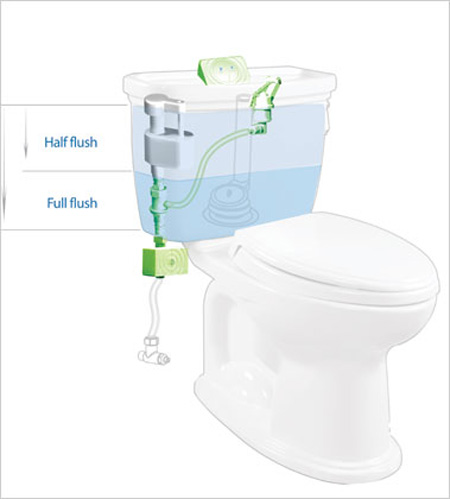
Dual-flush toilets could save even more. These have two selectable flush volumes, 1.6 gal. and 0.8 gal. The latter would typically be used for liquid waste, the former for solid. If four of a person's daily five flushes used the 0.8-gal. amount, each person could save 3.2 gallons per day. That's a reduction from 8 gallons to 4.8 gallons a day, which is a saving of 40%. In terms of total household water use, that comes to 40%-of-40% or 16%.

In earlier decades, most toilets flushed using 3.5 gallons of water, not the 1.6 gallons that are standard today. That was more than twice the waste water per flush!

On a related note, did you know that pharmaceuticals we consume are released through urine? This means after years of our being a society of pill poppers, there’s a vast quantity of pharmaceuticals lurking in our sewage systems. 90% of the pharmaceuticals taken end up in our urine. Scientists are now finding estrogen from birth-control pills, pain medication, and antidepressants in fish.

As for a "flush tax," my home state of Maryland has one! Since 2004, $2.50/mo. has been added to sewer bills (and an equivalent $30 a year fee on septic system owners) to pay for environmental cleanup efforts in the Chesapeake Bay. Read all about it in this article from the Chesapeake Bay Journal.

Tuesday, July 26, 2011

Dead Zone in Our Chesapeake Bay

We here in Maryland have a natural treasure living right nearby. It is the Chesapeake Bay:


Water that streams into the Chesapeake comes from a watershed that includes areas within six states and the District of Columbia:

New York, Pennsylvania, Maryland, Delaware,
Virginia, West Virginia, and the District of Columbia
form the Chesapeake Bay's Watershed Community

For many years the watershed area has streamed water into the bay that is heavily polluted by nitrogen and phosphorus, elements contained in lawn fertilizers and in manure generated on farms such as the chicken farms on Maryland's Eastern Shore. Storm water runoff takes those elements with it, and those so-called "nutrients" wind up creating huge "dead zones" in Chesapeake Bay where fish, crabs, clams, and oysters will die.

The dead zones occur because the nitrogen and phosphorus feed large "blooms" of algae growth in the bay. After completing its life cycle, the now-dead algae form a black glop that robs the water below of oxygen. The creatures living in that water either relocate or die. Many, such as oysters, cannot relocate. Others try and fail. The result is a widespread natural tragedy that happens like clockwork every summer.

Here is a map showing in red the dead zone in the Chesapeake Bay in 2003:


In this year of 2011 the dead zone is especially large, says this recent article from The Washington Post:
This year’s Chesapeake Bay dead zone covers a third of the bay, stretching from the Baltimore Harbor to the bay’s mid-channel region in the Potomac River, about 83 miles, when it was last measured in late June. It has since expanded beyond the Potomac into Virginia, officials said.
Especially heavy flows of tainted water from the Susquehanna River brought as much nutrient pollution into the bay by May as normally comes in an entire average year, a Maryland Department of Natural Resources researcher said. As a result, “in Maryland we saw the worst June” ever for nutrient pollution, said Bruce Michael, director of the DNR’s resource assessment service.
This is not just a local problem:
A similar phenomenon is taking shape in the Mississippi River Valley, where tons of chemical fertilizer run off huge industrial farms, the Nature Conservancy announced recently. Findings by researchers at Texas A&M University support predictions that remarkably heavy rains and snow melt in the valley will create the largest-ever dead zone in the Gulf of Mexico.
Dead zones run the length of the Atlantic Coast. Environmentalists say they are a testament to reports that pollution loads from ever-expanding cities and suburbs are growing and, in some cases, creating a monster.
Heavy snowmelt and rains make for great quantities of heavily polluted runoff ... and, of course, they cause "100-year" floods such as we saw on the Mississippi River earlier this year. This is all part of "global weirding," a byproduct of global warming. The fishermen, crabbers, and oystermen on the Chesapeake Bay will have an even smaller catch than usual this year as a result of it.

The Post article goes on:
In December, the Environmental Protection Agency finalized a “pollution diet” to dramatically reduce the levels of nitrogen, phosphorus and sediment that states can allow in the bay from municipalities and farms.
The plan is more aggressive than its predecessors in past years that were criticized as ineffective. Under the plan, Chesapeake Bay watershed states — Virginia, Maryland, New York, West Virginia and Pennsylvania — and the District were required to draft and submit strategies to the EPA for reducing nutrient pollution.
The final plans will cost billions to improve municipal water treatment plants that contributed to nitrogen runoff, and to improve conservation efforts by farmers, particularly large animal-feed organizations where phosphorus runs into the bay when rain washes away manure.
You can read about Katharine Antos ...


... the 31-year-old employee in the Environmental Protection Agency's Chesapeake Bay Program Office who got the various states to agree to their new "pollution diets," in this recent Post story. Antos worked to assemble the plans agreed to by the states just in time to meet a court-imposed deadline for 15-year plans to dramatically reduce Chesapeake Bay pollution.

But the overall "roadmap" that was agreed to has been challenged, says the first article ...
... by two powerful lobbies and other groups that are seeking a court order to block it. The American Farm Bureau Federation argued that costly conservation requirements could drive farmers in the Chesapeake Bay watershed out of business, and that states — not the EPA — should determine pollution limits.
The group’s lawsuit in a federal district court in Harrisburg, Pa., asks a judge to stop the plan from going forward. The National Association of Home Builders recently joined the suit.
At stake here for the plaintiffs is not just what gets done to curb pollution in the Chesapeake Bay, but also the extent to which the Chesapeake plan might be ...
... a harbinger for far-reaching requirements in the Mississippi River basin, where industrial farms are responsible for chemical runoff that lead to huge dead zones in the Gulf of Mexico.
The National Association of Home Builders joined the suit because:
... Housing developments with paved driveways, streets and roofs without greenery are another source of nitrogen runoff because they send more rain across lawns than can be absorbed, washing lawn fertilizer into the watershed. Environmentalists say builders have resisted calls to create greener communities with permeable stone and grassy areas that soak up rain.
The forces that oppose the Chesapeake Bay cleanup plan are powerful and rich, says the Chesapeake Bay Foundation. The CBF is ...
... part of a coalition that sued the EPA in 2009 after decades of weaker anti-pollution measures failed to clean the bay, lambasted the farm bureau’s suit to stop the EPA’s plan.
“Farmers, the chicken council, fertilizer institute, hog people, turkey people . . . these are big Washington lobbying associations,” said Will Baker, the foundation’s president. “They’re not mom-and-pop farmers. If you look at the amount of money they’ve given to candidates and lobbying, it’s in the hundreds of millions.”
Sadly, this controversy is playing out pretty much beneath the radar screen in these days when news coverage is dominated by the federal debt crisis. Yet how the suit is eventually decided could spell the demise of the agreed-to roadmap for the Chesapeake Bay's cleanup. It could also keep cleanup efforts for the Mississippi River from coming to full fruition. That dire outcome could deal a death blow to two of our treasured natural waterways in America, the Chesapeake Bay and the Mississippi River.

Yet the plaintiffs in the suit clearly have a lot at stake, too. They make or grow such things as new houses for us to live in and chickens for us to eat at Popeye's.  True, they are not mom-and-pop outfits. They are big corporations, and they have outsized legal and political power.

Still, if the suit is decided in favor of the EPA, the plaintiffs will have to pay for much of the bay and river cleanup. Not necessarily directly, but in terms of having the states impose on them more costly regulations that would force them to clean up their act. For example, homebuilders would have to build greener developments, which would reduce the number of houses per development and make the developments more expensive to build. Some of those added costs would be passed on to homebuyers, and some the developers would have to eat. The costs passed on to homebuyers would make the homes more expensive.

Meanwhile, fewer homes built would mean fewer jobs for carpenters and plumbers and electricians. And fewer building materials purchased from suppliers. There would be a ripple effect that would be felt widely in the local and even the national economy. Fewer people would be able to afford all that many chicken meals at Popeye's then ... and the prices of those meals would be going up as well.

It would cost us a lot more than we may think to clean up our waterways.

Still and all, what about those Chesapeake Bay watermen ...


... whose numbers have been dwindling for decades as the bay has gotten too little attention from state and local governments in the watershed area?

At the end of the day, I personally think it will be very unlikely that the tug of war between competing, admittedly legitimate interests will succeed in restoring the Chesapeake or the Mississippi, unless and until we come to feel a spiritual, sacramental connection to the earth we live on. That and that alone would tip the balance in favor of Mother Nature.