Friday, October 19, 2007

The Web of Life

In The Tao of Organicity I broached the topic of "organicity," by which I meant the idea that the cosmos is intrinsically organic in the way it has proceeded over the course of billions of years to develop physically, eventually to produce life and then conscious life. I said:

Things are said to have an organic unity if they fit together harmoniously as necessary parts of a whole. Organic also means "characterized by continuous or natural development." These are the senses of the word I am interested in when I say I have almost a religious faith in the organicity of the universe.


The Web
of Life
by Fritjof
Capra
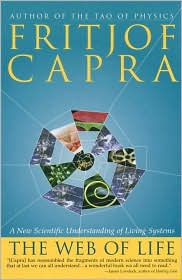
In that post I indicated my interest in reading Fritjof Capra's book The Web of Life, which I am now deeply immersed in. The book turns out to be an extremely readable introduction to a paradigm of thought called, variously, "systems theory," "cybernetics," "deep ecology," "self-organization," "complexity," and like terms.

I recognize Capra's topic as containing most if not all of what I have already written concerning new ways of looking at the world in light of the theory of evolution in my Beyond Darwin blog. Specifically, the ideas of biologist Stuart Kauffman in books such as At Home in the Universe are, ahem, right at home in Capra's paradigm.

Unlike any other book I have read about what I choose to dub "the organicity paradigm," Capra's gives a wide-ranging overview of the history of this kind of thinking, which goes back well over a century in scientific and philosophical circles. I hadn't realized that. I thought it sort of emerged wholly formed in the 1960s, say, at about the point when the increasing ubiquity of computers was enabling scientists to study nonlinear dynamical systems in some depth for the first time; this was the origin, for example, of chaos theory.


But, no. Among the antecedents of that enterprise was that of the original cyberneticists, starting in about 1946 with the Macy Conferences in New York City, dominated by the likes of Norbert Wiener and John von Neumann, from the hard sciences and engineering, and Gregory Bateson and Margaret Mead, from the social sciences.

Norbert Wiener
Norbert Wiener was, according to Wikipedia, "the founder of cybernetics, a field that formalizes the notion of feedback and has implications for engineering, systems control, computer science, biology, philosophy, and the organization of society." It is interesting that the seemingly machine-oriented concept of feedback generalizes to how living organisms do what they do.

Wiener apparently was intensely aware of this link when he wrote the following two things:

[Feedback is the] control of a machine on the basis of its actual performance rather than its expected performance. (Capra, p. 57).

We are but whirlpools in a river of ever-flowing water. We are not stuff that abides, but patterns that perpetuate themselves. (p. 52)


Those quotes resonate with me. In my own spiritual life, I seem to be seeking to get away from my erstwhile Christian worldview in which God is seen as the Great Expecter who sits in judgment of my, and everyone else's, "performance." According to that worldview, God (who is by definition external to us, or at least "separate in being" from us) sets up standards of conduct for us to adhere to and finds us to be in sin if we don't adhere to them.

I presently am finding that that worldview stokes my sense of "existential guilt," the subject of My Existential Guilt and My Existential Guilt (Part Two) in this blog. My reaction seems to have been to undergo an ongoing dark night of the soul, which now leads me to embrace a wholly different stance toward reality.

The new stance is the one I am calling "organicity." I was moving towards it when I wrote the three posts in my Does Nature Need Correcting? series — to wit, in the "organicity paradigm" there is no need for an external Great Correcter to judge nature, human or otherwise.

What then can control whatever tendencies we may have to be unethical or immoral? After all, the idea of a Great Expecter/Corrector — a judgmental God — has long served the human race as a jim-dandy external control mechanism.

In the organicity paradigm, the control has to come from within: from our actual performance, not our expected performance. There has to be self-regulation, rather than regulation by dint of some written-down list of must-do commandments and must-avoid "deadly" sins. With self-regulation comes the self-organization that produces Wiener's "patterns that perpetuate themselves" amidst the "river of ever-flowing water" of this world.

Thus might we come to see ourselves as "whirlpools" rather than as "stuff that abides." Whirlpools, after all, maintain themselves for some period of time, according to their inner dynamics ... then dissolve back into the river.

I hope it is evident that it is not easy to reconcile my "organicity paradigm" with that of a world created and judged by a God above and beyond it. No matter that God is also said to be immanent within the world; he is of another substance entirely. In my present frame of mind I simply cannot see how to reconcile his existence with an "organicity paradigm." One of them has to go, and right now, for me, it is admittedly God who is being discarded.

Wednesday, October 17, 2007

The Tao of Organicity

One night a few nights ago I went to sleep a dualist. When I woke up the next morning, I was a dualist no more. Outwardly at least, it was as simple as that.

Inwardly, I have been fighting a losing battle to stave off whatever the notional opposite of dualism is — monism, I suppose — for many years. The battle is now over. Monism has won.

Dualism? Monism? What do these words mean, and why are they so important to me?

The Tao
of Physics
by Fritjof
Capra
Fritjof Capra gives a clue in his well-known book The Tao of Physics. The book concerns the strong similarity between the time-honored worldview of the Eastern mystics, Hindu, Buddhist, and Taoist, and modern physics, with its realization that atoms are not really made up of independent, objectively characterizable "particles" after all.

Moreover, the dualism which imagines the observer always to be separate from what is being observed, when one is doing a scientific experiment at the atomic and subatomic level, no longer holds. Rather, according to one interpreter of quantum theory whom Capra quotes (p. 139), "An elementary particle is not an independently existing unanalyzable entity. It is, in essence, a set of relationships that reach out to other things."

Even according to a different quantum theory interpreter who generally has little in common with the first (p. 138):

One is led to a new notion of unbroken wholeness which denies the classical idea of analyzability of the world into separately and independently existing parts ... We have reversed the usual classical notion that the independent "elementary parts" of the world are the fundamental reality, and that the various systems are merely particular contingent forms and arrangements of these parts. Rather, we say that inseparable quantum interconnectedness of the whole universe is the fundamental reality, and that relatively independently behaving parts are merely particular and contingent forms within this whole.


So it is an illusion to believe that there are two things, the observer (along with his chosen experimental apparatus) and the object being observed (such as an electron). In quantum physics, when the attributes of a so-called "elementary" particle (which is really no more that a pattern of probabilities that certain kinds of interconnections with other particles and systems will predominate) is to be measured, it first has to be prepared for the measurement operation ... and how it is prepared for observation and measurement determines its eventual measured characteristics.

The act of preparation needed to fix the particle's position with total precision prevents learning its momentum (hence its velocity) with equal precision. This quantum indeterminacy is unavoidable. Why? In the final analysis, imply because the imagined distinction between the observer and the observed is untenable.


False, too, are other classical dualisms. One of these, for better or worse, is that of "an intelligent and personal God who stands above the world and directs it" (p. 20).

In his first chapter, Capra gives a brief history of classical Greek thought, in which there was a shift from "the monistic and organic view of the Milesians" — Thales of Miletus, Anaximander, and others — to the view that above the fundamentally dead world of matter was a separate order of pure being, or of indestructible substance. Though mere matter underwent change, Being was eternal.

In that dualist view, what was pure and unchanging came to seem, with Plato and Aristotle, more real than anything that changed from one mode of imperfection to another over the course of time. The philosophies of Plato and, later, Aristotle, came to pervade Western Christendom down through the millennia.

The Judeo-Christian God, born in the Middle East in a different culture, merged into the European worldview at the time of the decline of the Roman Empire. The nascent churches of Christendom had embraced the neo-Platonism of Plotinus in the third century A.D., and later, during the Middle Ages, the now-regnant Church of Rome rediscovered the original, fourth-century-B.C. thought of Plato and Aristotle.


Before Plato, in Greek culture, the philosophy of Leucippus and Democritus sought to avoid the dualism between the mere "things" we know in this material world and what would become Plato's Forms and the Aristotelian idea of Being as the noblest degree of abstraction. The pre-Platonists did this by assigning the unchanging permanence Plato would allocate to immaterial Forms to certain physical items: the atoms, as originally conceived of by the Greeks. But if atoms, matter's building blocks, were "passive and intrinsically dead," what produced motion and change?

The cause of the motion was not explained [by Democritus and other atomists], but was often associated with external forces ... of spiritual origin and fundamentally different from matter. In subsequent centuries, this image became an essential element of Western thought, of the dualism between mind and matter, between body and soul. (p. 21)


So the thought of the West was, even before Socrates, Plato, and Aristotle, on a slippery slope to dualism, leaving behind the insights of an earlier Greek philosopher, Heraclitus of Ephesus, who

believed in a world of perpetual change, of eternal 'Becoming'. For him, all static Being was based on deception and his universal principle was fire, a symbol for the continuous flow and change of all things. (p. 20)

It is this Heraclitean idea that you don't need a separate entity, spirit, to explain why "dead" matter undergoes change, that Capra extols as the lesson of modern science in The Tao of Physics. The same idea lies at the heart of Eastern religion, whether Hindu, Buddhist, or Taoist. That "perennial philosophy" of mystical traditions, says Capra (p. 10), "provides the most consistent philosophical background to our modern scientific theories."


Capra's discussion carries a lot of weight, for me. But it's not ultimately the reason why my dualist assumptions crumbled into dust one recent night while I was asleep. I am more attuned to matters biological than matters physical ... which is why I feel I ought to read Capra's The Web of Life before too much longer (I've ordered it from Amazon).

Though I haven't read it yet, I have done a lot of thinking about the area of modern scientific inquiry which one scientist, derisively, calls "emergilent chaoplexity." (See "This Man Wants to Control the Internet," Discover, Nov. 2007, pp. 99 ff.) Chaos and complexity are both hot topics in science these days, as are the idea of "emergence" and that dubbed "consilience" by entomologist Edward O. Wilson.

In chaos studies, scientists have found that there is rampant disorder at the heart of many natural processes. This "chaos" has a mathematical basis such that, although we can never be certain what a chaotic system will wind up doing, we can be sure that it is on a path set by its initial conditions. The so-called "butterfly effect" means that a butterfly beating its wings in Brazil may inexorably cause a tornado in Texas.

The study of complexity takes chaos study a step further by locating in mathematical "space" not only a region of chaotic dynamics, but also one where life inexorably emerges from a dynamical source located at the very "edge of chaos." In our universe, the biological realm "emerges" ineluctably from the workings of "mere" physics in ways that can be expressed mathematically and modeled on computers.

Meanwhile, Wilson's "consilience" — the word which puts the "il" in "emergilent chaoplexity" — proposes a new "unity of knowledge" (see his 1998 book Consilience: The Unity of Knowledge, which I also ought to read, but haven't). I gather that Wilson's main idea in showing how the various spheres of human knowledge today hope to "leap together" — the root meaning of "consilience" — is that reason ought at long last to replace mysticism ... which would seem to put him in opposition to Capra.

However, my thought is that "mysticism" is an ambiguous word, as is "reason." If you begin with an unquestioned assumption that spirit (if spirit exists) and matter are separate and dual, and that "mysticism" is a search for spirit, then it is easy for many of us to favor the matter side of this supposed dualism and call your stance the "rational" one.

Go all the way back to Heraclitus, though, and the dualism between mysticism and reason, as that between spirit and matter, disappears.

If the assumption that matter is dead and change comes from something apart from the material world is canceled, then it becomes eminently rational (yes) for so-called mystics to pursue scientific inquiries into how the cosmos works. And, since there is ultimately no way to separate out the individual consciousness that we house in our minds from all the rest of reality, it makes sense — for those who are so inclined; not all of us are — to experiment with altered states of mind, which is what the Eastern mystics have done since time immemorial.


The derisive phrase "emergilent chaoplexity" is one that I would prefer to replace with the word "organicity." I mean it to suggest that the cosmos is intrinsically organic in the way it proceeds over the course of billions of years to develop, and eventually to produce life and then conscious life.

Things are said to have an organic unity if they fit together harmoniously as necessary parts of a whole. Organic also means "characterized by continuous or natural development." These are the senses of the word I am interested in when I say I have almost a religious faith in the organicity of the universe.

I'll refer to that faith, then, as "the tao of organicity." In Chinese Taoism, the tao is the natural, spontaneous "way" of all things when left to their own devices and allowed to unfold without a lot of rules imposed on them from without. In my view now as a former dualist, my longstanding Christian faith was essentially a system of understanding in which God was an external rule-giver. Standing apart from nature, including human nature, and finding it/us "fallen" — or, since Adam's "sin," lacking in its original perfection — the God of the monotheists sought to "save" or "redeem" the world.

No wonder it was so easy to wed monotheistic ideas about God to philosophies from supposedly pagan Greece: both idea systems were fundamentally dualist (once Heraclitus and the Milesians were set aside in Greece). In the monotheist view, the material world is wholly distinct from a God who is basically spirit. Though God "became flesh" and was "made man" in Jesus Christ, in the Christian view, there is still a dualism such that Christ is like us in all ways but sin. That idea is undergirded by the idea that Mary, Jesus's mother, was born without the stain of Original Sin which the rest of us inherit from Adam and Eve — yet another dualism.

The list of monotheist dualisms goes on and on. God vs. world. Heaven vs. hell. Good vs. evil. Soul vs. body. Mind vs. matter.

In recent months, in this blog, I have tried to defend all the dualisms by means of some two dozen or more posts under the topic of Consciousness. My idea was that if it can be established that the attribute of the human mind which is variously called consciousness or sentience or subjective experience is indeed a distinct type of being from all the other, merely physical manifestations of mind/brain, then there is hope for all the other dualisms that are inherent in the Christian worldview.

Now, suddenly, I find myself on the other side of the fence, as it were, believing in my bones that dualisms are illusory.

In posts to come, I plan to discuss what has led me to this "sudden" insight, and where I think it will lead me now. But I must hastily note that this "insight" has not really been all that sudden. I have been flirting with it for well over ten years, at least since I first began trying to show how the ascent of complexity and such constructs as the "edge of chaos" in the halls of science today could be squared with Christian belief.

It did not take me long to twig to the notion that if Darwinian natural selection is abetted by self-organizing, complex systems whose dynamics unfold at the "edge of chaos," and if chaos is rightly associated in the Christian imagination with the evil workings of Satan, then there is every reason for Christians to resent the sciences of complexity as much as many of them have long resented Darwinian evolution theory.

Looking back, I realize that I never really overcame that difficulty, and the book I was trying to write under the assumption that it might reconcile Christian belief with the theory of evolution sort of petered out into nothingness. It never got finished, and today I can see why. The whole idea of an "edge of chaos" bridging the order-chaos dualism is fundamentally unchristian, if you stop to think how crucially dependent the Christian outlook is on the existence of a long list of dualisms.

I intend to extend these remarks about the anti-dualist Tao of Organicity in subsequent posts. Stay tuned ...

Tuesday, October 09, 2007

My Existential Guilt (Part Two)

In My Existential Guilt I talked about being dogged by a free-floating sense of guilt that bears only a loose relationship, if any, to my actual transgressions. Philosopher, author, and advocate of Unitarian Universalism James Park calls the phenomenon "existential guilt." His Existential Philosopher's Museum website has this page on existential guilt.

Park says:

... existential guilt will not stick to a definite violation of standards. It seems to float from one fault to another. When it does temporarily attach itself to one moral weakness, which we then correct, it takes wing and settles on another fault. Sometimes our existential guilt spreads itself over many 'sins'. ... Our existential guilt arises not from past events but from our core of being.


We tend to look to moral violations to explain our feelings of guilt, but that's a mistake. Why do we make it? "Perhaps we are reluctant to give up our moral interpretation of guilt because we lose control over the problem — and the solution."

Interestingly, during recent weeks and months as I have started to recognize how guilty and inauthentic I feel, I have also noticed how increasingly desperate I am to keep in control of everything that goes on within and around me. It's like my ever-present guilt is an acid I'm carrying around in a beaker, which is now full to the brim. I feel I have to use any method I can to keep from spilling it. So if I give my free-floating guilt a moral interpretation, then perhaps I can control it by amending my life or confessing my sins. But if moral transgressions are unrelated to the guilt — as they are with existential guilt — then I am left without recourse to one of my prime hoped-for stabilization methods.

Park:

When we treat our existential guilt as if it were conscience — by turning away from a troubling dimension of our lives — we discover that existential guilt follows us. Diversion brings no relief; it only spreads the problem. Because our existential guilt arises from within ourselves, we might attempt to escape by jumping out of our selves: We brick up the access to who we really are. We function automatically, hoping to 'quarantine' our disease. If our inner selves are consumed by guilt, we dare not dwell there. So we plunge into frantic and obsessive external activity.

I've done that from time to time. Recently, I've gone through a period of being obsessive about (I know this sounds really weird) my Apple TV. An Apple TV is a device that streams movies from iTunes to an HDTV. I bought one a couple of months ago and soon found myself getting sucked into mastering the technical details of (among other things) ripping DVDs and obtaining illicit movie content on the Internet in other ways.

And another of my obsessions is even weirder, since it is a sexual one: I get a voyeuristic charge out of the idea of women relieving themselves in public (or, for that matter, in private) and can spend days happily looking for pictures of them on the Internet — and there are many of these pictures — engaged in the act of "popping a squat" or sitting on a toilet. Park has a section on Sexology in which he promises to take up the topic of "Imprinted Sexual Fantasies." I'm looking forward to reading the book, when he gets it written, since I imagine that I somehow got imprinted with this particular sexual fantasy from an early age.

But for now my point is that my obsessive behavior in response to pervasive existential guilt can paradoxically involve morally dubious preoccupations: engaging in copyright violations, nurturing a secret (now, not-so-secret) interest in women's excretory functions, etc. It is if whatever guilt I am "supposed to feel" for transgressive behavior has been so drowned out by my free-floating existential guilt that I am now engaging in downright provocative behavior to try to revive the normal connection between behavior and guilt.

Meanwhile, I feel detached from my "true self," as if I were indeed "jumping out" of who I am by taking on the role of devil-may-care copyright violator, or secret pee voyeur, or, say, in another of the personas I have recently explored, the quintessential appreciator of life's ironies — even though the "real me" is inclined to take everything quite seriously. I find that I usually wear some kind of mask, even with my friends. The fires of my inner spontaneity are considerably damped.

Park:

As we become morally better — correcting one fault after another — we might have to invent ridiculous sins to explain our sense of guilt. Is this an attempt to transform existential guilt into moral conscience?


I think so. I'm clearly "inventing ridiculous sins" by acting them out. If I can do that, maybe my moral conscience will oust my existential guilt. Then I can deal with my pangs of moral conscience in the usual, approved ways.

Park:

Moral 'backsliding' might be caused by on/off guilt: As we climb the ladder of self-improvement, we should feel less guilty as we become better. But if we are really trying to overcome our existential guilt, becoming more perfect does not make us feel better. Thus, if we feel just as guilty near the top of the ladder, we give up — and slide all the way back to the bottom again.


That's definitely me!

Park, again:

Let a basketball represent our resilient personality-shell: The air inside is our pressurized existential guilt. The knocks and bumps of everyday life are the pangs of conscience. Little mistakes make us feel clumsy, inadequate, ashamed, inept. But usually we bounce back to shape quickly and easily.

Sometimes, however, these wounds of conscience injure us deeply, pierce thru our tough external shell, releasing our existential guilt. We might experience a gush of guilt or a devastating explosion. The explanation: We have a reservoir of pent-up existential guilt, which is sometimes released by a puncture-wound of conscience. But the tack that punctured our shell did not cause our existential guilt.


I have cleverly learned to avoid the "gush of guilt or devastating explosion" by various psychological dodges, which unfortunately have had the side effect of quashing my joie de vivre. My spontaneous inner self is factored right out of the equation, while joie de vivre depends on expressing the spontaneous self, warts and all.

So, is there hope for me?

If [our guilt] management techniques prove inadequate, we might still yearn for complete release from our existential guilt. If the pressurized guilt inside our basketball can be removed — replaced by forgiveness, atonement, joy, peace, & fulfillment — the little punctures of life will no longer release a gush of guilt.

When we understand the nature of our existential guilt, we can open ourselves to Existential Freedom. Existential Freedom removes our existential guilt, even if normal mistakes continue. Under Existential Freedom we still have pangs of conscience when we "mess up", but we no longer experience overwhelming guilt 'for' trivial reasons.


Wow! Where do I sign up?

We might have to grope our way toward freedom from existential guilt. Perhaps only after some years of struggling with this deeper guilt will we be convinced that becoming better does not cure our guilt. Then we can abandon our moral striving, surrender completely, & open ourselves to Existential Freedom — which overcomes, removes, & abolishes our existential guilt.


OK, consider me in "grope mode." But it's hard to imagine abandoning my moral striving, even now that I've begun to recognize what I'm groping toward. And exactly how do I "open myself" to existential freedom? It sounds like one of those things where you have to stop doing something that seems as natural and habitual as breathing.

Toward the end of this web page, Park asks some significant questions, including:

Have you known moments of release from existential guilt?
If so, how did you open yourself to Existential Freedom?
... what keeps you caught in existential guilt?


My answers are:

  • Yes, I have known many moments of release. In my own lexicon, I call them moments of "lassitude," but that's wrong. Lassitude is a state of mental and physical exhaustion. Here, what's exhausted and wants to retreat into its hidey-hole is my existential guilt itself. In a sort of "moral exhaustion," it simply shuts up for a while, and I feel as if God's in his heaven again.
  • It just happened, and I don't know why.
  • I don't know why I can't find the "lassitude" when I want to but can't.


More later ...

Monday, October 08, 2007

My Existential Guilt

The Taoist insight that things in our world are not fundamentally "broken" and do not need to be "fixed" was the topic of The Categorical and the Ineffable and other preceding posts in my Does Nature Need Correcting? series. Having written that last post yesterday, I woke up this morning with the powerful sense that I am suffering from a bad case of excessive guilt.

I don't mean feelings of guilt about any particular sin or sins, though I am not without those too. I mean what I think of as "free-floating guilt," guilt that bears no particular relationship to anything I have done.

Googling that phrase, "free-floating guilt," led me to The Existential Philosopher's Museum on the website of James Park, who calls the phenomenon "existential guilt." Park is an existential philosopher and author who advocates Unitarian Universalism as a religious stance.

I'm about to start investigating Park's sprawling website, but I have to admit I'm not really crazy about delving into existentialism and enlarging on what little I know about Unitarian Universalism, both of which I think of as somehow "godless." Yet I'm intrigued by Park's "Five Differences between Moral Conscience and Existential Guilt" which appear in a table about two-thirds of the way down this page.


Park says that moral conscience is remorse for particular misdeeds and omissions, while existential guilt is characteristically free-floating and non-specific. Well, I do have some specific misdeeds and omissions that I feel (some degree of) remorse for, but mostly what I feel is free-floating and non-specific guilt. So, check.

Park says that pangs of moral conscience are caused by the discrepancy between our actual behavior and our standards. In that sense, they are rationally justified. Existential guilt is uncaused and not psychologically intelligible. Check.

Moral guilt is temporary and passes with time. Existential guilt is permanent and renewed at every moment. Check.

Pangs of conscience are temporary and pass with time, says Park. I'm still feeling guilt over minor misdeeds from decades ago — even though I've "confessed" them in the prescribed manner of my faith. When Park says existential guilt "flows thru-out our selves [and is] pervasive [and] possesses our entire being," I know whereof he speaks. So, again, check.

If we suffer the strictures of moral conscience, we can, Park says, "relieve the tension by changing our behavior or standards." But existential guilt cannot be overcome in this way: "psychological techniques are useless." Yup. Check, again. I've been trying to engineer my own "reduction of tension" ever since the late 1980s, at the time when my parents died and I in mid-adulthood "got religion." (It hasn't worked.)

Specifically, the sacrament of penance in the Catholic Church — known popularly as "going to confession" — doesn't serve to reduce my tension. I expect that may be because it is not expected to have any effect on existential guilt.


Park asks, "Have you ever been
a perfectionist, driven by a deep sense of guilt that does not go away no matter how good you become?" Yes, I've been there. "Do you sometimes feel more guilty than you ought to feel?" Definitely. "Does your sense of guilt keep coming back attached to new 'reasons'?" Yes ... that, and I seem to manage to recycle old reasons that one would think had lost their sting.

Why? Why do I have this weird, senseless guilt? Why does nothing I do (or eschew doing) relieve the tension? Park says:

Human beings have been feeling guilty since before the dawn of civilization. The decline of organized religion in the West has corresponded with less interest in guilt. But at least for some people, it is still relevant to look into the deeper dimensions of the experience of guilt.


OK, then maybe the hidden agenda of this whole In Search of Solidarity blog has been, for me, an attempt to change the terms of religion so I could have my cake and eat it too: be religious, but get rid of the guilt.

In other words, I'd like religion to become, not nonexistent as atheists would prefer, but much less in the guilt-provoking vein ... simply because I myself have a boatload of existential guilt weighing me down at all times and I don't need to take on any additional guilt from the teachings of my church.


In view of the above, I believe I have been putting myself in an ever-tighter moral straitjacket over the course of the past several years. It is as if I have been trying to "cure" my existential guilt by ratcheting up punctiliousness. In making this attempt, all I have succeeded in doing is getting less natural and spontaneous — becoming less "refreshing," to repeat a word one of my friends used of me several decades ago.

I am no longer refreshing, and I rarely feel refreshed.

In recent posts to this blog (the Confessions series) I have admitted to being a closet prig and prude, while confessing to feeling "inauthentic" about it all. Inauthenticity is one of the characteristics Park speaks of as the lot of the existentially guilt-ridden, as a quick scan of his site reveals.

In other recent posts in my Does Nature Need Correcting? series, I have sidled up to a Taoist perspective in which there is no ground whatsoever for guilt. Guilt has no part in a philosophical system in which the whole object is to cultivate spontaneity and naturalness ... as if the only thing we can do wrong is not be spontaneous and natural.

I think the hidden agenda of my Taoism interest is my (formerly unconscious, now conscious) hope to cure my existential guilt.


One of the upshots of discovering that I suffer from existential guilt is that it renders suspect everything I have ever said in this blog, as well as in my other blogs, about religion, morality, and related matters.

It is as if I have held myself out to be an insightful art critic and then discovered to my supreme embarrassment that I have been color blind all these years. Or a music critic who can't, and never could, hear musical overtones.

Without quite realizing it, I have been carrying around a massive load of existential guilt for a very long time now. Because it makes no sense on the face of it to even believe a person can have such free-floating, unmotivated guilt, I haven't been able to put a name to it. Lacking the ability to name it, I simply assumed it wasn't there.

But it was, and is. I has been a bit like a dark star around which a visible star revolves. The position in the sky of the visible star is apt to wobble, as its brightness waxes and wanes. Translate that analogy into the realm of religion and morality, and you can see that my supposedly rock-steady pronouncements need to be taken, now, with a whole shaker of salt.

For my hidden (from myself) agenda has always been to say and make myself believe things that can help me shoulder my heavy load of existential guilt. So when I have dissed "conservative" religious outlooks which, as their theological starting point, emphasize how sinful we are in God's eyes — Christian fundamentalists/evangelicals, mainline churches as the Lutherans, and also my own church mates the "conservative" Catholics — I obviously can't be trusted to be objective.

There may be a valid case to be made that theologies of sin and guilt are simply incorrect and un-biblical, such as the argument set forth recently in a book by Garry Wills (see What Paul Meant). But I am clearly not the best judge: I want Wills to be right so very badly, simply because it might help cure my existential guilt. Ergo, I can't be trusted to pass evenhanded judgment on Wills' ideas.

In fact, I now realize my capacity for making moral judgments is generally out of whack, for the exact same reason. I simply don't have the ability to make consistent moral choices. I find myself trying to exorcise the tiniest lingering blemishes in my own personal behavior while excusing in the behavior of other people what many Christians call grievous sin — as if waving off someone else's major transgressions will somehow lessen my own existential guilt.

So I'm all over the map on sin and Christian morality. I'm a closet prig and a prude, while at the same time I'm tolerant of gays' and lesbians' right to act naturally and spontaneously according to their inmost natures.

I'll continue to explore the ramifications of my existential guilt in future posts ...

Sunday, October 07, 2007

The Categorical and the Ineffable

In earlier posts in this Does Nature Need Correcting? series I owned up to no longer believing in one of the most deep-seated premises of Christian thought: that nature, including human nature, is amiss and needs correcting. Now I'd like to explore one of the contrasting views I touched on in the original installment: the Taoist insight that things in our world are not fundamentally "broken" and do not need to be "fixed."

I discussed Taoism a some length in three posts (this, this, and this) I made some two years ago to another blog. Briefly: the tao is an ancient Chinese notion whose name means "the way." If we cultivate harmony with the tao, we will find the peace and tranquility of the nameless "uncarved block," a Taoist metaphor for the entity from which all named "vessels" are carved. Before "the myriad creatures" — the vessels — there conceptually came, in reverse succession, the "three," preceded by the "two," preceded by the metaphysical "one." The latter too has a predecessor, the tao.

As I review the first of my previous discussions, several things stand out:

  • If the monotheistic God of Western religion personifies the metaphysical One, the impersonal tao principle conceptually precedes him.
  • The tao transcends the person-nonperson distinction ... as it transcends all pairs of opposites. In actuality, calling the tao "impersonal" is as mistaken as calling it "personal."
  • In the history of Western thought, Plato was the consummate anti-Taoist.

Plato was heavily invested in the notion that only Ideas (a.k.a. Forms) are truly real. Platonic Ideas or Forms, such as the Form of the Round, are necessarily immaterial; all material objects such as the circles we draw on paper or the spherical shapes of planets represent imperfect copies of Forms. No man-made or nature-made shape is perfectly round, or square, or oval, or whatever. Hence, it is not fully real.

If material things are not fully real, then they're not fully knowable. Plato's hope was to, as I say, invest heavily in that which is truly and fully knowable. Whatever is truly and fully knowable is necessarily a Form or Idea, without material substance. But knowledge of Forms/Ideas lets us control the material world in ways otherwise unavailable to us. For example, even if a wheel is less than perfectly round, our knowledge of its Form lets us predict what a wheel will do. Do that sort of thing consistently enough, and human "progress" ensues.

To the Taoist, it takes only "cleverness" to coerce material outcomes in the world this way. "Wisdom" is something else entirely. The distinction between cleverness and wisdom parallels that between the categorical and the ineffable.


Plato sought knowledge of categories, which are in effect pigeonholes into which we stuff objects, by which we give them their names. But the Taoist's "uncarved block" is expressly said to be nameless, ineffable. It is "rough," where the vessels are "smooth." (But the tao is also "smooth," since it logically precedes the rough-smooth dichotomy.)

Plato said the categories, as Ideas or Forms, lay at the basis of reality. But the Taoist says the ineffable is the true origin of all.

Plato, in his Myth of the Cave, said true knowledge of the categories of reality would destroy the illusions that beset most of us. The highest knowledge of all was that of the Form of the Good.

The Tao te ching
by Lao-tzu
The Taoist, for his part, says such "cleverness" amounts to an illusion, and that real wisdom abandons attempts at exerting coercive power over the affairs of man and the world. According to the Tao te ching, also know as the Lao-tzu after its author:

The way never acts yet nothing is left undone.

Should lords and princes be able to hold fast to it,
The myriad creatures will be transformed of their own accord.

After they are transformed, should desire raise its head,
I shall press it down with the weight of the nameless uncarved block.

The nameless uncarved block
Is but freedom from desire,
And if I cease to desire and remain still,
The empire will be at peace of its own accord.

Western thought historically combines Platonism (as neo-Platonism) with Christian ideas concerning the "fallen" imperfection of the natural world, our sinfulness, and so on. When you shift mental focus all the way back to the tao, pairs of opposites like good and evil vanish. This is why the Taoist would say, in contradiction to the neo-Platonist Christian, that things in our world are not fundamentally "broken" and do not need to be "fixed."

Saturday, October 06, 2007

What Paul Meant

Garry Wills'
What Paul Meant
Garry Wills' What Paul Meant is, oddly enough, a Christian book that (at least in my view of it) suggests that my last post, Only Natural, is not as un-Christian as it may seem. In it, I confessed to no longer harboring what I take to be the canonical Christian view that (human) nature needs correcting.

According to that view, the world is a "fallen" one. Our inner nature is too. It's the fallout of Adam and Eve's original sin in the Garden of Eden.

If I read Wills right — and I am by no means sure I do — the Apostle Paul, author of many of the "letters" that make up the bulk of the New Testament and which document the original Christian movement as it existed before it even bore that name — may actually have had the opposite view. The Christian churches down through the centuries may have simply misread Paul.

The heart of the problem is this [Wills writes on pp. 172-173]. Paul entered the bloodstream of Western civilization through one artery, the vein carrying a consciousness of sin, of guilt, of the tortured conscience. This is the Paul that we came to know through the brilliant self-examinations of Augustine and Luther, of Calvin and Pascal and Kierkegaard. The profound writings of these men and their followers, with all their vast influence, amount to a massive misreading of Paul, to a historic misleading of the minds of people ... down through the centuries.


In this context Wills, who is Catholic, applauds the insights of Lutheran Bishop Krister Stendhal, whose 1961 lecture "The Apostle Paul and the Introspective Conscience of the West" maintained

that Luther and his followers took Paul's argument for freedom from the externals of the [ancient Jewish] Mosaic code as a confession of his [Paul's] own ability to follow moral law in general. They read as autobiography Paul's exclamation at Romans 7:22-24: "In my inner self, I am pleased with God's Law. But I observe another law in my limbs doing battle with the law in my mind, holding me prisoner to the law of sin in my limbs. Miserable person that I am, who is to set me free from this body doomed to death?" These words echoed thunderously in depths of generations for whom they are an autobiographical outcry.


Wills shows that Paul did not mean these words to be taken as autobiographical. For one thing, the idea of secular individualism which exploded during the centuries after Paul's death would not have been recognized by Paul. Paul was not concerned with individual salvation. He was concerned with the salvation of nations.

To Paul, the Brotherhood which would only later become a church was the Body of Christ. As a corporate body, it would be rescued from the manifold iniquities of this world by a gracious God, simply because this was God's plan as revealed by Jesus's death and resurrection.

Paul simply would not have understood the idea that an individual's personal sense of guilt has anything to do with the prospect of corporate salvation. Wills (pp. 173-174) interprets Bishop Stendhal as saying

In all of Paul's undoubtedly autobiographical references, there is no expression of guilt. Far from finding it hard to observe the Mosaic Law, he [having been born a Jew and still considering himself one] says that he observed it perfectly in his days as a Pharisee ... and in his days among the Brothers [i.e., the original followers of Jesus] he says repeatedly that he has done nothing for which his conscience could reproach him ... . [Stendhal's reading is that] in this one place [Romans 7:22-24] he is not telling us about himself.


Paul's Letter to the Romans is, says Wills, after Stendhal, "a complex interplay of 'persons' in diatribe-exchanges, meant to show that Gentiles and Jews — not as individuals but as societies — have both failed to observe their covenant with God." One of these two hypothetical "persons," a personification of the Jews as a historical group, is the implied speaker of the oft-quoted words at Romans 7:22-24, castigating "himself" for his centuries-long history of infractions against the Law of Moses.

Likewise, Paul has it that Gentiles, while not subject to the Jewish covenant, were subject to the covenant of natural law as it is written in their hearts. But like the Jews, they as a body had repeatedly broken their covenant.


In the early Roman proto-church, the Jews who counted Jesus as their Messiah and the Gentiles who likewise counted Jesus as (yes) the Jewish Messiah were nevertheless at odds with each other. "Paul is arguing," says Wills, "that neither side can reproach the other, and that God is on neither side."

So Paul was not addressing personal sin/guilt at all. And Paul and Jesus both said

that the worship of God is a matter of interior love, not based on external observances, on temples or churches, on hierarchies or priesthoods. Both were at odds with those who impose the burdens of "religion" and punish those who try to escape them. ... They saw only two basic moral duties, love of God and love of neighbor. ... Paul's message to us is not one of guilt and dark constraint" (p. 175, emphasis added).


My interpretation of that is the following conjecture: our modern need to "correct" nature stems from the sense of "guilt and dark constraint" which — Paul's intent notwithstanding — got built into the Christian sensibility from the early days of the post-Pauline church on.

In Wills' own terse words (p. 175), "Religion took over the legacy of Paul as it did that of Jesus."

Perhaps my coming to see this, however inchoately, is why I no longer feel comfortable thinking of myself as a partaker of the Christian religion.

Friday, October 05, 2007

Only Natural

Of late I have been struggling with my faith as a Christian. I don't feel all that much like a Christian these days. Today it hit me that one of the reasons why I don't has to to with the conflict between what is natural and what is Christian.

In general, it seems to me, Christianity is anti-nature. What I mean by the words "nature" and "natural" is hard to pin down. Let me try to sneak up on it.

Leading "the Christian life" amounts to, when you strip it down to outtward essentials, doing certain things and avoiding doing certain other things. What you do and what you eschew are done or conscientiously not done in the name of God. But the question is, why do you need to consciously embrace virtue and avoid sin?

The answer would seem to be that, by our very nature, we want the "wrong" things. Instead of doing righteous deeds, we veer in the direction of iniquity ... unless we consciously undertake a course correction, that is. That's what Christian living is: a permanent course correction that we build into our lives by intent, analogous to what a driver needs to do to steer a car that pulls to one side. The Christian commitment is one wherein we assiduously cock the steering wheel of our lives away from what would otherwise be the "straight ahead" position, under the assumption that the car's front end is out of alignment.

But where does that out-of-alignment assumption itself come from? For what it seems to imply is that our very nature is askew. Absent a course correction undertaken "in the name of God" — since what we generally do proceeds from our inner nature — unless that inner nature is somehow askew, no course correction would be necessary.


Indeed, the whole story of Adam and Eve in the Garden of Eden seems to tell us nothing so much as that our very nature — and indeed, that of the world as a whole — is out of whack. This is what it means to say that we, and it, are "fallen."

Recently I have begun to seriously doubt that perhaps most fundamental premise of the Christian stance. It no longer makes much sense to me to believe in the fallenness of (human) nature: my own, that of other people, or that of the world as a whole.

Today I took a walk around a nearby man-made lake, something I do quite often for air and exercise. This time, as I huffed and puffed, I found myself spontaneously meditating on what it means to say, as we often do, that something is "only natural."

The water level in the artificial lake I was hoofing it around was unusually low. Only natural, I mused, given how little rainfall we've been getting these last few months. But what about the fact that I responded to noticing the alarmingly low waterline by worrying about whether "global warming" is having something to do with its cause? Was my complex mental reaction to seeing the low water level somehow "unnatural" because complex and mental?

It too, I realized, was really only natural, given how much we have all been hearing about the global warming controversy. I am a (supposedly) intelligent creature, and it was only natural that my mind would construct such a hypothetical story about how our species' ever-growing "carbon footprint" might indirectly account for how many mud flats were visible at Lake Centennial. No matter how complex the activities of the individual human mind, there is nothing about them that can be deemed intrinsically unnatural.


Did I say "species"? Another thing I was keenly aware of on my health walk was just how many living kinds there were in that one modest-sized park. Every plant, every tree, every animal species — I saw squirrels and chipmunks and swans and Canada geese, and I knew by the avidity of the anglers (another animal species) that there were fish under the albeit diminished lake surface — was testimony to nature's vast diversity. Yet I knew the fact of the biosphere's diversity was "only natural" — Darwin showed us why.

Surely, though, the existence of each individual species was some kind of accident of nature, no? No, I found myself thinking, it was "only natural" that each particular species should have come about. Even if the long, tangled skein of causality that has led in the present moment to (saay) a Canada goose incorporated junctures at which "random" genetic mutations occurred, who is to say that some such chance-riddled skein was not bound to yield Canada geese and trout and squirrels and chipmunks and humans to appreciate them all, in the fullness of time? Who is to say that it is not "only natural" that chipmunks and willow trees and trout and avid trout fishermen should be expected to arise out of the complex, multidimensional processes of nature on this planet?

Well, what about man-made lakes and other copycat geographical features? Surely they are anything but "only natural"? Well, actually, no, I'd say they are in fact only natural. It is in fact only natural that a species such as ourselves, having risen to a unique level of consciousness and associated power over the forces of nature, should learn how to put lakes where none had been before.

And it is in fact only natural that this (our) species' unique power to manipulate the environment would tend to get things out of whack on occasi0n. If our vaunted carbon footprint does in fact threaten our whole enterprise of human progress, it is not surprising that this eventuality might crop up at some point in our history. And it is only natural that we should engage in heated debate about whether the "evidence" for global warming (in this particular case) ought to be credited. For if it isn't lying to us, we need to change our ways. It's only natural that we would be in no hurry to do that.


I was also mindful of another way in which the ideas of "natural" and "unnatural" have been understood by Christians. To wit, sex. Certain types of sex are said to involve "unnatural acts." But it seemed to me, as I walked and cogitated, that homosexual sex, said to be the most "unnatural" type of all, is actually perfectly natural for some people.

That phrase, "for some people," is key, I pontificated. Just as the natural world is so diverse that its living species are uncountable, the human world (which is, when you think about, it just one branch of the larger natural world) contains vast diversity as well. If this person is gay and that one is straight, who is to say that one of the two is "unnatural"?

We know now that many animals engage in "unnatural" (i.e., homosexual) sex. If one assumes that animals are simply incapable of doing anything which is not "natural," then calling this particular kind of activity "unnatural" beggars reason.

Yet the Christian stance has long been that there is a true, "one-size-fits-all" morality, and such things as homosexual sex, or any sex without the benefit of heterosexual marriage, lie outside its perimeter.

Any act or urge outside that perimeter is perforce, in Christian eyes, "unnatural." By this is meant that, were we not living in a fallen, post-Edenic world, we would not have such urges and would never commit such acts.


And that is precisely what I no longer seem to believe. I simply don't believe that "nature" can be corrupted ... not at its core.

I'm not saying that certain acts, under certain circumstances, are not unethical or immoral. All we need to do is look around us and we see immoral acts being committed right and left. All I'm saying is that this odd idea that the way to forestall immoral behavior is to "correct" nature is bogus.

Look at the prevalence of priestly child abuse over the course of recent decades in my own, Roman Catholic Church, for example. Look at the recent scandal of the prominent evangelical leader Ted Haggard being outed as gay. Look at the intolerance spouted by the late Jerry Falwell and the still very much alive Pat Robertson. They all bespeak the fact that even the most devout Christians fail at their attempts to "correct" their inner nature, because in the end nature wins.

It's like building a dam. For a while, the dam holds, but come a ninety-nine year hurricane or flood or earthquake, and the dam is history. It's only natural that we should try to control nature with dams and levees, and perhaps it's only natural that we should imagine that we are in fact bound to work assiduously to correct nature, but in the end nature always wins.

Which makes me think that the Taoists are right. Water eventually overcomes stone. "The most submissive thing in the world can run roughshod over the hardest in the world — that which is without substance [water] entering that which has no crevices [rock]. That is why I know the benefit of resorting to no action ... ." So says the Tao Te Ching. The best stance is to align ourselves with nature, not try to correct it.

Thursday, September 27, 2007

Going Postal

Terry
Pratchett's
Going Postal
Ever read a novel that impressed you as profound even though that didn't seem to be the author's intent at all? To me, Terry Pratchett's Going Postal is one of these.

Unbeknownst to me until three weeks ago, Pratchett has been writing these wry gems about an alternate universe he calls Discworld for many years. I stumbled across the series in the science fiction section of the library and took Going Postal home. I found that it wasn't really sci-fi, and as fantasy it fails to go by any usual rules. It's sort of like Monty Python meets The Hitchhiker's Guide to the Galaxy meets Charles Dickens.

The tyrant of Ankh-Morpork, Lord Vetinari, snatches one Moist von Lipwig from the gallows just before he plunges through the trapdoor to his death, and gives him another chance: run the Post Office, long defunct.

Moist has been quite happy as a lifelong con man, but he realizes that he cannot run and he cannot hide from the indefatigable golem, Mr. Pump. A golem is a very large humanoid made of ceramic stuff, but each golem was once just an ordinary machine or tool. Some golems are, say, former hammers. Mr. Pump is a former pump.

Golems are unstoppable in carrying out the mission they have been given. Vetinari has made Mr. Pump Moist's parole officer, so Moist for the time being decides to feign interest in his new position.

The Post Office slipped into decay a century ago, Moist learns, but it's can-do spirit lives on in the likes of old Mr. Groat, who along with a young homeless man named Stanley, who loves collecting pins, still lives in the Post Office headquarters. Moist twigs to the fact that the mountains of undelivered letters there, covered now in pigeon guano, are crying out (literally) to be delivered, even now. One thing leads to another, and before you know it Moist has conned himself into being (with the help of Groat, Stanley, and numerous others in the once-proud postal "family") their deliverer.

Meanwhile, the function of the Post Office has been taken over by "the clacks," a network of towers throughout the Discworld that send and receive messages by some sort of semaphore involving lights in the dark of night, and other signaling means, which the reader never quite comprehends, by day.

The clacks (a singular noun) was invented by the now-deceased father of chain-smoking Adora Belle Dearheart, she of the stiletto heels which she uses to impale the feet and other body parts of men who menace her in lowlife bars. Moist suspects the sweetness in her right away. He knows he will fall in love with her, but he cannot imagine that her cynical eye doesn't see right through his facade to the inveterate fraud he really is. Adora wants revenge on Reacher Gilt, the truly evil manipulator of people for personal profit who drove her father out of the clacks business in favor of his own consortium. Gilt is also indirectly responsible for the death of Adora's brother, an honest clacksman (tower operator) of the old style.

So one thing leads to another, and Moist, against his ingrained dishonest instincts, becomes something of a miracle-worker-slash-hero-slash-savior.

Along the way to a final showdown with Gilt he has occasion to retrieve his buried cache of $150,000, the honest proceeds of his dishonest life of crime. Seems Gilt has arranged for the Post Office to catch fire and burn, and the money is needed to rebuild. Moist can't just dig it up from where he has it buried without disillusioning all those who have come to trust him, who do not know about his past. So he fakes being led mystically to to the stash after praying to not one but several of the Ankh-Morpork gods.

Thus, several of the interlocking themes of the book. One, the more Moist ups the ante on being (again, still) the consummate charlatan, the more good he does in his world. Two, he accomplishes most of his fakery with naught but words — words that people want to hear and to believe, words that give them hope. Three, the more good Moist does, the more he thrills to it. It's more thrilling, more addictive, than any con he ever pulled for personal gain.

He knows deep down, much to his own chagrin, that he is not the selfless saint people see him as being. But he also knows confession to them of his own true nature would destroy the illusion, their hope, and all the good he is doing simply because it thrills him to put over the con of his life: arranging for the deliverance of the post, at snidely Reacher Gilt's expense.

His final victory depends on convincing one and all of what has long been rumored: that the souls of all the clacksmen who died doing their dangerous jobs on the towers because Gilt didn't do what was needed to keep them safe (it cost too much money) live on in the "overhead." They are now living messages that shunt eternally through the network unseen, for free. Moist enlists the aid of three outlaw clacksmen, "Mad Al and the boys," to bring one of these supposed hidden messages to light, thereby revealing the truth and incriminating Gilt and his cronies. The world wants to believe that these really were utterances of the disembodied dear departed, and Moist lets them go on believing it.

Toward the conclusion of the book, we get this exchange between Adora and Moist:

A quiet voice from the doorway behind him said: "Mad Al and the boys told me what you did."

"Oh," said Moist, not turning around. She'll be lighting a cigarette, he thought.

"It wasn't a nice thing to do," Adora Belle Dearheart went on, in the same level tone.

"There wasn't a nice thing that would work," said Moist.

"Are you going to tell me that the ghost of my brother put the idea in your head?" she said.

"No, I dreamed it up myself," said Moist.

"Good. If you'd tried that, you'd be limping for the rest of your life, believe me." [She is referring to the damage she could do with her stiletto heels.]

"Thank you," said Moist leadenly. "It was just a lie I knew people wanted to believe. Just a lie. It was a way to keep the Post Office going and get the Grand Trunk [the clacks network] out of Gilt's hands. You'll probably get it back, if you want it. You and all the other people Gilt swindled. I'll help, if I can. But I don't want thanking."

He felt her draw nearer.

"It's not a lie," she said. "It's what ought to have been true. It pleased my parents."

"Do they think it's true?"

"They don't want to think it isn't."

No one does. I can't stand this, Moist thought. "Look, I know what I'm like," he said. "I'm not the person everyone thinks I am. I just wanted to prove to myself I'm not like Gilt. More than a hammer, you understand [in the same way that a golem is now more than his former identity as a mere tool]? But I'm still a fraud by trade. I thought you knew that. I can fake sincerity so well that even I can't tell. I mess with people's heads —"

"You're fooling no one but yourself," said Miss Dearheart, and reached for his hand.

...

He let the golden glow rise. He'd fooled them all, even her. But the good bit was that he could go on doing it, he didn't have to stop. All he had to do was remind himself, every few months, that he could quit anytime. Provided he knew he could, he'd never have to. And there was Miss Dearheart, without a cigarette in her mouth, only a foot away. He leaned forward —

Words that "ought to have been true," words that generate belief and hope, are true, even if they're lies. People that utter such words and back them up with deeds are saviors, even if they're frauds. Impossible things like gods' interventions and souls that live on in the "overhead" are possible, even though they're ridiculous.

To me, who am going through a bit of a dark night of the soul in terms of my religious stance, those profound messages that flip cynicism into faith are immensely cheering.

Tuesday, September 25, 2007

The Prig in Me

I confessed in Religion, Solidarity, and My Need for Approval that my ulterior motive in being a religious person and in instituting this blog's "search for solidarity" has been (I now realize) a deep-seated need for the approval of others.

That seems to go hand in glove with my being a (closet) prig.

Most prigs are (for those who remember the TV show M*A*S*H) like the character Maj. Frank Burns: self-righteously moralistic, Burns was a nitwit who always came off as thinking himself superior to everyone else.

My type of priggery is cleverer than that. I pretend to be a Hawkeye Pierce or a Trapper John McIntyre or a B.J. Hunnicutt. Most of the time, for my own benefit as well as for that of others, I play the role of a "regular guy."

But deep down inside, I'm Major Burns.


A prig is not precisely a prude, but prudery is definitely part of the profile. Major Burns was always furtively hooking up with Hot Lips Houlihan, with an emphasis on "furtively." So there's a big component of hypocrisy built into the priggery/prudery profile.

I'm not gay, but in many ways I feel I'm like the evangelical leader Ted Haggard, recently exposed as a homosexual. The things that Haggard criticized (as it turned out, hypocritically) about today's culture are things that the prig/prude in me tends to criticize too.


That said, I do not understand the culture today.

Maybe it's because I'm a prig and a prude masquerading as an up-to-date kind of guy that I feel so out of it. I feel like (sorry to keep bringing up characters from ancient TV history) Mork from Ork.

Mork wasn't a prig or a prude, but he was an extraterrestrial who never could quite get the hang of Earth's more peculiar ways.

I can't quite get the hang of a culture in which just about every kind of behavior is defended by somebody — by plenty of somebodies — with possible exceptions being made for forcible rape and child exploitation or abuse. Yet when a male member of the U.S. Senate is caught in a sting operation tapping his foot for sex in a men's room stall, he has to resign. Isn't that hypocrisy on our parts?

Or is it that Senator Craig got crucified not for his true sexual nature but for his hypocrisy in pretending to be Mr. Straight all this time, and the furtiveness in his manner of satisfying his gay urges? Is our war on hypocrisy the thing Mork from Ork most needs to understand about today's culture? If so, perhaps there is only one sin left. It is being what I seem to have become: inauthentic.


If that's anywhere close to being correct, then the keynote of the cultural change that has taken place over the course of my 60-years-and-counting of life would seem to be this war on inauthenticity.

Sure, we've seen many other important trends, including the items on this list:

  • the growth of sexual freedom
  • women's liberation
  • gay liberation
  • the civil-rights revolution
  • the opening up of higher education to the masses
  • a historically unprecedented high standard of living
  • a teen-friendly mass culture
  • an atrophied public or civic religiosity

The list could go on, with many more items. But maybe they are all trumped by — or allies of — the war on inauthenticity and hypocrisy.


I'd better qualify the last list item. When I say that "public or civic religiosity" has dwindled, I don't mean that most Americans aren't religious. I mean that religion has become strictly a private matter. It's no longer allowed in the "public square," except for occasional glints such as when politicians end speeches with "God bless the United States of America" — and even then, atheists howl.

But notice the irony. What people do in the privacy of their bedrooms, even (or especially) if it's kinky, is OK to talk about on Jerry Springer, but if it's pious and prayerful, we need to hush it up. Would Mork from Ork even begin to have a clue about that?

Sunday, September 23, 2007

Religion, Solidarity, and My Need for Approval

I worry about myself sometimes.

As the proprietor of this blog in which my intention has been to explore ways in which we might all come together with regard to religious belief, I am suddenly aware that I have been acting all along with an ulterior motive. I woke up yesterday morning with one of those occasional profound insights I suppose we all are prone to from time to time. In my case, the profound insight was that I have a near-obsessive need to gain the approval of others.

Or is it that I have a near-obsessive need to avoid the disapproval of others?

Either way, my search for "solidarity" could be seen as a stealth technique of disapproval avoidance. After all, if there truly exists a set of religious views that all could agree on — which is highly doubtful — then my seeking it and finding it, and then leading others to it, would be a surefire way to inoculate myself against disapproval.

The strategy could work in multiple ways. It would put me on the same theological page with all my peers, all of us singing from the same hymn book. Ditto, philosophy: we could all agree on the same (God-centered) worldview. Even more important, such a "universal" belief system with God squarely at its center would necessarily (so I hope) be "correct" or "true" and would therefore put me in the best of favor with the Man Upstairs.

Problem is, when my prime motivation is disapproval avoidance, controversy becomes the enemy. Any imagined version of the truth that raises anybody's hackles gets short shrift. And where religion is concerned, every version of the truth raises somebody's hackles.

It seems pretty clear that, whatever you may think is the correct belief about who Jesus of Nazareth was, he was not afraid to raise the hackles of those around him. Ergo, I'm wrong to claim to be a Christian while really, mainly, being an avoider of disapproval.


I must admit to being somewhat astounded to realize just how strong my need to gain approval and avoid disapproval is these days.

It was not always thus. As a youth and young man, I had if anything an overly cavalier attitude toward the opinions of others about yours truly. Let's put it this way. I didn't go out of my way to curry favor, by any means.

Looking back, that all seems to have started changing with my mother's death when I was 38, then my father's three years later. It's as if as long as they were around, my ego aways had a safe harbor to return to if buffeted by high sea winds.

At my mother's passing I reacted by developing what seem to have been psychosomatic symptoms of perennial dizziness and malaise. After struggling along for a couple of years that way, I suddenly "found God." (What a coincidence!) Then Dad died, and my religious commitment just got deeper. Now it seems that I was unconsciously trying to relocate my safe harbor at a super-cosmic level.

Over time that psychological strategy has worn thinner and thinner, and as it has I have grown increasingly desperate to shore it up by "proving" that there really and truly is a God whom we can all believe in ... and that therefore I ought to merit his approval and that of everyone else too.

Of late, these attempts have grown more and more bankrupt, at least from the perspective of my near-obsessive psychic needs. I have now gotten to the point where I feel my judgments about my own ideas are so impaired that any hope of being objective about them is in jeopardy.

So I fall back on an inner recognition that, like Bilbo Baggins after too many years of hoarding the One Ring, my own soul has grown "thin and stretched." What good is being "right" about religion — if I am right — if it doesn't nourish the soul? If my being "right" is a secret way to serve a false God — my own approval needs — then it isn't right at all.

Thursday, September 13, 2007

Irony and Experience in Today's World

Huston
Smith's
The Soul of
Christianity
Religion scholar Huston Smith's The Soul of Christianity: Restoring the Great Tradition is a 2005 book that stands in eloquent riposte to a number of books that have been published recently maligning Christianity and religion in general. Among these is Daniel C. Dennett's Breaking the Spell: Religion as a Natural Phenomenon, which I discussed at length in my Science of Religion? series. Another is The End of Faith, Sam Harris' recent book proposing an end to religious faith as an antidote to religious hatreds, which I talked about in my The End of Faith? series.

To Smith, the Great Tradition that was the Christian Church of the first millennium and that thunders down through history to reach us (in diluted form) today is the answer to all such atheists who take a principled stand against religion in general, and who oppose Christian religion in particular.


There are many reasons why today's church pales beside the church of the past. We are the heirs of "new" outlooks that began in the sixteenth and seventeenth centuries:

  • the advent of the controlled experiment, the rise of science, and the adoption of a "scientistic" worldview
  • the burgeoning of secularism in governance and religious indifference in the ordering of human affairs
  • the dominance of technology, innovation, and the "myth of progress"
  • the replacement in our philosophical inquiries of the understanding that truth is objective with the insistence on purely subjective standards of truth
  • individualism run rampant, aided by the idea that each person can, and ought to, read Holy Scripture without mediation through church teaching
  • the "cult of narcissism"; the belief that "our wills are sovereign because unpremised, free because spontaneous, and the highest endowment we have" (pp. xxiii-xxiv)


Coming about as a reaction to all those features of modernity has been religious fundamentalism, Christian and otherwise. Smith takes Christian conservatives to task for throwing out the baby with the bathwater. In their insistence on reading the Bible literally, they miss much of its grandeur and, even worse, its meaning.

In their signature intolerance of the viewpoints of others, they also offer atheists like Dennett and Harris a takeoff point for junking all religion.

Smith offers a mild and moderate — yet ultimately radical — return to the understandings that informed the Christian life for a millennium or more after Christ was born, as a valid third way between atheism and fundamentalism ... while avoiding the mistake that has so long been made by modern religious liberals: taking a transcendent, supernatural God out of the picture and replacing him with a touchy-feely sentimentality and endless "rallying cries to be good" (p. xx).


While all the above is true, and most welcome, my one quibble with it is that it is preaching to the choir. Since I am a member of the choir, it is dulcet music to my ears. But I recognize that it will not be music to the ears of Mr. Dennett, Mr. Harris, Mr. Christopher Hitchens, Mr. Richard Dawkins, etc., etc., etc. (See In Search of Comity.)

Nor will it soothe the savage breast of the many vocal fundamentalists who spout in evangelical circles today.

Even worse, it is unlikely to persuade the many basically apathetic young people of today, irreligious but not formally atheistic. I'll call them the "lost sheep" who have simply given up on the search for God as source and guarantor of life's meaning. That is, they have "given up" to the extent that they ever considered committing to such a search in the first place.

There are several reasons why so many young people now have a tin ear when it comes to religion. For some, the very dogmatism of the conservatives is a red flag, a turnoff. For others, the problem is simply that their parents didn't even begin to communicate the "good side" of religion to them.

But let me tell you what I think the most basic problem is. It has to do with the point I made earlier about the "cult of narcissism": each of the "lost sheep" experiences his or her will as sovereign; as "unpremised" (meaning that what it wants doesn't have to square with what anyone thinks it ought to want); and as spontaneously, radically free.


I'd like to focus on the most important word in that tangled mass of verbiage: experience.

What we do depends on what we believe, and what we believe depends on what we experience. Smith himself makes much of this fact in his discussion of the early church:

Religion begins with experience — ritual, belief, and experience, and (to echo the cadence of St. Paul's aphorism ["Now abideth faith, hope, and love, and the greatest of these is love"]) the greatest of these is experience. The experience of things that inspire us gives rise to symbols as the mind tries to think about these invisible, inspiring things. ... eventually the mind introduces thoughts to resolve the ambiguities of symbols and to systematize intuitions ... (p. 97)


And that is where theology — "the mind of the church," initially absent in the original Christians' experience — came from. Theology formalized "faith's focal attention ... on a vision of reality that sets morality in motion, as a byproduct almost." Thus did Christianity come to "include the summons to the upright life" (p. 96).

Yet, however valid the summons, we are already several links in the chain down from the first disciples' pristine, original "experience of living in the presence of someone [Jesus] whose selfless love, crystalline joy, and preternatural power came together in a way [they] found divinely mysterious" (p. 96).

Some fifteen to twenty centuries after Christian theology and morality began to be codified, today's "lost sheep" see the church as simply disseminating moral teachings that don't square with their inner situation. In their experience, a sovereign, unpremised, "dark" will is the only thing between them and chaos.


We hear that word, "dark," a lot today. A recent series of "Pearls Before Swine" comic strips by Stephan Pastis, lampooning another well-known strip, "The Family Circus," illustrates what the word means in today's with-it culture (click to enlarge):


"We're so dark and they're so sweet" could stand as Reason Number One why so many young people won't consider joining up with the Christians today. They experience a life in which the only thing that stands between them and the chaos of their "dark" impulses is their idiosyncratic, sovereign will. If they don't do all of the "bad" things defined by Christians as sinful, it's simply because the don't choose to.

That is the ultimate irony of it all. The individual will, decoupled from God's overarching intent for us, can sometimes stand as a buffer against sin. But what it cannot do is open the self-willed up to the "experience of living in the presence of someone whose selfless love, crystalline joy, and preternatural power came together in a way [they might otherwise find] divinely mysterious."


The "lost sheep's" much too sophisticated awareness of how their own "dark" impulses can be self-managed — and their own sense of irony about doing it — means that their experience is unlike that of any earlier generation in history. What Huston Smith fails to do, sadly, is take this into account.

Irony is another "in" word these days, as this recent Doonesbury strip by Garry Trudeau indicates (again, click to enlarge):


We live in an age in which it is not only possible, but necessary for many, to take an ironic stance toward many of the worst evils of our history, not to mention the "dark" impulses within the human soul. As a result, we simply experience the world today in ways that must baffle Huston Smith and stands to impede any well-meaning attempts to turn back the clock to the sensibility of the Great Tradition of the church.

Sunday, September 09, 2007

Literal vs. Metaphorical

Daniel C.
Dennett's
Breaking the
Spell
As I finish reading Daniel C. Dennett's Breaking the Spell: Religion as a Natural Phenomenon I find that a prime aspect of religion that he seems blind to is the longstanding dispute between believers who understand their professions of faith in a literal way and those who understand them in a metaphorical, figurative way.

To take a quick example: In the Catholic Church at every Mass we recite the Nicene Creed, which begins, "We believe in one God, the Father Almighty, Maker of heaven and earth, and of all things seen and unseen ... ." Leaving aside the other clauses, what does "Maker of heaven and earth" mean? Specifically, what does it means to say God "makes" this world, our earth?

If you are one of those who understand this idea literally, you may have a hard time with any explanation of the earth's origins that doesn't square with the most direct possible interpretation of the words in Genesis, chapter 1. Which tends to leave the theory of evolution out in the cold.

If on the other hand you understand this idea of God as the world's maker metaphorically, both Darwin and Genesis could be absolutely right.


In talking about the literal versus the metaphorical, I would like to sidestep any attempt at a rigorous definition of the two terms. I am perfectly willing to substitute terms like "simile" or "analogy" for the noun metaphor, "figurative" or "poetic" for the adjective metaphorical.

In fact, I am willing to stipulate that for me, the name of God is a metonymy — a term-substituting figure of speech, such as a "suit" for a business executive, or the "crown" for the king or queen. In this case, the word "God" stands in for the Great Big Truth we would otherwise have no chance of expressing.

What I am really trying to get at is not what a metaphor or a metonymy is, but rather the way in which the human mind works when it is in "figure-of-speech mode," as contrasted with when it is operating in "literal mode."

Moreover, what I am really trying to say is that some people (among whom I count myself) respond to religious language by automatically adopting a "figure-of-speech stance" towards it, while other people reflexively adopt a "literalist stance." Literalists and figuratives, we might call these two groups.


A figurative religionist such as myself is, I imagine, apt to be more of a "liberal" when it comes to his or her understanding of theology; a literalist will tend to be a religious "conservative." Thus do "liberal" and "literal" effectively become direct antonyms, when the discussion turns to religion.

I'm not just talking about how different people read the Bible, mind you. Bible reading is part of it, but in my Catholic tradition, Bible reading is amplified by how believers interpret all the wide-ranging pronouncements the Church has authored down through history, as summarized in, among other writings, The Catechism of the Catholic Church. How we "hear" the creeds we say in church, along with the homilies, the prayers, and all the other parts of the Order of the Mass, depends crucially on whether we are liberal figuratives or literalist conservatives.


Most of the complaints which Dennett makes about religion seem (at least to this liberal figurative) to convict the literalist conservatives.

It is the literalist conservatives who cannot reconcile Darwin's evolution theory with a belief in God. It is they who mock science's materialistic outlook: nothing not made of matter and its movements and modifications exists. It is they who conflate that philosophical definition of materialism with the everyday one: a bias toward gaining material possessions and away from living a life of the spirit.

Literalist conservatives seem to be increasing their share of Christians in this country, and they are certainly not shy about claiming that liberal figuratives like myself are missing the boat. But I would counter that it is they who have it wrong. Christianity has historically not been literal in its reading of scripture.


Accordingly, I think Dennett himself misses a very big boat by assuming that the "spell" of religion needs "breaking" simply because maximally strident, intransigently radical fundamentalism so menaces the common enterprise of all humanity. Yes, that is a spell that needs breaking, but, no, it is not the same intoxication with the Infinite that typifies Christianity in its "Great Tradition" and informs all the other grand and magnificent World Religions.

Huston
Smith's
The Soul of
Christianity
So says religion scholar Huston Smith in The Soul of Christianity: Restoring the Great Tradition. Smith's 2005 book stands as the most eloquent possible riposte to Dennett's, though the latter would only be published the following year.

To Smith, the Great Tradition that was the Christian Church of the first millennium is the answer to all those — whether fundamentalist evangelicals or atheists like Dennett — who would polarize the world into two armed camps, one insistent that Holy Writ must be read literally, the other that it should be read as false.

Smith shows (see p. 17) that there are four levels of biblical exegesis that we must never fail to attend to. At the lowest level is the literal. Next up the line is the ethical: what should believers do or not do. Then comes the allegorical — as with ascribing meanings to Jesus's parables.

Most conservative literalists would not blanch at these three, but the fourth would raise many eyebrows. It is what Smith calls anagogic.

One online dictionary defines an anagogy as "a mystical interpretation of a word, passage, or text, especially scriptural exegesis that detects allusions to heaven or the afterlife." In Smith's view the word encourages a mythical outlook, à la Joseph Campbell; per Reinhold Niebuhr, "Myth is not history, it is truer than history."

The problem for literalists is that anagogic, mythical, mystical modes of biblical exegesis put slavish literalism on the back burner. These modes recognize, first and foremost, that "languages are geared to the worldviews that monitor them" (p. 20).

Recognizing that fact, we moderns accordingly need to transpose the language of the Bible away from the ancient worldviews that informed it, as it was set down, it is quite true ... but over into a mode of understanding that assiduously factors out "the sea change from the traditional to the scientistic worldview that has profoundly affected the way our language works."

Today's biblical literalists — including those who, like Dennett and other vocal nonbelievers, read scripture literally and then dispute it on that basis — don't do that. They are blind to what I think of as metaphorical ways of interpreting religious truth.

In posts soon to come, I intend to expand on the remarks above as I detail my highly positive reactions to Smith's magnificent defense of Christianity in its Great Tradition.