Saturday, August 11, 2007

A Reversal of Skepticism

Daniel C.
Dennett's
Breaking the
Spell
As I inch through Daniel C. Dennett's Breaking the Spell: Religion as a Natural Phenomenon, I realize more and more that our basic disagreement, Dennett's and mine, is a deep one. Dennett is skeptical about religious belief, while I am skeptical about religious skepticism.

Dennett shows how the evolution of human culture intertwines with our species' evolutionary biology to bias us in favor of religious ideas. We attribute agency and intent to anything that moves because, from day one of our existence on this planet, anything that moves might try to eat us. It behooves us to assume such an "intentional stance" toward all (seeming) agents, even if it predisposes us to animism, the belief that souls inhabit all or most objects. Animism is one seed of our general religious belief in gods, plural, and ultimately God, singular.

Also, we learn as infants that our parents have seemingly inexhaustible knowledge of strategic information that can keep us healthy and alive. We then naturally extend that parental reverence to the worship of quasi-omniscient godlike ancestors.

Our brains, too, have an evolved "god center" that makes it easy for us to respond to the pain-reducing placebo effects of hypnotic rituals and herbal nostrums prepared by shamans and witch doctors. These traditional, medically inert treatments marshal chemical pathways in the brain that ease our discomfort and give us hope for a real cure or remission of symptoms that may lie just around the corner. That inbuilt "hypnotizability-enabler" also, by the bye, makes it easy for us as a species to move from the primitive folk religions purveyed by shamans and folk healers to the sophisticated modern religions so prevalent today.

Dennett seems to think that all such modes of belief should be set aside simply because evolution has placed such strong thought magnets in our minds. Understanding this fact about ourselves, we should consciously attempt to "break the spell" of religion.


I take a different approach. Drawing an analogy with the commonplace observation "Even paranoiacs have enemies," I say that even God-predisposed minds can be right about God.

Yes, evolution, both biological and cultural, predisposes us to have minds that naturally fall into step with the idea that there is a God.

No, that doesn't mean there isn't a God. Nor does it mean we ought to deprecate the "spell" by which we customarily derive and maintain our personal religious beliefs.


The heart of the controversy, I think, has to do with what seems to be one of Dennett's implicit assumptions. Dennett wants to draw a bright line between things which are designed intentionally by some conscious author or agent and those which have what he calls a "free-floating rationale." I, on the other hand, think this line is at best a dotted one.

Dennett describes his idea of a free-floating rationale this way (pp. 59-60):

Blind, directionless evolutionary processes "discover" designs that work. They [the designs] work because they have various features, and these features can be described and evaluated in retrospect as if they were the intended brainchildren of intelligent designers who had worked out the rationale for the design in advance. ... The lens of an eye, for instance, is exquisitely well-designed to do its job, and the engineering rationale for its details is unmistakable, but no designer ever articulated it until the eye was reverse-engineered by scientists.


In like fashion, says Dennett, the ecological system by which animals eat the sweet-fleshed fruits of flowering plants and deposit the seeds they contain elsewhere when they defecate, thereby serving the interests of plant and animal alike — the plant gets a seed-distribution system, the animal gets nutrition — evolved in accordance with a blind, directionless, free-floating rationale.

Much of Dennett's task, once he has introduced the idea of free-floating rationales, is to show how they apply to the origins of our human religious proclivities during the long unfolding of our biological/cultural evolutionary history. By the time he gets to page 140, he is talking about how what he calls "folk religion" (and others call tribal or primitive religion) got started.

Folk religions are

the sorts of religions that have nor written creeds, no theologians, no hierarchy of officials. Before any of the great organized religions existed, there were folk religions, and these provided the cultural environment from which organized religions could emerge. Folk religions have rituals, stories about gods or supernatural ancestors, prohibited and obligatory practices. Like folk tales, the sayings of folk religion are of such distributed authorship that it is better to say that they have no authors at all, not that their authors are unknown.


Whoa. Stop the presses. Let's look more closely at that last sentence ... for I think it shows exactly where Dennett and I part company.

Precisely why, we might ask, is it "better" to say that the sayings of folk religion have no authors at all than it is to say that the sayings are of distributed authorship? Dennett's answer (which I think is ill-taken) is:

Like folk music, the rituals and songs of folk religion have no composers, and their taboos and other moral injunctions have no legislators. Conscious, deliberate authorship comes later, after the designs of the basic cultural items have been honed and polished for many generations, without foresight, without intent, by nothing but the process if differential replication during cultural transmission.


To my mind, Dennett's over-hasty assumptions about folk religion and folk music are undercut by his own endnote 8 on page 398, in which he allows that there are indeed composed "folk" songs, such as those of Huddie Ledbetter, Woody Guthrie, and Pete Seeger. "For my purposes," he avers nonetheless, "purism rules: those relatively ancient melodies and lyrics without authors are the folk music I am talking about."

Foul, I cry.

Just because we know Woody Guthrie wrote This Land Is Your Land and we don't know who the author or authors of the folk song Barbara Allen were, centuries back, doesn't mean Barbara Allen didn't have an author ... or a long series of authorial contributors over a long period of time whose names went unrecorded by history. In turn, the lack of known authorship doesn't mean that any given feature of Barbara Allen might not have been introduced into the song by someone who (however casually or offhandedly) had some sort of lyrical idea or musical intent in mind.

Likewise, with the features of folk religion. We may presume that some or all of the features that have gotten handed down through the generations originally had an intentional author.


True, the handing-down process selects some features and rejects others in ways that may well be free-floating, in the sense that certain features may be inadvertently forgotten or accidentally altered when no change was intended. Here is where blind, intentionless evolution reigns supreme. The Barbara Allen we know today has almost certainly been shaped and reshaped by directionless forces which have whittled away at it and polished it until it has reached the pinnacle of its present ability to rend our tender hearts.

But that does not mean Barbara Allen ought to be thought of as having no authors at all. Not by a long shot.

Such an intellectual disinclination, on my part, to conflate lack of known authorship with lack of authorship period may seem an overly subtle point. But I think it gets at the heart of the dispute between evolutionists and believers in divine creation.


Look at the current fuss over Intelligent Design. I.D. is, its proponents claim, a way of reconciling divine authorship-by-intent with fossil evidence that living species evolved gradually over eons of time.

Many I.D. proponents are like Michael Behe in making much of the idea that some of the fruits of evolutionary history, such as the eye, are "irreducibly complex." Too many unlikely innovations have to come together at one point in time for the eye to even "work."

Other I.D. proponents like William Dembski say the same thing in a different way. The eye couldn't arise, all by itself, because the odds against evolution hitting such a choice "target" are too vast. When the "target" is as "specified" as that for an eye, and when the odds against its being hit "accidentally" are sufficiently microscopic, there must have been a designer.

Darwinists are unanimous in rejecting both claims. Eyes and other complex organs are not irreducibly complex, they say, nor are the odds against their arising naturally insurmountable. Nature has ways of combining smaller features that arise for independent reasons, at quite short odds, into one big feature — the eye — and so the very question of a "specified target" being "hit" with ultra-low probability is moot.


What if, on the other hand, God was the "folk author" of the mutation that made for the first light-sensitive skin cells? What if God was the selfsame folk author of the mutation that started the transformation of the area around these cells into a light-focusing cup? Or of the one that started certain other cells down the road toward forming an out-and-out lens for the eye?

Evolution's free-floating rationales could have taken things from there, with the result being the complex eye of today.

In such a scenario, authorship-by-intent intertwines with blind forces of natural selection. It is not the case that "genesis" is all God's doing, or all Nature's.

When we look back on such an admittedly speculative scenario — it can't be proven scientifically — we are in the same position as when we look back on the process by which Barbara Allen, in its current form, came to be. There are undoubtedly junctures — who knows how many? — in that song's evolutionary history where authorship-by-intent happened. There are also junctures in which change happened by dint of some free-floating, directionless process. Accidental transmission errors occurred and were for whatever reason preserved. They accreted over time, and bob's your uncle: a folk classic was born.

Well, if you pay close attention to the various junctures in that evolutionary history of Barbara Allen, the song did evolve à la Darwin ... but with moments of intentional authorship. The very first such authorship event may well have been entirely intentional, as some unlettered English or Scots or Irish minstrel made up an original tune and some words to go with it.


Old-school creationists differ from I.D. proponents in insisting that God's authorship of the world and all the species in it happened during a brief six-day span at the beginning of time. There may have been more creative/destructive work done by God at the time of Noah's flood, but that's basically it. None of the evolution Darwin proposed actually happened, except possibly some minor tinkering with the characteristics that exist within established species: more, or fewer, spots on a leopard, say.

For old-school creationists, God's creative authorship does not meaningfully intertwine with the work of free-floating forces of Nature.

For orthodox Darwinists like Dennett — "for my purposes purism rules" — the free-floating forces of Nature do not intertwine with other, authorial sources of innovation and change, either.

But who says that purism has to rule? Why shouldn't we believe that the same intertwining of intentional authorship and free-floating change that produced Barbara Allen has produced all of evolution's fruits?


It seems to me that creativity is like that always. For example, right at present I have a couple of friends who are building a computer. Actually, two computers, one for each of them, but I am thinking of one of these computers in particular because after getting it put together, its builders found it would sometimes crash, seemingly without cause.

They don't know for sure what the problem is, so they are doing what any good tinkerer does: change something and see if it helps.

The first thing they will try to change is to reload the Windows operating system from scratch, on the theory that the copy they have on the hard drive they moved from an older computer has something incompatible about its "driver" software, vis-a-vis the new hardware. Rather than try to dope out which driver is bad, just reinstall them all, the thinking goes, along with a fresh copy of the rest of the operating software.

My friends are presently waiting for a newly purchased hard drive to be delivered, upon which they will install Windows afresh. If that fixes the problem — and well it may — they need never figure out what the actual source of the difficulty was. A problem not seen, as one so often hears, is a problem solved.

I, unfortunately, am plagued by the intuition that the problem is not one that can be solved by reinstalling Windows. To me it smells like a true hardware problem ... perhaps a graphics adapter that is making intermittent contact with the motherboard of the computer and occasionally "loses control" due to thermal expansion.

In fact, my friend who owns this malfunctioning computer says that, should the Windows reinstall not help, he and our other friend will exchange graphics adapters (the other friend having encountered no trouble with his) and see if the problem follows the one adapter as it moves to a different computer.


Do you see what that strategy represents? The rationale for the just-reinstall-Windows tactic amounts to little more than a free-floating, evolutionary one: kill off the (possibly) defective copy of Windows and let a known-to-be-healthy copy take its place. Then, if all is well, fine. No more thought need be spared about the original problem.

On the other hand, the swap-the-adapters tactic involves a little more cleverness ... or, in the terms of this discussion, a little more authorial intention added into the creative mix, alongside the blinder, more eyes-closed modus of change. For if the problem follows the graphics adapter to its new home, further steps will then have to be devised. Will, for example, cleaning the adapter's contacts with a swab dipped in alcohol put paid to the entire trouble? Or will the adapter have to be exchanged, at its commercial source, for a different one?


Even that scenario would demand but a minimum of insight or authorial involvement on the part of my friends. Even it is mostly a case of cobbling together an ad hoc solution to a problem that is not at all well understood. Even it is mostly a matter of "selection," to use an evolutionary term. Select the copy of Windows which makes things work better; select a particular graphics adapter that won't ever "lose it"; etc.

But what if neither of those two strategies fixes the problem? At some point, my friends may be forced to do something more truly creative, more truly authorial. They may have to come up with a problem-solving strategy that is really clever and accordingly hard to think of. I can't imagine what it would be, but suppose it involved realizing that something needed to be done to reduce the clock speed of the computer's processor chip.

Processors chips are built to be run at up to some top speed stated in gigahertz, but occasionally one might be produced with a borderline inability to be clocked that high. Slowing it down might accordingly keep its host computer from crashing at odd moments. If my friends tried the re-clocking approach and it was found to correct the problem, they would have authored a clever scientific way of demonstrating to the company which sold them the chip that it ought to exchange the old chip for a new one free of charge.

At such a juncture, authorship could be said to have taken the lead in the intertwined creative process and the free-floating approach to problem solving to have receded into the background.


We are, of course, a far cry in that example from the kind of authorship involved in, say, writing the operating system in the first place. Yet it seems to me that even such a highly authorial enterprise involves its share of cobbling together and refashioning of existing parts.

I have recently bought an Apple TV, which is a device that streams video files from my computer to my TV set across a wireless network in my home. I am told that Apple Inc. created the software that controls it by modifying their well-known operating system, Mac OS X, and, in particular, the Mac software called Front Row. Front Row is included with Mac OS X and allows videos to be shown on the screen of the computer without the user going through the complexities of the standard user interface.

People who are not at all computer-literate can use Front Row easily. Porting it, with appropriate modifications, to Apple TV was therefore a smart move on Apple's part. Why reinvent the wheel, when you can simply change its characteristics a little and give it a whole new direction in life?

Here, again, creative authorship-by-intent intertwines with the free-floating, cobble-something-together-out-of-what-you-already-have evolutionary approach.

When Daniel Dennett says he is a purist about such things as the evolution of folk songs and folk religions, he turns a blind eye to authorship-by-intent. When six-day creationists say they are purists about interpreting the biblical Book of Genesis, they turn a blind eye to Nature's venerable cobble-something-together approach. The reality, I think, lies somewhere in between.

Friday, August 03, 2007

Time for Nonviolence?

Two columns from The Baltimore Sun of 8/3/07, "Al-Qaida will defeat al-Qaida" and "For some veterans, battles continue on the home front", combine in their impact to suggest to me that it is time for us to consider nonviolence as the better way to handle problems we customarily confront with guns.

The first column expresses the opinion of Nelly Lahoud, a teacher at Goucher College here in Baltimore who is writing a book on radical groups in the Islamic tradition, that al-Qaida is a crazy-quilt patchwork of strange bedfellows who will not be able to maintain their marriage of convenience indefinitely:

In the process of maximizing its pool of jihadis, al-Qaida, while it gained the affiliation of many who happen to share similar political grievances, was also forced to welcome into its fold jihadis who are not all in agreement with each other on points of doctrine and law. ... Thus, if we take out the political dimensions that unite the jihadis and examine al-Qaida from a doctrinal point of view, we find a global movement that is much larger than the sum of its parts. That is because it consists of many groups that espouse differing doctrinal principles. ... The internal dynamics of al-Qaida, then, are not characterized by consensus building; rather, they are predicated on a rejection of other Muslims who do not share al-Qaida's narrow views. ... Strategists ought to realize that al-Qaida cannot be defeated through conventional wars. Instead, it must be given the space to self-destruct.

The second article is syndicated columnist Clarence Page's lament for those veterans of the Iraq war and other conflicts who have not gotten the type of Veterans Administration help that they need to conquer post-traumatic stress disorder, or what was in an earlier era called shell shock or battle fatigue. Marine Lance Cpl. Jeffrey Lucey killed himself at age 23 because he was haunted by his experiences in Iraq and the VA couldn't see its way clear to intervene.

It boggles my mind that a Bush administration so hellbent on staying the course in Iraq wouldn't be pulling out all the stops to get veterans the attention they need to make them whole (or as whole as possible) again. To me, it points up the fact that warmaking is no longer a viable option, politically or in other ways. The war machine is broken, and we had better start coming up with better alternatives for confronting hostile forces in the turbulent world.

I suggest an organized, principled commitment to nonviolence.

By nonviolence I mean the ideas of Gandhi and Martin Luther King, applied on a global, international scale. Mohandas K. Gandhi successfully led India's fight for independence, based on nonviolent principles. King led African Americans' successful fight for civil rights in the same manner.

The 1982 biopic Gandhi gives some idea what nonviolence is all about, practically speaking. Gandhi had, as a young man, an uncanny ability to figure out what to do to resist the government authorities in South Africa who wanted to treat Indian immigrants as little better than slaves. A successful resistance to the oppressive laws, he knew, could not resort to striking retaliatory blows, but neither could it be just passive acceptance of indignities imposed by the oppressors. By some alchemy, not striking back but not backing down would ennoble both the resistors and the oppressors, bringing out a sense of justice even in those who dispensed the injustice.

Gandhi moved to India after his rebellion in South Africa succeeded. He refined his brand of nonviolent resistance over the course of several decades there, until in 1947 it succeeded in bringing down the longstanding British dominion over his countrymen. A little more than a decade after India achieved its independence, Martin Luther King sought to apply Gandhi's principles of nonviolence to the American civil rights movement. King once said, "Nonviolence means avoiding not only external physical violence but also internal violence of spirit. You not only refuse to shoot a man, but you refuse to hate him."

So one of the ways nonviolence might apply to the current world situation would seem to be for Arab peoples who find themselves under the yoke of an oppressive dictator or an insensitive royal family to stand up for their human rights without assaulting or hating those who deny them those rights.


The Philosophy of Nonviolence


But what, really, is nonviolence? Wikipedia says it is

both a moral philosophy and a political strategy ... which reject the use of violence in efforts to attain social or political change ... [and it is] an alternative to both passive acceptance of oppression and armed struggle against it ...

Yet, says Wikipedia, nonviolence is not necessarily equal to pacifism, inasmuch as

since the mid 20th century the terms nonviolence or nonviolent resistance have been adopted by many movements for social change which do not focus on opposition to war. Some nonviolent actionists even may support certain wars, while being willing to use nonviolent strategies to achieve their own goals.

Nonviolence arises as a philosophy out of various religious traditions:

The central tenets of nonviolent philosophy exist in each of the major Abrahamic religious traditions (Islam, Judaism and Christianity) as well as in the major Dharmic religious traditions (Hinduism, Buddhism, Jainism and Sikhism). It is also found in many pagan religious traditions.

"The power of rulers depends upon the consent of the populace," runs one of the major tenets of nonviolence. "Nonviolence seeks to undermine the power of rulers through the deliberate withdrawal of ... consent and co-operation."


Nonviolence as a Contagious Meme


Many minds, my own included, have trouble putting credence in any "third way" that avoids both passive acceptance of oppression and armed struggle against it. Yet the examples of Gandhi and King show it can work.

Yet when the antagonist is not literally an oppressor, but, say, an international terrorist organization (or a proxy thereof such as al-Qaida in Iraq), one wonders how nonviolence could work then. How is it possible for America to use withdrawal of consent and co-operation to undermine a foreign power, particularly a stateless one?

One possible answer which springs to mind involves the power of memes to leap from culture to culture.

A meme is a recipe for how to do something or make something. For example, a word such as "meme" — coined by Richard Dawkins in his 1976 book The Selfish Gene — is a meme. In the case of the word "meme," the meme encapsulated by the word is a handy recipe for expressing the complex idea that human cultures evolve by virtue of inventing and transmitting packages of information about ... well, about how things are to be done or made.

Wearing a baseball cap turned backwards is a way of expressing a certain attitude to the world, or toward oneself, for example. It is accordingly a meme/recipe/packet of information that transmits itself to other people who are looking for ways to express that same attitude. Memes are potentially contagious. As their contagions spread, cultures evolve.

Nonviolence is a meme that can spread by contagion. So if we Americans were to adopt nonviolence in our own dealings with power elites at home, other cultures might catch the spirit and use the same techniques to overthrow their oppressors. In Arab cultures in particular — and in Muslim subcultures in Europe and elsewhere — such an eventuality might rob the fuel from the flame of resentment that turns ordinary people into jihadis. Where would al-Qaida be then?

By extrapolation, if other peoples began practicing nonviolent resistance to domestic oppression, we would no longer have to fight wars in places like Iraq to bring about just, democratic regimes there. And American youths like Jeffrey Lucey could stay at home in peace and never get bummed out by post-traumatic stress syndrome and battle fatigue.

So I say it's about time we started setting an example for the rest of the world, rather than trying to force it at gunpoint to adopt the ideas we say we revere — all the while undermining those very ideas by conspicuously curtailing human rights and liberties at home, in the name of national security and successfully prosecuting the war on terror.

Sunday, July 29, 2007

Ought We to Have a Science of Religion?

Daniel C.
Dennett's
Breaking the
Spell
Daniel C. Dennett's Breaking the Spell: Religion as a Natural Phenomenon is one of a slew of recent books questioning religion qua religion. Why are humans so persistently — so nearly universally — religious? What do we get out of it, considering how much time, energy, thought, and devotion we invest in it? These are questions Dennett would like to try to answer scientifically.

In the name of religion we forsake numerous alternative behaviors that would on their face seem to benefit us much more, in terms of the primary goal of all life forms to survive securely and reproduce prolifically. Evolutionists ask similar questions about lesser animals, after all, such as why do peacocks invest so heavily in growing the lush plumage that drains their energy economy so conspicuously. Answer: it helps them attract females and produce offspring.

But the rationale for us humans' heavy investments in religious beliefs and practices is more elusive to delineate — which is why Dennett says we need to look at religion in the same scientific way that biologists examine the costs and benefits of sexual selection, coevolution, and the other building blocks of modern evolution theory.


I began reading Breaking the Spell expecting to have the same generally negative reaction that has kept me from pressing on in The End of Faith, Sam Harris' recent book proposing an end to religious belief as a way of putting paid to religious hatreds once and for all. But I was pleasantly surprised to find that Dennett's presentation goes down as easily as Harris' provokes agita in me.

Another, even more surprising thing is something that Dennett teaches me about myself: I'm not really religious, not in his sense of the word.

To Dennett, religions are "social systems whose participants avow belief in a supernatural agent or agents whose approval is to be sought." I read that on page 9 without batting an eyelash. Yet when I turned to page 10, I got a shock. The shock had to do with my abrupt realization that I no longer believe in the power of prayer.

"For some people," Dennett writes,
prayer is not literally talking to God but, rather, a "symbolic" activity, a way of talking to oneself about one's deepest concerns, expressed metaphorically. It is rather like beginning a diary entry with "Dear Diary." If what they call God is really not an agent in their eyes, a being that can answer prayers, approve and disapprove, receive sacrifices, and mete out punishment or forgiveness, then, although they call this Being God, and stand in awe of it (not Him), their creed, whatever it is, is not really a religion according to my definition. It is, perhaps, a wonderful (or terrible) surrogate for religion, or a former religion, an offspring of a genuine religion that bears many family resemblances to religion, but it is another species altogether.

Well, lo and behold! I suddenly find that I myself have migrated at least part of the way toward upholding what is merely, for me now, a former religion with little lingering notion of divine agency in the affairs of this world. In my case, I have one foot still in Catholicism and the other foot in ... well, let me just call it post-enchantment Catholicism.

As Dennett points out in an endnote:
These transformations typically happen gradually. ... A religion of long standing could turn into a former religion gradually, as its participants gradually shed the doctrines and practices that mark the genuine article. (pp. 391-2)

He's talking about religions as institutions, and I'm talking about my own personal spirituality ... but in both cases the progression from religion to former religion is a gradual, stepwise one. In my case, I find that I no longer seem to view God as a divinity whom I ask to act upon this world in such a way as to answer my prayers. I still believe God exists. I still think of him as male. And I still expect to see his face, up in heaven, in the afterlife. Yet I don't seem to be terribly concerned anymore about obtaining signs of God's approval in the here and now.


I could at this point go into a long dissertation on why I think these changes in my spirituality are happening to me. But instead, I'll just cut to the chase and skip to the bottom line: There are many interlocking causes, but one of the biggest of them is that we Catholics see our "interface" with God the Heavenly Father as being mediated by other beings and entities. Jesus Christ is one mediator. The Holy Spirit is one. And the Church itself is a big one.

So I see God through the eyes of the Church. And I'm presently having a lot of problems with the fact that the Catholic Church seems to be backpedaling swiftly away from the liberalizing progress made in the 1960s at Vatican II. The recent decision not to allow deeply gay men into seminaries, not matter how strict the traditional vows of celibacy which they undertake to uphold, can stand as a representative sample of what I mean by backpedaling ... given that a significant percentage of priests have always been gay, and that was certainly true at the time of Vatican II.

I think such prejudice on the part of the Church is un-Christian. The Church at Vatican II seemingly outgrew its former status as one of the most judgmental institutions in human history. Now it's recidivating. This, though Christ expressly taught, "Judge not, lest ye be judged."

Which means that I'm "seeing," through the eyes of my mediating Church, a God I simply don't recognize any more ... so it makes no sense whatever to me to continue to pray to him.

If I were a Protestant, that might not be a problem, because Protestants believe the path of our words to God's ears (and his words to ours, in the Bible) is radically unmediated. There's no Church in between, and the other two Persons of the Holy Trinity are likewise off to one side.

But I'm not a Protestant ... I'm a person who gave the Protestantism of his forebears a wide berth as a youth and became a Catholic as an adult in large part because I was so impressed with the spirit of openness of Vatican II.


I mention all this because I want to be clear, in my own mind, that I am evaluating Dennett's book from the point of view of one who is no longer enchanted in a religious way, but also one for whom the enchantment has been so recent and so all-encompassing that I simply find it hard to sympathize with an argument like Dennett's, right from the get-go.

Dennett starts out from the point of view that we need to "break the spell" of religion so we can study religious belief scientifically and dispassionately. He claims to fully understand religious people's reluctance to do that, but I'm not sure anyone who has never been thus enchanted — and Dennett apparently hasn't — can be trusted to "grok" enchantment, really, deeply, and fully.

Thomas
M. King's
Enchantments:
Religion and
the Power of
the Word
Not long ago, under the umbrella title Enchantments, I posted a series of essays which discussed a fine book, Thomas M. King's Enchantments: Religion and the Power of the Word. King, a Jesuit priest-theologian teaching at Georgetown, shows how crucial the power of enchantment is to an individual's religious formation.

The Word of God is what, ultimately, has the most power to enchant us, King says. It gives us an ethic, a mission, a set of commandments which we are to live out without fail. Prayer can be defined as listening to nothing but God's voice. The world fades away into nothingness, as we seek the Father's approval in heaven.

Great saints and mystics like St. Ignatius and Thomas Merton did that. After an initial period of enchantment by the Word, however, they subsequently found that their determination to simply listen in prayerful silence to the enchanting words uttered by God Above was undermined by an unquenched force within their own soul. They experienced a Dark Night of the Soul, at which time the initial spell was broken and the world of the senses pressed back in on them in redoubled awe and awfulness.

Merton in particular experienced a Zen awakening to the glory of sheer meaninglessness. It was the diametrical opposite of his erstwhile relationship with the Word. Words gave meaning, but the world in its nakedness had none.

Yet the mature Merton was able to converge these two mutually opposed kinds of experience by turning away from the God-to-man monologue of the Word and toward a true back-and-forth dialogue with God — another type of prayer entirely.


I think Dennett goes wrong when he confuses religion with the first phase only, that of a spell or an enchantment. Certainly, in that phase, the rapt believer hears nothing but God's orders from on high and seeks nothing but God's approval. But that is not the end of the story. Nor is the prayer that is appropriate to that stage the only kind of prayer. Ergo, spells and enchantments are a necessary step in religious formation, but they are not the be all and end all.

If we are to have a science of religion, that science must start from a wider perspective than the one Dennett suggests. "Social systems whose participants avow belief in a supernatural agent or agents whose approval is to be sought" is only a partial and incomplete definition of religions.

Wednesday, July 18, 2007

Coherence of Belief (EOF5)

Sam
Harris'
The End
of Faith
The End of Faith, Sam Harris' recent book proposing an end to religious faith as an antidote to religious hatreds, is in part an exercise in understanding how, for each of us, all the things we believe in need to cohere. I touched upon the idea in my last post in this series, Basins of Attraction for Human Beliefs, in which I indicated:
... it seems that the various basins of attraction we find ourselves in in different matters of opinion and belief interact. I am in the yes-there's-an-afterlife camp but also in the God-loves-us-all-equally camp ... so it's no wonder that I'm in the find-a-way-not-to-take-
Deuteronomy-literally camp. I can't imagine hating anybody's religion so much I expect not to see them in heaven, right beside my mother and father.

One of the chief differences between Harris' atheistic worldview and my religious one is that the way he finds not to take the biblical injunction "You must stone [the infidel] to death, since he has tried to divert you from Yahweh your God" (Deut. 13:10) literally is not to take it at all. He favors junking all of scripture except perhaps certain portions which serve a legitimate — i.e., rational — spiritual purpose. Deuteronomy, read literally, doesn't do that; it asks us to do terrible things in the name of an arbitrary and bloodthirsty God whose existence cannot even be verified.

Though my worldview differs with Harris' about how we can find truth in the Bible if we read it in a non-literal way, I agree with him about the impossible dream we all share of "guaranteeing that our worldview is perfectly free of contradiction" (p. 57).

Harris is spot on when he shows that there are two forms of coherence that have to intertwine for us if we are to be persons at all — persons being seats of reliable, stable, non-contradictory, self-aware identity:
Beliefs are both logically and semantically related. Each [belief] constrains, and is in turn constrained by, many others. A belief like the Boeing 747 is the world's best airplane logically entails many other beliefs that are both more basic (e.g., airplanes exist) and more derivative (e.g., 747s are better than 757s). [Thus, logical coherence.] The belief that some men are husbands demands that the proposition some women are wives also be endorsed, because the very terms "husband" and "wife" mutually define one another. [Thus, semantic coherence.] In fact, logical and semantic constraints appear to be two sides of the same coin, because our need to understand what words mean in each new context requires that our beliefs be free from contradiction ... (p. 52).

If a person were to believe, for instance, two contradictory things about the place of his or her birth, Harris shows such a lack of coherence would eventually undermine the person's very identity:
Personal identity itself requires such consistency: unless a person's beliefs are highly coherent, he will have as many identities as there are mutually incompatible sets of beliefs careening around his brain (p. 54).

And yet, as Harris shows, there is no such thing as a perfectly consistent set of beliefs in any human brain:
If perfect coherence is to be had, each new belief must be checked against all others, and every combination thereof, for logical contradictions. But here we encounter a minor computational difficulty: the number of necessary comparisons grows exponentially as each new proposition is added to the list. How many beliefs could a perfect brain check for logical contradictions? The answer is surprising. Even if a computer were as large as the known universe, build of components no larger than protons, with switching speeds as fast as the speed of light, all laboring in parallel from the moment of the big bang up to the present, it would still be fighting to add a 300th belief to its list.


Along these lines, I worry about
the internal consistency of Harris' own atheistic belief system. In discussing the need for the grammatical sentences which we use to tell ourselves what our beliefs are to cohere semantically and logically, he parses the inner logic of There is an apple and an orange in Jack's lunch box, saying thereupon:
It just so happens that we live in a universe in which, if you put an apple and an orange in Jack's lunch box, you will be able to pull out an apple, an orange, or both (p. 58).

What is this "it just so happens" business? That phrase is one we use when we want to elide any attempt to explain the fact that appears in the subordinate clause following "that." It just so happens that I'm in love, It just so happens that the coin I just tossed came up heads, It just so happens that the species Homo sapiens exists — all these are locutions that sidestep the need to deal with explanations.

But there are (possibly imponderable) reasons for each of these "that" clauses. I'm in love because I've finally found a lady friend who understands me. The coin came up heads because of a particular combination of physical forces acting upon it. Our species is present on Earth because of a historical process of biological evolution over billions of years.

It just so happens that we live in a universe in which, if you put an apple and an orange in Jack's lunch box, you will be able to pull out an apple, an orange, or both is tantamount to saying It just so happens that we live in a logically and semantically coherent universe. It's all well and good if we want to sidestep naming the cause of this (when you think about it) astounding fact in the name of brevity or ease of locution. But when the chips are down, we need to admit that this is exactly what we are doing.

Just as It just so happens that the coin I just tossed came up heads at some point has to be expanded to The coin came up heads because of a particular combination of physical forces acting upon it, It just so happens that we live in a logically and semantically coherent universe has to be expanded to We live in a logically and semantically coherent universe because ... .


Because what? is of course the next question that needs answering. But Harris-the-atheist doesn't follow through with an answer. Instead, he seems to think this is the one question concerning causality that need not be answered at all.

I worry that that's downright incoherent. After all, Harris presumably believes in science and rational inquiry, the tools we generally use to answer all causal questions. When we use these tools, we typically assume all things to have rational causes. We need only look hard enough for them, and we are bound to locate them. It is sort of a post-Enlightenment "Seek and ye shall find" mentality.

But in the Harris worldview, all bets are off when it comes to seeking and finding the cause of cosmic causal coherence per se. That alone can have "It just so happens ... " slapped on the front of it — so we can make semantically coherent statements about it, presumably — and it can be set all by itself on a shelf of inexplicability, never to have its cause determined or named.

Accordingly, it is here and only here that Harris allows semantic and logical coherence, which are generally joined at the hip, to come apart and separate. The causal coherence of the world has no logical explanation, an assertion which he papers over semantically with an "It just so happens ... " locution.


In my religious worldview, I answer the Because what? question this way. There are two classes of existents: caused things and uncaused causes. Often caused things do their own causing, yielding more caused things. In fact, just about everything is a caused thing. The class of uncaused causes contains just one member: the Prime Mover whom Judeo-Christians call the Lord God of Hosts.

Observe the imaginable alternatives. Suppose the class of all uncaused causes is an empty set, and there is no God. Then we are left with the incoherence I just exposed in Harris' atheistic worldview, in which the axiom that semantic coherence unfailingly goes with logical coherence, and vice versa, fails.

Or, suppose the class of all uncaused causes contains multiple, independent entities — say, the Greek or Roman pantheon of gods. If we ignore for the moment the fact that even Classical culture tried to trace the genealogy of its gods back to one single source, we are left with the possibility that the gods could fall out (as they often did) and impose their conflicting wills on the world we are assuming is fundamentally coherent. Multiple gods, conflicting wills, and unfailingly rational worldly coherence simply don't go together all that well, do they?


No, the only way you can successfully explain the twin coherences of the world, semantic and logical, is with reference to the single Unmoved Mover whom we call God.

Perhaps this is why the Christian Bible insists we think of Jesus Christ as the embodiment of the preexistent Logos, a.k.a. the Word of God. Logos suggests, of course, logical coherence, while Word implies semantic coherence. Q.E.D.

Tuesday, July 17, 2007

Basins of Attraction for Human Beliefs (EOF4)

Sam
Harris'
The End
of Faith
I'm still considering The End of Faith, Sam Harris' recent book proposing an end to religion, all religion, as an antidote to hatreds and terrorist acts nominally grounded in religious faith. (See The End of Faith?, The Gandhi-and-Hitler Problem, and The Doubting of Harry for the first three installments in the series.)

As I said before, I dispute Harris on the grounds that he doesn't take into account the difference between true religion, which promotes life and love, and its demonic parody, which finds reasons to kill or torture "in the name of God."

I notice that Harris, an atheist, shares certain thought patterns with conservative-fundamentalist religious believers. One of these is the assumption that scripture, be it the Bible or the Qu'ran, ought to be interpreted literally in each and every passage, so when we Judeo-Christians read in Deuteronomy that God orders us to deal mercilessly with believers in other gods, that's it. There's no room for poetic re-interpretation.

That means that this and every other biblical passage are literally true, all in exactly the same way ... or (and this is what Harris actually thinks) they are balderdash. As such, some of the words of scripture may in a sort of by-the-bye way spark in us a glimmer of spiritual understanding, but the bulk of the Bible (or the Qu'ran) ought to go right on the trash heap.

Harris' outlook, frankly, gives me agita — heartburn. For all my ability to argue logically against it (see the earlier posts), I realize the dispute actually runs deeper than logic or reason. We disagree, I think, because our minds circulate in different basins of attraction.


Stuart
Kauffman's
At Home in
the Universe
A "basin of attraction" is an idea I borrow from the sciences of dynamical, state-changing systems. As I said in this post in another blog, one of the leading advocates of those sciences is Stuart A. Kauffman, whose book At Home in the Universe I consider to be a touchstone of understanding. Kauffman is a researcher into theoretical biology who finds that certain patterns of Darwinian evolution can be modeled on computers. The models reveal there is a built-in tendency for certain dynamical systems to produce "order for free," owing to their ability to "self-organize."

All dynamical systems move from state to state over the course of time. All are accordingly on some sort of "state cycle," such that eventually they will return to the state that they are observed in at any particular time. If the system is chaotic, it visits every other possible state that exists in its "state space" before it returns to where it began. Its state cycle, being arbitrarily long, seems to produce random results in any finite period of time.

If a system is tightly ordered, its state cycle is short, and it cycles forever among just a tiny handful of the possible states in state space. At the limit, the number of states in the state cycle is exactly one, and the system is frozen in place.

Neither a chaotic system nor a tightly ordered one can evolve gracefully. Chaotic systems cannot preserve new features they happen to stumble on which may be advantageous to their survival. Too orderly systems cannot easily generate new, adaptive characteristics to begin with. The only systems that can evolve gracefully are those that have state cycles that are fairly long, but not too long.


As such they are able to explore fairly large chunks of their state space in search of adaptive characteristics. The downside is that they pretty much are limited to that chunk of state space.

Such a system will often get "perturbed" by various events in its environment, such that it temporarily hops off its state cycle and enters a state that is not on the original cycle. Typically, though, that new, hopped-to state will be "near" the original state cycle. As the system proceeds to yet more new states following that initial perturbation-induced hop, it will tend to gravitate back to one of the states on the original cycle. After that, it will circulate around and around the original state cycle once again, pending another hop-inducing perturbation.

Kauffman calls the original state cycle an "attractor" within the state space of the system. It lies at what may be thought of as the bottom of a "basin of attraction" — in the bottomland of a drainage basin, as it were. As a raindrop falling on the Rocky Mountains, depending on exactly where it falls, will eventually find its way either to the Pacific Ocean or to the Gulf of Mexico, via the Mississippi River, a dynamical system will (following a perturbation) gravitate toward one attractor or another depending on what basin of attraction its current state is in.


Each basin of attraction has its attractor state-cycle. It is as if the attractor holds the system in a particular region of state space. To get the system into another region for wider exploration would require a huge perturbation. If such a perturbation occurred, the system might find itself forever in the grip of a different attractor. Now it would gravitate toward a new set of states which follow one another in a new cycle, never to know its original state cycle, ever again. Such radical changes in gracefully evolving systems are rare, needless to say.

It is speculative on my part, but I would wager a great deal of money that the human mind is like a gracefully evolving dynamical system, in terms of the beliefs it holds. At some level of its operation, a human person's belief system is a collection of state spaces, one for each matter of opinion or topic of belief.

For example, take my belief that the Bible (or at least parts of it) ought to be interpreted loosely, something like poetry. The passage from Deuteronomy which Harris cites as typical of religious scripture — the one that urges God's chosen people to show pagan worshipers no mercy — is, on this view, hyperbole. It is an extended figure of speech which is intended not to be followed literally but to let us know how very, very seriously we are to take our personal and communal commitments to God.

The question I am addressing here is not, however, whether mine is the right interpretation. It is, rather, why I seem to be able to entertain it at all, while people like Harris are not. My contention is that my belief system as it concerns biblical interpretation is simply in a different basin of attraction than Harris' is.

Every time I come across new information about the Bible and how people and churches have interpreted it, what generally happens is that the new information acts as a perturbation. It knocks me out of my comfortable groove for a bit.

This is exactly what happened when I read Harris' claim that the thirteenth chapter of Deuteronomy — which contains the divine order, "You must stone [the infidel] to death, since he has tried to divert you from Yahweh your God" (Deut. 13:10) — marks Judeo-Christian religion as irredeemably bloodthirsty.

But then my basic understanding of what the Bible "says," when taken as a whole, reasserts itself. As the state of my belief about biblical interpretation finds its original attractor once more, I am able to reason that such a command, which seems so counter to everything I hold sacred, cannot be read literally.


But that only begs the question, why do I hold so sacred the notion that Judeo-Christian religion is meant to unite us in life, love, and peace, not set us at one another with swords drawn and stones ready to be slung?

I could give many answers, but the simplest one is that I have always rejected the divisive aspects of religion, even before I believed in God.

When I was 13, I happened to be taken to Sunday School by a cousin I was staying with. I had not been raised by churchgoing parents, and had spent little time in church. This was a new experience for me. That day, the topic of discussion was whether, as young people about to start having dates, we ought to go out with those of other religions.

I was called on first, as the guest in the discussion circle. I had no doubt that I knew the right answer: yes, because it was a good way to get to know families of different faiths.

I was quickly disabused of my foolish assumptions by the Sunday School teacher and the rest of the class. No, going out with someone of another faith was an invitation to disaster. For what would happen if marriage and children ensued? Possibly the children would grow up confused and have no faith at all!


Even as (at that time) a budding agnostic, I simply knew that couldn't be right. Surely God didn't want his children to wall themselves off from one another over disputes of religion. Surely that wasn't the purpose of religion. The purpose of religion had to be to bring us all together in God's eyes, not tear us apart.

I couldn't have stated it in just this way then, but that last paragraph truly reflects my inchoate understanding of what it had to be like to believe in a God on High who made us and loves us, one and all.

Again, my intent here is not to argue the point, but to show that my barely formed understanding of who God is was already in a God-unites-not-divides basin of attraction. Much later in my life, my actual beliefs about God (once I had become religious) encountered the state-cycle attractor they circulate on today. But even then, it was that attractor which was their destiny.


Less directly, that God-unites-not-divides attractor is surely responsible, at least in part, for my belief in liberal, rather than literal, biblical interpretation.

Strictly speaking, my belief concerning universal human brotherhood, with no exceptions whatsoever, and my belief concerning liberal Bible interpretation are, though compatible, separate matters. To prove the point, I need only note that Harris, despite his atheism, agrees with me on the first matter and disagrees with me on the second. In fact, he believes that the only way to serve brotherhood and peace is to abandon religion.

I won't abandon religion so easily. One of the reasons (see An Ever-So-Desperate Need) is that I believe I'll be reunited with my departed parents in heaven someday. That's a belief that I cherish as the result of the earthquake in my soul that occurred at the time my mother died. It was so huge, it put me in an entirely different basin of attraction vis-à-vis the question of the afterlife!


So it seems that the various basins of attraction we find ourselves in in different matters of opinion and belief interact. I am in the yes-there's-an-afterlife camp but also in the God-loves-us-all-equally camp ... so it's no wonder that I'm in the find-a-way-not-to-take-
Deuteronomy-literally camp. I can't imagine hating anybody's religion so much I expect not to see them in heaven, right beside my mother and father.

Sunday, July 15, 2007

The Doubting of Harry (EOF3)

In this week's TIME Magazine, Lev Grossman asks the question, "Who Dies in Harry Potter?". The answer: God.

"The Doubting Harry. Why we love a world where dragons are real and religion is the fantasy," reads the article's subhead, as printed in the magazine itself. In the text of the article, Grossman points out how different J.K. Rowling's "Harry Potter" series is from C.S. Lewis' "Chronicles of Narnia" or J.R.R. Tolkien's "Lord of the Rings." Both of those can be read as Christian in their basic outlook, while
Harry Potter lives in a world free of any religion or spirituality of any kind. He lives surrounded by ghosts but has no one to pray to, even if he were so inclined, which he isn't. Rowling has more in common with celebrity atheists like Christopher Hitchens than she has with Tolkien and Lewis.

In the Potter books, there is no God, no heaven, no prayer. Says Grossman:
What does Harry have instead of God? Rowling's answer, at once glib and profound, is that Harry's power comes from love. This charming notion represents a cultural sea change. In the new millennium, magic comes not from God or nature or anything grander or more mystical than a mere human emotion. In choosing Rowling as the reigning dreamer of our era, we have chosen a writer who dreams of a secular, bureaucratized, all-too-human sorcery, in which psychology and technology have superseded the sacred.

I think that's pretty close to the truth about the Harry Potter worldview ... with the caveat that Rowling actually takes potshots at bureaucracy. She portrays it as the enemy of love, not its friend, because of its pettifogging blindness to the dangers posed by the dark and evil Lord Voldemort.

Actually, now that I think about it, there's one more caveat. I tend to doubt that Rowling would feel comfortable with calling love a "mere human emotion." When Harry does his heroic feats to thwart Voldemort, the emotions he typically feels are anger, fear, disgust, bafflement ... but not love. He's forced to battle He Who Must Not Be Named before he's gained his full maturity and become aware of the power of love. In fact, it is through being confronted with the challenges from hate that he grows in love.

All that notwithstanding, clearly love as a deep commitment to humanity and life and a radical opposition to powers of death and destruction — not a "mere human emotion" — is what Rowling's Potter series is all about.


Which means that Grossman is basically right. Rowling seems to be saying — all caveats aside — just what Grossman thinks she's saying: we ought to build a world in which love triumphs over death in our hearts and minds ... and do so in the absence of religion.

That seems to me to be a tall order.

Sam
Harris'
The End
of Faith
In my estimation as a religious believer, I see religion's mission as exactly that: to build a world in which love triumphs over death in human hearts and minds. Yet, as I have documented in my previous two installments in this "The End of Faith?" series, this introductory post and The Gandhi-and-Hitler Problem, books are now cropping up right and left challenging that view. The one I am reading right now is Sam Harris' 2004 screed titled The End of Faith.

Harris opposes faith in both its guises, fundamentalist-conservative and moderate-liberal. He thinks religion is constitutionally unable to set aside those parts of Holy Writ that call for us to make war on infidels ... i.e., anyone with a different Holy Book. He despises modern, moderate theists for their "tolerance" of other religions because that toleration, he claims, effectively turns a blind eye to the seeds of hatred in every faith.


In the second of my previous posts in this series, I took Harris to task for failing to distinguish between religion and its various demonic parodies. In trying to lay out what I meant by "demonic parody," I ought to have likened the faith/demonic parody opposition to that between the Force and the Dark Side in "Star Wars." Anakin Skywalker can morph into Darth Vader, as George Lucas showed us in his motion picture double-trilogy, while still mouthing the selfsame idealistic formulas of his youth. No matter what the ideal, there is a level of commitment to it that can turn anyone into a death-dealing tyrant.

Or, as The Skeptic, Michael Shermer, points out in his most recent Scientific American column, "Bad Apples and Bad Barrels: Lessons in Evil from Stanford to Abu Ghraib":
Aleksandr Solzhenitsyn, who knew a few things about the capacity for evil inside all of our hearts of darkness, explained it trenchantly in The Gulag Archipelago: "If only there were evil people somewhere insidiously committing evil deeds, and it were necessary only to separate them from the rest of us and destroy them. But the line dividing good and evil cuts through the heart of every human being. And who is willing to destroy a piece of his own heart?"

I believe that implicitly: the line dividing good and evil cuts through the heart of every human being. In fact, it's exactly what my religion tells me is true, with its distinction between angels and humans. Angels (even if they are fallen) don't have a divided-heart problem. The angels in heaven are good through and through. Those in hell are thoroughgoing Darth Vaders.


So I wonder if the overt attempts by Harris and others to dethrone God, aided by the more indirect influence of Rowling et al., would even work. The fact that religion itself has dealt in death, both in the present and historically, could be taken (as Harris takes it) as evidence that faith per se is harmful to life and love. But it could also be taken as I take it: as testament to the depth of the divided-heart problem we all have to confront, with or without religion. Given that religion, when it is pure and not a demonic travesty, is specifically targeted at this very problem, wouldn't we be foolish to give it up?

Wednesday, July 11, 2007

The Gandhi-and-Hitler Problem (EOF2)

Sam
Harris'
The End
of Faith
Sam Harris' recent screed The End of Faith has as its premise that the world can no longer afford religion — any religion.

As I said in The End of Faith?, "You must stone [the infidel] to death, since he has tried to divert you from Yahweh your God" (Deuteronomy 13:10, in the Judeo-Christian Bible) stands for Harris as a sort of précis of what religion, at its very core, is. It is, to Harris, an irrational faith in words supposedly written by the Creator of the universe, and these words unfailingly exhort us to kill those who don't believe them.

There are a seemingly infinite number of possible rejoinders to such a gruesome caricature of religious faith. The one that impresses me as most apt is that which carefully distinguishes between true religion and its demonic parody.


Since I am a Christian, let me adopt a modicum of objectivity by claiming, as a paragon of true religion, someone from a different religious tradition entirely: Mohandas K. Gandhi, who was a Hindu. His Hindu title, Mahatma, means "great soul."

The life of this spiritual leader of India's independence movement from British rule in the late 1940s is portrayed in Richard Attenborough's marvelous 1982 biopic, Gandhi. The film shows Gandhi as insistent on Hinduism's philosophy, religious customs, and precepts ... including that of ahimsa, nonviolence.

Though a committed Hindu, Gandhi repeatedly and consistently attempted to bridge the differences between Hindus and India's many Muslims. Gandhi was vehemently opposed to any independence plan that partitioned India into two separate countries. After independence was gained, India and Muslim Pakistan underwent a bloody partition nonetheless, and Gandhi was assassinated by a radical Hindu who objected to Gandhi's ultimate acquiescence in the partition.

Those Hindus and Muslims who killed one another out of opposing religious convictions were of a mindset diametrically opposed to that of Gandhi. Where Gandhi's mindset was what I would choose to call "true religion," that of the sectarian killers in the former "Raj" of India was its "demonic parody."


Another example of demonic parody, from the recent history of religion, is that of Nazi Germany under Adolf Hitler. Nazism in the Third Reich was fed by a selective mixture of faux-Christian theology along with the iconography of ancient Germanic and Roman paganism — see Wikipedia articles Nazism and Religion and Positive Christianity. Into the mix went also a widespread belief in mysticism and occultism, along with a perverted scientific viewpoint which claimed Germans were demonstrably the "master race." Taken together, these beliefs underwrote the Nazis' persecution of Jews and their attempt to conquer all of Europe.

True Christianity, in view of Jesus' admonition to "turn the other cheek" (see Matthew 5:38), has developed a rational doctrine of "just war" which sets out the necessary exceptions to a general rule of Christian pacifism. Among the constraints: "Force may be used only to correct a grave, public evil, i.e., aggression or massive violation of the basic human rights of whole populations," according to the United States Conference of Catholic Bishops in 1993.

Accordingly, to the extent the Nazis' hodgepodge of Christianity alloyed with other influences is a religion at all, it is a demonic parody of true religion.


Northrop
Frye's
Words with
Power
By "demonic parody" I mean any perversion of religion to glorify not life but death. I take the term from Northrop Frye's Words with Power: Being a Second Study of the Bible and Literature, the late literary critic's second book on how the Christian Bible informs all of Western literature and culture. Frye associates demonic parodies, biblical or otherwise, with such things as the casting of God's creation into the category of an inert, manipulable "object," and also with themes of tyranny and sadomasochistic domination. But the main thrust of demonic parody of religion is to urge us toward what Sigmund Freud called thanatos: the death instinct or death drive.

I hasten to add that, as I admit ought to be quite apparent to all of us who believe in God, Western Judeo-Christian religion has historically come under the spell of thanatos from time to time. Like everything nasty that exists in the unconscious mind, the renunciation of the will to live — another way of referring to the death instinct — can all too easily be psychologically displaced outward onto other human beings, Freud showed. Thus, the burnings at the stake done by the Inquisition to "save the souls" of witches, heretics, and other unbelievers.

Of course, thanatos does not always get fully displaced onto others — thus, today's radical Islamist suicide bombings that claim the lives of countless innocents and make supposedly Paradise-bound martyrs of their perpetrators.


Harris wants to abolish religion because he himself seemingly cannot disentangle it from thanatos. He cannot distinguish what I am calling the demonic parody of religion from the real thing.

Historically, I admit, Harris is quite right to accuse numberless religionists of falling prey to the death instinct, whether displaced outward or not. When they have done so, they have turned God into a killer-by-proxy, and sometimes even a suicide-by-proxy.

I can offer two main reasons why Harris' solution to this historical reality — his prescription of religion-no-more — is a bad idea.

First, thanatos is a powerful instinct. It will never be abolished. It must be fought head on.

Second, fighting it head on requires true religion: religion which gives us a rational basis for rejecting the death drive in all its manifestations.

Yes, I said a "rational" basis. Harris gets religion quite wrong when he calls it fundamentally irrational. It is not fundamentally irrational to take certain things on faith and then use them to extend our understanding of the world. When we do arithmetic to compute a trajectory to the moon, for example, we place our faith in the unprovable axioms of number theory. That's not irrational. No more is it fundamentally irrational to adopt as an axiom that a God who truly exists and is himself rational made the world.

Faith only turns irrational when it glorifies thanatos. Extolling death is wholly incoherent for the living. Thanatos is crazy.

Pope Benedict
XVI's
Christianity and
the Crisis
of Cultures
As I discussed in several earlier posts on Pope Benedict XVI's Christianity and the Crisis of Cultures, including among others The Self-Contradictions of Liberty, and in posts I made about the Pope's much-maligned Regensburg Lecture (see The Pope of Reason and The Pope and Islam), Christianity is first and foremost a reasonable religion.

By that I mean that it finds the coherence and reasonability of God's created world to be grounded in the fact that reason and logical coherence are core attributes of the divine nature. In his lecture, Benedict took Islam to task for (sometimes) thinking of God as capable of putting on and taking off reason like a mask. Translation: if God tells you to do the irrational, you do it willingly, for the orders come straight from the deity behind the mask.

Christianity says no to that. Christianity has (hopefully) purified itself of any tendency it has had in the past to do the irrational and logically incoherent: kill (or die) in the name of God.


Furthermore, I believe that all true religions are just like Christianity in this regard. They house foreign, impure elements of demonic parody that glorify not life but death. Islam is no exception. Neither is Hinduism.

As for the Nazis' amalgam of religion and racism, it was never a true religion at all. It was a demonic parody from day one.

The antidote to demonic parody is not to jettison religion entirely, as Harris wants. It is rather to use our God-given reason to purify the religions we have.

Tuesday, July 10, 2007

The End of Faith? (EOF1)

Sam
Harris'
The End
of Faith
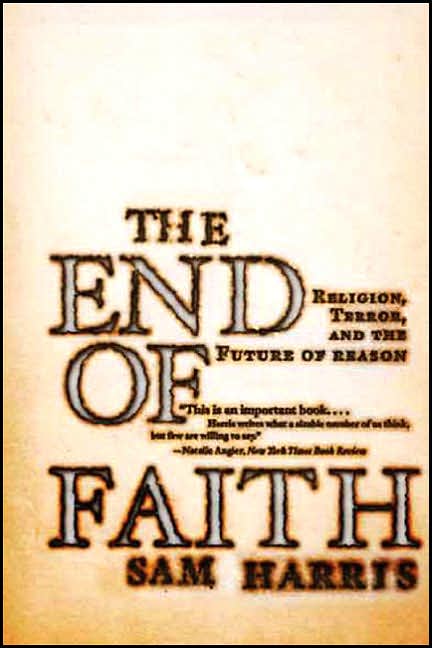
Sam Harris' 2004-2005 screed against religion, all religion, has finally popped into my bedside reading stack. Called The End of Faith, it was recently a New York Times bestseller. Its subtitle is "Religion, Terror, and the Future of Reason." Its premise is that religion qua religion is fatally flawed by virtue of its hostility to reason, and can never, ever stop underwriting terrorist bloodbaths.

Harris is a scholar, an academic, a graduate in philosophy at Stanford University. He has delved deeply into Eastern and Western religious traditions. Spirituality, both within and external to these faith traditions, interests him deeply, as does the basis of belief, disbelief, and uncertainty in our brain's functioning.

He quite apparently also is a committed — nay, militant — atheist.


The author directs much of his venom about religion at people like me, whom he would label a religious "moderate." (I would prefer to think of myself as a religious "liberal," but never mind.) To Harris, moderates are worse than fundamentalists because we moderates' watchword is "tolerance." We carefully avoid smiting those of other persuasions.

Harris can't stand that. Early on, he conspicuously cites language from chapter 13 of Deuteronomy, the fifth book in the Judeo-Christian Bible, in which God directs his chosen people to kill anyone trying to "secretly seduce you" over to the worship of rival gods. This sort of thing, he says, is what fundamentalists who spare not the sword get right about their religion ... and moderates who turn a blind eye to such divine adjurations get wrong.

In fact, "You must stone [the infidel] to death, since he has tried to divert you from Yahweh your God" (Deut. 13:10) stands for Harris as a sort of précis of what religion, at its very core, is. It's not just Judeo-Christian religion that sparks our thirst for blood to be drawn in God's name. It's also Islam, another well-known form of monotheism ... in which the blood is shed in Allah's name. And, with other necessary changes to the holy name, it is likewise true of every other world religion that demands that we call things true on faith rather than by seeking and finding incontrovertible empirical evidence.

If religions are fundamentally calls to vanquish other religions, Harris thinks the future of our world depends on jettisoning them all in favor of science, empiricism, reason ... and, yes, even a sophisticated spirituality which does not depend on unverifiable portions of Scripture.


We wouldn't be eliminating all spirituality, in Harris' longed-for world in which the old religions have vanished into oblivion, because:

There are undoubtedly spiritual truths that we would want to relearn ... and these are truths that we have learned imperfectly in our present state. How is it possible, for instance, to overcome one's fear and inwardness and simply love other human beings? (p. 24)

When I read this, I wanted to shout at Harris, "That's what Christianity is. It's a time-tested method of learning to overcome one's own fear and selfishness and replacing them with love for others."

But Harris doesn't see it that way. He goes on:

Assume, for the moment, that such a process of personal transformation exists and that there is something worth knowing about it; there is, in other words, some skill, or discipline, or conceptual understanding, or dietary supplement that allows for the reliable transformation of fearful, hateful, or indifferent persons into loving ones. If so, we should be positively desperate to know about it. There may even be a few biblical passages that would be useful in this regard — but as for whole rafts of untestable doctrines, clearly there would be no reasonable basis to take them up again.

In my next post in this "The End of Faith?" series, I'll take up the subject of why I totally disagree with Harris' understanding of what religion really is. As a foretaste of that, let me just say that I think ideologies which provoke hatred and bloodshed are a demonic parody of true religion ... never mind the extent to which they historically and currently have held millions in their grip.

Monday, July 02, 2007

Back to Dualism

Douglas
Hofstadter's
I Am a
Strange Loop
For the last few weeks I have been exploring in this blog Douglas Hofstadter's new book, I Am a Strange Loop. The book argues that the "I" or self is a symbol that naturally arises in each human brain in the same way as self-reference ineluctably arises in logical-mathematical systems used for the derivation of theorems that are proved by applying rules of inference. The theorems such systems generate are analogous to our thoughts, and the individaul symbols which are strung together to form these formulas and theorems are analogous to the symbols, categories, and meanings that emerge from the neural interactions of our cranial gray matter.

My response to this view of the self has taken me on something of a roller-coaster ride. At first, in a series of posts that challenged Strange Loop's casual assumption that the self is the same as the conscious soul, I sketched out an alternate view of human self-awareness in which our capacity for conscious experience echoes God's own such capacity. In that alternate view, which I labeled "Genesis By Experience," or GBE, I held that mind is distinct from matter in the same way as God is distinct from the physical world.

GBE was thus a dualistic worldview in which the fact of being seen by an observant, conscious mentality — God's — is what confers existence on us and everything around us. I noted that quantum physics seems to show something similar: that possibly, just possibly, when we observe one of two equiprobable quantum events, we confer existence on the one event and consign the other to oblivion. This existence-conferring act of observation on our part applies to quantum alternatives that to our ordinary way of understanding had to be chosen in the past. Yet by observing them in the present, ex post facto, we "fix" them in existence and expunge their twins' existence from reality retrospectively.

Not being all that comfortable with the intrinsic mind-matter/God-world dualism of my ideas, I then looked for and thought I spotted a way in which it could be eliminated without sacrificing the notion that there is a God. I thought God might in fact be the "I" of the world, a symbolic category that could emerge from the mechanical physical workings of the universe in much the same way as the individual "I" emerges from each of our brains.


I was merrily constructing a "God Is a Strange Loop" (or GISL) theology along just those lines — lines suggested to my mind by Hofstadter even though he himself owns to no God — when I experienced a philosophical cave-in. I noticed that the "strange loop" in Hofstadter's crucial discussion of Principia Mathematica — the logical-mathematical system wherein self-referentiality obtrudes despite all its designers' efforts to exclude it — requires of us a commitment to the notion that such a system cannot be logically inconsistent.

The alternative possibility is that the system might very well be inconsistent, which simply means it can prove theorems that aren't true. To allow inconsistency in such a system is to turn coherence into incoherence, which accordingly turns the world which we hope to model by such a mathematical system into an unknowable farce.

There's a pattern here. An external mind is required to choose between a pair of choices. One choice is that the system is an incoherent, logically inconsistent, useless mess. The other choice is for the system to be logically consistent ... which, as Hofstadter shows by presenting to us lay readers Gödel's Incompleteness Theorem, has the side effect of making it logically incomplete. Logical incompleteness means there are system-internal truths which the system itself is powerless to prove. Again, an external observer is required to "see" the veracity of those truths.


The requisite external observer is usually one that has a mind, is conscious, and has a sense of self — typically, it is one of us humans. But if we were to envision the universe-as-a-whole as basically a repository of truths — some of which are unprovable in a Gödelian sense, some not — who then would the external observer be?

Here, obviously, is where I think the God/world dualism comes into play. The cosmos-external observer is God. In so saying, I am simply claiming that the pattern of needing an external observer to choose between two mutually exclusive alternatives, incoherence and incompleteness, applies to the cosmos as a whole, whose external observer is God, but it does not apply to God himself. By virtue of the mind-matter/God-world dualism, the need to confer existence on God — via an external-observational imposition of causal coherence upon God — simply doesn't arise. God's very being is made, as it were, of causal coherence.


In short, I am back to a dualistic view of reality: God is distinct from the world which God creates and sustains, by virtue of his ongoing, conscious act of "seeing" or observing the world and all in it. The distinction between each conscious, observing human mind and the body/brain that carries it around echoes that very God/world dichotomy.

The "I" or sense of self may well arise within the human brain exactly as Hofstadter proposes — but it is not the same thing as consciousness per se, and it is not the same as the soul.

David J.
Chalmers's
The
Conscious
Mind
I accordingly say consciousness arises, just as David J. Chalmers argues in The Conscious Mind: In Search of a Fundamental Theory, as subjective "phenomena" within the mind: "raw sense experience" lacking all causal efficacy. We quasi-empathetically know something of "what it is like to be red," whenever we observe a red tricycle. But having (or lacking) such knowledge makes zero difference to our behavior, or to its causal impact on the external world.

Moreover, I say, the soul comes from God. Specifically, it is God's seeing us that confers an immortal soul upon each of us.

In chapter 15, "Entwinement," Hofstadter constructs an elaborate thought experiment about "Twinwirld," a world that is just like ours except that almost all babies are born as identical twins. The linguistic and cultural customs of Twinwirld are such that each pair of twins develops a single, unitary sense of self — and thus, in Hofstadter's estimation, a single consciousness, and just one soul.

Any hesitation Hofstadter's reader might have in crediting the single-souledness of Twinwirld's ubiquitous twins is supposed to vanish when Hofstadter tweaks the rules, and each dual "pairson" becomes a conjoined ("Siamese") twinset. I couldn't get through this part of the book without wondering why the conjoined Twinwirld twins couldn't be surgically separated, thus creating two persons, two minds, two consciousnesses ... and two souls.

Nor could I find an answer to the nagging question, what happens if one half of a Twinwirld twinset dies and the other survives? The question may not matter if there is no afterlife, as Hofstadter seems to believe. But if there is ... and if there is only one soul per twinset ... then what?


It seems to be quite true, as Hofstadter points out in his "Post Scriptum re Twinwirld" section, that in at least one rare case of earthly twindom — that of Greta and Freda, the Chaplin twins of York, England — two twins can indeed develop a single "self," for all practical purposes. But, I would add, this is not necessarily the same thing as having a single consciousness, which by Chalmers' reckoning cannot be either proved or disproved for Greta and Freda, or for any other pair of twins.

Nor is it the same thing, by my reckoning, as having a single soul. If, God forbid, Greta dies and Freda lives (assuming they're both still with us), I believe Greta's soul would find a heavenly abode while bereft Freda's remained, waiting patiently, here on earth.


So Hofstadter and I now seem to be at daggers drawn. Peeking ahead at chapters still to come, I can see that he intends to take up the topic of dualism, presumably to kayo it summarily. Needless to say, when I get there I will be highly skeptical.

Sunday, July 01, 2007

God Is a Strange Loop, Part 5

Douglas
Hofstadter's
I Am a
Strange Loop
In God Is a Strange Loop, Part 4, I suggested that God is an emergent property of the universe. Specifically, God is the "I" who emerges from that which he bestows truth upon.

A lot of prior discussion led up to that conclusion. In that previous post and in its three predecessors from this, my "God Is a Strange Loop" series, I leveraged ideas laid out by Douglas Hofstadter in his book I Am a Strange Loop, ideas concerning how a human brain produces a self-referential "I" symbol, into the basis for a theology.

The gist of Hofstadter's notion of the "I" is that it is analogous to the self-referential, externally knowable-as-true propositions lurking in supposedly purely mechanical systems that do nothing but extend a handful of basic axioms into a cornucopia of provable theorems. They do so by means of applying one rule after another, each rule aptly chosen from a small set of rules of inference.

Hofstadter shows that emergent self-referentiality in such "axiomatic systems," as they are called, mirrors the same phenomenon in the brain, which at some level is just an elaborate machine. Hence a brain is just like an axiomatic system in its basic operation, with the system's "theorems" being replaced by the brain's "thoughts."

But certain of the system's self-referential, manifestly true propositions, such as "I am not provable," are not capable of being derived in any systematic, bottom-up way. We see the truth of them, but only from above, as it were. The system itself is blind to their truth.


In the series' previous post, I called this top-down phenomenon "truth bestowal," while Hofstadter calls it by the less grandiose name "downward causation." In that earlier post I glossed over the fact that these two phrases are not really perfect synonyms. For Hofstadter, "downward causation" is only "real" to a limited, nuanced degree, while to me, "truth bestowal" is much more "real" than that — it implies there is a God.

In short, exactly here is where you can begin to see a sliver of daylight coming between my worldview and Hofstadter's.


For Hofstadter, the "reality" of many things that we know about, such as, for example, a rainbow, is due to how our brains evolved. We simply see the world as fundamentally organized into high-level objects, causal patterns, and meaningful categories. A rainbow is a real object, to our brain's way of looking at things, even if it is just a collection of water droplets refracting sunlight into organized hues of color.

To take another example, even though the image on a TV screen is just a bunch of colored pixels, we see in it faces and trees, blue skies and white clouds and the like. Those identifiable, meaningful splotches and blobs in the image are real to us, as long as they behave coherently in the ways we associate with the symbols we have long since built up in our brains for ... well, for faces, trees, blue skies, clouds, and so on.

The categories we viewers impose on the TV image have no causal effect on how the scene develops. But for the creators of the TV program, it is a different story. Imagine the program is a cartoon. The cartoonist imposes order and meaning on the moving picture according to some preconceived mental notion of how the characters and objects represented by the moving blobs and splotches ought to behave. From this perspective, Mickey Mouse or Homer Simpson is much more real to the cartoonist than just a bunch of screen pixels. Their behavior is imbued by the creator with order and meaning.

We, too, impose order and meaning upon our own behavior. We do this in accordance with our idea of how we as individuals — as the special persons we each refer to as "I" — ought to behave. Our brain's internal "I" symbol has "causal potency," says Hofstadter. If our "I" calls for us to, for instance, shake somebody's hand, it arranges for our body to make the proper muscular movements in order to accomplish that. In other words, the ephemeral high-level symbol called our "I" somehow "pushes stuff around" at the lower, physical levels of bodily organization, so that they do its bidding.


I haven't finished reading I Am a Strange Loop yet, but as of chapter 14, it is not clear exactly how Hofstadter thinks the "I" pushes stuff around at lower, more physical levels.

I gather he thinks that the top-down symbols (including the "I") by which a brain comprehends its body and its surrounding world it exists in are genuinely real, but with an asterisk. The asterisk points to, in effect, a footnote which says, "These high-level things of the mind are 'real' only to the extent that they map what's really going on at the lower level of neurons and the chemicals they squirt back and forth at one another millions of times each second."

I think they are "realer" than that. To show why, I'm hoping to concoct an argument that I derive from Hofstadter's own presentation concerning the nature of the "I". It is an argument that answers a question that Hofstadter himself seems to sidestep. Unfortunately, however, it is also an argument that undermines one of my own basic assumptions in this series of posts.


The argument I would like to concoct runs something like this. Hofstadter shows that an axiomatic system that is ostensibly about the truths of number theory — "4 is not a prime number," for example — contains unsuspected self-referential propositions that can be interpreted on another level entirely.

For instance, take the proposition "I, this very proposition, am not provable." This proposition actually exists, Hofstadter shows, as a well-formed formula of the axiomatic system called PM, after Russell and Whitehead's masterwork Principia Mathematica. The proposition is called, by Hofstadter, KG, after the initials of Kurt Gödel, its discoverer.

Of course, KG has a lower-level, number-theoretical meaning within PM as well — one which, as its higher-level meaning suggests, cannot be derived within PM through the application of its rules of inference to other true propositions.

If KG indeed cannot be proven from the bottom up within PM, as "4 is not a prime number" can, then how can we know it is true? As Hofstadter shows, we can arrive at our certainty of KG's truth by virtue of recognizing that if KG were false — if "this" very proposition were in fact provable — an inconsistency would exist within the axiomatic system as a whole.


Such an inconsistency would be like the one rotten apple that spoils the bunch, for once a lie can be proven within any axiomatic system of mathematical logic, every lie can be proven. Hofstadter shows that much quite well, I think.

But what Hofstadter fails to show, I think, is for what reason KG is true. That question is, I would say, distinct from that of why we prefer to reject the alternative proposition that KG is false. We prefer to reject that alternative proposition in order to avoid turning all of mathematical logic into a cocked hat. But what gives us the right to impose that preference of ours on objective "reality"?


The "KG is true" proposition is, as Hofstadter correctly shows, one whose truth must come from outside PM, since it certainly does not come from within. Ergo, the "I" which emerges from within the bowels of the axiomatic system PM, and which makes it possible to construct well-formed formulas like "I am unprovable," is just as blind as the system as a whole to the truth of KG!

Recognition of that fact does not make me terribly happy. The reason is that I have been trying to show that God could be the "I" which emerges from the world-as-a-whole — if we look at the entire world as a entity that is fully analogous to a mechanical system such as PM — in just the same way as each of our brains is also a PM-equivalent machine.

In other words, if the organ inside the cranium of each of us is, at its lowest levels of operation, just as much of a theorem-deriver (or thought-deriver) as PM is, then Hofstadter is right: an "I" can be expected to arise within it, just as one does in Russell and Whitehead's axiomatic system PM, once Kurt Gödel gets through with it. I have simply been trying to extend that notion to consider the world as a whole as if it, too, is (or has) a PM-equivalent brain.

If the world-as-a-whole somehow can be assumed to be "conscious" and to have an emergent "self" or "I" arising from within it, then perhaps the proper name of that "I" is God. This, at least, is what I have been trying to claim in the present series of posts.


But, I now see, my hopeful claim won't work. Why not? Because any "I" that arises from the operation of the world-as-a-whole as if it were some kind of PM-equivalent axiomatic system will necessarily be a "blind I." It will necessarily be blind, that is, to the truth of any propositions about the world-as-a-system that take the form of KG, "I am unprovable."

Hence, adopting if only for the sake of argument the notion that such a "world I" is capable of being generated at all, as a necessarily "blind I" it would fail to provide an essential reason why the world-as-a-system is not riddled through and through with logical inconsistency.

For, if the "world's KG" is true, the system-internal "world I" is unavoidably blind to the reason why.

That leaves us right where we were before: without a vantage point outside the world system from which "the truth of the 'world's KG'" — the truth that is coherence itself — can be bestowed and known.


There must be a reason why the world "prefers" truth and coherence to lies and logical inconsistency. And — unless you turn a "blind I" to the usual presumption that facts have reasons — that reason must come from outside the world. The basis of all logical coherence, a.k.a. "the truth of the 'world's KG'," cannot be derived from within the world-as-a-system itself.

Which suggests that God does not emerge, as I had been hoping to demonstrate, as a sort of "world I." And we are back to a dualistic scenario in which the "mind" of God is wholly separate from the "body" of the world. This is where I was as of the last post in my "Genesis by Experience" series, which I abandoned out of distaste for the mind-body dualism. Instead of continuing to develop that "GBE" philosophy, I embarked on this, my "God Is a Strange Loop" series. Now I fear I will have to go back to the dualism of GBE.

More later ...